 Brands
The Huawei Sedan Beating Maybach, BMW and Porsche in China

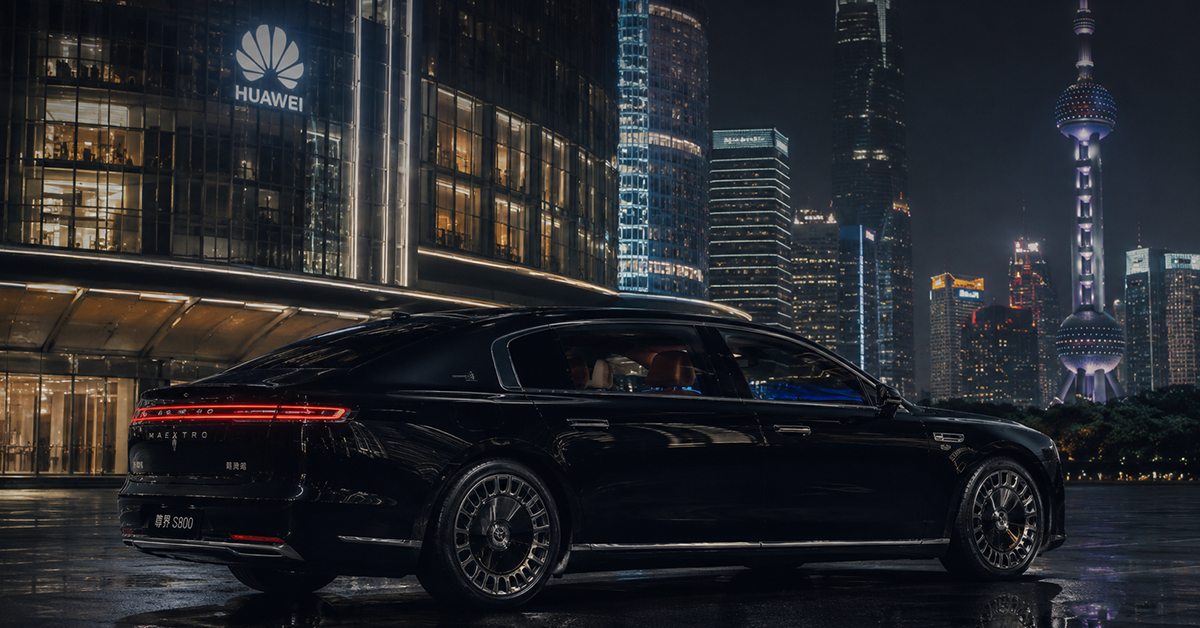
AI-generated concept illustration of the Maextro S800 — not an official Maextro or Huawei image. | Rev N Rise
Most people outside China have never heard of the Maextro S800. In April 2026, it outsold the Mercedes-Maybach S-Class, the Porsche Panamera and the BMW 7 Series — combined. The car was co-developed by Huawei, costs $103,000 and has been China's best-selling luxury sedan for months. Europe's most prestigious brands have spent decades building their reputations in China. A phone company just took the top of the market from all of them.
| Rank | Model | Origin | April Sales | Jan–Apr 2026 |
|---|---|---|---|---|
| #1 | Maextro S800 | 🇨🇳 | 1,142 | 5,465 |
| #2 | Mercedes-Maybach S-Class | 🇩🇪 | 736 | 3,012 |
| #3 | Porsche Panamera | 🇩🇪 | 616 | 1,362 |
| #4 | Mercedes-Benz S-Class | 🇩🇪 | 521 | 2,596 |
| #5 | BMW 7 Series / i7 | 🇩🇪 | 436 | 2,976 |
| #6 | Audi A8 | 🇩🇪 | 260 | 1,309 |
The Maextro S800 was not built by a traditional automaker. It is the product of the Harmony Intelligent Mobility Alliance — a cooperation framework between Huawei Technologies, the world's largest telecommunications equipment manufacturer, and JAC Group, a state-owned Chinese automaker. Huawei provides the software, the intelligent driving systems, the user interface and the technology ecosystem that defines the S800's character. JAC provides the manufacturing capability and the automotive engineering. Together they have created something that established European luxury brands — who have spent decades and billions of dollars building their positions in China — have been unable to match.
The Maextro brand was launched in 2025 as Huawei's most premium automotive sub-brand — positioned above the Aito and Luxeed ranges that Huawei has developed with other manufacturing partners. The S800 is its first and currently only model. A sedan, an SUV and an MPV are all confirmed for 2026, which means the range that just beaten the Maybach in monthly sales is still in its very earliest stages of development.
The S800 is a large luxury executive sedan — directly competing with the Mercedes-Benz S-Class, BMW 7 Series and Porsche Panamera in size, positioning and price. It is available in two powertrain configurations: a fully electric BEV variant and an extended-range electric EREV variant that uses a petrol engine as a generator to charge the battery, eliminating range anxiety for buyers outside major cities.
Pricing runs from CNY 708,000 to CNY 1,018,000 — approximately $100,800 to $145,100 at current exchange rates. The entry price is approximately 40 percent lower than a comparable Porsche Panamera and significantly below the Mercedes-Maybach S-Class entry point. For Chinese buyers who might previously have considered a German luxury sedan, the S800 offers comparable or superior technology at a meaningfully lower price point — with the added appeal of a locally developed product from a brand they already trust for their smartphones and laptops.
The technology on board is where the S800 makes its most compelling argument. Huawei's ADS intelligent driving system — one of the most advanced in China — is standard. The infotainment runs on HarmonyOS, Huawei's own operating system, with native integration for every app and service that Chinese buyers use daily. The interior display setup is best described as a command centre — multiple large screens, ambient lighting that responds to driving mode and a voice assistant that actually works. For a Chinese buyer used to the seamlessness of Huawei's ecosystem across their devices, getting into an S800 feels like a natural extension of their digital life. Getting into a BMW 7 Series does not.
The S800's dominance does not exist in isolation. It is the most visible symptom of a broader and accelerating shift in China's automotive market — one that is causing genuine alarm among European premium brands. BMW Group's China deliveries fell 10 percent year-on-year in Q1 2026 to 143,958 vehicles. Mercedes-Benz China deliveries declined 27 percent to 111,600 units. Porsche closed a third of its Chinese dealerships. Audi dropped out of the luxury sedan top five.
The reason is not price — the S800 is expensive by any measure. The reason is relevance. Chinese consumers in 2026 have fundamentally different expectations of what a luxury car should do, how it should connect to their digital lives and what its technology should feel like compared to buyers in Europe or North America. German premium brands spent decades building their reputations in China on engineering precision, brand heritage and the status signal of a foreign badge. Those advantages have not disappeared — but they have been significantly diluted by Chinese brands that offer more relevant technology, faster software updates and a brand identity that resonates with younger Chinese buyers in a way that a 100-year-old European automaker simply cannot.
| Brand | Maextro — Huawei + JAC Group (HIMA framework) |
| Model | S800 — large luxury executive sedan |
| Powertrains | BEV (full electric) + EREV (extended-range electric) |
| Price Range | CNY 708,000–1,018,000 ($100,800–$145,100) |
| Sales Start | August 2025 |
| April 2026 Sales | 1,142 units — #1 in segment |
| Jan–Apr 2026 | 5,465 units — leads all rivals |
| vs Maybach (Jan-Apr) | S800: 5,465 / Maybach: 3,012 — 81% ahead |
| vs BMW 7 Series (Jan-Apr) | S800: 5,465 / BMW: 2,976 — 84% ahead |
| Intelligent Driving | Huawei ADS — top-tier China system |
| Software | HarmonyOS — full Huawei ecosystem |
| Upcoming LiDAR | 896-line mass-production LiDAR — world's highest |
| New Models 2026 | Maextro sedan + SUV + MPV confirmed |
| BMW China Q1 2026 | Down 10% year-on-year |
| Mercedes China Q1 2026 | Down 27% year-on-year |
| Porsche China | Closed a third of dealerships — major restructure |
The Maextro S800 is not coming to Europe, the US or Australia in the near future. The regulatory approvals, right-hand drive adaptations and market-specific software requirements make a rapid global expansion unlikely. But the story the S800 tells is one that matters everywhere: the assumption that luxury means European is no longer universal.
China is the world's largest automotive market. The brands that dominate it shape the global industry — both in revenue and in the direction of technology development. When a Huawei-backed sedan outsells the Maybach by 81 percent in China's most exclusive segment, European automakers do not just lose those sales. They lose the data, the software learning, the brand equity and the engineering insight that comes from dominating a market. The gap between what Chinese buyers want and what European brands currently offer is widening. The S800 is the most visible proof of that gap.
The April 2026 data from ECC Intelligence tells the story without any editorial required. The Maextro S800 sold 1,142 units. The Maybach S-Class sold 736. The Panamera sold 616. The BMW 7 Series sold 436. Chinese buyers in the world's most expensive sedan segment are choosing a Huawei-backed car over the brands that defined luxury motoring for a generation. The numbers speak for themselves.
The Maextro S800 is not a curiosity. It is not a Chinese-market anomaly that will correct itself when the novelty wears off. It has been China's best-selling luxury sedan for consecutive months, it costs less than a Panamera and it offers technology that makes a BMW 7 Series feel five years behind. Huawei built a phone company into one of the world's most recognisable technology brands. It is now doing the same thing in cars — starting at the top. The brands that have sold luxury in China for decades are not being disrupted by a budget alternative. They are being beaten by something better. That is a much harder problem to solve.