 Brands
2027 BMW M3 CS Handschalter — The Last Manual, RWD M3 Ever Built

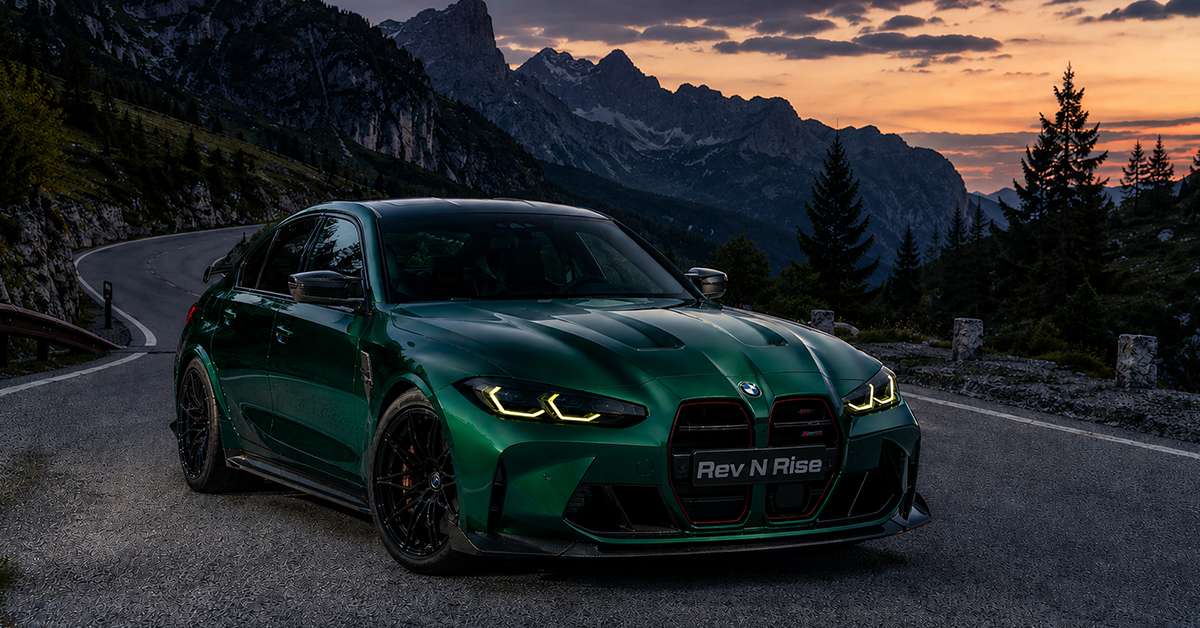
AI-generated concept illustration of the 2027 BMW M3 CS Handschalter — not an official BMW image. | Rev N Rise
BMW just confirmed what every M3 purist feared — and gave them exactly what they wanted at the same time. The 2027 BMW M3 CS Handschalter is real. It has a six-speed manual gearbox. It is rear-wheel drive only. It weighs 75 pounds less than the standard M3. It costs $108,450. And when production ends later this year, it will almost certainly be the last manual, rear-wheel-drive BMW M3 ever made. If you want one — you need to move now.
The BMW M3 has had a manual gearbox available since the original E30 M3 of 1986. For four decades, the three-pedal setup was simply part of what the M3 was — the car that proved you could have genuine sports car engagement in a practical four-door body. Even as dual-clutch automatics became faster and more refined, BMW kept offering the manual because its customers wanted it.
That era is ending. The next-generation M3 — codenamed G84 — will for the first time be available as an electric car, with a four-motor EV setup producing over 1,000 horsepower. The petrol version will continue, but reports indicate it may come exclusively with an automatic transmission and all-wheel drive. If those reports prove correct, the 2027 M3 CS Handschalter is not just the final G80. It is the last manual, rear-wheel-drive M3 that will ever exist. BMW is making it count.
Handschalter is German for hand shift — manual gearbox. BMW used the same suffix for the Z4 M40i Handschalter, a limited North American special edition that marked the end of the manual Z4. The name carries weight. When BMW calls something a Handschalter, it means the manual gearbox is the entire point of the car — not an option, not a trim level, but the defining feature. The M3 CS Handschalter is available strictly with rear-wheel drive and a six-speed manual transmission — no automatic option, no AWD option, no exceptions.
This also means the CS Handschalter is the first M3 CS in history to offer a manual. The previous M3 CS — which carried over from the competition Sport special edition — was sold exclusively with an eight-speed automatic and xDrive all-wheel drive. The Handschalter eschews xDrive and the automatic transmission in favor of a pure rear-wheel-drive setup with a manual gearbox. For buyers who felt the previous CS was too focused on lap times at the expense of driving feel, the Handschalter answers that directly.
The S58 3.0-litre twin-turbocharged inline-six is one of the finest engines BMW has ever produced — a unit that has won multiple International Engine of the Year awards and set a new standard for what a six-cylinder sports car engine should feel and sound like. In the M3 CS Handschalter it produces 473 horsepower and 406 lb-ft of torque.
That is 70 horsepower less than the previous M3 CS with its eight-speed automatic. BMW limits the power output of cars fitted with manual gearboxes to improve reliability — the manual gearbox's mechanical limits require a lower torque ceiling than the automatic can handle. The result is still a very fast car: 0-60mph in 4.1 seconds and a top speed of 180mph with the standard M Driver's Package included. But the point of this car has never been the numbers. It is the way those numbers arrive — through your right hand and left foot, at a pace you control.
The CS Handschalter is the lightest version of the G80 M3 ever produced. It weighs 3,798 pounds — nearly 75 pounds less than the standard M3, achieved through an extensive lightweighting programme that includes carbon-fibre reinforced plastic for the hood, roof, front splitter, side skirts and rear spoiler, as well as the centre console. A titanium exhaust silencer and standard M carbon bucket seats reduce weight by a further 42 pounds.
Optional carbon-ceramic brakes — priced at $8,500 — remove a further 32 pounds of unsprung weight, bringing the total weight reduction to approximately 107 pounds over the standard M3. For a sports car, unsprung weight reduction is disproportionately valuable — lighter wheels and brakes transform how the chassis responds to road inputs, improving steering feel, turn-in precision and mid-corner stability in ways that adding power never can.
The Handschalter's chassis setup goes beyond the standard CS. The shock absorbers are taken from the M4 CSL — BMW's most extreme production car — and combined with new springs, revised rear axle links, unique steering calibration and stability control settings specifically tuned for rear-wheel drive. The car sits 6mm lower than the standard M3. The result, according to BMW, is a setup that prioritises driver involvement and rear-drive nimbleness over the all-weather accessibility of the xDrive CS that preceded it.
For buyers who have driven the previous M3 CS and found it slightly sanitised by its AWD system — capable but not quite raw enough — the Handschalter directly addresses that criticism. Removing the front axle drive entirely, adding the CSL's shocks and tuning the stability systems for a car that will oversteer on demand delivers a fundamentally different driving character. One that the next-generation M3, with its performance-focused AWD and likely automatic-only specification, may never replicate.
The Handschalter carries the full M3 CS visual package — aggressive front splitter, side skirts, exposed carbon roof, mirror caps, and rear spoiler all finished in carbon-fibre. Yellow daytime running lamps echo BMW racing cars. A frameless kidney grille, red-accented badging and red contour lines set it apart from lesser M3s.
Standard colours are Black Sapphire and Isle of Man Green. For an additional $4,500, BMW Individual offers two heritage colours: Techno Violet and Imola Red — both names that will mean something to anyone who knows BMW M history. The Imola Red in particular connects the Handschalter directly to the E46 M3, considered by many to be the last truly analogue M3 before electronics began to dominate the package. Ordering one in Imola Red is a statement. BMW knows exactly what it is doing.
| Model | 2027 BMW M3 CS Handschalter |
| Generation | G80 — sixth generation M3 finale |
| Engine | S58 3.0L twin-turbo inline-six |
| Output | 473 hp / 406 lb-ft torque |
| Gearbox | 6-speed manual — only option |
| Drive | Rear-wheel drive — only option |
| 0–60 mph | 4.1 seconds |
| Top Speed | 180 mph — M Driver's Package standard |
| Weight | 3,798 lbs — lightest G80 M3 ever |
| Weight Saving vs M3 | ~75 lbs (107 lbs with carbon-ceramic brakes) |
| Shock Absorbers | M4 CSL spec — exclusive to Handschalter |
| Ride Height | 6mm lower than standard M3 |
| Carbon Elements | Hood, roof, splitter, skirts, spoiler, centre console |
| Exhaust | Titanium silencer — standard |
| Seats | M carbon bucket seats — standard |
| DRL Colour | Yellow — BMW racing heritage reference |
| Standard Colours | Black Sapphire / Isle of Man Green |
| Individual Colours | Techno Violet / Imola Red — +$4,500 |
| Carbon-Ceramic Brakes | Optional — $8,500 — saves 32 lbs |
| M Front Strut Brace | Optional — $1,100 |
| Availability | North America only — US + Canada |
| US Price | $108,450 incl. destination |
| Canada Price | $132,500 CAD |
| Production Start | July 2026 |
| First Deliveries | Fall 2026 |
| Production Numbers | Very limited — BMW not disclosing exact figure |
At $108,450, the M3 CS Handschalter costs approximately $28,000 more than the base M3. That premium buys you the manual gearbox, the CS chassis upgrades, the CSL-spec shocks, the carbon-fibre weight reduction programme and — most importantly — the certainty that you own the last of its kind. Production starts in July 2026 and will be very limited in numbers, with first deliveries in fall 2026.
Should you buy it? If you have ever wanted a manual M3 and have the means — yes. Not because it is the fastest M3. Not because it is the most practical. But because it is the last of a line that stretches back to 1986, and the next M3 will almost certainly never offer what this one does. Manual gearboxes in sports sedans are disappearing. Pure rear-wheel drive in performance saloons is disappearing. The combination of both, in a BMW M3, with the badge and the heritage that comes with it, will not be available again. The Handschalter knows exactly what it is. Buy one while you still can.
BMW built the G80 M3 for six years and sold it in every configuration imaginable. Then, as the final chapter, it gave the car exactly what purists had been asking for since day one: a manual gearbox, rear-wheel drive and a weight saving programme that makes it the lightest M3 ever. The 2027 M3 CS Handschalter is the M3 that should have existed all along. And if the rumours about the next generation prove correct — automatic only, AWD only — it is the M3 that will never exist again. Production starts in July. Numbers are very limited. If you want it, the time to act is now.