 Brands
Audi Recreates the 1935 Auto Union Lucca — The V16 Silver Arrow That Hit 203MPH

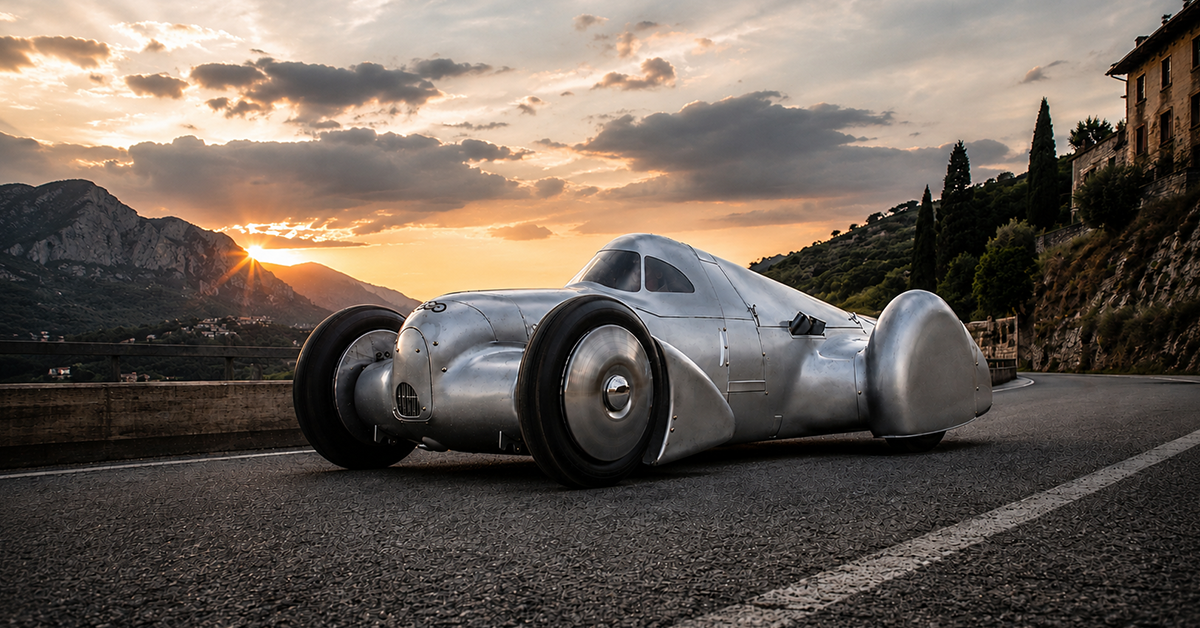
AI-generated concept illustration of the recreated Auto Union Lucca — not an official Audi image. | Rev N Rise
In February 1935, a driver named Hans Stuck climbed into a streamlined silver machine on a straight stretch of Italian autostrada near the city of Lucca and drove it to 326.975 km/h — 203 miles per hour. There were no safety barriers. No fireproof suit. No data telemetry. Just a V16 engine, a handcrafted aluminium body and one of the most extraordinary feats of pre-war engineering ever attempted. For 91 years, that car existed only in photographs. Audi just brought it back.
The 1930s were the era when speed was everything. German manufacturers — Auto Union and Mercedes-Benz — poured extraordinary resources into their Grand Prix cars and speed record machines, chasing numbers that seemed physically impossible. The cars were called Silver Arrows because when racing regulations mandated that cars be stripped of their paint to reduce weight, the bare aluminium bodywork gleamed silver in the European sun. They became the most famous racing cars of their era — and the most dangerous.
The Auto Union Lucca was a different kind of Silver Arrow. It was not a Grand Prix car — it was a Rennlimousine, which translates literally as "racing sedan." Its purpose was pure speed on public roads — specifically, the long straight stretches of Italian autostrada that offered the only surfaces in Europe flat and smooth enough to attempt record runs. The car was a fully enclosed streamliner — low, narrow, with a teardrop-shaped body, a covered cockpit canopy, enclosed wheels and a tapered tail designed to slip through air with minimum resistance.
On February 15, 1935, Hans Stuck — already a Grand Prix legend — drove the Lucca on that Italian straight to a flying-start mile average of 320.267 km/h and a measured top speed of 326.975 km/h. In a car without seatbelts, without roll protection, without any of the safety infrastructure that modern racing takes for granted. In 1935. On a public road. At 203 miles per hour. The record stood as one of the greatest speed achievements of the pre-war era — and then the original car disappeared into history, surviving only in black-and-white photographs and period documents.
Audi Tradition — the division of Audi AG responsible for preserving and celebrating the brand's motorsport history — decided several years ago that the Lucca was the most significant gap in its historic Silver Arrow collection. The original car no longer existed. There was no donor vehicle, no surviving mechanical components, no intact bodywork to restore. Everything would have to be built from scratch, using only historical photographs and archival documents as reference.
The project was assigned to Crosthwaite & Gardiner — a British restoration workshop that has already rebuilt several Silver Arrow cars and which Audi regards as having the most relevant expertise in the world for this kind of work. The brief was straightforward and simultaneously almost impossibly demanding: recreate the Auto Union Lucca as accurately as historically possible, to a standard that would allow it to be driven in public demonstrations. No shortcuts. No modern substitutions where the original specification could be achieved. Every component handcrafted specifically for this car.
The project took just over three years and was completed in early 2026. The streamlined body — with its cockpit canopy, its enclosed wheel fairings and its dramatically tapered tail — was described by the Crosthwaite & Gardiner team as particularly labour-intensive to manufacture. Every curve of that aluminium skin had to be shaped by hand against wooden bucks, beaten and refined until it matched the profiles visible in the historical photographs. The result, when measured in Audi's wind tunnel in April 2026, achieved a drag coefficient of 0.43 Cd — a remarkable figure for a car designed in 1935 using pre-computer aerodynamic intuition.
The original Auto Union Lucca was powered by a 5.0-litre supercharged 16-cylinder engine. For the recreation, Audi and Crosthwaite & Gardiner made the decision to fit the 6.0-litre supercharged 16-cylinder unit from the 1936 Auto Union Type C — a slightly later and more powerful version of the same basic architecture, chosen because it could be made to run reliably during demonstration events without placing excessive thermal stress on the recreation's components.
Small modifications were made to accommodate this: the ventilation system designed for the car's 1935 Berlin race configuration was fitted, and minor radiator and bodywork changes allow the Lucca to be converted between its original Italian autostrada specification and the AVUS circuit layout when required. The engine produces 520 PS (513 horsepower) and drives a car weighing approximately 960 kilograms. The fuel is a methanol-heavy blend similar to the pre-war Grand Prix racing fuels of the period. The sound — a supercharged 16-cylinder at full chat — is described by everyone who has heard it as genuinely unlike anything produced by any modern car.
To understand why the Auto Union Lucca mattered in 1935 — and why its recreation matters in 2026 — you need to understand the world it came from. The 1930s speed record wars between Auto Union and Mercedes-Benz were not merely engineering competitions. They were national prestige projects, followed obsessively by the international press and public in a way that has no direct modern equivalent. Each new record was front-page news across Europe. The drivers were superstars. The engineers were celebrities.
Auto Union itself was an extraordinary entity — a merger of four independent German manufacturers (Audi, DKW, Horch and Wanderer) created in 1932 as they faced financial ruin during the Great Depression. The four interlocked rings that became the Auto Union badge — and survive today as Audi's logo — represented those four brands. The racing programme that followed was simultaneously a survival strategy and an act of defiance: four struggling companies proving, at 200 miles per hour on Italian autostradas, that German engineering was the best in the world. The Lucca was part of that story. One of the most dramatic chapters of it.
After its static debut in Lucca, Italy — appropriately, in the city that gave the original record run its name — the recreated Auto Union Lucca will make its first dynamic public appearance at the 2026 Goodwood Festival of Speed from July 9 to 12. It will drive up the famous Goodwood hillclimb course under its own power, in public, with the 16-cylinder supercharged engine running at full voice. After Goodwood, it joins Audi AG's permanent historic vehicle collection alongside the other Silver Arrows — where it will remain as the only driveable example of this specific car in existence.
For anyone planning to attend the 2026 Goodwood Festival of Speed, the Auto Union Lucca is one of the most compelling reasons to be there. There are very few automotive experiences that connect the present to the 1930s in a direct, moving, full-volume way. The Lucca — on the Goodwood hillclimb, under power, in July 2026 — will be one of them.
| Car Name | Auto Union Lucca — Rennlimousine |
| Original Record Date | February 15, 1935 |
| Location | Autostrada near Lucca, Italy |
| Driver | Hans Stuck |
| Top Speed (1935) | 326.975 km/h — 203 mph |
| Flying-Start Mile Avg | 320.267 km/h |
| Class | International Class C — world record |
| Body Style | Streamliner — enclosed wheels — cockpit canopy — tapered tail |
| Drag Coefficient | 0.43 Cd — wind tunnel confirmed April 2026 |
| Engine (recreation) | 6.0L supercharged 16-cylinder — 1936 Auto Union Type C |
| Output | 520 PS (513 hp) |
| Weight | ~960 kg |
| Fuel | Methanol-heavy blend — period correct |
| Builder | Crosthwaite & Gardiner — British specialists |
| Construction | All components handcrafted — zero donor parts |
| Build Time | Just over 3 years |
| Completed | Early 2026 |
| Project Manager | Timo Witt — Audi Tradition |
| Static Debut | Lucca, Italy — early May 2026 |
| Dynamic Debut | Goodwood Festival of Speed — July 9-12, 2026 |
| After Goodwood | Joins Audi AG historic Silver Arrow collection — permanently |
| Units | 1 — the only driveable example in existence |
"This car makes a statement: the Auto Union Lucca is emblematic of the technical innovation of the four rings in the 1930s."
— Audi Tradition — Official Statement, May 2026The recreated Auto Union Lucca is one of the most significant automotive stories of 2026 — not because it is fast by modern standards, not because it is for sale, not because it previews any future Audi product. But because it is a physical act of remembrance. Three years of handcraft. Every component made from scratch. A 16-cylinder engine that hasn't been heard on a public road in nearly 90 years, about to run up the Goodwood hillclimb in July. Hans Stuck drove the original to 203 miles per hour on an Italian road in 1935 with nothing but courage and engineering genius to keep him alive. Audi built his car back from photographs. That is what the four rings mean. That is what Vorsprung durch Technik looked like before the slogan existed.