 Brands
Huawei XPixel Just Turned Car Headlights Into a Cinema

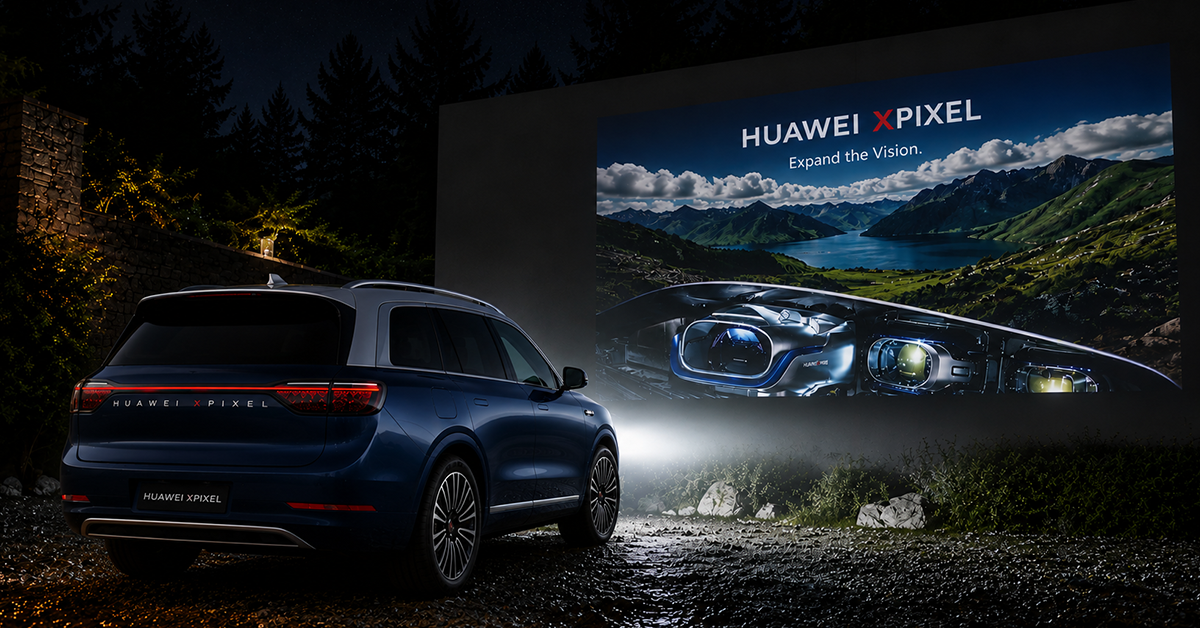
AI-generated concept illustration of Huawei XPixel headlight projection technology — not an official Huawei image. | Rev N Rise
Park your car in front of a wall. Switch on the headlights. Watch a movie on a 100-inch screen. This is not a concept. It is not a prototype. It is a production technology revealed by Huawei at the Beijing Auto Show this month — and it is coming to cars before the end of 2026. The headlight, one of the most unchanged components in automotive history, just became something completely different.
XPixel is Huawei's smart headlight platform — a system that has been in production vehicles for approximately three years in its original monochrome form. The existing version, already fitted to cars like the Stelato S9, can project navigation arrows onto the road, guide pedestrians across crossings with dynamic ground graphics, indicate lane changes with projected markers and display warning information in low-visibility conditions. It is, by any measure, already a significant advancement over conventional adaptive LED headlights.
The new version revealed at the 2026 Beijing Auto Show takes everything the monochrome system does and adds the one thing it was missing: full colour. One million individually controlled pixels per headlamp. Full RGB output — a colour gamut of up to 125 percent of the HD TV standard. DLP (Digital Light Processing) chip technology — the same principle that powers dedicated cinema projectors — integrated into what remains a fully road-legal headlight assembly. The result is a headlight that can project anything. Movies. Games. Live sport. Navigation graphics. Safety warnings. Anything a screen can show, the XPixel headlight can project onto any surface in front of the car.
When the car is parked, XPixel's Open-Air Cinema mode projects a full-colour 100-inch image onto any flat surface in front of the vehicle — a wall, a garage door, a purpose-built screen, even a large rock face. The image quality, according to demonstrations at Beijing, is described as comparable to a dedicated home cinema projector — crisp, bright and sufficiently detailed to make a full-length film genuinely watchable at night or in low-light conditions.
The content source is the car's own entertainment system — streamed or stored content piped directly to the headlight projectors rather than a dashboard screen. No separate projector unit. No cables. No external equipment. The headlights are the projector. The car is the cinema. For families camping, for couples at the end of a cliff-top drive, for anyone who has ever wanted to watch something on a large screen outdoors without carrying equipment — the concept is immediately appealing and the execution, based on Beijing demo footage, appears genuinely impressive.
Critically, the projection capabilities and the headlight's primary safety function are completely independent of each other. XPixel does not compromise the vehicle's lighting performance to deliver the projection feature. The same physical unit handles full road-legal illumination, adaptive beam shaping and full-colour projection — simultaneously if required — from a single compact three-part device. Huawei describes it as a "three-in-one smart car-light unit" combining illumination, projection and colour output in a module no larger than a conventional adaptive headlight.
The cinema function is the headline. But for everyday driving, XPixel's road projection capabilities are arguably more significant. When driving, the system projects directly onto the road surface in front of the car — displaying navigation arrows, turn-by-turn directions, lane change guidance and speed limit indicators exactly where the driver's eyes are already looking. There is no need to glance at a navigation screen or interpret a heads-up display. The road itself becomes the navigation interface.
Safety applications extend further. XPixel can illuminate pedestrian crossings in advance of a pedestrian stepping out — projecting a visible light pattern onto the crossing surface to alert both the driver and the pedestrian. It can highlight lane markings in adverse weather conditions where conventional road markings become invisible. In fog or heavy rain, it can project speed limit reminders and hazard warnings onto the road surface immediately ahead. In earlier monochrome versions already deployed on the Stelato S9, drivers have reportedly described the lane guidance and navigation projection as genuinely transformative for night driving — reducing cognitive load and improving reaction times in complex junctions.
The technical foundation of XPixel is DLP (Digital Light Processing) — a technology originally developed for cinema projectors and now adapted for automotive use. At its core, DLP uses millions of microscopic mirrors — each one smaller than a human hair — that can individually tilt toward or away from a light source at speeds of up to several thousand times per second. By controlling which mirrors reflect light and which do not at any given moment, the system creates a precise, high-resolution image.
In XPixel's full-colour version, the addition of RGB (red, green, blue) light sources — one per channel — allows each of the million pixels per headlamp to display any colour in the visible spectrum. The result is a system capable of rendering full-motion video, static navigation graphics and safety projections with equal precision, switching between modes instantly in response to the vehicle's state. When you pull up and park, the system automatically transitions from navigation mode to cinema mode. When you start moving, it transitions back. There is no manual switching required.
The entire module — including the RGB light sources, the DLP array, the adaptive driving beam system and the standard illumination functions — fits within a headlight housing no larger than a conventional adaptive LED unit. Huawei has engineered the system to require no additional space in the vehicle's front end, making it compatible with existing body designs without requiring significant structural changes.
The full-colour XPixel system will debut on the next-generation Aito M9 — the flagship luxury SUV co-developed by Huawei and Seres that has already sold over 280,000 units since its 2023 launch, outselling the BMW X5, X7, Mercedes GLE and GLS combined in China during the same period. The facelifted M9 went on pre-sale on April 22, 2026, at a starting price of 669,800 yuan — and XPixel is listed as one of its headline new features.
Huawei has confirmed that XPixel will expand beyond the Aito M9 to additional models including the Qijing GT7 — a shooting brake-style performance SUV — and the Luxeed V9 MPV. Mass production of the XPixel module is scheduled to begin on August 30, 2026. This is not a future technology. It is a production-confirmed system with a specific manufacturing start date, going into cars that are already available to order.
XPixel in its full cinema and projection form is currently a China-only technology — and that is likely to remain the case for several years. The regulatory gap is significant. The United States only formally authorised adaptive driving beams — the basic version of pixel-controlled headlights — in 2022, after decades during which Federal Motor Vehicle Safety Standards prevented their deployment. Full road-projection systems like XPixel would require an entirely new regulatory framework that does not yet exist in the US, the UK, Europe or Australia.
European manufacturers including Audi, BMW, Mercedes and Volkswagen have developed Matrix LED and Digital Light systems capable of basic beam shaping and simple monochrome road projections — but these systems operate at far lower resolution than XPixel and cannot project full-colour imagery. The regulatory environment in Europe is more permissive than the US but still significantly behind what China's roads currently allow. Whether XPixel's entertainment capabilities specifically — the cinema mode — would face additional objections from safety regulators is an open question. A car that can project a movie onto a wall while parked is not inherently unsafe. But regulators tend to move cautiously, and cautiously, in this context, means slowly.
The honest answer for UK, US and Australian readers is that you will not be watching movies from your headlights in the near future. But you may well be seeing XPixel-style navigation projection within five years — as Western regulators gradually catch up to what Chinese roads already permit and as the technology's genuine safety benefits become impossible to ignore.
| Technology | DLP — Digital Light Processing — million micro-mirrors |
| Resolution | 1,000,000 pixels per headlamp |
| Colour Output | Full RGB — 125% of HD TV colour standard |
| Parked Mode | 100-inch full-colour projection on flat surfaces |
| Content Sources | Movies, live sport, games, music visualisations |
| Driving Mode | Navigation arrows, turn-by-turn directions on road |
| Safety Features | Pedestrian crossing illumination, lane markings, speed limits |
| Adverse Weather | Hazard warnings projected onto road in fog and rain |
| Module Design | Three-in-one — illumination + projection + colour |
| Previous Version | Monochrome XPixel — in production 3 years — Stelato S9 |
| First Full-Colour Car | Aito M9 facelift — pre-sale from April 22 2026 |
| Other Models | Qijing GT7 + Luxeed V9 MPV |
| Mass Production | August 30 2026 |
| Revealed | Beijing Auto Show — May 2026 |
| Availability | China only — regulatory approval needed elsewhere |
| Developer | Huawei — sold to automakers as a system |
The XPixel story is not really about watching movies from your headlights. It is about the pace at which Chinese automotive technology is moving — and the widening gap between what Chinese cars can do and what Western cars are allowed to do. The headlight has been fundamentally unchanged for decades. It illuminates the road ahead. That is its job. Huawei has taken that component and turned it into a navigation system, a safety platform and a home cinema — simultaneously, in a production module, going into cars before the end of this year.
Western manufacturers are not standing still. Audi and BMW have developed impressive pixel headlight systems of their own. Mercedes Digital Light is genuinely advanced for a mainstream production technology. But none of these systems approach the resolution, the colour capability or the entertainment functionality of XPixel. The gap is partly regulatory — Chinese roads permit things that Western roads do not yet allow. But it is also partly a question of ambition. Huawei approached the headlight as a software-driven platform. Western manufacturers approached it as a lighting component with some additional features. The results of those different starting philosophies are now visible in production cars.
Huawei XPixel is one of the most genuinely surprising automotive technology announcements of 2026. Not because cinema projection from a headlight is obviously useful — it is a feature most people will use occasionally at best. But because it represents a completely different way of thinking about what a car component is for. The headlight is no longer just a safety device. It is a display, a navigation tool, a safety system and an entertainment platform — all in one module, all in production, all going into cars before the end of this year. Western manufacturers will catch up. Regulators will eventually allow it. But right now, in 2026, China's roads have something that nobody else's do — and XPixel is the clearest possible illustration of exactly why the global automotive industry is paying such close attention to what is happening in Beijing.