 Brands
Acura — History, Models and Everything You Need to Know
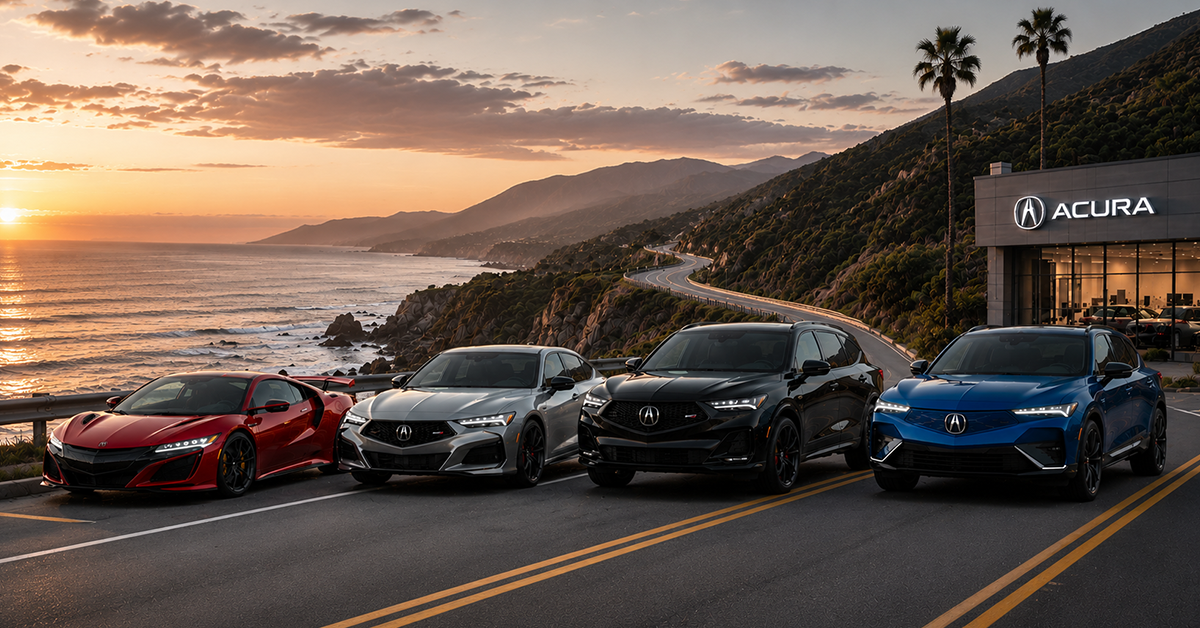
AI-generated concept illustration — Acura brand overview. | Rev N Rise
Acura is Honda's luxury and performance division — and the brand that proved Japanese manufacturers could compete in the premium car market. Founded in 1986 as the first Japanese luxury brand in North America, Acura gave the world the original NSX supercar, the Integra hot hatch icon and a lineup of refined luxury vehicles that consistently challenge European rivals at lower prices. The Integra Type S and ZDX electric SUV signal that Acura's best chapters are still being written.
Honda launched Acura on March 27 1986 — the first Japanese manufacturer to create a dedicated luxury brand for the North American market, beating Toyota's Lexus and Nissan's Infiniti to the concept by three years. The launch lineup consisted of two models: the Legend saloon — a V6-powered luxury car that immediately earned praise for its refinement, build quality and value — and the Integra — a sporty compact that offered performance and handling that embarrassed many European sports cars at a fraction of the price.
The NSX of 1990 — sold as the Honda NSX in most markets but Acura NSX in North America — was the most significant product Acura ever produced. It was the first mass-production car to use an all-aluminium body and chassis, the first mid-engine production car developed with input from a Formula 1 driver — Ayrton Senna provided development feedback — and the first supercar that could be relied upon to start every morning and never visit a dealer for unplanned repairs. It changed what the supercar world expected from mid-engine cars and directly influenced Ferrari's development of the F355.
Through the 1990s and 2000s Acura expanded with the MDX SUV — which became one of North America's best-selling luxury SUVs — and the TL saloon. The brand's identity became somewhat blurred in the 2010s as it moved toward softer, less performance-focused products. The relaunch of the Integra nameplate in 2022 — and particularly the launch of the Integra Type S in 2023 — signalled a return to the performance-focused values that made Acura's early years so compelling.
The original Acura/Honda NSX deserves its reputation as one of the most significant cars of the 20th century. When it arrived in 1990, supercars were notoriously unreliable, difficult to drive at the limit and temperamental in everyday use. The NSX changed all of that. Its aluminium monocoque — the first in any production car — was lighter and stiffer than steel. Its naturally aspirated VTEC V6 produced 274 horsepower and revved to 8,000rpm with a linearity and responsiveness that turbocharged rivals could not match. And it started every morning, never overheated and could be serviced at a Honda dealership. Ayrton Senna helped develop the suspension — his influence on the steering feel and chassis balance is credited by Honda engineers as transformative. The NSX proved Japan could build world-class supercars. Ferrari noticed and responded with better products as a direct result.
Acura's competitive advantage is Honda's engineering DNA applied to premium products — the same attention to powertrain refinement, chassis precision and long-term reliability that makes Honda's mainstream cars exceptional, deployed in more expensive and more performance-focused vehicles. The Integra Type S — 320 horsepower, six-speed manual, limited-slip differential, available for under $50,000 — is one of the most compelling performance cars in the current market at any price. The MDX Type S offers three-row SUV practicality with genuine sports car driving dynamics. And Acura's reliability record — built on Honda's manufacturing quality and engineering conservatism — gives buyers confidence in long-term ownership that European luxury brands cannot always match. Acura's challenge is raising its profile outside North America and competing more effectively with Genesis, which has captured much of the Asian luxury brand narrative in recent years.