 Brands
Aston Martin Valhalla vs McLaren W1 — Which Hypercar Wins?

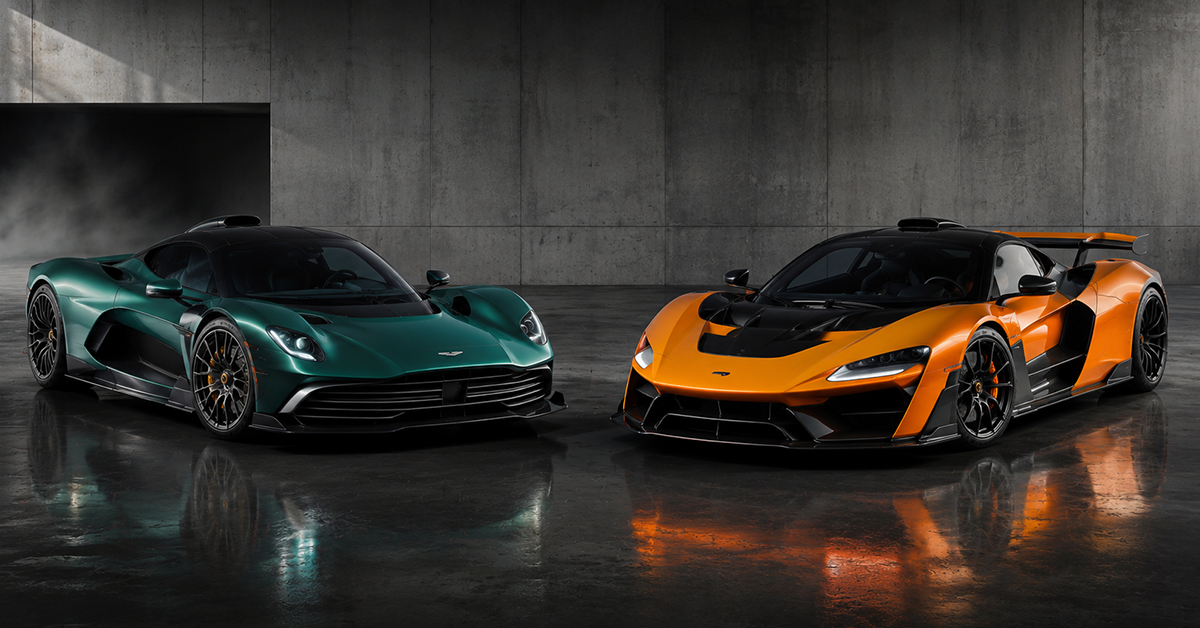
AI-generated concept illustration of the Aston Martin Valhalla and McLaren W1 — not official images. | Rev N Rise
The McLaren W1 wins on outright performance — more power, less weight, and the rear-wheel-drive purity that comes with both. The Aston Martin Valhalla wins decisively on value — it costs over $1 million less while still offering more than 1,000 horsepower and the traction advantage of all-wheel drive. For most buyers chasing the most house-money hypercar experience, the Valhalla is the smarter purchase.
Two hypercars built around genuine Formula 1 technology transfer, sold out before most buyers even saw final specifications, and separated by more than $1 million in price. The Aston Martin Valhalla and McLaren W1 represent two very different answers to the same basic question — how do you translate F1 engineering into a road car people can actually drive. Having studied every number behind both, this is the most complete comparison of the two available anywhere.
| Specification | Valhalla | McLaren W1 |
|---|---|---|
| Starting Price | $1,051,700 Winner | $2.1 million |
| Combined Output | 1,064 hp | 1,258 hp Winner |
| Drive | All-wheel drive Winner | Rear-wheel drive |
| 0-60/62 mph | ~2.5 sec | 2.7 sec |
| Top Speed | 217 mph | 217 mph |
| Curb Weight | ~3,417 lbs | 3,084 lbs Winner |
| Engine | 4.0L twin-turbo V8 (AMG-derived) | 4.0L twin-turbo V8 (bespoke) |
| Production Run | 999 units Winner | 399 units |
| Everyday Usability | Front-axle lift, AWD traction Winner | More analogue, less forgiving |
| Racing Heritage | Aston Martin F1 team | McLaren F1 team |
| Allocation Status | Sold out | Sold out |
This is the single most lopsided number in the entire comparison. The Aston Martin Valhalla starts at approximately $1,051,700, while the McLaren W1 starts at roughly $2.1 million — meaning the W1 costs almost exactly double. For that extra million-plus, the W1 delivers 194 more horsepower and a marginally quicker 0-60 time, but the Valhalla's value proposition at half the price, with all-wheel drive and genuinely more everyday usability, is difficult to argue against on pure numbers.
The McLaren W1 produces 1,258 horsepower against the Valhalla's 1,064 horsepower — a genuine 194hp gap — while also weighing roughly 330 pounds less at 3,084 pounds versus the Valhalla's approximately 3,417 pounds. That combination of more power and less weight gives the W1 a real power-to-weight advantage, even though McLaren sends all of it through the rear wheels alone, with no all-wheel-drive safety net.
The Valhalla's all-wheel-drive system, by contrast, puts power down through all four corners, with electric motors on the front axle providing genuine torque vectoring. That means the Valhalla's real-world acceleration in anything other than perfect, dry conditions is likely to be considerably more consistent and confidence-inspiring than the W1's — a meaningful real-world advantage that a simple 0-60 number doesn't fully capture.
Both cars trace their DNA directly to their respective manufacturer's Formula 1 program, but the resulting philosophies diverge sharply. McLaren built the W1 around an entirely new bespoke V8 and made the deliberate choice to keep it rear-wheel-drive only, prioritising weight and driving purity above all else — the same approach that defines a Formula 1 car's relationship between driver and machine. Aston Martin took its AMG-derived V8 and built a sophisticated all-wheel-drive hybrid system around it instead, with active aerodynamics and a raised-heel cockpit layout directly informed by sessions with its own F1 drivers at Silverstone.
Neither approach is wrong. McLaren's bet is that purity and weight discipline matter more than outright traction. Aston Martin's bet is that all-wheel-drive confidence and genuine everyday usability — at roughly half the price — represent the smarter way to bring F1 technology to a road car most owners will actually want to drive regularly.
McLaren is building just 399 examples of the W1, compared to Aston Martin's 999 Valhallas — meaning the W1 will be a genuinely rarer sight on the road, and that scarcity alone tends to support stronger long-term collector value, all else being equal. Both production runs sold out well before either car was fully revealed to the public, a clear signal that demand for both significantly outstripped supply regardless of the price gap between them.
| Category | Valhalla | McLaren W1 |
|---|---|---|
| Price | ✓ Winner | — |
| Outright Power | — | ✓ Winner |
| Power-to-Weight | — | ✓ Winner |
| Everyday Usability | ✓ Winner | — |
| Exclusivity | — | ✓ Winner |
| Engineering Risk | Draw | Draw |
| Overall | 2 Wins | 3 Wins |
On outright performance: McLaren W1. More power, less weight, and the rear-wheel-drive purity that purists specifically seek out. The W1 wins this comparison on the metrics that matter most to enthusiasts chasing the highest possible performance ceiling.
On value and usability: Aston Martin Valhalla. If you want over 1,000 horsepower, genuine F1-derived engineering, and all-wheel-drive confidence at roughly half the W1's price, the Valhalla delivers an exceptional package that's hard to argue against on rational grounds.
The short answer: Buy the W1 for the purer, faster hypercar experience. Buy the Valhalla for nearly the same thrill at a genuinely sensible price by comparison.