 Brands
BYD Is Sending Its Own Ship to Australia — 5,000 Cars, One Bold Statement

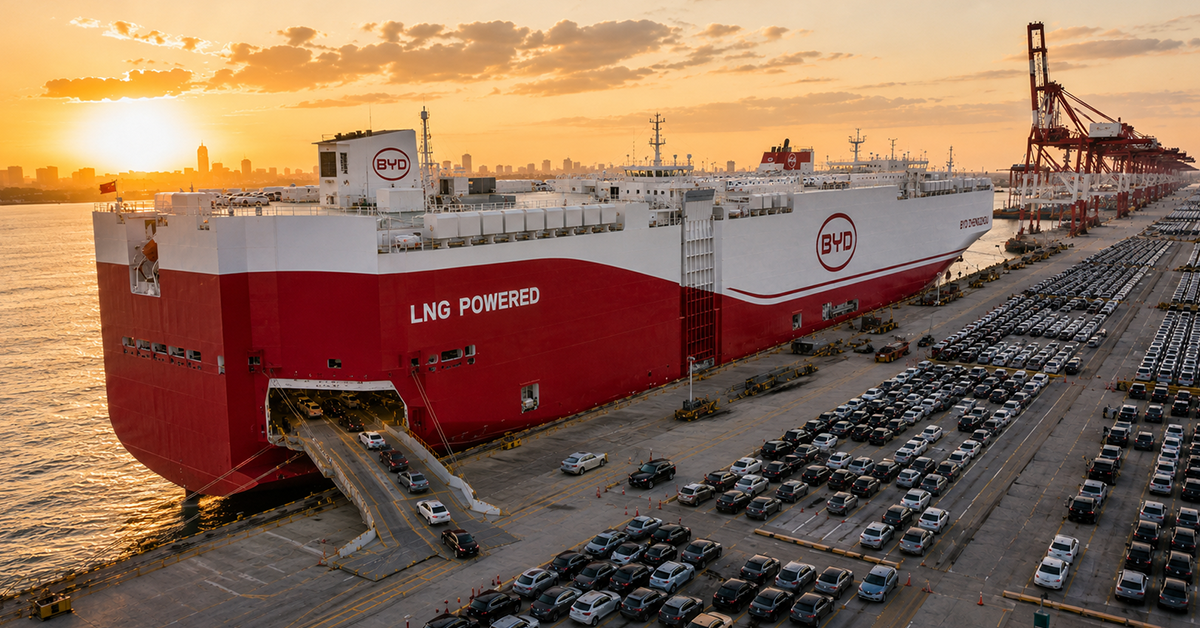
AI-generated concept illustration of the BYD Zhengzhou car carrier ship — not an official BYD image. | Rev N Rise
BYD has done something no Chinese car brand — and very few automakers of any nationality — has ever done in Australia. It has dispatched its own purpose-built car carrier ship, loaded with nearly 5,000 vehicles, directly to Australian ports. The BYD Zhengzhou has left Shanghai. It is heading to Melbourne. And it is a first for the entire EV industry in this country.
The BYD Zhengzhou is one of eight purpose-built, BYD-owned roll-on roll-off car carrier vessels — giant ships designed specifically to transport BYD's vehicles from its factories in China and Thailand to markets around the world. Having your own fleet of car carrier ships is extraordinarily rare for an automaker. Toyota has dedicated vessels. Volkswagen has dedicated vessels. The fact that BYD — a company that sold its first car in Australia just four years ago — now operates its own fleet of eight car carriers is one of the clearest possible signals of the scale and ambition of its global expansion.
The Zhengzhou has now officially departed Shanghai carrying almost 5,000 BYD and Denza vehicles bound for Australia — and is expected to dock first at the Port of Melbourne in early June 2026. This single shipment is a direct response to surging Australian buyer demand that has outpaced BYD's standard logistics arrangements. Rather than wait for space on shared carrier vessels — which can take weeks to schedule — BYD dispatched its own ship. That is the decision of a company that is genuinely treating Australia as a priority market, not an afterthought.
The context behind this shipment is as significant as the shipment itself. In 2026, BYD has overtaken Tesla as Australia's most popular electric vehicle brand — a position Tesla had held since it entered the Australian market more than a decade ago. In April 2026, BYD delivered its 100,000th new energy vehicle in Australia — a milestone that arrived just four years after the brand's first Australian delivery in 2022. No imported brand has grown this quickly in the Australian market in the modern era.
The demand driving this growth is real and accelerating. Rising fuel prices and cost-of-living pressures have pushed Australian buyers toward electrified vehicles at a pace that caught even BYD by surprise. In April, the company announced it would bring an additional 30,000 new energy vehicles to Australia over the coming months to meet the backlog of orders. The 5,000-car shipment from the Zhengzhou is the first physical delivery of that commitment. More ships will follow.
| First Australian Delivery | 2022 — BYD Atto 3 |
| 2025 Australian Sales | 52,415 units — 8th best-selling brand |
| 2026 Market Position | #1 EV brand in Australia — overtook Tesla |
| 100,000th Delivery | April 2026 — major milestone |
| Extra Vehicles Announced | 30,000 additional NEVs — announced April 2026 |
| Ship Name | BYD Zhengzhou — BYD-owned RORO carrier |
| BYD Ship Fleet | 8 purpose-built car carrier vessels |
| Cargo | ~5,000 BYD + Denza cars |
| Departed | Shanghai — May 2026 |
| First Port | Port of Melbourne — early June 2026 |
| Industry First | First EV brand to send own dedicated ship to Australia |
| New Models in 2026 | 7-8 confirmed — incl. Atto 1, Atto 2, Sealion 5, Sealion 8 |
| 2026 Target | Top 3 brand in Australia |
| Dealer Network | Expanding to 150 dealers by mid-2026 |
The Zhengzhou's cargo includes both BYD-branded vehicles and models from Denza — BYD's premium sub-brand that is preparing to enter the Australian market for the first time. The arrival of Denza in Australia signals a new phase in BYD's local strategy: having established the brand in the mainstream and affordable segments, it is now moving upmarket. Denza vehicles are positioned to compete with Lexus, Audi and BMW in the premium segment — at prices that significantly undercut those established brands.
The specific BYD models on board are expected to include stock for the recently launched Sealion 5 and Sealion 8 — both of which have generated strong early order banks — as well as the Shark 6 plug-in hybrid ute, which has become BYD's fastest-growing model in Australia. The Shark 6 became the best-selling PHEV of all time in Australia within just 12 months of its launch — a record that illustrates exactly why BYD needed its own ship.
The fact that BYD has overtaken Tesla as Australia's most popular electric brand deserves more than a passing mention. Tesla has been the dominant force in Australian EV sales since the Model 3 arrived in 2019. Its Supercharger network, its brand recognition and its software ecosystem gave it advantages that no rival could immediately replicate. BYD has not overcome those advantages by matching them — it has overcome them by offering something different: a wider range of body styles, more affordable entry points, plug-in hybrid options for buyers who are not ready for full electric and a Blade Battery technology reputation for safety that has resonated strongly with Australian buyers.
Tesla remains the most popular single electric model in Australia — the Model Y continues to outsell any individual BYD model. But as a brand, BYD's combined volume across the Atto 3, Seal, Sealion 7, Shark 6, Sealion 6, Dolphin, Atto 1 and Atto 2 has surpassed Tesla's two-model range. That is a structural advantage that will only widen as BYD's model count grows toward eight or more in 2026.
The 5,000-car shipment is the first of several. BYD has committed to delivering 30,000 additional vehicles to Australia throughout 2026 — approximately 25,000 more than the initial Zhengzhou cargo. That volume, added to BYD's existing sales run rate, would put the brand on course to significantly surpass its 52,415-unit 2025 tally and make a credible push toward the top-three position that BYD Australia CEO Stephen Collins has publicly targeted.
The Denza brand's Australian launch adds another dimension to this growth story. If BYD can establish Denza as a credible premium alternative to European brands — as it has done in China, where Denza models outsell several established luxury brands — the revenue and margin implications for BYD's Australian business are significant. A brand that arrived in Australia in 2022 selling a single compact SUV is in 2026 operating eight car carriers, delivering premium sub-brand vehicles and targeting a top-three position in one of the world's most competitive automotive markets. The BYD Zhengzhou left Shanghai this week. By the time it docks in Melbourne in June, BYD's Australian story will have moved on again.
"Moving into 2026, we're planning to change our mindset from a challenger brand to more of a leadership way of thinking and of doing business."
— Stephen Collins, CEO, BYD AustraliaFour years ago BYD sold its first car in Australia. Today it operates its own fleet of car carrier ships, has delivered 100,000 vehicles, overtaken Tesla as the country's most popular EV brand and is preparing to launch a premium sub-brand. The BYD Zhengzhou is not just a ship carrying 5,000 cars. It is the most visible symbol of one of the fastest automotive market transformations in Australian history. The question is no longer whether BYD will become a major player in Australia. It already is. The question now is how far it intends to go — and whether any established brand is capable of slowing it down.