 Brands
Ferrari Luce First EV Reveal Date Confirmed — Everything We Know Before May 25
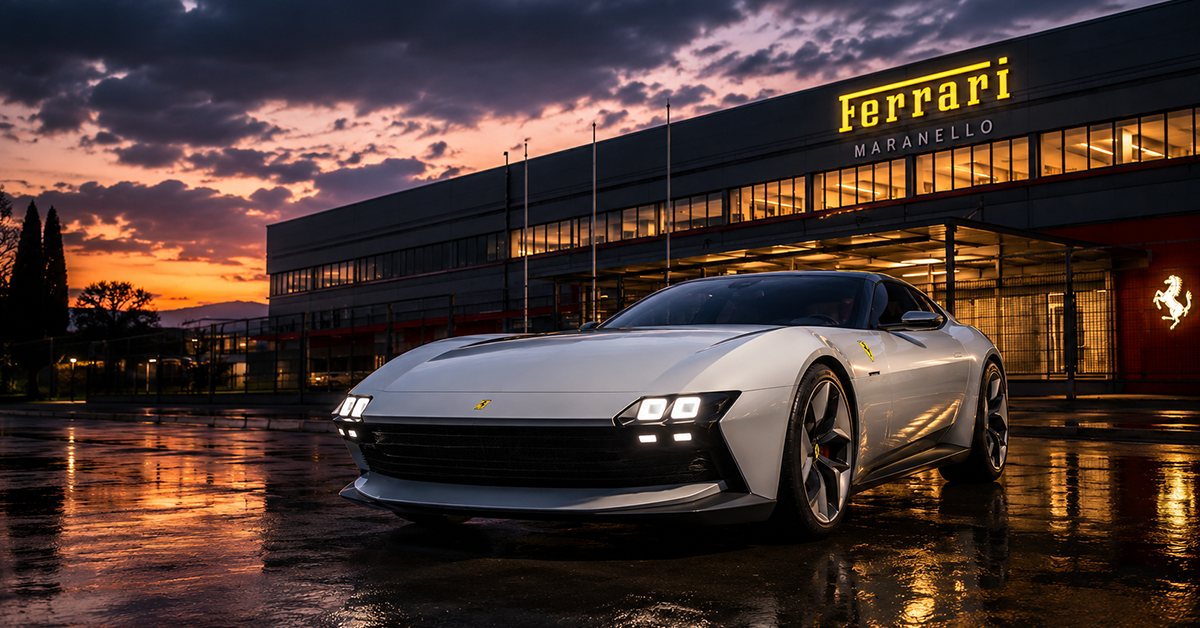
AI-generated concept illustration of the Ferrari Luce — not an official Ferrari image. | Rev N Rise
It's finally happening. After years of teasers, spy shots and carefully timed reveals, Ferrari is about to show the world its most significant car ever built. On May 25, 2026, the Ferrari Luce — the brand's first fully electric vehicle — will be unveiled in Italy. And everything confirmed so far suggests it's going to be extraordinary.
Ferrari didn't choose the name Luce by accident. In Italian, it means light — and the brand is using that word with full intention. This isn't simply an electric car wearing a prancing horse badge. Ferrari has been clear from the start that the Luce represents a philosophy: electrification as a means, not an end. A declaration that Ferrari's entry into the EV world happens entirely on Ferrari's terms.
That mentality has shaped every decision on this car — from the bespoke engineering beneath the floor to the controversial decisions made inside the cabin. Nothing about the Luce is ordinary. Nothing was borrowed from a parts bin. And that is precisely what makes May 25 one of the most anticipated dates in modern automotive history.
Let's get to what matters. The Ferrari Luce is built on a bespoke 880-volt platform that Ferrari engineered from scratch, solely for this model. Four electric motors — one at each wheel — deliver a combined output exceeding 1,000 horsepower. That figure alone puts the Luce in hypercar territory before you've even opened the door.
| Platform | Bespoke Ferrari 880V EV architecture |
| Motors | 4 × electric (one per wheel) |
| Combined Output | 1,000+ hp (official figures TBC) |
| Battery Energy Density | 195 Wh/kg — highest in any production EV |
| Battery Position | Built into floorpan as structural member |
| Target Range | 330+ miles |
| Centre of Gravity | 80mm lower than equivalent ICE Ferrari |
| Weight Distribution | 47:53 front to rear |
| Wheelbase | 116.5 inches |
| Steering | Four-wheel steering |
| Traction | Torque vectoring on each individual axle |
| 0–62mph | Faster than the Ferrari 12Cilindri (official figure TBC) |
| Starting Price | €500,000+ (approx. £420,000 / $550,000) |
| Production Start | Late 2026 — first deliveries early 2027 |
Acceleration figures haven't been officially confirmed yet, but Ferrari has indicated the Luce will out-accelerate the 12Cilindri — one of the quickest road cars the brand currently produces. With four motors, four-wheel steering and torque vectoring on each axle, the Luce is engineered to feel dramatically lighter and more agile than its 2.3-tonne kerb weight would suggest. Ferrari's words, not ours.
Range is targeted at over 330 miles — a serious number for a performance EV that will spend plenty of time near its limits. The battery cells sit mainly between the axles, lowering the centre of gravity by 80mm compared to a conventional Ferrari layout. The result is a car that Ferrari claims handles unlike anything that has worn its badge before.
Here is where the Ferrari Luce gets genuinely fascinating. When Ferrari needed someone to design the cabin of its first EV, it didn't turn to a car designer. It called Sir Jony Ive — the man who shaped the iPhone, the iMac and some of the most iconic objects of the last thirty years — through his creative collective LoveFrom, co-founded with designer Marc Newson.
The result has sparked serious debate before anyone has even seen the complete car. Rather than following the industry's obsession with enormous touchscreens and stripped-back digital dashboards, the Luce goes in the opposite direction entirely. Physical buttons are back. Analogue controls are celebrated. A 12.5-inch digital instrument cluster sits behind the steering wheel, styled with deliberately retro-inspired graphics as a tribute to Ferrari's heritage rather than a sprint toward the future.
"That makes no sense to me."
— Sir Jony Ive, Designer, Ferrari Luce InteriorIt is a bold move. In a segment where every rival is fighting over who can fit the largest display, it might just be the most intelligent decision Ferrari has ever made about an interior. The Luce doesn't try to out-tech its competition. It out-thinks them.
Ferrari has released a handful of teasers including a brief nighttime video that gave enthusiasts their first real look at the Luce in motion, still wrapped in camouflage. What emerged was surprising. The silhouette appears taller and more upright than a traditional Ferrari — closer to a grand tourer or shooting brake than a low-slung sports car.
Square, separated headlights are visible in the teasers — a design cue that aligns with the interior's retro theme and sets the Luce apart from everything else on the road. Spy shots captured across Europe, including Sweden, confirm a wheelbase of 116.5 inches — slightly shorter than the Purosangue — and proportions that suggest something genuinely new in Ferrari's lineup.
The complete picture will be revealed on May 25. Until that day, all eyes are on Italy.
The Luce arrives at a critical point for the performance car industry. Lamborghini has quietly cancelled its pure-EV Lanzador project and pivoted to hybrids. McLaren and Aston Martin have both acknowledged that EV demand at the very top of the market has not materialised the way they expected. Even Ferrari has adjusted its long-term targets — now aiming for 20 percent EVs by 2030 instead of the 40 percent originally planned.
Against that backdrop, the Luce is a high-stakes wager. If it succeeds — if it proves that a Ferrari can be fully electric and still feel unmistakably like a Ferrari — it changes the conversation for the entire segment. If it falls short, it will embolden every rival still hesitating at the EV starting line.
Rivals will be watching May 25 just as closely as fans will.
Ferrari has not officially published pricing for the Luce, but consistent reporting places the starting figure above €500,000. Options through Ferrari's Tailor Made personalisation programme — Ferrari's bespoke service that lets buyers specify rare leathers, custom carbon, unique paint and dedicated designer time — could push individual cars significantly beyond that. This is not a volume product. Allocation will be strictly limited and demand already appears to outstrip supply well before the reveal has even happened.
Ferrari will assemble the Luce in a dedicated new facility in Maranello called the E-Building — purpose-built for electric vehicle production and representing the start of Ferrari's full EV manufacturing era. Production is expected to begin in late 2026 with first customer deliveries arriving in early 2027.
The May 25 event marks the third and final phase of the Luce's carefully staged launch — following the technology reveal in October 2025 and the interior and name announcement in February 2026. After the exterior reveal, Ferrari's first EV will finally exist in full.
Ferrari has spent decades building a reputation for doing things its own way. The Luce suggests that instinct hasn't changed just because the power source has. Over 1,000 horsepower, a range beyond 330 miles, a Jony Ive interior that dares to be different and a price tag that ensures exclusivity — this is Ferrari's electric future, built entirely on Ferrari's terms. May 25 cannot come soon enough.