 Brands
Ford — History, Models and Everything You Need to Know
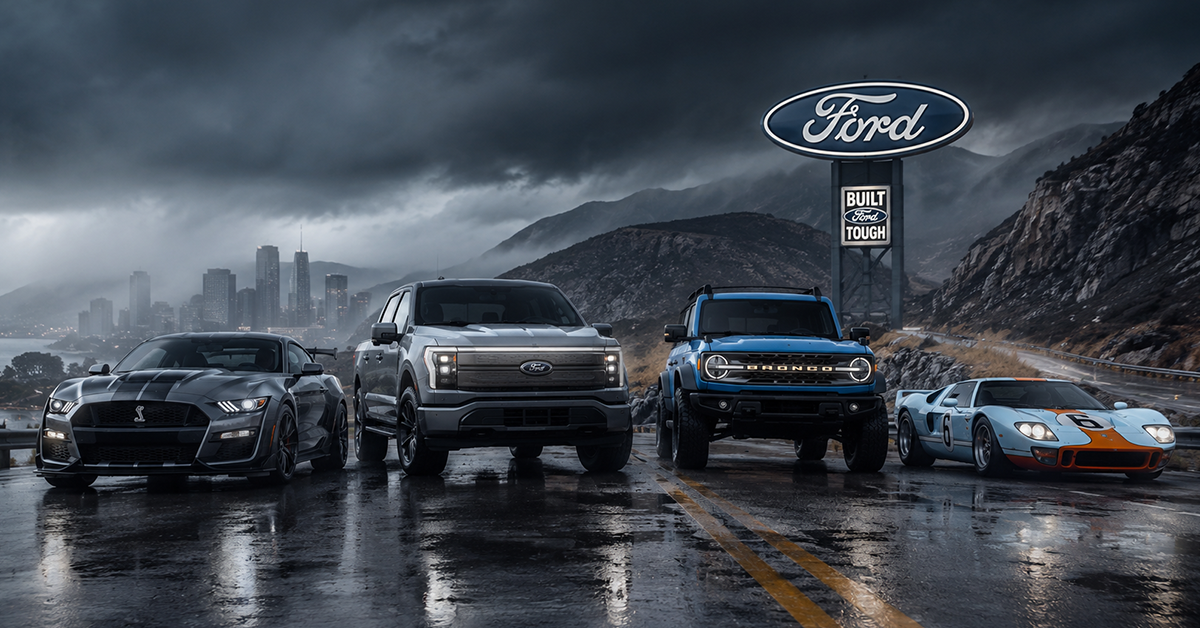
AI-generated concept illustration — Ford brand overview. | Rev N Rise
Ford Motor Company is one of the most important companies in the history of American industry. Founded by Henry Ford in 1903, it invented the moving assembly line, made car ownership accessible to ordinary Americans and created some of the most iconic vehicles ever built — from the Model T to the Mustang to the F-150. Today Ford sells millions of vehicles across more than 100 countries and is in the middle of one of its most ambitious transformations.
Henry Ford founded the Ford Motor Company on June 16 1903 in Detroit, Michigan, with $28,000 in capital from twelve investors. The company's first car, the Model A, went on sale the same year. But it was the Model T — launched in 1908 — that changed everything. Affordable, simple to maintain and available in any colour as long as it was black, the Model T democratised personal transportation for the first time in history.
Ford's introduction of the moving assembly line at the Highland Park plant in 1913 was the most significant manufacturing innovation of the 20th century. It reduced the time to build a Model T from over 12 hours to 93 minutes, dropping the price from $850 to $260 and making it affordable to the workers building it. By 1918, half of all cars in America were Model Ts. The assembly line concept was copied by every manufacturer in the world and is the foundation of modern industrial production.
Ford introduced the flathead V8 engine in 1932 — a significant engineering achievement that gave ordinary Americans access to V8 power for the first time. The F-Series truck arrived in 1948 and began its journey to becoming the best-selling vehicle in America. The Mustang launched on April 17 1964 — selling over 400,000 units in its first year and creating an entirely new market segment called the pony car. The GT40 won Le Mans four consecutive times from 1966 to 1969, beating Ferrari in one of motorsport's most celebrated rivalries.
Through the 1980s and 1990s, the Ford Escort, Sierra and Mondeo defined European family motoring. The Focus — launched in 1998 — became one of Europe's best-selling cars and a World Rally Championship winner. The 21st century has been defined by the F-Series' continued dominance of the American truck market and Ford's increasingly committed pivot toward electrification — with the Mustang Mach-E, F-150 Lightning and Explorer EV representing the brand's electric future.
In 1963, Henry Ford II attempted to buy Ferrari. Enzo Ferrari agreed to the deal — then walked away at the last moment. Furious, Ford II launched a programme to beat Ferrari at Le Mans. The result was the GT40 — a low, mid-engined racing car developed in partnership with Lola Cars and powered by Ford's V8. After two years of failures, the GT40 achieved one of the most dramatic results in motorsport history at the 1966 Le Mans 24 Hours — finishing first, second and third. Ford won Le Mans again in 1967, 1968 and 1969. The four consecutive victories remain one of the defining achievements in American motorsport history. The story was dramatised in the 2019 film Ford v Ferrari starring Matt Damon and Christian Bale.
Ford Performance is the division responsible for taking Ford's motorsport DNA directly into road cars. The Mustang GT500 produces 760 horsepower from a supercharged 5.2-litre V8. The Ranger Raptor — powered by a twin-turbo V6 — is one of the most capable factory performance pickups ever built. The Focus RS and Fiesta ST have won multiple hot hatch of the year awards and proven that Ford's performance credentials extend well beyond its American muscle car heritage. Ford's involvement in NASCAR, the World Rally Championship and the World Endurance Championship provides a continuous feedback loop of real race technology into its road car development.
Ford's strength lies in its ability to operate at two ends of the market simultaneously — building affordable, practical everyday vehicles while maintaining genuine performance and motorsport credibility that few mainstream brands can match. The F-Series dominates the American truck market with a loyalty no competitor has meaningfully challenged in 40 years. The Mustang is an American cultural icon with genuine global appeal. Ford's history of motorsport success — from Le Mans to NASCAR to the WRC — gives it an authenticity that money cannot buy. And Ford's willingness to commit to electrification boldly — with the F-150 Lightning putting EV technology into the hands of the buyers who most needed convincing — shows strategic courage that distinguishes it from more cautious rivals.