 Brands
Honda CR-Z — IMA Specs, Manual vs CVT, Prices and Final Year
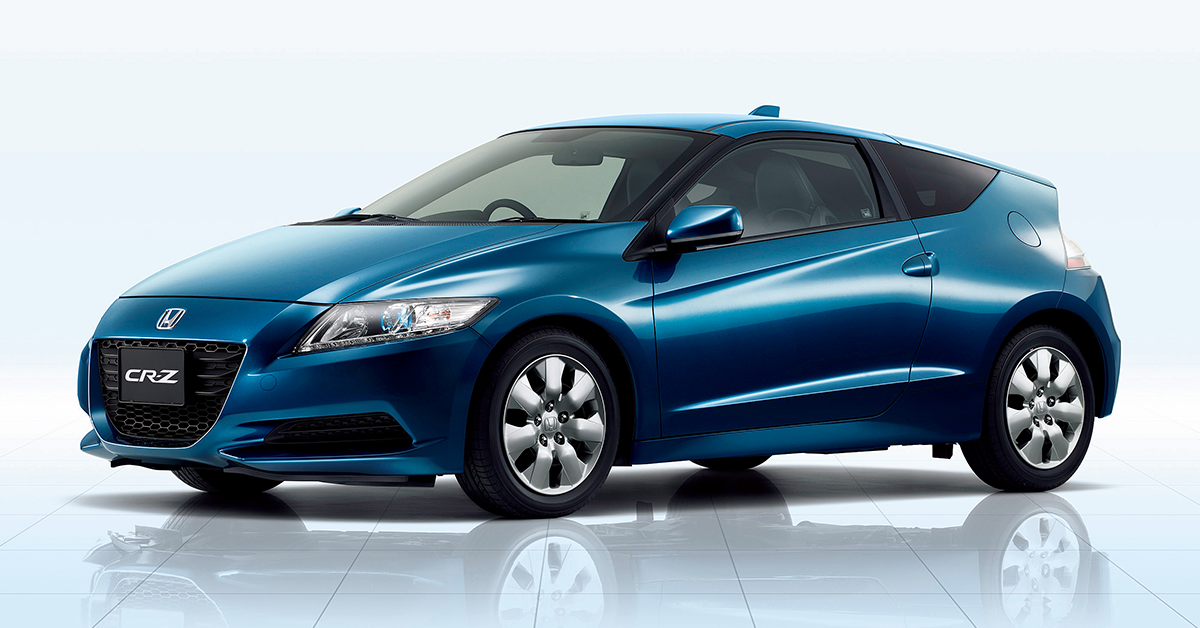
Official press image of the Honda CR-Z (Japan). | © Honda Motor Co., Ltd.
The CR-Z was Honda's small hybrid coupe with a six-speed manual, sold from 2010 to 2016. Here are Honda's own Japan and US prices, IMA hybrid specs, 2016 update, Final label edition and the end of production.
The Honda CR-Z is a small hybrid coupe that Honda no longer builds. Honda’s American release for the 2011 model calls it a two-passenger sport hybrid coupe with a 1.5-liter i-VTEC engine and the Integrated Motor Assist (IMA) system (Honda). Honda’s Japanese releases say it was the first hybrid offered with a six-speed manual transmission and that its world premiere was at the Detroit show in January 2010 (Honda). Our Honda Models article covers the cars Honda sells today, and this article covers the CR-Z from launch to the final edition.
| Debut | Detroit, January 2010 (Honda) |
| Japan sales start | 26 February 2010 (Honda) |
| US dealer debut | 24 August 2010 (Honda) |
| 2011 US starting price | $19,200, manual (Honda) |
| 2016 US starting price | $20,295, LX manual (Honda) |
| Japan launch price, β | ¥2,268,000 with tax (Honda) |
| Hybrid system | IMA with 1.5L i-VTEC (Honda) |
| Manual transmission | Six-speed, a first for a hybrid (Honda) |
| Total sales in Japan | About 40,000 by June 2016 (Honda) |
| Production ended | Within 2016 (Honda) |
Sales began in Japan on 26 February 2010 (Honda). Honda’s launch prices there, including consumption tax, were ¥2,268,000 for the β grade and ¥2,498,000 for the α grade, each with a CVT or a six-speed manual (Honda). In the United States, dealers received the car on 24 August 2010 at a starting price of $19,200 for the manual, plus a $750 destination charge (Honda). Honda’s 2016 final US price list started at $20,295 for the LX manual (Honda). The Japanese prices include consumption tax and exclude insurance and registration costs (Honda).
Honda’s US ratings were 31 city, 37 highway and 34 combined for the 2011 manual, and 35, 39 and 37 for the CVT (Honda). For 2016 the ratings were 31, 38 and 34 for the manual, and 36, 39 and 37 for the CVT (Honda). Honda’s 2016 materials list a combined 130 horsepower from the engine and IMA motor (Honda), while its Japanese launch release lists the engine alone at 113 or 114 PS (Honda). We explain the differences in the powertrain section.
The CR-Z had a short life. Honda’s Japanese release of 9 June 2016 says the car had sold about 40,000 units in total since sales began in February 2010, and that production would end within 2016 (Honda). The same release announced a limited α Final label edition at ¥2,800,000 including 8 percent consumption tax (Honda). Honda’s Japanese archive page for the final model says it was announced in August 2015 and ended in January 2017 (Honda).
Reports add some context. They say the name stands for Compact Renaissance Zero and that the car is regarded as a spiritual successor to the second-generation CR-X (reported). A report says it was built at Suzuka, in Mie prefecture, and Honda’s Japanese release gives the same plant (Honda, reported). Reports say US sales through June 2016 were only 1,205 (reported). We found no Honda statement giving a reason for the end, so those reasons are reports’.
A note on method: figures from Honda’s own pages carry a (Honda) tag, and everything else is tagged as reported. Where sources disagree, we print both values and do not choose between them, and we list what we could not confirm at the end. The sections that follow cover the car’s history, its hybrid system, Japanese pricing, US pricing for 2011 and 2016, size and safety, and the end of production. Honda’s pages in the text we read give no sales total by country, so we offer none, and every price may have changed since publication.
Honda’s global newsroom dates the plan to 13 July 2009, when Honda announced that it would begin Japanese sales of the CR-Z sporty hybrid in February 2010 and the Fit Hybrid before the end of that year (Honda). Reports say the idea was previewed by the Honda Small Hybrid Sports concept at the 2007 Geneva show, and that a revised CR-Z Concept 2009 had a design very similar to the production car (reported). A report says the car was first shown in America at the 2008 Detroit show (reported).
| Plan announced | 13 July 2009 (Honda) |
| World premiere | Detroit, January 2010 (Honda) |
| Japan announcement | 25 February 2010 (Honda) |
| Japan sales start | 26 February 2010 (Honda) |
| US dealer debut | 24 August 2010 (Honda) |
| Japan Car of the Year | 2010-2011 (Honda) |
| Commemorative edition on sale | 14 January 2011 (Honda) |
| Final model announced in Japan | August 2015 (Honda) |
| Final Label on sale | 10 June 2016 (Honda) |
| Japan model ended | January 2017 (Honda) |
Honda’s Japanese release gives the production launch sequence. The world premiere was at the North American International Auto Show in Detroit, with press days on 11 and 12 January 2010 (Honda). Honda announced the Japanese car on 25 February 2010 and began sales the next day (Honda). Honda’s Geneva show page says the European version made its debut at the 2010 Geneva International Motor Show (Honda). US dealers received the car on 24 August 2010, and a report says Canadian sales began on 10 August (Honda, reported).
Honda won an award early. A Honda release of 9 November 2010 says the CR-Z was named 2010-2011 Japan Car of the Year (Honda). On 22 December 2010 Honda announced a commemorative edition of the α grade, with a dedicated Deep Sapphire Blue Pearl color and 16-inch lightweight alloy wheels, on sale for a limited time from 14 January 2011 (Honda). That edition cost ¥2,794,000 including tax (Honda). The edition is a Japanese special, and we found no US equivalent.
The car was updated twice. A report says a 2013 refresh brought a higher-voltage lithium-ion battery that raised output to 130 horsepower and improved fuel economy (reported). Honda’s own 2015 release for the 2016 model year describes new styling inside and out, a new EX-L trim and 130 horsepower from a 144-volt lithium-ion pack (Honda). Honda’s Japanese archive says the final model was announced in August 2015 (Honda). We cover the 2016 changes in their own section below.
Honda’s Japanese pages describe the end. The 9 June 2016 release says production would finish within the year, and it launched the α Final label special edition on 10 June (Honda). Honda’s Japanese archive lists the model as ending in January 2017 (Honda). Reports say that in the US the car was discontinued after the 2016 model year (reported). A report says 2016 was its final US model year, with Honda confirming in June 2016 that the car would not return for 2017 (reported).
Honda’s pages do not number the CR-Z’s generations, and a report gives its model years as 2011 to 2016 (reported). We did not find a Honda page with global sales by year, so the only total we give is the 40,000 in Honda’s 2016 release. Honda’s Japanese pages say the car was built at Suzuka, and its July 2009 release is the earliest Honda page we found on the car (Honda). Our Honda history article covers the company’s wider timeline, including its other hybrids and sports cars, and we do not repeat it here.
Honda’s Japanese release describes the engine as a 1.5-liter four-valve i-VTEC that idles one of its two intake valves at low rpm, and says that together with the lightweight IMA system it delivers acceleration comparable to a 2.0-liter engine and strong low-speed torque (Honda). The engine is rated at 83 kW (113 PS) at 6,000 rpm with the CVT and 84 kW (114 PS) with the six-speed manual, with torque of 144 and 145 N·m at 4,800 rpm (Honda). Those are the engine-only figures for Japan.
| Engine, Japan | 1.5L four-valve i-VTEC (Honda) |
| Engine output, CVT | 83 kW (113 PS) (Honda) |
| Engine output, manual | 84 kW (114 PS) (Honda) |
| Motor, Japan | 10 kW (14 PS), 78 N·m (Honda) |
| US combined output, 2016 | 130 hp (Honda) |
| US torque, manual | 140 lb-ft (Honda) |
| US torque, CVT | 127 lb-ft (Honda) |
| US battery, 2016 | 144-volt lithium-ion (Honda) |
| Drive modes | Sport, Normal, Econ (Honda) |
| Japan 10-15 mode, CVT and manual | 25.0 and 22.5 km/L (Honda) |
The electric motor is a thin DC brushless unit. Honda lists it at 10 kW (14 PS) at 1,500 rpm and 78 N·m at 1,000 rpm for both transmissions (Honda). Adding the engine and motor figures arithmetically gives 127 or 128 PS and 223 or 224 N·m, but Honda’s page does not state a system total, and the peaks do not necessarily occur together (Honda, our calculation). Honda’s table lists 100V beside the motor (Honda).
US figures differ. Honda’s 2016 release lists 130 horsepower at 6,000 rpm combined, a 15 kW electric motor and a 144-volt lithium-ion battery pack, with 140 lb-ft of torque for the manual at 1,000 to 2,000 rpm and 127 lb-ft for the CVT at 1,000 to 3,000 rpm (Honda). 15 kW is about 20 horsepower (Honda, our calculation). Reports give 122 horsepower and 128 lb-ft for the original car, and one listing shows 122 horsepower for the 2016 car, against Honda’s 130 (reported). We print both.
The six-speed manual was the headline. Honda’s Japanese and American releases both call it a first for a mass-produced hybrid, and a Honda page says the manual was designed specifically for the car (Honda). The CVT comes with steering-wheel paddle shifters, standard in Japan (Honda). Honda’s Japanese release describes a three-mode drive system, which it calls Honda’s first, combining drive-by-wire throttle, transmission, electric power steering and air conditioning control (Honda). The modes are Sport, Normal and Econ (Honda).
Economy was the point of the hybrid system. Honda’s Japanese release gives 25.0 km/L in the 10-15 mode for the CVT and 22.5 km/L for the manual, with JC08 figures of 22.8 and 20.6 km/L (Honda). Honda’s US releases give 36 city, 39 highway and 37 combined mpg for the 2016 CVT and 31, 38 and 34 for the manual (Honda). A report says the CR-Z was the last Honda still built with IMA, which was being replaced by two-motor systems (reported). Our Honda Insight article covers an earlier IMA car.
There are limits. Honda’s Japanese page gives the engine and motor separately and no 0 to 100 km/h time, and the US pages in the text we read give no acceleration time either (Honda). A report says the CR-Z was not fast but fun to drive (reported). A 2016 listing gives a 0.6 kWh battery, which we could not find on a Honda page (reported). We therefore give no performance claim and no battery capacity from Honda. Honda’s Japanese table lists the same motor for both transmissions (Honda).
Honda’s release of 25 February 2010 lists two grades. The β costs ¥2,268,000 including consumption tax, or ¥2,160,000 before tax, and the α costs ¥2,498,000, or ¥2,379,048 before tax (Honda). Each is front-wheel drive and each comes with a CVT or a six-speed manual at the same price (Honda). The release table lists the engine as the 1.5-liter i-VTEC plus IMA for both grades (Honda). The α costs ¥230,000 more than the β with tax (Honda, our calculation). The prices exclude insurance, taxes other than consumption tax, and registration costs (Honda).
| β grade with tax | ¥2,268,000 (Honda) |
| β grade before tax | ¥2,160,000 (Honda) |
| α grade with tax | ¥2,498,000 (Honda) |
| α grade before tax | ¥2,379,048 (Honda) |
| Japan sales plan | 1,000 a month (Honda) |
| Weight, CVT | 1,160 kg (Honda) |
| Weight, manual | 1,130 kg (Honda) |
| Length, width, height | 4,080, 1,740, 1,395 mm (Honda) |
| Commemorative edition | ¥2,794,000 with tax (Honda) |
| α Final label | ¥2,800,000 with 8% tax (Honda) |
Honda’s plan for Japan was 1,000 cars a month, built at its Suzuka plant (Honda). A report says Honda had received 4,500 orders by the day of the announcement, and that Honda expected about 70 percent of buyers to choose the CVT and 30 percent the manual (reported). Another report says 3,349 cars had been sold by the end of October 2010 (reported). Honda’s 2016 release puts the total at about 40,000 since launch (Honda). We found no Honda figure for any single year.
Weights and size come from Honda’s specification table. The CVT car weighs 1,160 kg and the manual 1,130 kg (Honda). Length is 4,080 mm, width 1,740 mm, height 1,395 mm and wheelbase 2,435 mm for both (Honda). Those are about 160.6, 68.5, 54.9 and 95.9 inches (Honda, our calculation). The manual is 30 kg lighter than the CVT car (Honda, our calculation). Honda’s table lists the same dimensions for both transmissions (Honda). Honda’s table does not list seating capacity or cargo volume in the text we read (Honda).
Special editions followed. The Japan Car of the Year commemorative edition, on sale from 14 January 2011, was based on the α grade with a dedicated Deep Sapphire Blue Pearl, 16-inch lightweight alloys and other equipment, at ¥2,794,000 including tax, or ¥2,660,953 before tax (Honda). That is ¥296,000 above the α launch price including tax (Honda, our calculation). The release says the edition was sold for a limited time, with CVT and manual versions both listed at the same price (Honda).
The final Japanese edition is the α Final label. Honda’s release of 9 June 2016 says it went on sale on 10 June at ¥2,800,000 including 8 percent consumption tax, with CVT and manual versions at the same price (Honda). It adds a black interior, an embroidered Final label logo on black combination front seats, matte-painted 17-inch lightweight alloy wheels, an aluminum console plate, a piano-black steering garnish, a tonneau cover and premium pedals (Honda). Its special color is Brilliant Sporty Blue Metallic (Honda).
Honda’s archive page adds that the Final label uses 17 by 6.5J wheels with 205/45R17 tires (Honda). The Final label’s ¥2,800,000 is ¥302,000 above the α launch price, but the launch price implies 5 percent consumption tax (2,379,048 times 1.05 gives 2,498,000) while Honda’s 2016 release states 8 percent, so the gap is not a like-for-like price rise (Honda, our calculation). Honda’s page for the final model also lists ten body colors, six solid and four two-tone (Honda). We did not find per-grade prices for the final standard models in the text we read.
American Honda’s release of 22 June 2010 lists six versions. The base CR-Z costs $19,200 with the manual and $19,850 with the CVT, the EX $20,760 and $21,410, and the EX with navigation $22,560 and $23,210 (Honda). All prices exclude tax, license, registration, destination and options, and the destination and handling charge is $750 (Honda). The base manual with destination therefore comes to $19,950 (Honda, our calculation). Dealers received the car on 24 August 2010 (Honda). Honda’s release headline calls it an all-new 2011 sport hybrid coupe, and says dealer prices may vary (Honda).
| Base, manual | $19,200 (Honda) |
| Base, CVT | $19,850 (Honda) |
| EX, manual | $20,760 (Honda) |
| EX, CVT | $21,410 (Honda) |
| EX with Navi, manual | $22,560 (Honda) |
| EX with Navi, CVT | $23,210 (Honda) |
| Destination and handling | $750 (Honda) |
| CVT premium | $650 on every trim (Honda, our calculation) |
| EPA, manual | 31/37/34 mpg (Honda) |
| EPA, CVT | 35/39/37 mpg (Honda) |
The price structure is regular. The CVT adds $650 on every trim (Honda, our calculation). The EX costs $1,560 more than the base car with either transmission (Honda, our calculation). Navigation adds $1,800 to the EX (Honda, our calculation). The EX with Navi manual costs $3,360 more than the base manual (Honda, our calculation). The EX with Navi CVT, at $23,210, is the most expensive 2011 version (Honda). Honda’s release calls the six-speed manual a first for a mass-produced hybrid and says the CVT has steering-wheel paddle shifters (Honda).
Fuel economy was Honda’s EPA estimate. The manual is rated at 31 mpg city, 37 highway and 34 combined, and the CVT at 35, 39 and 37 (Honda). A report says the CVT ranked fourth and the manual tenth on the 2011 EPA list of fuel-efficient vehicles (reported). Other reports call the numbers unimpressive for a hybrid (reported). Honda’s figures were EPA estimates for the 2011 model year (Honda). Honda’s release lists three drive modes, Sport, Normal and Econ, plus Eco Assist and Eco Scoring tools to coach efficient driving (Honda).
Equipment differed by trim. The base car has an AM/FM/CD/USB audio system with six speakers, automatic climate control, power windows and locks, remote entry and cruise control (Honda). The EX adds a 360-watt audio system with seven speakers including a subwoofer, Bluetooth HandsFreeLink and a leather-wrapped steering wheel (Honda). Honda Satellite-Linked Navigation with voice recognition is on the EX with Navi and is not available in Alaska (Honda). The release does not list wheel sizes or dimensions (Honda).
Safety equipment was standard across the range. Honda lists the Advanced Compatibility Engineering body structure, Vehicle Stability Assist, dual-stage multiple-threshold front airbags, front-side airbags with a passenger Occupant Position Detection System, side-curtain airbags, active head restraints, anti-lock brakes, tire pressure monitoring and a front design to reduce pedestrian injury (Honda). The release describes the car as a two-passenger coupe (Honda). We did not find crash-test ratings on the Honda pages we read.
Listings and other markets differ. Listings show the 2011 manual at $19,345 and the CVT at $19,995, each $145 above Honda’s figure, with the EX at $20,905 and the EX with navigation at $22,705 and $23,355 (reported, our calculation). We print both sets. Reports say Canadian prices were $23,490 for the manual and $24,290 for the CVT, and that Australian prices started at 34,990 Australian dollars for the manual (reported). A report gives Canadian ratings of 6.5 city and 5.3 highway liters per 100 km for the manual (reported).
American Honda’s release of 2 November 2015 says the 2016 CR-Z went on sale on 3 November with new styling inside and out and a new line-topping EX-L with standard navigation (Honda). The LX costs $20,295 with the manual and $20,945 with the CVT, the EX $22,140 and $22,790, and the EX-L $24,440 and $25,090 (Honda). The destination charge is $835 (Honda). The cheapest 2016 car therefore costs $21,130 with destination (Honda, our calculation). Honda’s release says prices exclude tax, license, registration and options (Honda).
| 2016 LX, manual | $20,295 (Honda) |
| 2016 LX, CVT | $20,945 (Honda) |
| 2016 EX, manual | $22,140 (Honda) |
| 2016 EX, CVT | $22,790 (Honda) |
| 2016 EX-L, manual | $24,440 (Honda) |
| 2016 EX-L, CVT | $25,090 (Honda) |
| Destination, 2016 | $835 (Honda) |
| 2016 combined output | 130 hp (Honda) |
| 2016 wheels and tires | 16-inch, 195/55R16 (Honda) |
| Battery warranty | 8 years or 100,000 miles (Honda) |
Prices follow a pattern. The CVT adds $650 on each trim (Honda, our calculation). The EX costs $1,845 more than the LX, and the EX-L $2,300 more than the EX (Honda, our calculation). The 2016 LX manual is $1,095 above the 2011 base manual before destination (Honda, our calculation). Honda’s EPA ratings are 31, 38 and 34 mpg for the manual and 36, 39 and 37 for the CVT (Honda). The fuel economy carried over from 2011 with a one mpg gain on some figures (Honda, our calculation).
The powertrain did not change in kind. Honda lists a 1.5-liter 16-valve SOHC i-VTEC engine, an IMA system with a 15 kW DC brushless motor and a 144-volt lithium-ion pack, 130 horsepower combined, and an idle-stop function (Honda). Drive modes are Econ, Normal and Sport, with an S+ boost button on the steering wheel (Honda). The wheels are 16-inch aluminum alloys with a new swept five-spoke design and 195/55R16 tires (Honda). Reports say the changes did not touch the powertrain (reported).
New standard equipment is listed. Every trim gets a center console with armrest, an electric parking brake, Smart Entry with Push Button Start and a 7-inch Display Audio touchscreen with Pandora compatibility (Honda). The EX and EX-L add Honda LaneWatch, which shows the passenger-side road on the screen (Honda). The EX-L adds heated leather-trimmed seats, navigation with voice recognition, HD traffic and an SMS text function (Honda). EX and EX-L also have LED daytime running lights, HID headlights, fog lights and a 360-watt seven-speaker audio system with a subwoofer (Honda).
Honda’s 2016 brochure lists six colors: Ivory Pearl, Aegean Blue Metallic, Polished Metal Metallic, Milano Red, Deep Violet Pearl II and Jet Black (Honda). Interiors are black fabric on the LX, black and orange fabric on the EX, and black leather with heated front seats on the EX-L Navi (Honda). The brochure lists warranties of 3 years or 36,000 miles basic, 5 years or 60,000 miles powertrain and 8 years or 100,000 miles for the battery pack (Honda). It says the car has no rear seat (Honda).
Some 2016 figures conflict. A used-car guide shows the 2016 LX at $21,780 when new, against Honda’s $20,295 before destination and $21,130 with it (reported). A report puts Canadian pricing at $26,290 for the manual and $27,590 for the CVT (reported). Honda’s brochure gives no dimensions, wheelbase, cargo volume or curb weight, and another page lists US weights of 2,690 to 2,707 pounds (reported). Honda says a rear cargo console and an expandable cargo area exist, with no figures (Honda).
Honda’s Japanese specification table gives a length of 4,080 mm, a width of 1,740 mm, a height of 1,395 mm and a wheelbase of 2,435 mm (Honda). Reports give the same four figures in inches as 160.6, 68.5, 54.9 and 95.9, which match our conversion (reported). Honda lists a vehicle weight of 1,130 kg for the manual and 1,160 kg for the CVT, which is about 2,491 and 2,557 pounds (Honda, our calculation). A US listing gives curb weights of 2,690 to 2,707 pounds (reported).
| Length, Japan | 4,080 mm (Honda) |
| Width, Japan | 1,740 mm (Honda) |
| Height, Japan | 1,395 mm (Honda) |
| Wheelbase, Japan | 2,435 mm (Honda) |
| Weight, Japan manual | 1,130 kg (Honda) |
| Weight, Japan CVT | 1,160 kg (Honda) |
| US curb weight in a listing | 2,690 to 2,707 lb (reported) |
| Europe CO2 | 117 g/km (Honda) |
| Europe combined economy | 5.0 L/100 km (Honda) |
| US seating | Two passengers (Honda) |
The US weights are higher than the Japanese ones by about 133 to 216 pounds, depending on which pair is compared (reported, our calculation). We do not know whether the two figures use the same definition, and we give no reason. A report says the front-to-rear weight balance is about 60 to 40, and that the car uses forged aluminum lower arms and lightweight 16-inch wheels (reported). Honda’s page does not state the weight balance in the text we read.
Efficiency figures come from several Honda sources. Honda’s Geneva show page gives the European version CO2 emissions of 117 g/km and combined fuel consumption of 5.0 liters per 100 km (Honda). 5.0 L/100 km is about 47 mpg in US gallons, against EPA ratings of 34 to 37 mpg, and the figures come from different test procedures (Honda, our calculation). Honda’s Japanese release gives 25.0 km/L, or 4.0 L/100 km, in the old 10-15 mode for the CVT (Honda, our calculation).
Safety is similar across the years. The 2011 and 2016 US releases list the Advanced Compatibility Engineering structure, front airbags with dual stages, front-side airbags with passenger occupant detection, side-curtain airbags, active head restraints, anti-lock brakes and tire pressure monitoring (Honda). Vehicle Stability Assist is listed for 2011, and the 2016 release adds a multi-angle rearview camera and LaneWatch on the upper trims (Honda). A report says the car has six airbags (reported). We did not find crash-test results on Honda pages.
Seating and space need care. Honda’s 2011 release calls the car a two-passenger coupe, and its 2016 brochure says there is no rear seat (Honda). A report says other markets had a 2+2 arrangement (reported). Honda’s pages we read do not list a cargo volume, only an expandable cargo area and a rear cargo console (Honda). We therefore give no cargo figure. Reports describe the car as a two-seat hybrid hatchback (reported). A report quotes Honda’s Japanese presentation as describing a low, short and wide package (reported).
Taken together, the CR-Z was a light, small, frugal-on-paper coupe whose measured figures depend on the market and the test cycle. The Japanese car is lighter than the American car on the sources we found (Honda, reported), the European car claims 117 g/km (Honda), and the US car has the 130 horsepower rating that Honda quotes (Honda). We found no Honda page that reconciles all of these into one specification, so we keep each market’s figures separate, and we advise checking the specification for a given market and year. Honda’s Japanese table, its European show page and its US releases each cover a different market and year.
Honda’s Japanese release of 9 June 2016 is the clearest Honda statement. It says the CR-Z, on sale since February 2010, had been supported by many customers and had sold about 40,000 units in total, and that production would end within the year (Honda). It does not give a reason (Honda). Honda’s archive page for the Final label says it is a special model to mark the last footsteps of the CR-Z (Honda). We found no later Honda sales total. Honda’s release says the edition is a special model that carries Honda’s gratitude to customers (Honda).
| Total sold by June 2016 | About 40,000 (Honda) |
| Production end | Within 2016 (Honda) |
| Final label on sale | 10 June 2016 (Honda) |
| Final label price | ¥2,800,000 with tax (Honda) |
| Final US model year | 2016 (reported) |
| US sales, January to June 2016 | 1,205 (reported) |
| Canada sales rate | Fewer than 10 a month (reported) |
| Japan archive model ended | January 2017 (Honda) |
| Models named after it | Accord Hybrid, Clarity (reported) |
| Honda reason for end | Not found |
Reports supply the sales picture. One says sales of the 2016 CR-Z in the US were only 1,205 through June, down 6.7 percent from the previous year (reported). Another says fewer than 10 a month were sold in Canada (reported), and a third says only 10 were sold in the Philippines between January and May 2016 (reported). A report says it was not the lower fuel prices or the shift away from small cars that explains the decline (reported). These are reports’ readings, not Honda’s.
Honda’s North American statement is quoted in reports. They say Honda would discontinue the CR-Z in 2016 as it significantly expanded its sales of electrified vehicles with the addition of two new volume models (reported). A report names the Accord Hybrid and the Clarity as the models that came after it (reported), and another says the car was the last Honda still built with IMA (reported). A report says the end was confirmed by a Honda spokeswoman in Japan, and another that it was widely expected (reported).
A successor was rumored but did not come. Reports said a new CR-Z might arrive around 2018 (reported). Another report said rumors pointed to a turbocharged four-cylinder car in 2017 (reported). We found no Honda announcement of one. Honda’s later hybrid coupe is a different car, and our Honda Prelude article covers it in detail. We found no Honda statement calling the Prelude a CR-Z successor, and we do not suggest it.
Several facts differ by source. Honda’s 2016 materials list 130 horsepower while one listing lists 122 (Honda, reported). The 2011 US base price is $19,200 in Honda’s release and $19,345 in listings (Honda, reported). The 2016 LX is $20,295 in Honda’s release and $21,780 in one used-car guide (Honda, reported). US curb weight is 2,690 to 2,707 pounds in a listing, while Honda’s Japanese table gives 1,130 to 1,160 kg (reported, Honda). We kept every value and its tag.
What we could not confirm: a Honda reason for the end of production, a system output for the Japanese car, acceleration times, the battery capacity from a Honda page, crash-test results, cargo volume, a global sales total by year, and Honda pages for the Canadian, Australian and Philippine figures. Everything else is tagged to Honda’s pages or to reports. We also did not find Honda’s own statement on the withdrawal from Australia. Prices and availability may have changed since publication, and we will update the sections when Honda publishes more.
