 Brands
Hyundai Santa Fe — 2027 Trims, Hybrid, XRT and Prices
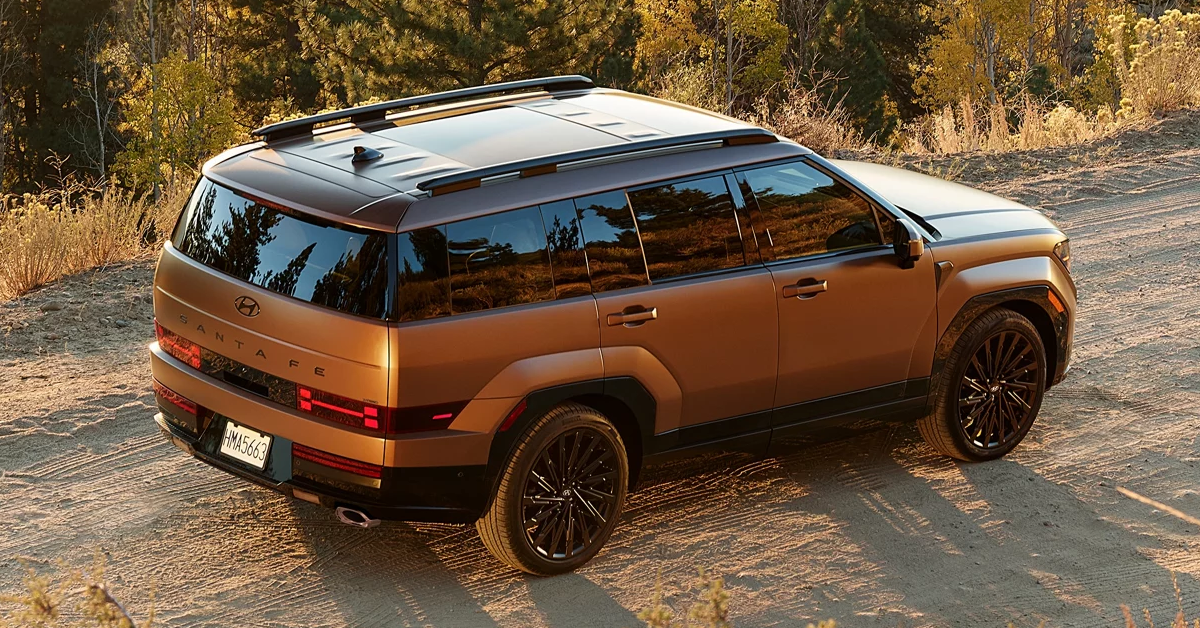
Official image of the Hyundai Santa Fe. | © Hyundai Motor Company
Hyundai Santa Fe. The midsize SUV unveiled in 2000, the fifth generation of 2024, its 277 hp turbo and 232 hp hybrid, 2027 prices, sales and crash ratings.
The Santa Fe is Hyundai’s midsize SUV and, according to Hyundai’s own history release, its first SUV (Hyundai). Hyundai says it unveiled the first generation in 2000, showed it to European audiences at the 2000 Geneva Motor Show and sold it in dealerships from 2001 (Hyundai). It is now in its fifth generation, which Hyundai revealed in 2023 for the 2024 model year, so the nameplate is 26 years old in 2026, since 2026 minus 2000 is 26 (Hyundai, our calculation).
| Unveiled, per Hyundai | 2000 (Hyundai) |
| First dealers, per Hyundai | 2001 (Hyundai) |
| Fifth generation model year | 2024 (reported) |
| Length, fifth generation | 4,830 mm (Hyundai) |
| Width | 1,900 mm (Hyundai) |
| Wheelbase | 2,815 mm (Hyundai) |
| Cargo space | 1,148 liters (Hyundai) |
| North American engines | 2.5T 277 hp, hybrid 232 hp (reported) |
| 2027 SE price | 35,300 dollars (Hyundai) |
| Global sales in first 20 years | More than 5,260,000 (Hyundai) |
We read Hyundai’s own pages first. They were the Hyundai worldwide newsroom release of May 19, 2020 on two decades of the Santa Fe, the Hyundai Australia release on the fifth generation, the Hyundai worldwide awards page, the Hyundai worldwide newsroom release on IIHS awards and the Hyundai USA price pages. Reports supply U.S. prices for 2026, sales tables and the Institute ratings, and carry the reported tag. Prices and availability may have changed since publication, and exchange rates are not applied.
The current car is large and boxy. Hyundai Australia gives the fifth generation as 4,830 mm long, 1,900 mm wide and 1,720 mm high on a 2,815 mm wheelbase, with 1,148 liters of cargo space and a tailgate opening 1,275 mm wide (Hyundai). In North America it comes with a 2.5-liter turbo of 277 horsepower or a 1.6-liter turbo hybrid of 232 horsepower, according to reports (reported). Our Hyundai Tucson article covers the smaller SUV below it.
Hyundai USA lists 2027 prices of 35,300 dollars for the SE, 37,840 dollars for the SEL, 42,290 dollars for the XRT, 44,850 dollars for the Limited and 47,850 dollars for the Calligraphy (Hyundai). The spread from SE to Calligraphy is 12,550 dollars, which is 35.6 percent, since 47,850 minus 35,300 is 12,550 (Hyundai, our calculation). Hyundai USA’s hybrid page lists 2026 hybrid prices including destination from 36,400 dollars (Hyundai).
Sales make the car important. A sales table shows 142,404 U.S. Santa Fes in 2025, about 15.8 percent of Hyundai’s 901,686 U.S. total, since 142,404 divided by 901,686 is 0.158 (reported, our calculation). Hyundai says it sold more than 5,260,000 Santa Fes globally in the first 20 years (Hyundai). That averages 263,000 a year, since 5,260,000 divided by 20 is 263,000 (Hyundai, our calculation).
This guide covers the first four generations, the fifth-generation size and powertrains, 2026 and 2027 U.S. prices, sales, crash ratings and the items we could not confirm. Our Hyundai Models article lists the whole range, our Hyundai history article covers the company and our Hyundai Sonata article covers the sedan that shares Hyundai’s U.S. showrooms. We found no Hyundai page listing U.S. fuel economy for the 2027 car, so those figures are reported. Hyundai Australia’s 2,815 mm wheelbase is 58.3 percent of the 4,830 mm length, since 2,815 divided by 4,830 is 0.583 (Hyundai, our calculation). Dealers received the car from 2001, so it has been in showrooms for 25 years in 2026, since 2026 minus 2001 is 25 (Hyundai, our calculation). Hyundai Canada says the Santa Fe is its longest-running SUV in Canada (Hyundai).
Hyundai’s own release on two decades of the Santa Fe says the first generation, built from 2000 to 2006, was Hyundai’s first SUV and seated five (Hyundai). Hyundai says it introduced the car in 2000, showed it at the 2000 Geneva Motor Show and put it in dealerships from 2001 (Hyundai). Hyundai ramped up production in 2001 because of strong demand in the United States (Hyundai). Hyundai Canada says the Santa Fe has been sold there since October 2000 (Hyundai).
| First generation | 2000 to 2006 (Hyundai) |
| First shown in Europe | 2000 Geneva Motor Show (Hyundai) |
| First in dealerships | 2001 (Hyundai) |
| Canada dealers | October 2000 (Hyundai) |
| 2003 update | More power, computer-controlled four-wheel drive (Hyundai) |
| Second generation launch | January 2006, Detroit show (Hyundai) |
| Second generation engines | 2.2 diesel, 2.7 V6 (Hyundai) |
| Second generation seats | 5 to 7 (Hyundai) |
| Model code, first generation | SM (reported) |
| Years per generation | 6 each (Hyundai, our calculation) |
A 2003 update added a more powerful engine and a computer-controlled four-wheel-drive system, according to Hyundai (Hyundai). The release gives no engine sizes, power figures, prices or sales for the first generation, so we do not state any (Hyundai). Reference listings give the first generation the model code SM and say production began in June 2000 (reported). They also list regional names, the Hawtai Shengdafei in China and the Santa Fe Classic in Russia (reported).
The second generation arrived in 2006. Hyundai says it was launched at the North American International Auto Show in January 2006 with a new 2.2-liter diesel engine and an updated 2.7-liter gasoline V6 (Hyundai). It introduced an optional third row, which expanded the car from five to seven seats (Hyundai). From the 2000 introduction to the 2006 launch is 6 years, since 2006 minus 2000 is 6, and the second generation ran to 2012, which is another 6 years (Hyundai, our calculation).
Safety equipment was part of the pitch. Hyundai says Electronic Stability Control, ABS and side curtain airbags covering all rows of seats were standard on the second generation (Hyundai). That matters for the third row, because the curtain airbags reached the extra seats the car had gained. The release does not list crash-test results for either of the first two generations, so we have no rating to report for them (Hyundai).
The model-year labels differ from Hyundai’s generation dates. Hyundai gives the second generation as 2006 to 2012, while a reference listing gives the model years as 2007 to 2012 (Hyundai, reported). A report also gives the first generation a production start of June 2000, while Hyundai says dealers received the car from 2001 (Hyundai, reported). Both can be true, because a production start can come months before dealer sales. Hyundai’s first two generations together span 12 years, since 2012 minus 2000 is 12, and the car was on sale in showrooms for about 5 years of the first generation, since 2006 minus 2001 is 5 (Hyundai, our calculation). The release describes the first generation in only a few lines, so details beyond those above are not confirmed (Hyundai).
A long-wheelbase Santa Fe came later. A reference listing says it was sold as the Santa Fe XL in Canada and the United States and as the Maxcruz in South Korea, with the Maxcruz name listed for 2013 to 2019 (reported). The Maxcruz dates of 2013 to 2019 overlap the third generation of 2012 to 2018 (Hyundai, reported). Hyundai Australia also calls the Santa Fe Hyundai’s first SUV, which matches the worldwide release (Hyundai).
Hyundai says the third generation of 2012 to 2018 used the Storm Edge design language and came as a five-seater or as a long-wheelbase version with six or seven seats (Hyundai). It offered an optional eight-inch touchscreen (Hyundai). The generation ran for 6 years, since 2018 minus 2012 is 6 (Hyundai, our calculation). Hyundai’s release gives no engine, power or price figures for it, so we do not give any (Hyundai).
| Third generation | 2012 to 2018, Storm Edge (Hyundai) |
| Third generation seating | 5, 6 or 7 (Hyundai) |
| Third generation optional screen | 8 inches (Hyundai) |
| Fourth generation introduced | 2018 (Hyundai) |
| Fourth generation design | Cascading Grille (Hyundai) |
| Second-row legroom gain | 38 mm (Hyundai) |
| Euro NCAP, fourth generation | 5 stars (Hyundai) |
| Four-wheel drive | HTRAC (Hyundai) |
| Canada sales peak | 33,246 in 2015 (reported) |
| Canada sales, 2026 January to September | 7,204 (reported) |
The fourth generation arrived in 2018 with Hyundai’s Cascading Grille, Hyundai says (Hyundai). Second-row legroom grew by 38 mm, and the car earned a five-star rating from Euro NCAP (Hyundai). Hyundai lists Rear Occupant Alert, the first full head-up display in a Hyundai and the HTRAC four-wheel-drive system among its features (Hyundai). Hyundai’s awards page also lists a five-star Euro NCAP result for the large off-road class in 2019 (Hyundai).
Hyundai’s worldwide release counts more than 5,260,000 Santa Fe sales around the world in the first 20 years (Hyundai). That is an average of 263,000 a year, since 5,260,000 divided by 20 is 263,000 (Hyundai, our calculation). The release does not split the total by generation or by country (Hyundai). The 20 years run from the 2000 introduction, so the first year of that count came before dealers had the car (Hyundai).
The Santa Fe is a long-running line in several markets. Hyundai Canada says it is Hyundai’s longest-running SUV in Canada, and Hyundai Australia calls it Hyundai’s first SUV (Hyundai). Canadian sales have fallen a long way, according to a sales table, from a peak of 33,246 units in 2015 to 7,204 in the first nine months of 2026 (reported). The nine-month figure is 21.7 percent of the 2015 peak, since 7,204 divided by 33,246 is 0.217 (reported, our calculation).
The Canadian peak is 26,042 units above the 2026 nine-month total, since 33,246 minus 7,204 is 26,042 (reported, our calculation). The comparison is not like for like, because one figure is a full year and the other covers nine months, so the full-year gap may be smaller or larger (reported). Hyundai says second-row legroom grew 38 mm in 2018, and Hyundai Canada lists gains of 36 mm for the 2.5T and 20 mm for the hybrid in 2023, so each of the last two generations added rear space (Hyundai). We found no Hyundai page that gives annual Canadian sales, so we do not use a Hyundai tag on these figures. The 2026 nine-month total averages about 800 a month, since 7,204 divided by 9 is 800, while the 2015 peak averaged about 2,771 a month, since 33,246 divided by 12 is 2,771 (reported, our calculation). Together the third and fourth generations cover 11 years from 2012 to 2023, since 2023 minus 2012 is 11 (Hyundai, reported, our calculation).
The fourth generation lasted from 2018 to the fifth-generation reveal in 2023, which is 5 years, since 2023 minus 2018 is 5 (Hyundai, reported, our calculation). Reports say Hyundai revealed the fifth generation in Korea and gave it a North American debut at AutoMobility LA in November 2023 (reported). Hyundai Canada’s reveal page says the same Los Angeles show was the venue (Hyundai). Hyundai Australia lists Korea for the second half of 2023 (Hyundai).
Hyundai Australia gives the fifth generation as 4,830 mm long, 1,900 mm wide and 1,720 mm high, or 1,770 mm with roof rails, on a 2,815 mm wheelbase (Hyundai). The Calligraphy is 1,730 mm high, or 1,780 mm with rails (Hyundai). The wheelbase is 58.3 percent of the length, since 2,815 divided by 4,830 is 0.583, and the roof rails add 50 mm on either body (Hyundai, our calculation). Tire sizes are 235/60R18, 255/45R20 and 245/45R21 (Hyundai). The Calligraphy is 10 mm taller than the other trims, since 1,730 minus 1,720 is 10 (Hyundai, our calculation).
| Length | 4,830 mm (Hyundai) |
| Width | 1,900 mm (Hyundai) |
| Height, roof | 1,720 mm (Hyundai) |
| Wheelbase | 2,815 mm (Hyundai) |
| Cargo space | 1,148 liters, +120 (Hyundai) |
| Tailgate opening width | 1,275 mm, +145 (Hyundai) |
| Third-row headroom | 958 mm, +69 (Hyundai) |
| Third-row legroom | 761 mm, +15 (Hyundai) |
| Front legroom | 1,052 mm (Hyundai) |
| Second-row legroom | 1,075 mm petrol, 1,055 mm hybrid (Hyundai) |
Cargo and access were the headline gains. Hyundai gives 1,148 liters of cargo space, 120 liters more than the previous model, and a tailgate opening 1,275 mm wide, 145 mm wider (Hyundai). The previous figures were therefore 1,028 liters and 1,130 mm, since 1,148 minus 120 and 1,275 minus 145 give those values (Hyundai, our calculation). The extra opening width is 12.8 percent, since 145 divided by 1,130 is 0.128 (Hyundai, our calculation). The extra cargo volume is 11.7 percent, since 120 divided by 1,028 is 0.117 (Hyundai, our calculation).
Third-row space grew. Hyundai gives third-row headroom of 958 mm, which is 69 mm more and the best in its class, and third-row legroom of 761 mm, which is 15 mm more (Hyundai). The third row reclines 10 degrees and the seating height is 282 mm, 30 mm higher (Hyundai). The previous third-row headroom was therefore 889 mm and legroom 746 mm, since 958 minus 69 and 761 minus 15 give those values (Hyundai, our calculation). The previous seating height was 252 mm, since 282 minus 30 is 252 (Hyundai, our calculation). Third-row headroom is 87 mm below the front, since 1,045 minus 958 is 87 (Hyundai, our calculation).
Front and second-row space is also listed. Front headroom is 1,045 mm, or 1,020 mm with a sunroof, second-row headroom is 1,030 mm, or 1,007 mm with a sunroof, front legroom is 1,052 mm and second-row legroom is 1,075 mm on petrol cars and 1,055 mm on hybrids (Hyundai). A sunroof costs 25 mm of front headroom and 23 mm of second-row headroom, since 1,045 minus 1,020 and 1,030 minus 1,007 give those values (Hyundai, our calculation).
Shoulder room is 1,511 mm in front, 1,475 mm in the second row and 1,360 mm in the third (Hyundai). The third row is 151 mm narrower than the front, since 1,511 minus 1,360 is 151, and its legroom is 314 mm shorter than the petrol second row, since 1,075 minus 761 is 314 (Hyundai, our calculation). Petrol second-row legroom is 20 mm more than the hybrid, since 1,075 minus 1,055 is 20 (Hyundai, our calculation).
Hyundai Australia lists a six-seat version with power-reclining independent second-row seats and power fold-and-dive seats with cushion-angle adjustment, which it calls a world first (Hyundai). It lists a 12.3-inch digital cluster and infotainment screen in a Panoramic Curved Display, a 6.6-inch climate display, a Bilateral Multi-Console storage space, a UV-C sterilization tray, dual wireless phone charging and USB-C ports up to 27 watts (Hyundai). Over-the-air software updates are listed too (Hyundai). Hyundai Australia lists on-sale timing as the first half of 2024 for Australia, North America and Europe, and the second half of 2023 for Korea (Hyundai).
Hyundai Australia lists four powertrains. The 2.5 GDI makes 194 PS and 25.1 kgf-m, or 246 Nm, with an eight-speed automatic, the 2.5T GDI makes 281 PS and 43.0 kgf-m, or 422 Nm, with an eight-speed dual-clutch, the 1.6T hybrid makes 180 PS and 27.0 kgf-m, or 265 Nm, with a six-speed automatic and the 1.6T plug-in hybrid makes 160 PS and 27.0 kgf-m (Hyundai). Korea and North America get the 2.5T and the hybrid, Europe gets the hybrid and plug-in, and other regions get the 2.5 GDI (Hyundai).
| 2.5 GDI, Hyundai Australia | 194 PS, 25.1 kgf-m (Hyundai) |
| 2.5T GDI, Hyundai Australia | 281 PS, 43.0 kgf-m (Hyundai) |
| 1.6T hybrid, Hyundai Australia | 180 PS, 27.0 kgf-m (Hyundai) |
| 1.6T plug-in, Hyundai Australia | 160 PS, 27.0 kgf-m (Hyundai) |
| 2.5T, North America | 277 hp, 311 lb-ft (reported) |
| Hybrid, North America | 232 hp, 271 lb-ft (reported) |
| 2.5T 0 to 100 km/h | 8.0 seconds (Hyundai) |
| Hybrid 0 to 100 km/h | 9.5 seconds (Hyundai) |
| 2.5T weight | 2,155 kg (Hyundai) |
| 2026 combined mpg, gas and hybrid | 22 to 24 and 34 to 36 (reported) |
The 2.5T makes 87 PS more than the 2.5 GDI, since 281 minus 194 is 87, which is 44.8 percent, and 176 Nm more, since 422 minus 246 is 176, which is 71.5 percent (Hyundai, our calculation). We do not convert PS to horsepower. The plug-in hybrid lists 160 PS for its engine, which is 20 PS below the hybrid’s 180 PS, since 180 minus 160 is 20 (Hyundai, our calculation).
Reports give North American outputs. The 2.5-liter turbo makes 277 horsepower and 311 lb-ft, and the hybrid makes a combined 232 horsepower and 271 lb-ft with a six-speed automatic (reported). Some early reports gave the hybrid engine alone as 177 horsepower and 195 lb-ft (reported). The electric motor then adds 55 horsepower, since 232 minus 177 is 55, and 76 lb-ft, since 271 minus 195 is 76 (reported, our calculation).
The turbo is 45 horsepower above the hybrid, since 277 minus 232 is 45, which is 16.2 percent of 277, and 40 lb-ft above it, since 311 minus 271 is 40 (reported, our calculation). A report says the turbo is down 4 horsepower from the previous 281, and another says the base 191 horsepower four-cylinder was dropped (reported). A listing gives the hybrid 231 horsepower and a curb weight of 4,431 to 4,575 pounds (reported).
Hyundai Australia lists weights and acceleration. The 2.5 GDI weighs 2,060 kg and takes 11.5 seconds from 0 to 100 km/h, the 2.5T weighs 2,155 kg and takes 8.0 seconds, the hybrid weighs 2,225 kg and takes 9.5 seconds, and the plug-in weighs 2,295 kg and takes 9.1 seconds (Hyundai). Top speeds are 198, 210, 190 and 190 km/h (Hyundai). The turbo is 3.5 seconds quicker than the 2.5 GDI, since 11.5 minus 8.0 is 3.5, and 12 km/h faster, since 210 minus 198 is 12 (Hyundai, our calculation). The plug-in is 0.4 seconds quicker than the hybrid, since 9.5 minus 9.1 is 0.4, though both top out at 190 km/h (Hyundai, our calculation).
The hybrid is 70 kg heavier than the turbo, since 2,225 minus 2,155 is 70, and the plug-in is 235 kg heavier than the 2.5 GDI, since 2,295 minus 2,060 is 235 (Hyundai, our calculation). Fuel economy is reported. A listing gives the 2026 gas Santa Fe 22 to 24 mpg combined and the hybrid 34 to 36, so the hybrid is 12 mpg better at the extremes, since 36 minus 24 is 12 (reported, our calculation). A review says the hybrid costs 1,100 to 1,350 dollars more than the gas car (reported).
Hyundai USA lists 2027 gas prices of 35,300 dollars for the SE, 37,840 dollars for the SEL, 42,290 dollars for the XRT, 44,850 dollars for the Limited and 47,850 dollars for the Calligraphy, including destination (Hyundai). The steps are 2,540 dollars from SE to SEL, 4,450 to XRT, 2,560 to Limited and 3,000 to Calligraphy, and they add to 12,550 dollars, which is 35.6 percent, since 47,850 minus 35,300 is 12,550 (Hyundai, our calculation).
| 2027 SE price | 35,300 dollars (Hyundai) |
| 2027 SEL price | 37,840 dollars (Hyundai) |
| 2027 XRT price | 42,290 dollars (Hyundai) |
| 2027 Limited price | 44,850 dollars (Hyundai) |
| 2027 Calligraphy price | 47,850 dollars (Hyundai) |
| SE to Calligraphy gap | 12,550 dollars (Hyundai, our calculation) |
| 2026 SE, one report | 35,050 or 36,400 dollars (reported) |
| 2026 starting price, another report | 36,650 dollars (reported) |
| 2026 hybrid SE | 36,400 dollars (Hyundai) |
| 2026 hybrid Calligraphy | 48,700 dollars (Hyundai) |
A 2026 price list in a report gives 36,400 dollars for the SE, 38,940 for the SEL, 43,390 for the XRT, 45,950 for the Limited and 48,950 for the Calligraphy (reported). Each is 1,100 dollars above the matching 2027 figure on Hyundai USA’s page, since 36,400 minus 35,300 and 48,950 minus 47,850 are both 1,100 (Hyundai, reported, our calculation). We could not confirm that the lists use the same basis, so the gap is not proof of a price cut. The 2027 XRT at 42,290 dollars is 4,450 above the 2027 SEL, and the 2026 list shows the same 4,450 gap, since 43,390 minus 38,940 is 4,450 (Hyundai, reported, our calculation).
Other 2026 lists conflict. One lists SE front-wheel drive at 35,050 dollars, SE all-wheel drive at 36,850, SEL at 37,590 and 39,390, XRT all-wheel drive at 42,040, Limited six-seat at 44,600 and 46,400, and Calligraphy at 47,600 and 49,400 (reported). Another says pricing starts at 36,650 dollars, which is 35,050 plus a 1,600 dollar destination charge, and that the Calligraphy starts at 49,200 (reported, our calculation).
All-wheel drive adds 1,800 dollars on each trim in the first list, since 36,850 minus 35,050, 39,390 minus 37,590 and 46,400 minus 44,600 are each 1,800 (reported, our calculation). The 2026 Calligraphy all-wheel drive is 14,350 dollars above the SE front-wheel drive, which is 40.9 percent, since 49,400 minus 35,050 is 14,350 (reported, our calculation). The list shows the XRT only with all-wheel drive, 2,650 dollars above the SEL all-wheel drive, since 42,040 minus 39,390 is 2,650 (reported, our calculation).
Hyundai USA lists 2026 hybrid prices including destination of 36,400 dollars for the SE, 38,690 for the SEL, 45,700 for the Limited and 48,700 for the Calligraphy (Hyundai). The Calligraphy hybrid costs 12,300 dollars more than the SE hybrid, since 48,700 minus 36,400 is 12,300, which is 33.8 percent (Hyundai, our calculation). The Limited costs 7,010 dollars more than the SEL, since 45,700 minus 38,690 is 7,010 (Hyundai, our calculation). The SEL hybrid is 2,290 dollars above the SE, since 38,690 minus 36,400 is 2,290, and the Calligraphy is 3,000 above the Limited, since 48,700 minus 45,700 is 3,000 (Hyundai, our calculation).
A listing gives the hybrid Calligraphy at 48,700 front-wheel drive and 50,500 all-wheel drive, which is 1,800 dollars more (reported, our calculation). Reports say the 2026 changes were a new transmission for the gas-only powertrain, extra standard safety equipment and new Terrain Modes for the XRT (reported). The same 36,400 dollar figure appears as a gas SE price in one report and as a hybrid SE price on Hyundai USA’s page, so check trim and year. Prices and availability may have changed since publication, and exchange rates are not applied.
A Hyundai Motor America sales table reprinted by third parties shows 142,404 Santa Fes in 2025 against 119,010 in 2024, up 23,394 or 19.7 percent (reported, our calculation). The fourth quarter was 40,244 against 35,329, up 4,915 or 13.9 percent, and December was 14,440 against 13,309, up 1,131 or 8.5 percent (reported, our calculation). A separate database gives 113,343 for 2024 and 131,574 for 2023, so the 2024 figure conflicts (reported).
| 2025 U.S. sales | 142,404 (reported) |
| 2024 U.S. sales | 119,010 or 113,343 (reported) |
| 2025 change, per table | Up 19.7 percent (reported, our calculation) |
| 2023 U.S. sales | 131,574 (reported) |
| 2026 January to September | 103,115 (reported) |
| Hybrid, first half 2025 | 13,601 (reported) |
| Share of Hyundai Motor America 2025 | 15.8 percent (reported, our calculation) |
| 2025 Institute award, per Hyundai | Top Safety Pick Plus (Hyundai) |
| 2026 Institute award | Top Safety Pick Plus (reported) |
| Fourth generation Euro NCAP | 5 stars (Hyundai) |
On that database’s numbers, 2025 was up 29,061 units, or 25.6 percent, since 142,404 minus 113,343 is 29,061 (reported, our calculation). It also says 2024 fell 18,231 units from 2023, which is 13.9 percent, since 131,574 minus 113,343 is 18,231 (reported, our calculation). The fourth quarter of 2025 was 28.3 percent of the year, since 40,244 divided by 142,404 is 0.283, and December was 35.9 percent of that quarter (reported, our calculation).
The database lists 103,115 U.S. sales for January to September 2026, up 0.9 percent for the period (reported). The first nine months of 2025 were 102,160, since 142,404 minus 40,244 is 102,160, and 103,115 is 955 above that, which is 0.9 percent (reported, our calculation). The 2026 average is about 11,457 a month, since 103,115 divided by 9 is 11,457, against about 11,867 in 2025, since 142,404 divided by 12 is 11,867 (reported, our calculation).
Hybrids grew faster. A first-half 2025 table shows 13,601 Santa Fe Hybrid sales, up 56 percent, which implies about 8,718 a year earlier, since 13,601 divided by 1.56 is 8,718 (reported, our calculation). Hyundai Motor America sold 901,686 vehicles in the U.S. in 2025, so the Santa Fe was about 15.8 percent of the total, since 142,404 divided by 901,686 is 0.158 (reported, our calculation).
Crash ratings are mostly independent. Hyundai’s awards page lists an IIHS Top Safety Pick Plus award for 2025 and a five-star overall rating from the U.S. government for 2024 among its Santa Fe honors (Hyundai). The Institute lists the 2025 to 2026 Santa Fe and the 2026 to 2027 Santa Fe as Top Safety Pick Plus winners (reported). Hyundai’s newsroom of October 31, 2025 counts the Santa Fe among eight 2025 Top Safety Pick Plus awards (Hyundai).
The Institute says the small overlap front rating for the 2024 to 2026 Santa Fe is Good, with the driver-side and passenger-side ratings based on a test of a 2024 SE conducted by Hyundai and Kia (reported). Its moderate overlap rating applies to 2025 to 2027 models built after November 2024 (reported). The fourth generation received five Euro NCAP stars, according to Hyundai (Hyundai). We found no Euro NCAP result for the fifth generation, so ratings may change with trim and build date. Hyundai’s awards page also lists a 2025 Women’s Worldwide Car of the Year supreme winner award, a 2024 SUV of the Year award in the U.K. and a hybrid seven-seater award in the U.K. for 2025 (Hyundai). Hyundai’s March 24, 2026 release, reprinted on a third-party site, says the Santa Fe is among six Hyundai models with a 2026 Top Safety Pick Plus (reported). Hyundai Australia lists Forward Collision-Avoidance Assist 2, Lane Following Assist 2, Highway Driving Assist 2, a Surround View Monitor, Remote Smart Parking Assist, Safe Exit Assist and a radar-based Rear Occupant Alert, and calls its Driver Monitoring System Hyundai’s first in North America (Hyundai).
Several figures conflict. Hyundai Australia lists the hybrid at 180 PS, reports give 232 or 231 horsepower combined and 177 horsepower for the engine alone, and the turbo is 281 PS in Hyundai’s list and 277 horsepower in reports (Hyundai, reported). We do not convert PS to horsepower. The 2024 U.S. sales figure is 119,010 or 113,343, and the 2026 SE price is 35,050 or 36,400 dollars depending on source (reported).
| Hybrid power | 180 PS, 232 hp or 231 hp (Hyundai, reported) |
| Turbo power | 281 PS or 277 hp (Hyundai, reported) |
| 2024 U.S. sales | 119,010 or 113,343 (reported) |
| 2026 SE price | 35,050 or 36,400 dollars (reported) |
| Second generation years | 2006 to 2012 or 2007 to 2012 (Hyundai, reported) |
| First generation start | 2000 or 2001 (Hyundai, reported) |
| 2027 model year | Carryover, minor changes (reported) |
| 2027 fuel economy | No Hyundai page found (Hyundai) |
| 2027 hybrid prices | Not found (Hyundai) |
| Fifth generation Euro NCAP | Not found (Hyundai) |
Dates conflict as well. Hyundai gives the second generation as 2006 to 2012, while a reference listing gives model years 2007 to 2012, and Hyundai calls the first generation 2000 to 2006 while reports give a June 2000 start of production (Hyundai, reported). Hyundai Australia lists North America for the first half of 2024, and reports give March 2024 for the turbo and spring for the hybrid (Hyundai, reported).
The model year 2027 brings minor changes. A reprinted Hyundai Motor America release of November 11, 2026 lists the 2027 Santa Fe, gas and hybrid, as a carryover model with minor changes (reported). Reports describe a facelift, and one says the gas car gets a new torque-converter automatic in place of the dual-clutch, while another expects the powertrains to carry over (reported). We found no Hyundai page that confirms the facelift details.
Several items are not confirmed. We found no Hyundai page for U.S. fuel economy of the 2027 car, for fifth-generation towing capacity, for 2027 hybrid prices or for North American dimensions. We did not verify India, Middle East, Southeast Asian or European prices, although a report says Europe faces a price rise and fewer options for 2027 (reported). We also did not read Hyundai Canada’s reveal page in full, only its search summary. That summary lists second-row legroom gains of 36 mm for the 2.5T and 20 mm for the hybrid, which is a 16 mm difference, since 36 minus 20 is 16, and says Hyundai Motor Manufacturing Alabama allotted 190 million dollars for tooling to prepare production (Hyundai, our calculation). It also gives March 2024 for the 2.5T and spring for the hybrid (Hyundai).
Hyundai’s own pages we read give no Santa Fe sales figure after 2020, so every later sales figure is reported. The 5,260,000 global total covers the first 20 years to 2020, and the 2025 U.S. total of 142,404 equals 2.7 percent of it, which is a different period and not a share, since 142,404 divided by 5,260,000 is 0.027 (Hyundai, reported, our calculation). We do not know the present global total. Hyundai says its 2025 global retail sales were 4,108,605 units, up 2 percent, but that is for all models and not for the Santa Fe (Hyundai). A figure of 984,017 U.S. sales covers Hyundai plus Genesis, so we use the 901,686 figure for Hyundai alone (reported).
To check this guide, begin with Hyundai’s May 19, 2020 release, the Hyundai Australia fifth-generation release and Hyundai USA’s price page, then compare model years before comparing numbers. Our Hyundai Tucson article covers the smaller SUV and our Hyundai Models article shows where the Santa Fe sits in the range. Prices and availability may have changed since publication, and exchange rates are not applied.