 Brands
Jaguar Land Rover and Stellantis Just Agreed to Build Cars Together in America

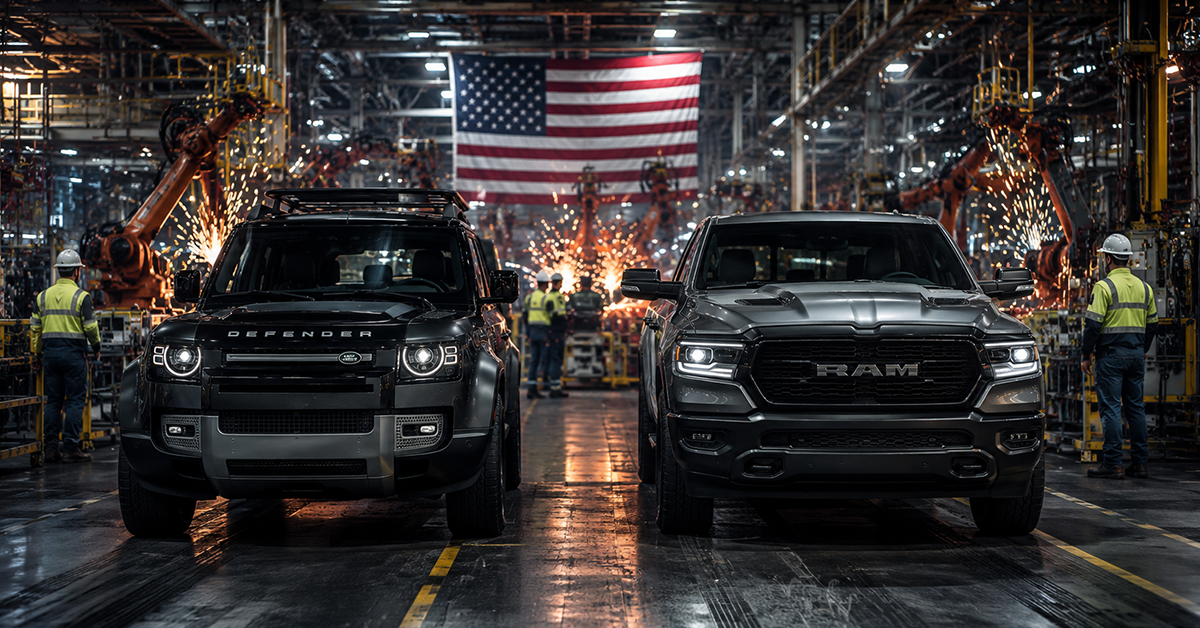
AI-generated concept illustration representing the JLR and Stellantis US partnership — not an official JLR or Stellantis image. | Rev N Rise
Two of the world's most recognisable automotive brands — Jaguar Land Rover and Stellantis — signed an agreement yesterday to explore building cars together in the United States. The announcement, made in Auburn Hills, Michigan on May 20, is one of the most unexpected automotive partnerships in years. A British luxury brand and an American-Italian conglomerate. Fourteen brands on one side. Range Rover on the other. The reason behind the deal is straightforward — and it tells you everything about the state of the global car industry right now.
On May 20, 2026, Stellantis and Jaguar Land Rover jointly announced the signing of a Memorandum of Understanding — an MOU — to explore opportunities to collaborate on product development in the United States. The announcement was made from Auburn Hills, Michigan — the location of Stellantis's North American headquarters and, by coincidence, the same city where Stellantis was hosting its Investor Day the following day.
An MOU is a non-binding agreement — it is a declaration of intent to explore collaboration rather than a confirmed deal. No specific models, no confirmed production volumes, no timeline for implementation has been announced. What has been confirmed is that the two companies have formally agreed to begin exploring how their respective strengths could be combined to create value in the US market. Given the context behind the announcement, the direction of that exploration is not difficult to predict.
Jaguar Land Rover builds almost all of its vehicles in the United Kingdom — at plants in Solihull, Castle Bromwich and Halewood. Every vehicle it ships to the United States therefore arrives as an import subject to US import tariffs. In April 2026, those tariff costs became so significant that JLR took the extraordinary step of pausing all US shipments — halting deliveries of Range Rover, Defender, Discovery and all Jaguar models to American dealers while it assessed how to respond.
The pause was temporary, but the underlying problem is not. JLR sells approximately 100,000 vehicles per year in the United States — one of its most important markets globally — and the premium pricing of its Range Rover and Defender models makes those vehicles particularly vulnerable to tariff-driven price increases that could erode demand. A $5,000-$10,000 tariff premium on a £80,000 Range Rover is painful but manageable. The same tariff on a £50,000 Defender puts it in direct price competition with fully domestic alternatives that carry no tariff burden at all.
The solution — building at least some JLR models in the United States — would eliminate that tariff exposure entirely. Any vehicle assembled in America is domestic for tariff purposes, regardless of where the brand originates. The challenge is that JLR has no US manufacturing capability. Stellantis has significant US manufacturing capability — and is actively looking for ways to utilise it more fully as its own sales volumes have declined.
Stellantis's US manufacturing situation is the mirror image of JLR's problem. The company has multiple large US assembly plants that have been operating below capacity — the consequence of declining sales across Dodge, Chrysler and Ram that left Stellantis with more factory space than it currently needs. Idle manufacturing capacity is expensive. Every hour a plant runs below full utilisation represents fixed costs — wages, utilities, tooling depreciation — that are not being recovered through vehicle sales.
Building JLR vehicles in a Stellantis US plant would address this directly. The plant gets utilised. The workers stay employed. The fixed costs get covered. And Stellantis earns a manufacturing margin on each JLR vehicle produced — adding revenue without requiring significant new product development investment of its own. For a company that has spent two years restructuring its cost base and is under intense pressure to return to profitability, contract manufacturing for a premium brand is exactly the kind of value-creating activity that makes financial sense.
No specific models have been confirmed — and the MOU explicitly describes this as an exploratory process. But the commercial logic points clearly toward certain candidates. The Land Rover Defender is the most obvious choice. It is JLR's highest-volume model globally, its biggest US seller and the product most directly affected by import tariffs given its price point relative to domestic American SUV alternatives. A US-built Defender would be cost-competitive in a way that an imported Defender increasingly is not.
The Range Rover Sport and the standard Range Rover are also plausible candidates for US production — particularly the Sport, which sells in volumes that would justify the tooling investment. The Jaguar brand's future is more uncertain — Jaguar is in the middle of a complete brand reinvention with all-electric models — and a US Jaguar production line seems less likely in the near term than a Land Rover one.
For Stellantis, the most logical production location would be one of its Michigan or Ohio plants — geographically close to both suppliers and the Auburn Hills headquarters. The Sterling Heights Assembly Plant in Michigan — currently focused on Ram 1500 production — and the Belvidere Assembly Plant in Illinois — which Stellantis has been working to reopen after a period of idling — have both been mentioned in industry analysis as plausible candidates for JLR contract production.
| Announcement Date | May 20, 2026 — Auburn Hills, Michigan |
| Agreement Type | MOU — Memorandum of Understanding — non-binding |
| Parties | Stellantis N.V. + Jaguar Land Rover (JLR) |
| Purpose | Explore product + technology co-development in the US |
| JLR CEO | PB Balaji |
| Stellantis CEO | Antonio Filosa |
| JLR US Issue | Paused US shipments in April 2026 — import tariffs |
| JLR US Sales/yr | ~100,000 vehicles — major market |
| JLR Plants (UK) | Solihull, Castle Bromwich, Halewood — all UK |
| Stellantis US Plants | Multiple — some operating below capacity |
| Stellantis Brands | 14 — incl. Jeep, Ram, Dodge, Chrysler, Fiat, Alfa Romeo |
| Most Likely JLR Model | Land Rover Defender — highest volume, most tariff-affected |
| Confirmed Models | None — MOU only |
| Timeline | Not confirmed — exploratory stage |
| Binding? | No — non-binding MOU |
For Land Rover buyers in the United States, a US-assembled Defender or Range Rover Sport would have two practical implications. First, it would likely mean lower or more stable pricing — without import tariff exposure, JLR would have more flexibility to hold prices steady rather than passing tariff costs to customers. Second, it might mean shorter delivery wait times — domestic production typically has faster logistics chains than transatlantic shipping from UK factories.
The character of the vehicles would not change. Land Rover's engineering, design and development would remain entirely British — the production location is a manufacturing decision, not a brand identity decision. A Defender built in Michigan to the same specifications as one built in Solihull is the same Defender. For most buyers, the production postcode is irrelevant. What matters is the price and the availability — and on both counts, US production would be a positive development.
The JLR-Stellantis MOU is one deal — but it is part of a much larger pattern of automotive industry restructuring that is happening simultaneously across multiple manufacturers. Toyota is building a new $2 billion plant in Texas. Honda is retreating from EVs and doubling its US manufacturing. Ford is expanding US production. The common thread is the same cost reality that drove JLR to pause its US shipments: manufacturing in the country where you sell is becoming an economic necessity rather than a preference.
For JLR specifically, the partnership with Stellantis offers something that a standalone US plant investment would not: speed. Building a new JLR factory in the United States from scratch would take five to seven years and cost billions. Using existing Stellantis capacity — already built, already tooled, already staffed — could get a US-assembled Land Rover into American showrooms within two to three years of a confirmed agreement. In the context of tariff pressures that are affecting JLR's US business today, that speed advantage is worth a great deal.
"Working with Stellantis allows us to explore complementary capabilities in product and technology development that support our long-term growth plans for the US market."
— PB Balaji, CEO, Jaguar Land Rover — Official Statement, May 20 2026The JLR-Stellantis MOU is not a done deal. It is the beginning of a conversation — a formal agreement to explore whether two very different companies can find enough common ground to build vehicles together in America. But the commercial logic on both sides is compelling. JLR needs US manufacturing to avoid tariffs. Stellantis needs production volume to fill its factories. A Land Rover Defender built in Michigan, at competitive pricing, without import tariff exposure, is a product that would be stronger in the US market than one shipped from Solihull. Whether that product ever exists depends on the negotiations that follow this MOU. But the fact that both sides have signed says they both believe it might.