 Brands
Koenigsegg — History, Models and Everything You Need to Know
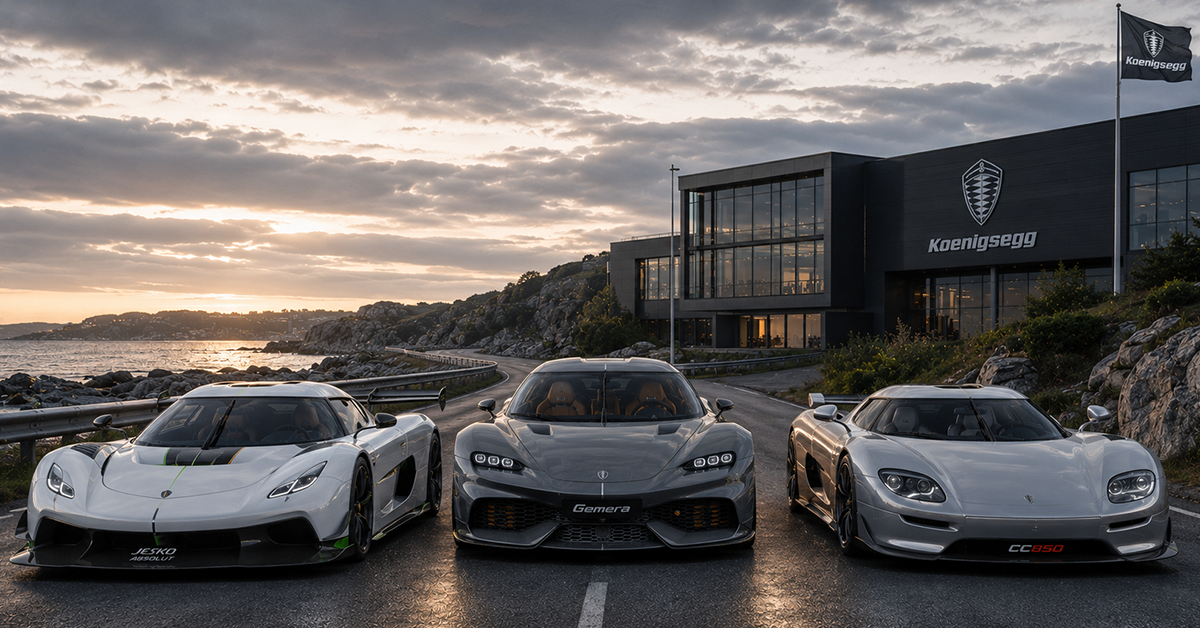
AI-generated concept illustration — Koenigsegg brand overview. | Rev N Rise
Koenigsegg is the Swedish engineering phenomenon that builds some of the most radically innovative hypercars in the world — a company founded by a 22-year-old with no automotive industry background who decided he could engineer better solutions than the established manufacturers. From camless engine technology to a transmission system with no conventional gearbox, Koenigsegg's willingness to challenge fundamental automotive engineering assumptions has made it one of the most genuinely original car companies on earth.
Christian von Koenigsegg founded his company in 1994 at the age of just 22, in Angelholm, southern Sweden — a town with no automotive manufacturing heritage whatsoever. According to Koenigsegg's own account, the idea was partly inspired by a Swedish animated film he watched as a child about a car that could transform itself into anything required. He set out with the explicit goal of building the perfect supercar — uncompromised by the inherited conventions and legacy engineering decisions that constrain established manufacturers who must maintain compatibility with existing platforms and supply chains.
Koenigsegg spent nearly a decade in development before producing its first car — the CC8S — in 2002. The lack of haste reflected Koenigsegg's engineering philosophy: rather than adapting existing components and technologies, the company chose to design and manufacture the overwhelming majority of its components from scratch, in-house. This approach is extraordinarily resource-intensive for a company of Koenigsegg's tiny size, but it has enabled engineering solutions that no other manufacturer has matched.
Through subsequent models — the CCX, Agera, Regera, Jesko and Gemera — Koenigsegg has consistently introduced genuinely novel engineering solutions rather than simply iterating on conventional hypercar formulas. The company remains privately held by the Koenigsegg family and produces fewer than 30 cars per year, making it one of the smallest serious car manufacturers in the world by volume while consistently competing for the title of world's fastest production car.
Koenigsegg's most distinctive engineering achievements are technologies that no other manufacturer has successfully commercialised. Freevalve — developed through Koenigsegg's subsidiary of the same name — is a camless engine valve actuation system that uses pneumatic and hydraulic actuators to control each valve independently, eliminating the conventional camshaft entirely. This allows infinitely variable valve timing and lift, optimising engine performance, efficiency and emissions far beyond what conventional camshaft-based engines can achieve. The technology has taken Koenigsegg over a decade and significant resources to perfect, and the company has begun licensing it to other manufacturers.
The Direct Drive transmission, introduced on the Regera in 2015, eliminates a conventional multi-speed gearbox entirely. Instead, the combustion engine connects to the rear wheels through a single fixed gear ratio combined with hydraulic clutches and electric motor assistance at lower speeds — meaning the Regera has no gearbox in the traditional sense. This radically simplified drivetrain reduces weight, eliminates shift time and creates a completely seamless, uninterrupted power delivery from standstill to top speed — something no conventional transmission, however fast-shifting, can fully replicate.
Koenigsegg's competitive position is built entirely on fundamental engineering originality — while Bugatti, Pagani and most other hypercar manufacturers refine and extend conventional automotive engineering to its limits, Koenigsegg regularly questions whether the conventional approach is correct at all. The Freevalve camless engine technology and Direct Drive transmission are not marketing gimmicks — they represent genuine first-principles re-engineering of automotive fundamentals that other manufacturers have not attempted because the resource investment required is enormous relative to the production volumes involved. Christian von Koenigsegg's personal involvement in every engineering decision, even after three decades of running the company, gives Koenigsegg a coherence of vision that larger, more bureaucratic hypercar operations often lack. For buyers who want the most genuinely innovative engineering in the hypercar world rather than simply the most powerful or most expensive, Koenigsegg remains the most interesting choice available.