 Brands
Nissan — History, Models and Everything You Need to Know
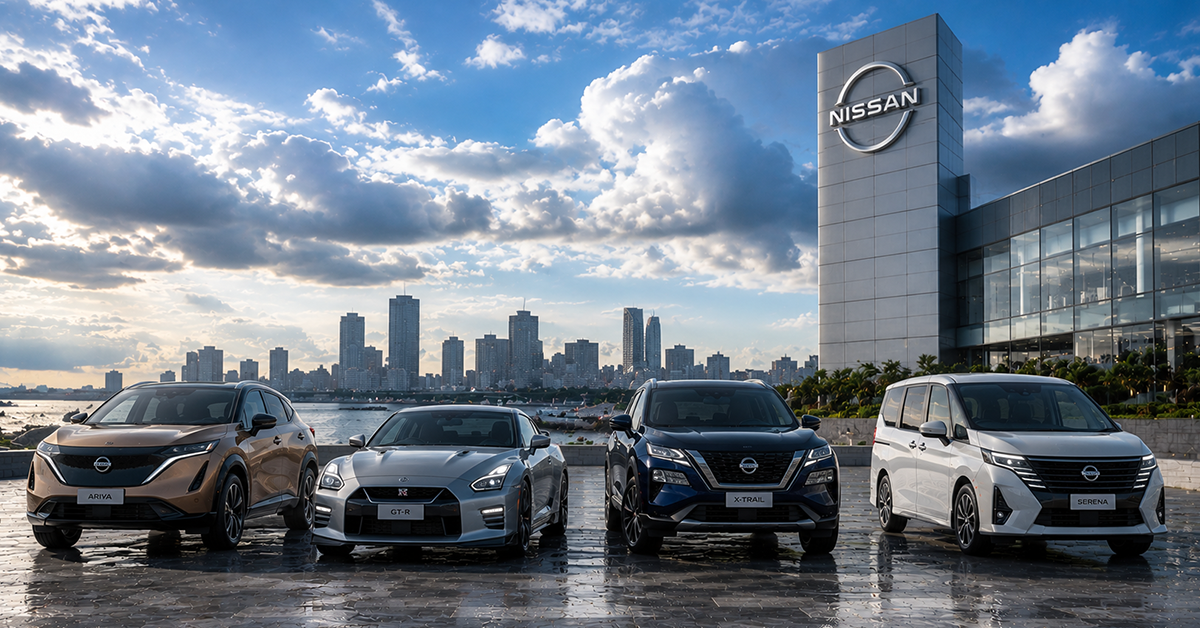
AI-generated concept illustration — Nissan brand overview. | Rev N Rise
Nissan is one of Japan's oldest and most significant car manufacturers — the company behind the legendary Skyline GT-R, the world's first mass-market electric car and one of the most recognised pickup trucks on earth. From the track-dominating GT-R to the revolutionary Leaf, Nissan's history is defined by moments that changed what cars could be.
Nissan Motor Co. was established in 1933 in Yokohama, Japan by Yoshisuke Aikawa. The brand name derives from "Nihon Sangyo" — the holding company that controlled it. Nissan began exporting cars to the United States in 1958 under the Datsun name — a brand it used in export markets until the early 1980s when the Nissan name replaced it globally. The Datsun 240Z of 1969 was the car that established Nissan's international performance reputation — a beautiful, affordable sports car that combined European styling with Japanese engineering reliability and outperformed European rivals at a fraction of the price.
The Skyline GT-R arrived in 1969 and began one of the most celebrated performance car dynasties in automotive history. The R32 generation — launched in 1989 — won 29 consecutive races in the Japanese Touring Car Championship, earning the nickname "Godzilla" from the Australian motorsport press after it arrived and dominated the 1991 Bathurst 1000. The R33 evolved the formula. The R34 of 1999 — with its sophisticated four-wheel steering, multi-link suspension and twin-turbocharged RB26 inline-six — is considered by many enthusiasts to be one of the greatest driver's cars ever built. Values for clean R34s now regularly exceed $200,000 AUD in Australia and significantly more in other markets.
In 2010, Nissan changed the automotive world with the Leaf — the world's first mass-market electric car, launched years before any mainstream competitor offered a comparable product. The Leaf sold over 600,000 units globally in its first decade and proved that electric cars could be practical and affordable for ordinary buyers. That pioneering work laid the foundation for every mass-market EV that followed.
The Nissan GT-R nameplate spans four generations across more than five decades and represents the most consistent performance engineering achievement in Japanese automotive history. The PGC10 Skyline GT-R of 1969 — powered by the S20 inline-six from Nissan's Prince racing programme — won 49 consecutive races in Japanese touring car competition before the series was discontinued. The hiatus lasted until 1989 when the R32 returned — fitted with the twin-turbocharged RB26DETT inline-six, advanced ATTESA E-TS all-wheel drive and Super HICAS four-wheel steering. It dominated every racing series it entered.
The R35 GT-R — launched in 2007 — took the concept global. With a twin-turbocharged 3.8-litre V6 producing 480 horsepower in base form and a launch control system that enabled 0-100km/h in under 3 seconds, it offered supercar performance at a sports car price and humiliated far more expensive rivals on tracks around the world. The R35 was discontinued in most markets in 2024. Its successor has not been officially confirmed — but the GT-R name is too important to Nissan's identity to disappear permanently.
NISMO — Nissan Motorsports International Co. — is Nissan's performance division and one of the most respected motorsport organisations in Japan. Founded in 1984, NISMO is responsible for Nissan's Super GT programme, GT3 racing cars, the GT-R NISMO road car and the NISMO performance parts and restoration programme. In May 2026, Nissan opened the first NISMO Performance Centre outside Japan in Melbourne, Australia — giving GT-R owners access to factory-certified Meister technicians, official NISMO parts and the same restoration standards applied at the Omori Factory in Yokohama. Additional NISMO Performance Centres in Sydney, Brisbane and Perth are planned.
Nissan's legacy of engineering firsts is remarkable — the GT-R proved that Japanese manufacturers could out-engineer European sports car makers at a fraction of the price; the Leaf proved that electric cars could be practical and affordable before Tesla had sold a single Model S. The Navara and Patrol have built reputations for durability in the harshest environments on earth. And Nissan's e-Power hybrid technology — which uses a petrol engine exclusively as a generator to charge a battery that drives electric motors — offers a uniquely smooth driving experience that neither conventional hybrids nor pure EVs fully replicate.