 Brands
Tesla Model S and X Production Ends — A 14-Year Legacy

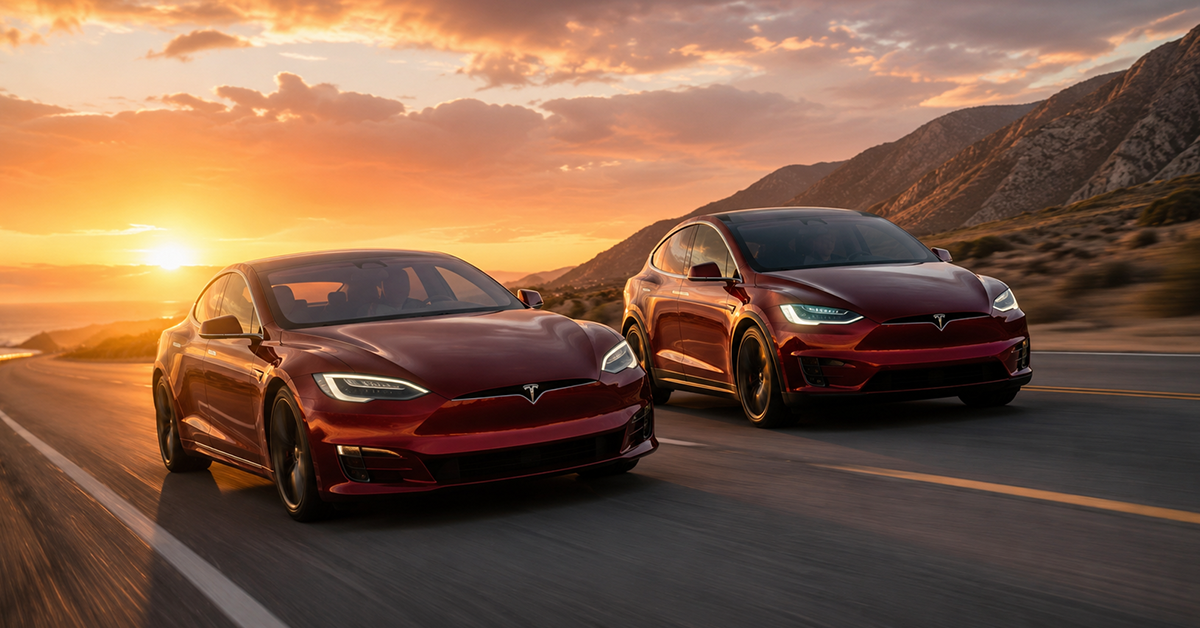
AI-generated tribute illustration of the Tesla Model S and Model X — production ended May 10, 2026, after a 14-year run. | Rev N Rise
On May 10, 2026, the last Tesla Model S and Model X rolled off the production line at Fremont, California. Fourteen years. Eleven years. 750,000 cars. One industry changed forever. The Model S didn't just make electric cars acceptable — it made them desirable, fast, luxurious and inevitable. The Model X made families fall in love with Falcon Wing doors and a car that felt like the future. There will never be cars quite like them. This is their story.
To understand what the Tesla Model S did, you have to remember what came before it. In 2012, the electric car was a punchline. The first-generation Nissan Leaf was the best-known EV in America — sensible, virtuous, utterly loveless. It looked like it had been designed to apologise for itself. The idea that an electric car could be fast, beautiful, luxurious and worth genuinely wanting was considered somewhere between wishful thinking and science fiction.
Then the Model S arrived. And nothing was ever the same again.
Car and Driver's first instrumented test in 2012 opened with the line: "The reality is that most electric cars simply haven't been very good." Then it spent the rest of the review explaining why the Model S was different. Different in a way that mattered. Different in a way that forced the entire automotive industry to sit up and pay attention — not to Tesla specifically, but to the question that the Model S had just answered: what if an electric car was simply the best car?
The Model S went into production at Tesla's Fremont, California factory in June 2012. The factory itself was significant — it had previously been a joint General Motors and Toyota facility, abandoned and shuttered. Tesla bought it for $42 million, a bargain that would come to seem more extraordinary with every passing year. Production began slowly, as it always does with a startup. Tesla built its 1,000th Model S by October 31, 2012. By the end of the year, 2,650 had been delivered.
The base model started at approximately $60,000. The larger battery pack delivered 265 miles of range — an extraordinary figure for the time. The car was designed by Franz von Holzhausen, who had replaced Henrik Fisker as lead designer in 2008 after a dispute with Elon Musk. The result was a full-size luxury sedan with a fastback roofline that managed to look like nothing else on the road while simultaneously looking completely credible. It was the right car, designed by the right person, at the right moment.
Motor Trend named it Car of the Year for 2013 — a unanimous decision that caused consternation in some quarters and celebration in others. It was the first time in the award's history that a car without a combustion engine had won.
What happened between 2012 and 2026 is one of the most extraordinary stories in automotive history. The Model S didn't stay still. It evolved, constantly, in ways that no car had ever evolved before — not through annual model year updates, but through over-the-air software updates that could change how the car drove, what it could do and how fast it could go, while it sat in your garage overnight.
In 2014, Autopilot arrived — the first mainstream semi-autonomous driving system, delivered to existing owners through a software update. In 2016, the exterior was substantially refreshed. The range kept climbing. The charging network kept growing. In 2021, the most important update of all: the Model S Plaid.
Three electric motors. Over 1,000 horsepower. A 0-60mph time of 1.99 seconds under ideal conditions — officially the quickest production car ever tested by Car and Driver at the time of its launch. A car with seven seats, a full boot, air suspension, and enough range for a family road trip that also happened to be faster than almost every supercar ever built. The Plaid was not a niche performance experiment. It was a mainstream production car available for order on Tesla's website. The industry stared at it and understood, perhaps for the first time, exactly how serious the situation had become.
In 2015, the Model X arrived alongside the Model S — a three-row electric SUV that shared approximately 30 percent of its components with the sedan. The Model X was a stranger, more theatrical car. Its defining feature was the Falcon Wing rear doors — gullwing-style doors that folded upward in two sections, opening in tight parking spaces, rising like a spaceship. They were impractical in ways that Tesla spent years fixing and defending. They were also unforgettable.
No car before or since has made quite the same impression on a child sitting in a car park, watching those doors rise. The Model X understood something important: that the future of transport didn't have to be serious. It could be joyful and ridiculous and wondrous. It could have a Fart Mode. It could have a Bioweapon Defence Mode, which activated a hospital-grade HEPA filter and positive air pressure inside the cabin. The Model X was many things, but boring was never one of them.
The final 2026 Model X offered 352 miles of EPA-rated range, a Plaid variant with three motors and sub-2.5-second 0-60mph capability, and Full Self-Driving as a software subscription. An eleven-year journey from Falcon Wing doors to hands-free autonomous highway driving, delivered in the same physical vehicle.
| Production Start | June 2012 — Fremont, California |
| Production End | May 10, 2026 — Fremont, California |
| Production Run | 14 years (Model S) / 11 years (Model X) |
| Combined Units Sold | ~750,000 Model S + Model X |
| Original Base Price (2012) | ~$60,000 |
| Original Range (2012) | 265 miles EPA |
| Final Range — Model S (2026) | 410 miles EPA |
| Final Range — Model X (2026) | 352 miles EPA |
| Model S Plaid Output | 1,020 hp — tri-motor |
| Model S Plaid 0–60 mph | 1.99 seconds (ideal conditions) |
| Awards | Motor Trend Car of the Year 2013 |
| Time Magazine | Best Inventions of the Year 2012 |
| Signature Edition (final run) | 350 units — 250 Model S / 100 Model X |
| Signature Edition Price | $159,420 — garnet red, gold accents |
| Fremont Factory Next Use | Tesla Optimus humanoid robot production |
| Replacement | None announced |
To mark the end of the Model S and Model X, Tesla created a Signature Edition — 350 cars in total, split between 250 Model S and 100 Model X units. These were not available to the general public. Tesla sent exclusive invitations to selected long-time customers — the people who had been there from the beginning. Each car was finished in a distinctive garnet red paint with gold accents throughout, including gold Tesla logos, gold brake calipers and "Signature" lettering in the interior. Priced at $159,420, they sold out immediately.
The delivery event planned for May 12 was postponed at three days' notice — a very Tesla moment, equal parts frustrating and fitting for a company that has always operated on its own timeline. The cars were delivered in the days that followed. Somewhere, 350 people are now the last owners of a new Tesla Model S or Model X. They hold something irreplaceable.
The legacy of the Model S and Model X is not measured in units sold. 750,000 cars is genuinely modest compared to the volumes of the Model 3 and Model Y that followed, or the millions of units that Toyota, Ford or GM sell annually. Neither car was ever a mass-market product. They were something more valuable: a proof of concept.
It proved that an electric car could win a drag race against a Ferrari. It proved that an electric car could travel 300 miles on a charge. It proved that an electric car could have a cabin that embarrassed the Mercedes S-Class. And it proved — this was the most important thing — that people would want one. Not because they were being responsible. Not because petrol was expensive. Because the car itself was magnificent.
Every electric car sold today — every BMW iX3, every Porsche Taycan, every Rivian R2, every Jaguar Type 01 — exists in the world that the Model S and Model X made possible. The executives who authorised those programmes, the engineers who designed those platforms, the buyers who opened their minds to the idea — all of them were, in some way, responding to what happened when a Model S or Model X first went by them on the road and they thought: wait. What was that?
Tesla has confirmed no replacement for the Model S or Model X. The Fremont factory floor that built every one of them is being repurposed for production of the Optimus humanoid robot — arguably the most ambitious thing Tesla has ever attempted. Elon Musk described the end of Model S and X production as an "honourable discharge" — a retirement with dignity rather than a cancellation. The language was chosen carefully. This was not a failure. These cars did exactly what they were supposed to do. They just finished doing it.
The high-end EV segment they vacated will not stay empty. Lucid, Rivian and Cadillac are already there. The Model S alumni — the designers, the engineers, the battery chemists and software architects who built it — have seeded the entire electric vehicle industry. Their fingerprints are on nearly every serious electric car being developed anywhere in the world right now.
That is a legacy that no production end date can touch.
"It's a poignant moment. The Model S and X have been incredible cars that helped make sustainable energy cool and showed the world that electric vehicles could be better than gasoline cars in every way."
— Elon Musk, CEO, Tesla — X (formerly Twitter), May 2026The Tesla Model S and Model X changed the automotive industry more profoundly than any cars since the Ford Model T. They didn't just prove that electric cars could work — they proved they could win. The Model S redefined the luxury sedan. The Model X made families fall in love with Falcon Wing doors and a car that felt like the future. Every EV on sale today is, in some way, their descendant. Fourteen years. 750,000 cars. One factory in Fremont. The last ones rolled off the line on May 10, 2026 — finished in garnet red with gold calipers, ready for owners who understand exactly what they hold. The Model S and X are gone. What they started will never be.