 Brands
Toyota Project Orca — Inside the $2 Billion Texas Factory That Could Bring the Tacoma Home

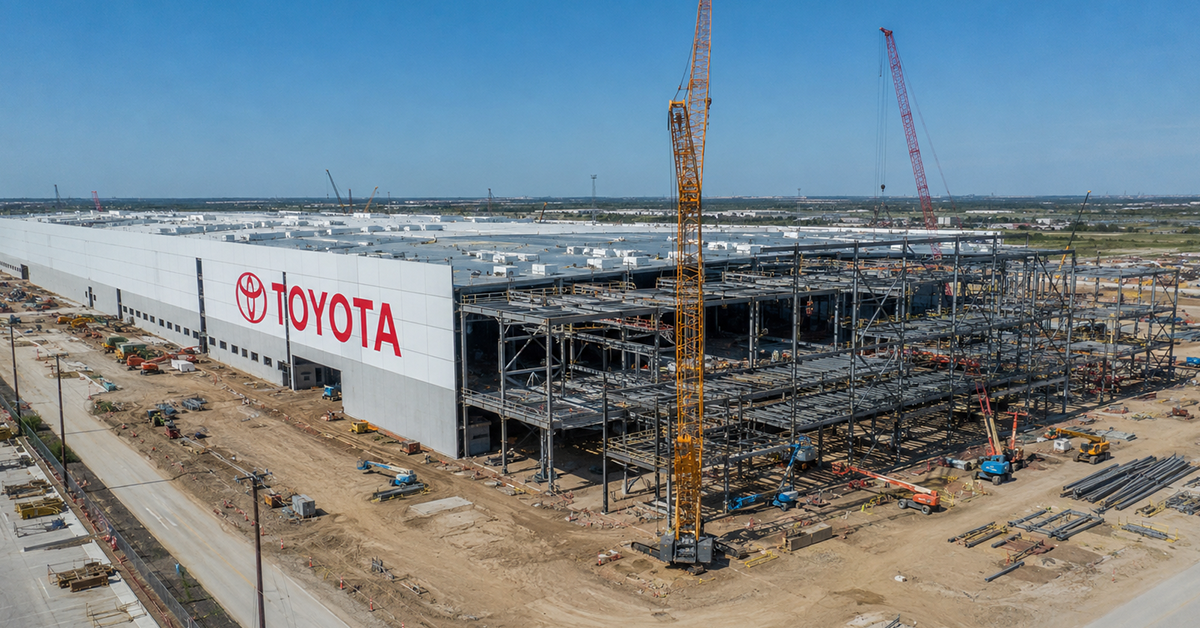
AI-generated concept illustration of Toyota's Project Orca factory in San Antonio, Texas — not an official Toyota image. | Rev N Rise
Toyota has filed for approval to build a brand new $2 billion vehicle assembly plant in San Antonio, Texas — right next to its existing truck factory. Internally codenamed Project Orca, the facility will create 2,000 new jobs, generate $6.3 billion in annual revenue and begin production in 2030. Nobody has officially confirmed which car it will build. But the evidence points very strongly at one answer: the Tacoma is coming home.
On May 14, 2026, Toyota Motor Engineering & Manufacturing North America filed with the Texas Comptroller of Public Accounts for approval to build a new vehicle assembly line in Bexar County, Texas. The filing — which Toyota confirmed publicly the following day — describes a $2 billion investment split between $1.05 billion for buildings and property improvements and $950 million for machinery and equipment.
The proposed facility would be built directly adjacent to Toyota's existing San Antonio manufacturing complex — a 2.2 million square-foot plant that currently produces the Tundra full-size pickup and Sequoia full-size SUV, and assembled nearly 200,000 vehicles in 2025 with a workforce of approximately 3,700 people. Project Orca would add a completely new, separate assembly line to that complex. Construction is scheduled to begin before the end of 2026, with the facility completing in 2029 and vehicle production starting in 2030.
If approved, Project Orca will become Toyota's sixth vehicle assembly operation in the United States — joining existing plants in Georgetown, Kentucky; Princeton, Indiana; Huntsville, Alabama; Blue Springs, Mississippi; and the existing San Antonio facility. It will also be one of the largest single automotive manufacturing investments in US history.
Toyota's filing answers this question directly. The company states that Project Orca would need to be located "at, or in close proximity to, an existing Toyota manufacturing facility that has access to sufficient transportation infrastructure" — and that the timeline for construction commencement in 2026 made San Antonio the only viable option. The existing plant's infrastructure, supplier network, workforce and logistics connections make expansion significantly faster and cheaper than building from scratch elsewhere.
Toyota has also been explicit about its broader manufacturing philosophy. The company's statement to Reuters on May 15 read: "Our production philosophy is to build where we sell and buy where we build." This is not a new principle for Toyota — it has guided the company's North American manufacturing strategy for four decades. What is new is the scale and urgency of the commitment. Project Orca is part of Toyota's previously announced plan to invest as much as $10 billion in US manufacturing projects, which includes a $912 million pledge to increase output of hybrid components and vehicles across five states.
Toyota has not officially confirmed which vehicle Project Orca will produce. The filing with the Texas Comptroller does not name a specific model. But the automotive industry's analysis of the available evidence points strongly toward one conclusion: the Toyota Tacoma.
The Tacoma is America's best-selling mid-size pickup truck — a position it has held almost continuously for nearly two decades. It is one of the most searched vehicles in the United States and one of Toyota's highest-margin products globally. It is also, as of 2021, manufactured entirely in Mexico — at Toyota's plant in Baja California and, until recently, at a facility in Tijuana. Moving Tacoma production to the US would be Toyota's single most significant American manufacturing statement of this decade.
The economic case is compelling. Toyota's own filing states that Project Orca would generate more than $600 million in total annual economic output once manufacturing commences, and generate as much as $6.3 billion each year in revenue for Toyota. Those are Tacoma-scale numbers. The Tundra and Sequoia are already produced at San Antonio. A third model — specifically one of Toyota's highest-volume, highest-revenue products — is the logical next step for a facility being purpose-built with $950 million in new machinery and equipment.
| Project Name | Project Orca — Toyota internal codename |
| Filing Date | May 14, 2026 — Texas Comptroller of Public Accounts |
| Location | Bexar County, San Antonio, Texas |
| Adjacent To | Toyota Motor Manufacturing Texas — existing plant |
| Existing Plant Output | ~200,000 vehicles/year — Tundra + Sequoia |
| Existing Plant Jobs | ~3,700 employees |
| Total Investment | $2 billion |
| Buildings + Property | $1.05 billion |
| Machinery + Equipment | $950 million |
| New Jobs Created | 2,000 — between 2028 and 2030 |
| Construction Start | Before end of 2026 |
| Facility Completion | 2029 |
| Production Start | 2030 |
| Annual Economic Output | $600 million+ for local economy |
| Annual Revenue (Toyota) | ~$6.3 billion |
| US Plant Count After | 6 — Toyota's sixth US assembly facility |
| Model Confirmed | None — Toyota has not specified |
| Most Likely Model | Toyota Tacoma — currently built in Mexico |
| Broader Context | Part of Toyota's $10 billion US investment plan |
Toyota's San Antonio facility opened in 2006 — built specifically to produce the Tundra pickup, which Toyota was moving upmarket to compete directly with American full-size trucks. The plant has operated continuously since, adding the Sequoia SUV to its production roster and growing its workforce to nearly 4,000 people. It is one of the most productive Toyota facilities in the world.
The San Antonio complex is surrounded by a dense supplier ecosystem — hundreds of component manufacturers who have located near the plant specifically to serve Toyota's production needs. Adding a new assembly line to this environment is significantly less complex and less expensive than building an entirely new plant in a new location. Toyota's choice to expand here rather than elsewhere is strategically sensible on every level: faster to build, cheaper to operate, easier to staff and better connected to existing supply chains.
If Project Orca does produce the Tacoma — and the evidence strongly suggests it will — the practical implications for buyers are meaningful. A US-built Tacoma would benefit from the same supplier proximity, workforce quality and manufacturing precision that has made the Tundra and Sequoia competitive products in the US market. Toyota's US plants consistently rank among the highest in quality metrics — a track record that a Texas-built Tacoma would inherit from day one.
Production starting in 2030 means a US-built Tacoma is at minimum four model years away. The current Tacoma — redesigned for 2024 with a twin-turbo four-cylinder and a hybrid option — will continue in its current form until Project Orca comes online. But for a truck that sells over 300,000 units per year in the United States, knowing that its future production home is confirmed — in Texas, in a brand-new $2 billion facility — is a genuinely significant piece of news for anyone considering a Tacoma purchase decision over the next few years.
"Our production philosophy is to build where we sell and buy where we build. This reflects our long-term commitment of investing in the North American region, local manufacturing and suppliers."
— Toyota Motor North America, Official Statement, May 15 2026Project Orca is Toyota's biggest US manufacturing commitment in a generation. $2 billion. 2,000 jobs. $6.3 billion in annual revenue. A new assembly line in San Antonio that will produce — almost certainly — America's best-selling mid-size truck, built on American soil for the first time since 2021. The facility won't open until 2030. The model hasn't been officially confirmed. But the filing has been made, the construction timeline is set and Toyota has committed to a level of US manufacturing investment that leaves very little doubt about its intentions. The Tacoma is coming home.