 Brands
Volkswagen Saveiro — History, Tukan and Specs
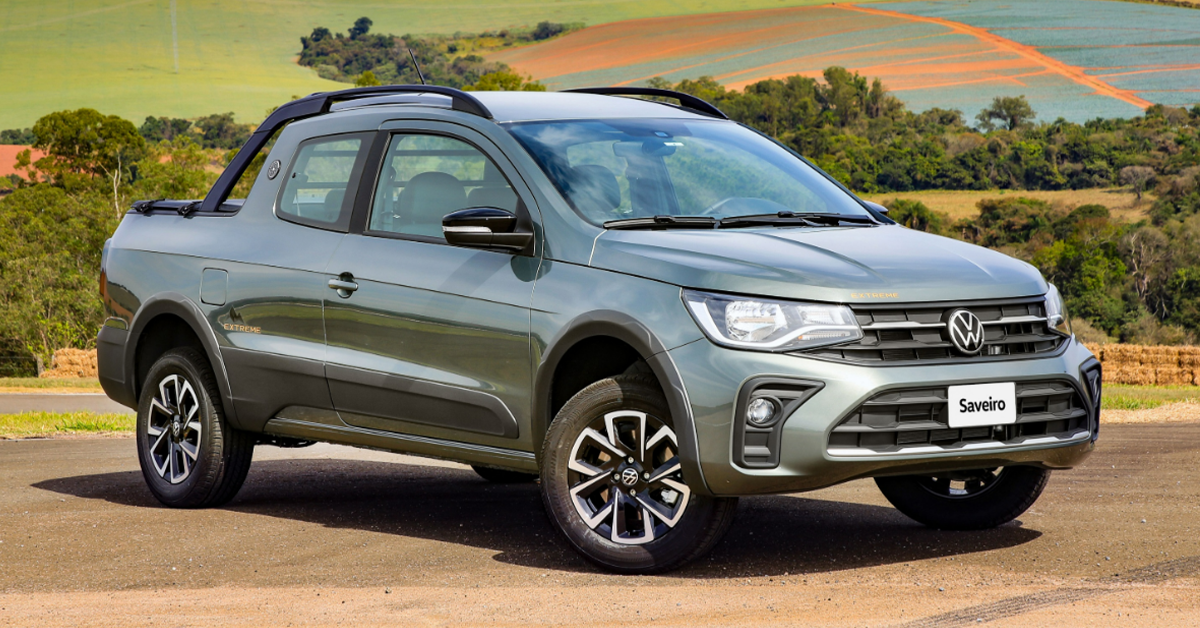
Official press image of the Volkswagen Saveiro. | © Volkswagen AG
The Volkswagen Saveiro is the small Gol-based pickup that Volkswagen do Brasil has built since 1982. Here is the full Saveiro story, from the square first generation and the 2016 update to the 1.6 engine, trims, prices, exports and the Tukan that reports say will replace it.
The Volkswagen Saveiro is the small pickup truck that Volkswagen do Brasil has built since 1982. It is a coupé utility, meaning a car-based pickup with a cab and a cargo bed in one body, and it grew out of the Gol family. A reference source describes it as a lightweight pickup truck and says all Gol generations have been sold with this body style (reported). This guide follows the Saveiro from its launch in July 1982 to the 2026 range, and then to the Tukan, the new pickup that reports say will replace it.
| Launched | July 1982 (reported) |
| Body style | Coupé utility pickup, Gol family (reported) |
| Name origin | Traditional Brazilian fishing boat (reported) |
| First engine | 1.6-litre air-cooled (reported) |
| Second design | Late 1997, 1998 model year (reported) |
| Current plant | Anchieta, São Bernardo do Campo (reported) |
| Brazilian production | Over 1.8 million units (reported) |
| Exports | 400,000 units, 65 markets (reported) |
| Years in production | Nearly 44 as of July 2026 (reported) |
| Successor | Tukan, sales planned early 2027 (reported) |
The launch date matters because the Saveiro is now one of the longest-running models in Brazil. A trade report says the pickup was launched in July 1982 (reported), and a Brazilian report from July 2026 calls it the model that has been in production the longest in Brazil, with nearly 44 years of history (reported). Another report says it was the last member of the Gol family to be launched, and that its only engine at the start was the 1.6-litre air-cooled unit already used in the Voyage and the Parati (reported).
The name comes from a traditional Brazilian fishing boat, according to a reference source (reported). The Saveiro was not alone in its market. A Brazilian history series lists the Ford Pampa, the Fiat Pickup City, the Chevrolet Chevy 500 and the Saveiro as the car-based pickups that appeared in that period, and describes the Saveiro as a direct result of the Gol line (reported). It was therefore a small, cheap and practical truck for work, built on the same ideas as the hatchback that it came from.
The Saveiro has been through several generations. A Brazilian history series says the second design, nicknamed “bolinha” or little ball, arrived at the end of 1997 as a 1998 model (reported). A new generation designed and built in Brazil was shown for South America in 2009 and 2010 (reported), and updates followed in 2016 and 2024 (reported). Sources disagree on how many generations the pickup has had, with counts of three, four and five appearing, so we give the dates and not a single count.
Sales and exports have been large. A Brazilian report says that production in Brazil has passed 1.8 million units, counting the plants in Taubaté and São José dos Pinhais as well as the current plant in São Bernardo do Campo (reported). Volkswagen do Brasil also announced a milestone of 400,000 Saveiros exported, according to the same press coverage, with shipments to 65 markets on five continents since 1982 (reported). Those numbers make the Saveiro a bigger export success than its small size suggests.
The story is now close to a change of era. Reports in 2026 say Volkswagen unveiled a new pickup called the Tukan in Brazil to replace the Saveiro, with sales planned for early 2027 (reported). We cover the details in the last section. In the sections before it we cover the first generation, the later updates, the engine and the numbers, the trims and prices, and the plants and exports. For the wider family of Volkswagen vehicles, see our Volkswagen models list, and for the brand’s other pickup, read our Amarok guide.
The first Saveiro appeared in 1982 and is often called the square generation in Brazil. A Brazilian history series about the first phase says the market already had car-based pickups from rivals, and that the Saveiro came directly from the Gol line (reported). The Gol itself had been launched in 1980 as a replacement for the Beetle, according to a Brazilian report (reported), so the Saveiro arrived two years later as part of a growing family of models built on the same basic car.
| First launch | July 1982 (reported) |
| Family | Gol, Voyage, Parati, Saveiro (reported) |
| Gol launched | 1980 (reported) |
| Parati launched | 1982 (reported) |
| First engine | 1.6 air-cooled (reported) |
| Position in family | Last Gol-family model launched (reported) |
| Exports began | 1982 (reported) |
| Rivals of the time | Ford Pampa, Fiat Pickup City, Chevy 500 (reported) |
| Second design | Late 1997 (reported) |
| Nickname of second design | Bolinha (reported) |
A trade report says the Saveiro and the Parati station wagon were both launched in 1982 (reported). The Voyage sedan joined the Gol family in the same year, according to another Brazilian timeline (reported). The family therefore offered a hatchback, a sedan, a wagon and a pickup from one platform. For Volkswagen do Brasil this was an efficient way to sell several body styles, and for buyers it meant that the Saveiro shared parts and service with the best-known car in the country.
The launch engine was the 1.6-litre air-cooled unit that was already in use in the Voyage and Parati, according to a Brazilian report (reported). The same report calls the Saveiro the last member of the Gol family to be launched. Air cooling links the model to the old Volkswagen tradition, and the choice shows how closely the early Saveiro followed the Beetle-era engineering that Volkswagen do Brasil still used. We could not confirm power figures for that engine in the sources we found, so we do not give them.
A reference source says the first-generation Gol was built in the São Bernardo do Campo plant (reported), and a trade report says the first Saveiros were produced at Taubaté (reported). The sources differ on the early plant, so we show both. What is clear is that production moved between several Volkswagen plants in Brazil over the years, as the later section on plants explains, and that the current plant is Anchieta in São Bernardo do Campo.
Exports began in the very first year. A Brazilian report says the shipments abroad started in 1982, the same year as the launch, and have since reached 65 markets on five continents (reported). That is unusual for such a small pickup, and it shows that there was demand for a compact work truck in several countries. The first-generation trucks were the start of a long export story that, according to reports, passed 400,000 units in 2026.
The square Saveiro lasted until the second design arrived at the end of 1997. Its place in the history of Volkswagen do Brasil is secure, because it showed that the Gol platform could support a practical pickup, and later generations followed the same formula. If you want the background on the car it came from, read our Golf guide, which covers the global hatchback, and note that the Gol is a Brazilian model with a different story from the European Golf. Brazilian reports also say the Saveiro was exported from its first year, which makes it an early success.
The second Saveiro arrived at the end of 1997 as a 1998 model, according to a Brazilian history series, and the series says that the new design was nicknamed “bolinha”, which means little ball in Portuguese (reported). The name refers to the rounder shape that replaced the square design of 1982. This second design was also based on the Gol, and it kept the pickup in line with the changes that the hatchback received, as the Gol moved to new generations over the 1990s.
| Second design | Late 1997, 1998 model year (reported) |
| Nickname | Bolinha, little ball (reported) |
| Gol best-seller in Brazil | 27 straight years, 1987 to 2014 (reported) |
| Gol family total | 10 million units by March 2013 (reported) |
| Mexico name | Pointer Pick Up, from 1999 (reported) |
| Top export market 2026 | Mexico, 9,437 units, January to June (reported) |
| Gol production end | 2023 (reported) |
| Gol replacement | Polo Track (reported) |
| Right-hand drive | Never offered (reported) |
| Generation count | Three, four or five, by source (reported) |
The Gol is the key to the Saveiro’s story. A reference source says the Gol was the best-selling car in Brazil for 27 consecutive years from 1987 to 2014, and that it has been the most popular car in Argentina since 1988 (reported). It adds that cumulative production of the Gol and its derivatives, including the Saveiro, reached 10 million units in March 2013 (reported). When the Gol sold in such numbers, the pickup version could use the same parts, dealers and service network, which kept costs low.
The pickup has also been sold under other names. A reference source says it has been sold as the Pointer Pick Up in Mexico since 1999 (reported), and Mexico is the largest export market for the current Saveiro, with 9,437 units shipped from January to June 2026, according to a Brazilian report (reported). A reference source on Volkswagen Argentina says that the Gol-based pickup was built there and named Saveiro (reported). The same body has therefore carried different badges in different countries.
The Gol itself ended in 2023. A reference source says the Gol was built for 43 years, that production ended in 2023 and that a version of the Polo called the Polo Track became its replacement (reported). That left the Saveiro as the last of the Gol-family models still in production, because the Parati had left earlier. The Parati was replaced by the SpaceFox, according to the same source (reported). The Saveiro therefore became the survivor of a family that had once had four members.
A South African news site said that the Saveiro was long rumoured for South Africa but consistently ruled out because it is a left-hand-drive-only model (reported). The same site noted that the pickup is an update of a design that debuted in 2009 and that it was the third update since then (reported). The sources we found do not list a right-hand-drive Saveiro, and Volkswagen has said that its successor is not coming to Australia (reported).
Generation counts differ between sources. One Brazilian article calls the current Saveiro the third generation of the pickup, a Uruguayan report says the pickup has run through four generations in 45 years, and a 2026 report says it crossed five generations (reported). The difference comes from whether facelifts are counted, so we recommend reading the dates in this guide and not relying on any one number. The sections that follow concentrate on the current Brazilian-built version and its numbers. Treat any single generation count with care, because each source counts differently.
Volkswagen showed its first official pictures of the next-generation Saveiro in August 2009, according to a trade report, which said the pickup was designed and built for the South American market and borrowed styling from the Tiguan (reported). The report named the Fiat Strada, the Chevrolet Montana and the Ford Courier as its rivals. A second report said the new generation was announced for 2010, with a front-end design closer to other new Volkswagens, especially on the upper trims (reported).
| First pictures of 2010 generation | August 2009 (reported) |
| 2010 engine, petrol | 1.6 VHT, 74 kW (101 hp) (reported) |
| 2010 engine, ethanol | 77 kW (104 hp) (reported) |
| 2010 trims | 1.6, Trend, Trooper (reported) |
| 2016 investment | R$200 million (reported) |
| 2016 Cross engine | 1.6 MSI, up to 120 hp (reported) |
| 2016 other versions | 1.6 Total Flex, up to 104 hp (reported) |
| Production by then | 1.1 million at São Bernardo (reported) |
| 2024 update | New flagship trim, 1.6 engine (reported) |
| Brazil deliveries by 2024 | More than 1.6 million (reported) |
That 2010 truck used a 1.6-litre engine called the VHT, for Volkswagen High Torque, which made 74 kW (101 hp) on petrol and 77 kW (104 hp) on ethanol, according to a trade report (reported). Three trim levels were offered: a base 1.6, the Trend and the Trooper, with the Trooper aimed at younger and more active buyers and with more visual equipment (reported). The engine could run on two fuels, which is a defining feature of Brazilian cars and a key reason for the pickup’s long success in its home market.
In 2016 Volkswagen launched what it called the new Saveiro and invested 200 million reais in it, according to a Brazilian trade site (reported). That report says the Robust, Trendline and Highline versions used the 1.6-litre Total Flex engine with up to 104 hp on ethanol, while the Cross used the new 1.6 MSI engine from the EA211 family with up to 120 hp (reported). A South American site said the update made the pickup more connected than rivals, and another report said the 2017 line brought the Robust version (reported).
A market-data report says that more than 1.1 million Saveiros had been produced at the São Bernardo do Campo plant by then, and that more than 200,000 had been exported to over 60 countries (reported). The two figures show how quickly volumes had grown: the 2026 exports total of 400,000 is roughly double that earlier export figure, and the 1.8 million units of Brazilian production compare with the earlier 1.1 million at one plant. The numbers come from different dates and sources, so they are only an indication.
The latest update arrived for the 2024 model year. A trade report headline says the 2024 Saveiro debuted with a 1.6-litre naturally aspirated engine and a new flagship trim (reported), and the same report says the pickup had been on sale in Brazil for 41 years with more than 1.6 million units delivered to customers (reported). A South African report called it the third update since the 2009 debut and noted that the pickup did not follow rivals in offering turbo power (reported).
The newest trim is the Extreme, which remained in the range for the 2027 model year, according to a Brazilian report (reported). Its sea-style soft tonneau cover is described as exclusive to the Extreme in one report (reported). The last update, in other words, kept the old mechanical formula and focused on trims and appearance. That helps explain why reports in 2026 describe the Saveiro as aged, and why Volkswagen has prepared the Tukan as a larger and more modern replacement.
Today’s Saveiro has one engine. A Brazilian review site says it is the 1.6-litre 16-valve EA211 unit, sold as the 1.6 MSI, calibrated to give 106 hp on petrol and 116 hp on ethanol, with 15.4 and 16.1 kgfm of torque respectively (reported). A Volkswagen-based trade summary says the whole range uses the same engine and a five-speed manual gearbox (reported). The 2026 range is therefore simple, with no choice of engines and no automatic transmission.
| Engine | 1.6 MSI, EA211, 16 valves (reported) |
| Power, petrol | 106 hp (reported) |
| Power, ethanol | 116 hp (reported) |
| Torque | 15.4 kgfm petrol, 16.1 kgfm ethanol (reported) |
| Gearbox | Five-speed manual (reported) |
| Automatic or turbo | Not offered (reported) |
| Fuel tank | 55 litres (reported) |
| Payload range | 600 to 740 kg, by version and source (reported) |
| Bed volume range | 580 to 924 litres, by source (reported) |
| Towing | Up to 750 kg with tow bar (reported) |
A US trade site noted that the Saveiro does not offer an automatic transmission or a turbocharged engine (reported). That is a clear disadvantage against rivals that offer turbo engines, and a Brazilian comparison says the Fiat Strada has a 1.3 naturally aspirated engine and a 1.0 turbo, while the Saveiro has a single naturally aspirated 1.6 (reported). The same comparison says the Saveiro suits buyers who value torque for carrying weight, with up to 116 hp and 16.1 kgfm (reported).
The fuel tank holds 55 litres, according to a Brazilian review site, which says the range is up to 484 km on ethanol or 710 km on gasoline on the highway (reported). The front suspension is an independent McPherson design with an anti-roll bar, according to a data site (reported). The 2026 range uses 185/70 R14 tyres on the Robust and 195/55 R15 on another trim, according to a separate summary (reported). These are modest numbers, but they fit a compact work truck.
Payload and bed size are where sources disagree. For payload, a data site gives 715 kg for the Robust single cab and another page gives 712 kg for the Trendline single cab (reported), while a second summary gives 740 kg for the single cab and 680 kg for the double cab (reported). A Brazilian site says the Robust double cab carries 638 kg (reported), and another site says up to 600 kg in one configuration (reported). The differences come from versions and sources, so check the manual.
Bed volume also varies. Data sites give 924 litres for the single cab (reported), and a double-cab figure of 580 litres appears in one Brazilian report (reported). A marketplace comparison gives 645 litres as the gross volume of the bed against 1,354 litres for the Fiat Strada single cab (reported). A summary also lists a towing capacity of up to 750 kg with a tow bar (reported). We show these as ranges, because the sources use different cab types and measuring methods.
Length and wheelbase follow the same pattern. One summary gives a total length of 4,616 mm for the single cab and 4,868 mm for the double cab, with a bed length of 1,165 mm and 780 mm (reported). The same table gives wheelbases of 2,700 mm and 2,950 mm, but we could not confirm those against another source, so we treat them with care. For exact figures, use the official data sheet of Volkswagen do Brasil for the model year you want, and not our summary. Always check the model year, cab type and version before you compare any two numbers.
In Brazil the Saveiro is offered in four versions, according to a July 2026 report: the Robust in single or double cab, the Trendline in single cab and the Extreme in double cab (reported). A marketplace site lists the same line-up as Robust CS, Robust CD, Trendline CS and Extreme CD, all with the 1.6 engine and the five-speed manual gearbox (reported). A Brazilian data site says the 2026 model year kept the Robust, Trendline and Extreme versions unchanged from the year before (reported).
| Versions | Robust CS and CD, Trendline CS, Extreme CD (reported) |
| Price range, July 2026 | R$114,490 to R$136,490 (reported) |
| Price range, 2026 table | R$112,690 to R$134,190 (reported) |
| Robust CS, earlier price | R$110,490 (reported) |
| Extreme CD, earlier price | R$131,490 (reported) |
| 2025 starting price | R$99,990, Robust CS (reported) |
| 2027 new version | Robust Etanol, ethanol only (reported) |
| Ethanol version output | 116 hp, 16.1 kgfm (reported) |
| 2025 Brazil registrations | 67,753 units (reported) |
| January to September 2026 | 38,726 units (reported) |
The Robust is the work-oriented base model. A Brazilian review site says it is aimed at companies, fleets and service work (reported), and a trade report says it has a reinforced bed protector as standard and black-mask headlights (reported). The Trendline adds more equipment in single-cab form, while the Extreme is the flagship double cab with an exclusive sea-style bed cover, according to one report (reported). The Extreme is also the version that suits weekend and recreational buyers.
Prices change often. The July 2026 report gives a range from R$114,490 to R$136,490 for the four versions (reported). A marketplace price table for 2026 gives R$112,690 to R$134,190, comparing the Robust, Trendline and Extreme (reported). An earlier Brazilian report listed the Robust single cab at R$110,490, the Trendline single cab at R$118,490, the Robust double cab at R$127,490 and the Extreme double cab at R$131,490 (reported). The three sources differ because they are from different dates.
Earlier price points show how the range has moved. A marketplace guide for the 2025 model year listed the Robust CS at R$99,990, the Robust CD at R$103,990, the Trendline CS at R$112,990 and the Extreme CD at R$117,790 (reported). Another report said the Saveiro Robust single cab was priced from R$109,990 in 2026 (reported). Brazilian prices include taxes, and the company also offers discounts to business buyers, according to a report on corporate-buyer discounts of up to R$26,000 (reported).
A new version is on the way. A Brazilian report says the 2027 Saveiro gains an ethanol-only version called the Robust Etanol and gets cheaper (reported), and a second report says the launch of the single-cab Robust configuration would happen between the end of 2026 and the start of 2027 (reported). The engine is the 1.6 MSI calibrated for ethanol only, with 116 hp and 16.1 kgfm, and the five-speed manual gearbox (reported). The report says it is the first pickup to join the federal Sustainable Car Programme (reported).
The ethanol version is aimed at companies and fleets, according to the same report (reported). It says the Saveiro registered 67,753 units in Brazil in 2025 and 38,726 units from January to September 2026 (reported), which means that the pickup still sells in large numbers despite its age. Another report says the Saveiro will stay in production even after the Tukan arrives (reported), while other reports say it will be phased out, so confirm the status with a dealer before you order. A Brazilian report also says the Saveiro was among the top 20 registered models in 2026 up to July (reported).
The Saveiro is built at the Anchieta plant in São Bernardo do Campo, in the state of São Paulo, according to a July 2026 Brazilian report (reported). Anchieta opened in 1959 and reached 15 million vehicles produced, according to a business-news site, and Volkswagen’s later Brazilian plants opened in Taubaté in 1976, São Carlos for engines in 1996, São José dos Pinhais in 1999 and the parts centre in Vinhedo in 2004 (reported). The Saveiro is therefore tied to the oldest Volkswagen plant in Brazil.
| Current plant | Anchieta, São Bernardo do Campo (reported) |
| Anchieta opened | 1959 (reported) |
| Earlier Saveiro plants | Taubaté, São José dos Pinhais (reported) |
| Exports since 1982 | 400,000 units (reported) |
| Export markets | 65 on five continents (reported) |
| Rank among VW do Brasil exports | Fourth, behind Gol, Voyage, Fox (reported) |
| Exports, January to June 2026 | 11,397 units to 15 countries (reported) |
| Top 2026 destination | Mexico, 9,437 units (reported) |
| Brazil sales to 21 July 2026 | 26,192 units (reported) |
| Tukan plant | São José dos Pinhais (reported) |
It was not always built only there. The 2026 report says that the 1.8 million units of Brazilian production include earlier output at Taubaté and São José dos Pinhais (reported), and an Argentine site says the first units were built in Taubaté before Anchieta took over production for several decades (reported). Production was therefore moved between plants over time, which is common for long-running models that share space with newer vehicles on the same lines.
A 2024 report said that part of the Virtus production was moved from Anchieta to São José dos Pinhais in Paraná to make more room for the Saveiro from 2025 (reported). The quoted executive said the Saveiro was one of the products the company was missing and that space would be created at São Bernardo do Campo (reported). That shows that demand for the pickup was strong enough in 2024 for Volkswagen to rearrange its plants for it, and the pickup has ranked high in sales ever since.
Exports are a major part of the story. A July 2026 report says that Volkswagen do Brasil reached 400,000 exported Saveiros, that exports began in 1982 and that the pickup has been sent to 65 markets on five continents (reported). It is the fourth most exported Volkswagen do Brasil model ever, behind only the Gol, the Voyage and the Fox, and in 2026 it is the company’s second most exported model (reported). The Saveiro is therefore a Brazilian export product as well as a local one.
The recent export destinations are in Latin America. From January to June 2026, 11,397 units were exported to 15 Latin American countries, with Mexico taking 9,437, Uruguay 730 and Paraguay 552 (reported). Other destinations listed are Argentina, Bolivia, Colombia, Ecuador, Peru, Costa Rica, Guatemala, Honduras, Panama, Curaçao, the Dominican Republic and St. Maarten (reported). Domestic sales were 26,192 units to 21 July 2026, and 3,142 units in June, according to Brazilian press reports (reported).
The next Volkswagen pickup will not be built at Anchieta. Reports say the Tukan will be built at the São José dos Pinhais plant in Paraná, with 76 percent locally sourced components (reported), and that production will begin in 2027 (reported). The shift of the pickup from one plant to another closes a chapter for Anchieta. For readers who want the wider picture of Volkswagen products and where they are built, see our Volkswagen models list, and see our Amarok guide for Volkswagen’s larger pickup. The Brazilian press reports on the milestone gave the figures as Volkswagen do Brasil statements (reported).
Volkswagen confirmed the name of its new pickup in early 2026. A trade report dated 5 February 2026 says the new pickup is called the Tukan, that it was announced for Brazil and other South American markets and that production would start in 2027 (reported). The same report suggested that it could sit between the Saveiro and the Amarok in the Brazilian range and said engine options had not been announced (reported). Volkswagen showed the finished truck in August 2026, according to later reports.
| Tukan name confirmed | February 2026 (reported) |
| Tukan unveiled | August 2026, Barretos Rodeo Festival (reported) |
| Body styles | Single cab and double cab (reported) |
| Sales start | Early 2027 (reported) |
| Platform | MQB, shared with T-Cross (reported) |
| Rear suspension | Leaf springs (reported) |
| Plant | São José dos Pinhais (reported) |
| Local content | 76 percent (reported) |
| Australia | Not coming (reported) |
| Saveiro production end | Late 2026 or early 2027, by source (reported) |
The Tukan was unveiled at the Barretos Rodeo Festival in São Paulo state, in single-cab and double-cab bodies, according to a US trade site, which says sales are scheduled for early 2027 (reported). It says the Tukan is larger than the Saveiro and will add turbocharged engines and automatic transmissions, unlike the Saveiro (reported). An Australian site says it rides on the MQB platform shared with the T-Cross, and that Volkswagen has confirmed it will not be sold in Australia (reported).
A trade report says the Tukan will be built at the São José dos Pinhais plant in Paraná with 76 percent of components sourced locally (reported). An Australian news site adds that the Tukan uses leaf springs at the rear in place of the coil springs that other MQB-based Volkswagens use, which gives a higher payload (reported). A Brazilian site says Volkswagen has confirmed the Tukan as its first national flex hybrid pickup (reported). We treat the hybrid detail with care until Volkswagen publishes specifications.
When will the Saveiro end? Reports differ. A Ukrainian news site citing a US trade site says production is expected to end in the last quarter of 2026 (reported), an English-language news site says its planned retirement is in early 2027 (reported), and a Uruguayan report says the Saveiro will stop being produced soon after 45 years (reported). A Brazilian report, however, says the pickup will continue in production even after the Tukan arrives, with an ethanol-only version (reported). Both statements cannot be fully right, so check with Volkswagen do Brasil.
The Tukan may reach other countries. A South African news site says Volkswagen Group Africa has confirmed that interest has been shown in bringing the Tukan to South Africa, but that no decision is announced (reported). The same site notes that the Tukan shares its platform with the Polo and the Tera, and that the Tera enters local production in 2027 (reported). An Australian site reports that Volkswagen has ruled out the Tukan for Australia (reported). The first market will be Brazil, with deliveries across South America in 2027.
In short, the Saveiro is close to the end of a run that began in 1982. It leaves behind a record of 1.8 million units built in Brazil, 400,000 exports and a place as the longest-produced model in the country, according to reports (reported). The Tukan has bigger ambitions, with more power, more equipment and a larger body. If Volkswagen publishes official specifications we will update this guide. Meanwhile, the Volkswagen models list shows every car Volkswagen has built, and our Amarok guide covers the global pickup.
