 Brands
Volkswagen — History, Models and Everything You Need to Know
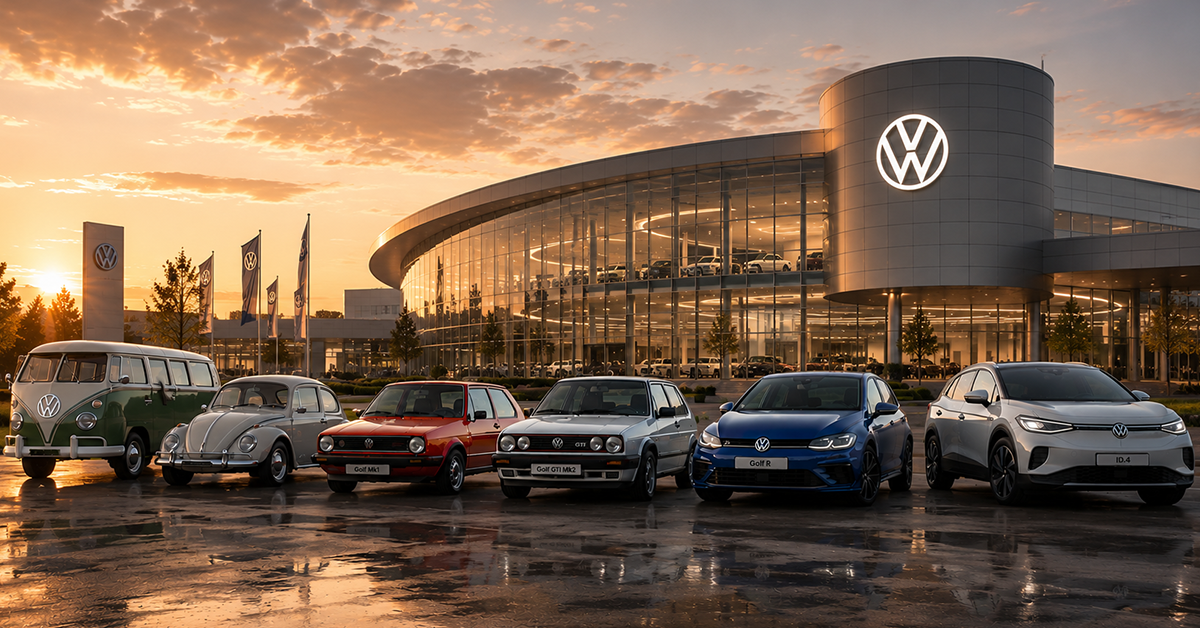
AI-generated concept illustration — Volkswagen brand overview. | Rev N Rise
Volkswagen is Germany's most important car brand and the flagship of one of the world's largest automotive groups. The name means "people's car" — and for nearly 90 years, that is exactly what Volkswagen has built: practical, reliable, well-engineered cars for ordinary buyers. From the original Beetle to the Golf GTI to the electric ID range, Volkswagen has been at the centre of automotive culture in Europe and globally for generations.
Volkswagen was established in 1937 in Wolfsburg, Germany, with a mission to produce an affordable car that ordinary German families could buy. The car developed for this purpose — the KdF-Wagen, later renamed the Volkswagen Beetle — was designed by Ferdinand Porsche and became one of the most iconic and enduring vehicles in automotive history. Over 21 million Beetles were produced between 1938 and 2003, making it the best-selling single car model in history at the time of its discontinuation.
After World War II, Volkswagen rebuilt under British supervision at the Wolfsburg factory before returning to German control. The Beetle became a global cultural phenomenon through the 1950s and 1960s — particularly in the United States, where it was embraced as an antidote to the excess of American cars. The Volkswagen Transporter van arrived in 1950 and became equally iconic. By the early 1970s, Volkswagen was one of the largest car manufacturers in the world, but the Beetle's age was beginning to show against modern front-wheel-drive competitors.
The Golf arrived in 1974 as the Beetle's successor — a front-wheel-drive hatchback designed by Giorgetto Giugiaro that established a new template for mainstream European cars. It was practical, efficient and well-engineered. The Golf GTI, introduced in 1976, went further — a performance version with a fuel-injected engine and firmer suspension that invented the hot hatch segment and created a car culture template that every manufacturer has attempted to replicate in the 50 years since. The Polo arrived in 1975. Both the Golf and Polo remain in production today, making them among the longest-running nameplates in automotive history.
In 2015, Volkswagen's Dieselgate emissions scandal caused significant reputational damage. It was revealed that Volkswagen had installed defeat device software in diesel engines to falsify emissions test results across approximately 11 million vehicles worldwide. The fallout included billions of dollars in fines, legal settlements and the forced resignation of CEO Martin Winterkorn. The scandal prompted a company-wide pivot toward electrification that produced the MEB platform, the ID range and one of the most ambitious EV investment programmes in the industry.
Volkswagen is not just a car brand — it is the flagship of one of the world's most powerful automotive conglomerates. The Volkswagen Group owns 12 brands: Volkswagen, Audi, Porsche, SEAT, Cupra, Skoda, Lamborghini, Bentley, Bugatti, Ducati motorcycles, MAN trucks and Scania commercial vehicles. Combined, the group sells over 9 million vehicles per year globally and employs over 650,000 people. The group's structure allows brands to share platforms and technologies at enormous scale while maintaining separate identities and price positioning — Skoda at the affordable end, Bentley and Bugatti at the ultra-luxury extreme.
Volkswagen's 2026 lineup balances petrol, hybrid and electric options across multiple segments, with the electric ID range now firmly established alongside the traditional combustion models.
No single model better defines Volkswagen's place in automotive culture than the Golf GTI. Introduced in 1976 — originally as an internal project that Volkswagen's management nearly cancelled — it combined a fuel-injected 1.6-litre engine with sports suspension, front disc brakes and a distinctive tartan interior in a practical five-door body. The result was a car that could be driven hard on a twisting road and used sensibly for everyday errands without compromise. It created the hot hatch segment and has been continuously refined through eight generations ever since. Every hot hatch sold today — from the Renault Clio RS to the Honda Civic Type R — exists because the Golf GTI proved the concept in 1976. The GTI remains the benchmark against which all others are measured.
Volkswagen occupies a unique position in the automotive market — premium enough to charge above-average prices, practical enough to justify them. The Golf has defined the benchmark for compact cars for 50 years. Volkswagen's engineering precision — particularly in terms of interior quality, ride comfort and long-distance refinement — consistently exceeds what buyers expect at the price point. The VW Group's scale gives the Volkswagen brand access to the same platforms and technologies as Audi and Porsche, deployed at significantly lower prices. And the ID range — particularly the ID. Buzz, which successfully revived the Transporter van's iconic status in electric form — demonstrates that Volkswagen can build emotionally resonant electric cars as well as rational ones.