 Brands
Bugatti — History, Models and Everything You Need to Know
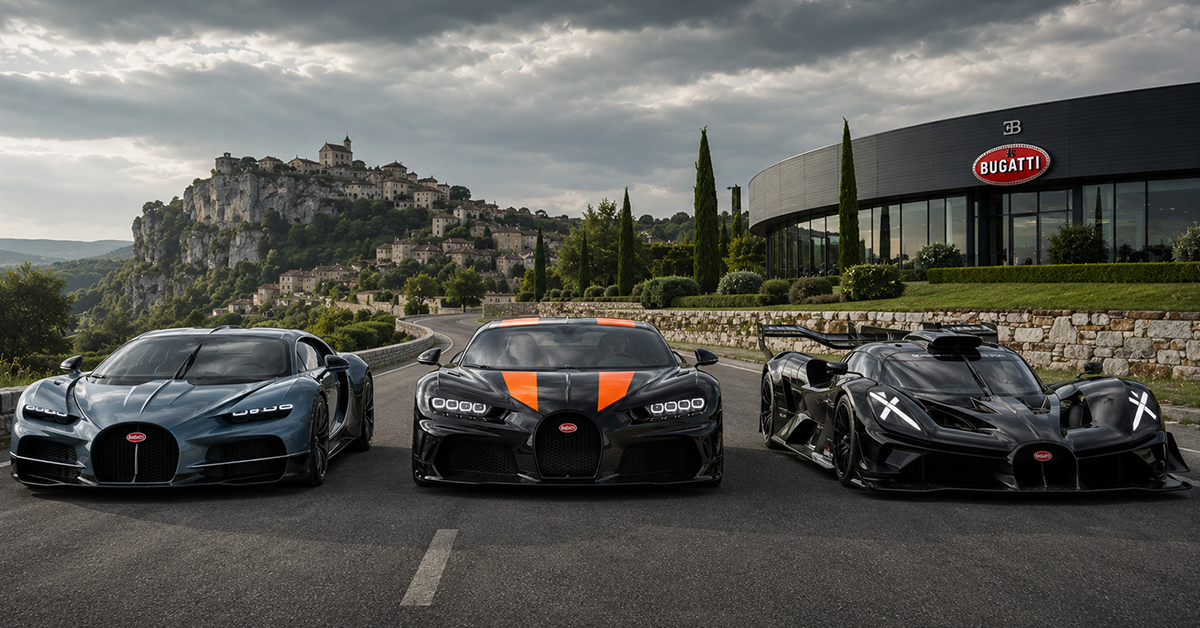
AI-generated concept illustration — Bugatti brand overview. | Rev N Rise
Bugatti builds the fastest, most extreme and most engineeringly extraordinary cars in the world — the brand responsible for the first production car to exceed 250mph, then 300mph, and now the hybrid V16-powered Tourbillon that represents the absolute pinnacle of what internal combustion engineering can achieve before electrification fully takes over. Founded by Ettore Bugatti in 1909, revived by Volkswagen in the early 2000s and now under Rimac's stewardship, Bugatti exists in a category entirely its own.
Ettore Bugatti — an Italian-born engineer working in eastern France — founded his automobile company in 1909 in Molsheim, then part of Germany following the Franco-Prussian War (the region returned to France after World War I). Bugatti's pre-war and interwar cars were renowned for elegant engineering and motorsport success — the Bugatti Type 35 won over 1,000 races during the 1920s, making it one of the most successful racing cars in history. The Type 41 Royale was an extraordinarily extravagant luxury car built for European royalty, of which only six were ever made.
The original Bugatti company ceased automotive production after World War II, and the name lay largely dormant for decades aside from sporadic revival attempts. Volkswagen Group acquired the Bugatti brand in 1998 and committed enormous resources to relaunching it with an entirely new philosophy: build the most technically extreme car the world had ever seen, regardless of cost. The result, after years of development, was the Veyron — launched in 2005.
Bugatti's ownership structure evolved further in 2021 when Rimac Group — the Croatian electric hypercar and technology company backed by Porsche — formed a joint venture with Volkswagen's Bugatti operations, creating Bugatti Rimac. This partnership combined Bugatti's extreme combustion engineering heritage with Rimac's cutting-edge electric powertrain technology, setting the stage for the hybrid Tourbillon that followed.
The Bugatti Veyron represented one of the most extreme engineering undertakings in automotive history. Its quad-turbocharged 8.0-litre W16 engine — essentially two V8s joined at a common crankshaft — produced 1,001 horsepower, an output figure that no production car had previously approached. Cooling that much power required ten radiators. The Veyron became the first production car to exceed 250mph, recording 253.81mph in 2010 with the Super Sport variant. Volkswagen reportedly lost money on every single Veyron sold — the engineering cost of achieving that performance exceeded what even a $1.7 million price tag could recover. The Veyron was not built to be profitable. It was built to prove that no limit was beyond reach.
The Chiron succeeded the Veyron in 2016, refining the W16 formula further. The Chiron Super Sport 300+ became the first production car to exceed 300mph in a controlled 2019 test, reaching 304.77mph — a speed record that remains one of the most remarkable achievements in automotive engineering history.
The Bugatti Tourbillon, unveiled in 2024, represents Bugatti's most significant philosophical shift since the Veyron. Rather than continuing with the W16 engine that had defined the brand for two decades, the Tourbillon uses a newly developed naturally aspirated V16 engine combined with electric motors for a combined output of 1,800 horsepower. The name Tourbillon — borrowed from the most complex and prestigious mechanism in luxury watchmaking — reflects Bugatti's ambition to position the car as much as a piece of precision craftsmanship as a performance machine. The interior dashboard uses physical, mechanical gauges with genuine moving components rather than digital displays — a deliberate rejection of screen-based technology in favour of horological-grade mechanical artistry.
Bugatti occupies a category that exists almost entirely alone — manufacturers like Koenigsegg and Rimac compete on raw speed, and manufacturers like Pagani compete on artistic craftsmanship, but no other brand combines both extremes with Bugatti's level of consistency and historical pedigree. The Tourbillon's hybrid V16 represents Bugatti's answer to the central question facing every hypercar manufacturer: how do you maintain the emotional and mechanical drama of extreme performance while satisfying increasingly stringent emissions regulations? Bugatti's answer — keep the combustion engine but supplement it with electric power rather than replacing it entirely — preserves the brand's core identity while extending its relevance into a new regulatory era. For the small number of buyers who can afford a Bugatti, the brand remains the definitive statement of automotive engineering taken to its absolute limit.