 Brands
Pagani — History, Models and Everything You Need to Know
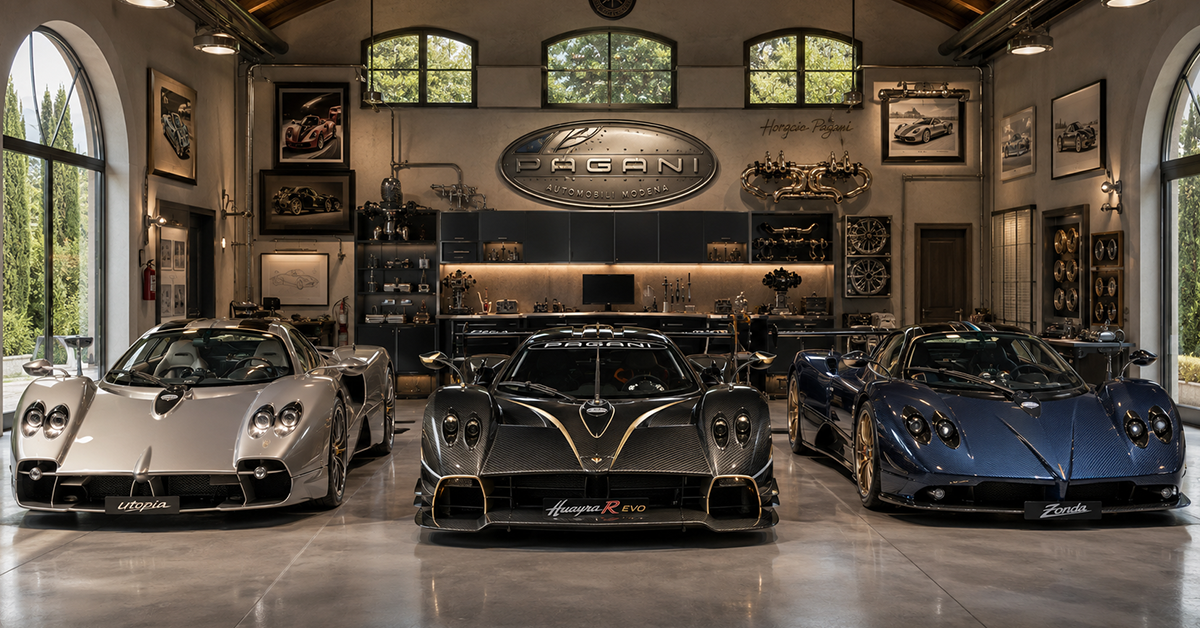
AI-generated concept illustration — Pagani brand overview. | Rev N Rise
Pagani is the smallest and most artistically obsessive hypercar manufacturer in the world — a company founded by a single visionary engineer who believes that a car can be both a precision machine and a genuine work of art. Based in a tiny Italian town near Modena, Pagani produces only a handful of cars each year, each one taking thousands of hours to hand-build and costing well over $2 million. No manufacturer obsesses over detail quite like Pagani does.
Horacio Pagani was born in Argentina and moved to Italy in 1982 specifically to work in the heart of the country's supercar industry. He joined Lamborghini, where he developed the carbon fibre body for the Countach Evoluzione and rose to become head of the composite materials department. Frustrated that Lamborghini would not commit to using carbon fibre more extensively in production, Pagani left in 1991 to found his own company — Pagani Automobili — in 1992, in the small town of San Cesario sul Panaro near Modena.
Pagani's vision was unusually specific: to combine art, science and engineering into a single discipline, treating a car as seriously as a sculptor treats a sculpture. He spent seven years developing his first car before it launched — an extraordinary length of development time for a tiny independent manufacturer with minimal resources. The Zonda finally launched in 1999, powered by a Mercedes-AMG V12 engine, having been built with a level of obsessive detail that established Pagani as a serious force in the hypercar world despite the company's tiny scale.
The Zonda remained in production for an extraordinarily long time — variants and special editions continued until 2017, with the final cars selling for many millions of dollars. The Huayra, launched in 2011, succeeded the Zonda and introduced active aerodynamics that adjusted automatically to optimise downforce and drag in real time. The current Utopia, launched in 2022, represents Pagani's latest flagship — a return to a more analogue, driver-focused philosophy after the technologically dense Huayra.
What separates Pagani from every other hypercar manufacturer is the literal application of art to engineering. Horacio Pagani studied the work of Leonardo da Vinci extensively and has spoken at length about applying da Vinci's principles — where engineering and aesthetics are inseparable, where a beautiful solution is often the correct solution — to automotive design. The interior of every Pagani features exposed, polished titanium gear linkages that function as sculptural objects as much as mechanical components. Carbon fibre weave patterns are deliberately exposed and oriented for visual effect as well as structural performance. Even the bolts and fasteners are designed and finished as carefully as the bodywork. Each Pagani takes thousands of hours to construct, with most major components fabricated and finished by hand rather than mass-produced.
Pagani's competitive position is unique even within the rarefied hypercar world — it is a company so small that it produces fewer cars in a year than Ferrari or Lamborghini produce in a single day, yet it competes directly for the same ultra-wealthy clientele. That scale enables a level of personalisation and craftsmanship that even Bugatti and Koenigsegg struggle to match. Where most hypercar manufacturers pursue ever-higher horsepower figures and ever-faster acceleration times, Pagani's philosophy prioritises beauty, mechanical artistry and the emotional experience of owning something genuinely handcrafted. A Pagani buyer is purchasing a relationship with Horacio Pagani's design team as much as a car — most clients visit the factory multiple times during the build process to personally select materials and finishes. In a hypercar segment increasingly defined by electric powertrains and digital performance, Pagani's continued commitment to naturally aspirated and lightly turbocharged combustion engines, manual gearboxes and analogue driving experiences makes it one of the last true holdouts of a particular kind of automotive romance.