 Brands
Toyota Supra — The JDM Legend That Keeps Coming Back
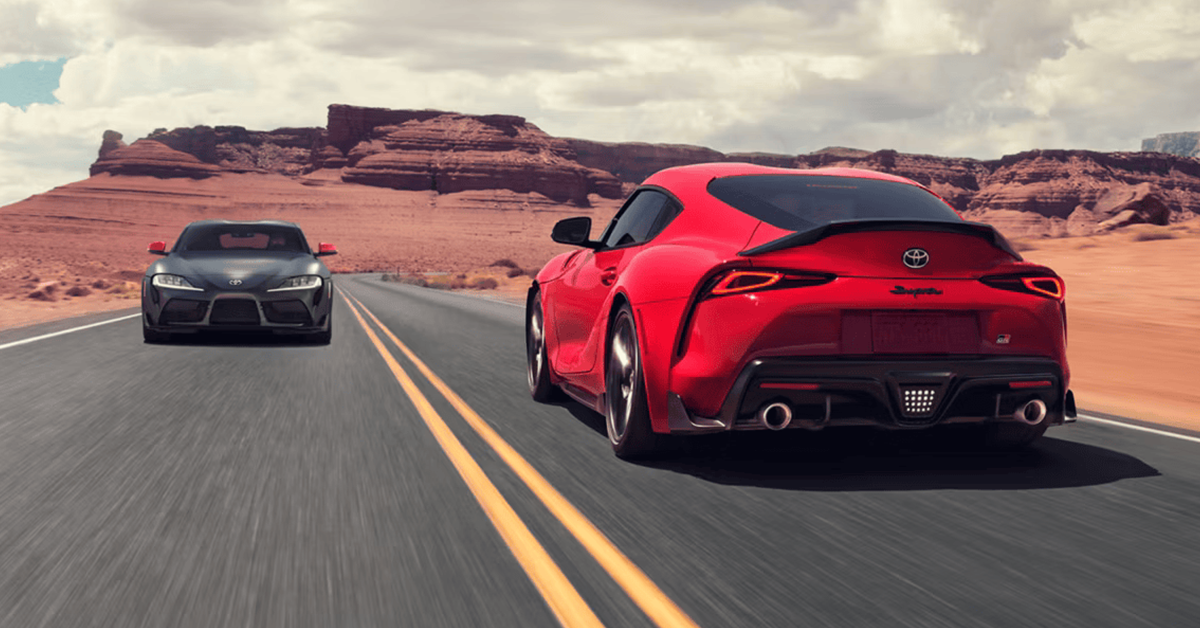
Official press image of the Toyota Supra. | © Toyota Motor Corporation
Few nameplates in Toyota’s entire history have had a stranger, more emotionally complicated relationship with their own fans than the Supra. It has been reborn, retired, and reborn again — each return greeted with a mixture of genuine excitement and instinctive suspicion from an enthusiast base that has learned not to take the car’s continued existence for granted. In 2026, that pattern repeats one more time. Production of the current generation ends this spring, and once again, nobody outside Toyota knows exactly when, or in what form, the Supra will return.
The Supra name first appeared in Japan in 1978, not as a standalone model but as the Celica XX — a longer, more powerful grand tourer variant of the standard Celica, built specifically to accommodate a smooth inline-six engine in place of the regular car’s four-cylinder. It reached North America for the 1979 model year badged as the Celica Supra, distinguished by its stretched body and six-cylinder power. Through the A60 generation, the Supra remained closely tied to the Celica nameplate — a related but distinct performance flagship rather than a fully independent model.
That changed with the A70 generation, launched in the mid-1980s, when Toyota finally split the Supra onto its own dedicated rear-wheel-drive platform, separate from the front-wheel-drive Celica it had originated from. This was the moment the Supra genuinely became its own car rather than a dressed-up variant of something else — establishing the rear-drive, turbocharged inline-six identity that would define every generation that followed.
If any single generation explains why the Supra name still commands this much attention decades later, it is the A80, sold from 1993 to 2002. Powered by Toyota’s now-legendary 2JZ-GTE — a twin-turbocharged 3.0-litre inline-six — the Mk4 Supra became one of the most celebrated Japanese performance cars ever built, and remains the generation tuners and collectors alike treat with genuine reverence. The 2JZ’s reputation rests specifically on its structural over-engineering: its cast-iron block and forged internals were built with such generous safety margins that tuners routinely push the engine to two, three, even four times its factory power output while retaining the original block internals — a level of tunability that has made the 2JZ-powered Mk4 a benchmark reference point in performance tuning culture for over three decades, well beyond Toyota’s own involvement with the car.
The A80’s production ended in 2002, and for the next 17 years, the Supra name simply did not exist on any new car. That gap became, in its own way, part of the legend — a nameplate frozen at its most celebrated moment, discussed and mythologised by an entire generation of enthusiasts who had never been able to buy one new.
When Toyota finally revived the Supra for the 2019 model year, it did so through a genuinely unusual arrangement: a co-development partnership with BMW, sharing its platform, chassis and drivetrain with the BMW Z4 roadster. The two cars were built on the same production line at the Magna Steyr plant in Graz, Austria. Toyota led exterior styling and tuned the car’s specific driving character, while BMW supplied the underlying engineering, including the turbocharged B58 inline-six engine at the heart of every A90 Supra sold.
The arrangement proved genuinely controversial among purists, who questioned whether a Supra built on BMW mechanicals could legitimately carry the name at all — a debate that has followed the A90 through its entire production run, generating a steady stream of good-natured “it’s just a BMW” commentary online alongside more considered professional praise for how the car actually drives. Offered exclusively with rear-wheel drive and a choice of a six-speed manual or eight-speed ZF automatic, the A90 also briefly offered a 2.0-litre turbocharged four-cylinder variant producing 255 horsepower between 2021 and 2024, before that entry-level option quietly disappeared from the US lineup.
Toyota has officially confirmed that Supra production ends in March 2026 at the Graz plant — the same facility building the BMW Z4, which is ending production simultaneously. The reason is structural rather than a statement about the Supra’s popularity: with BMW discontinuing the Z4, the shared platform and production line the current Supra depends on simply ceases to exist. Toyota has been explicit that this is not intended as a permanent end for the nameplate, but the company has not confirmed a timeline, a platform, or even whether a future Supra would continue the BMW partnership or return to a fully independent Toyota design.
To mark the occasion, Toyota released the GR Supra MkV Final Edition. The US-market car uses the standard 382 horsepower and 368 lb-ft turbocharged inline-six, but adds genuine mechanical upgrades — retuned suspension and upgraded brakes — alongside a carbon-fibre ducktail spoiler, elevated front tyre spats and front wheel arch flaps, available with either the automatic or the six-speed manual. US pricing starts around $67,950 to $69,085. A considerably more extreme version, the A90 Final Edition, was built exclusively for Europe and Japan in a limited run of just 300 units — using a revised version of the same engine producing 429 horsepower and 420 lb-ft, paired exclusively with the six-speed manual, and finished with an aero package designed by Toyota Gazoo Racing’s European division, KW suspension, Akrapovič titanium exhaust, Brembo brakes, Recaro seats and Michelin Pilot Sport Cup 2 tyres.
Toyota’s own product planning leadership has been careful not to promise too much about the Supra’s future, while also making clear the nameplate is not being permanently retired. Cooper Ericksen, senior vice president of Product Planning and Strategy for Toyota Motor North America, has stated: “It would be logical that we would have a next-gen Supra. But when and how is still TBD. Definitely there will be a gap. The question is how big will that gap be. It is our goal to have a gap that is significantly less [than the last one].” Given that the previous gap between generations ran a full 17 years, that is a genuinely low bar to clear — but it is also the clearest official signal yet that the Supra name is expected to return in some form, rather than disappear permanently the way the Celica or MR2 eventually did.
Speculation about the sixth generation is already circulating, with at least one Japanese publication reportedly suggesting a future Supra could move to a mid-engined, hybrid four-cylinder layout producing around 500 horsepower — a configuration that, if accurate, would represent the most radical structural change in the nameplate’s history. None of this has been confirmed by Toyota, and until an official platform partner or in-house programme is announced, the honest answer is that nobody outside Toyota’s own product planning team knows what the next Supra will actually be, or when it will arrive.