 Brands
Toyota Century — Japan's Most Exclusive Car Isn't a Lexus
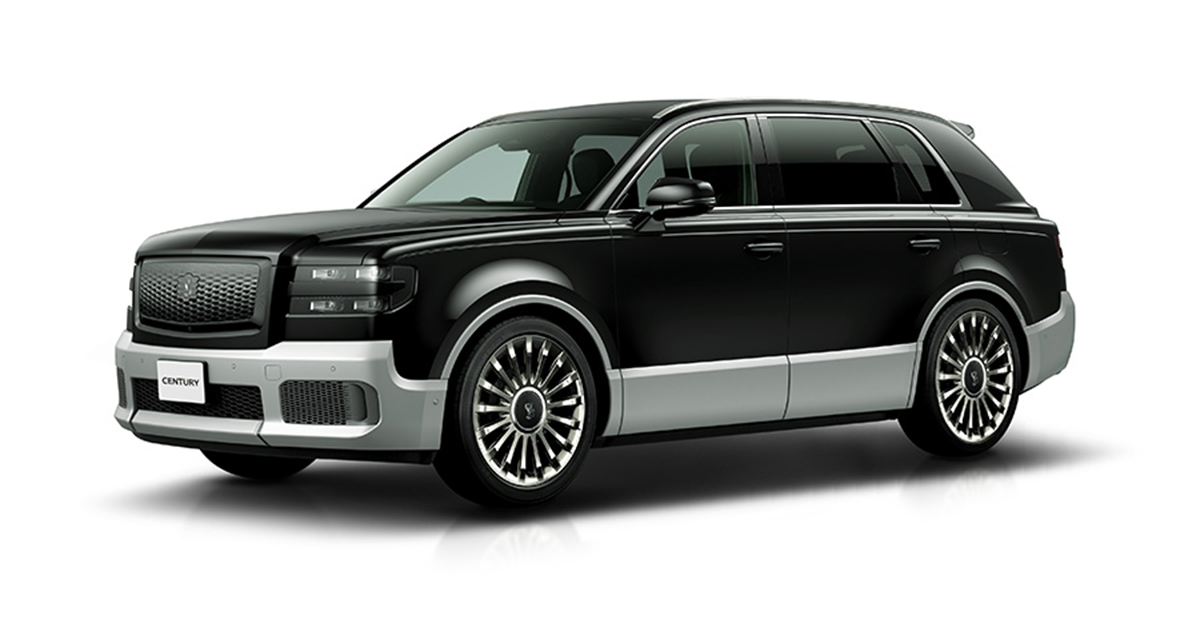
Official press image of the Toyota Century. | © Toyota Motor Corporation
Ask most drivers outside Japan what Toyota’s most prestigious model is, and they will say Lexus. They would be wrong. Sitting entirely outside Toyota’s regular lineup, sold through select dealers only in Japan, and carrying a phoenix emblem in place of the familiar three-oval badge, the Century has been the genuine top of Toyota’s hierarchy since 1967 — a car built specifically for the Emperor of Japan, senior government ministers and the country’s most powerful business leaders. It has never chased volume, never sought international fame, and has spent nearly six decades deliberately avoiding exactly the kind of attention every other luxury flagship courts.
The Century debuted in 1967, timed to commemorate the 100th birthday of Sakichi Toyoda, the founder of Toyota Industries and the man whose earlier textile loom business eventually gave rise to the entire Toyota Motor Corporation. At the time, Japan’s market for chauffeur-driven executive cars was dominated entirely by Western luxury brands — and Toyota set out specifically to build something that could compete on Japan’s own terms, incorporating traditional Japanese design philosophy and a human-centred approach to achieve a level of quietness and comfort no imported car could match. It was never conceived as a volume product. It was conceived as the ultimate domestic transport for Japan’s most elite figures — the Emperor, top-ranking government officials, and the chairmen of Japan’s largest corporations.
For decades, the Century remained something close to Japan’s best-kept automotive secret — a symbol of extraordinary wealth and status that deliberately avoided the visual flamboyance Western luxury brands relied on. There is no shouting grille, no aggressive styling, no badge-engineering exercise borrowed from a lesser model. The Century was, and remains, Toyota’s answer to a very specific question: what does true prestige look like when it refuses to announce itself?
The first-generation Century ran for an extraordinary thirty years, powered across its lifespan by 3.0, 3.4 and 4.0-litre V8 engines — itself a genuine rarity, since the Century was one of the very few Japanese cars of its era to use a V8 at all. When the second-generation Century (G50) finally arrived in 1997, it introduced something no other mass-produced Japanese passenger car has ever used before or since: a genuine 5.0-litre V12 engine, internally designated the 1GZ-FE. Producing 276 horsepower and approximately 481 Nm of torque — deliberately capped under Japan’s gentleman’s agreement on power output, an informal industry-wide ceiling manufacturers observed at the time — the engine was engineered specifically around silence and smoothness rather than outright performance, carrying between 4,500 and 6,500 pounds of car so quietly that owners and drivers reportedly cannot feel it working under load.
A rare CNG-fuelled variant, the 1GZ-FNE, was built exclusively for the small number of Century units sent abroad for ambassadorial and diplomatic use. Fuel economy was never remotely the point — the G50’s V12 typically returns around 11 mpg, against roughly 19 mpg for the earlier V8 generation, a figure the original target buyer never once considered relevant to the purchase decision.
The current, third-generation Century debuted in 2018, moving away from the V12 in favour of a plug-in hybrid V8 system — the 2UR-FSE, a 5.0-litre V8 hybrid producing approximately 425 horsepower — a genuine step toward modern efficiency and environmental performance without abandoning the effortless, silent power delivery the nameplate has always been built around. This generation deepened Toyota’s explicit embrace of Omotenashi — the Japanese concept of hospitality — as the car’s central design philosophy. Every mechanical detail, down to the door hinges and seat mechanisms, is engineered specifically to operate with exceptional smoothness and silence, treating the sound and feel of the car’s operation as inseparable from the comfort of the passenger being carried.
The Century has almost no conventional trim ladder in the way most cars structure their lineup. Toyota builds it essentially as one car, with wheelbase length, rear seat packages and engine choice serving as the primary points of differentiation rather than a base model climbing toward a loaded flagship. Special-order configurations exist specifically for the Imperial Household — vehicles the general public, regardless of budget, will never be able to purchase.
A new chauffeur-driven vehicle to meet the demands of a new age, developed under the concept of ‘The Chauffeur.’
— Toyota Motor Corporation, official global newsroom, September 2023In September 2023, Toyota unveiled an entirely new interpretation of the Century nameplate: a full-size SUV, officially unveiled at Toyota City and confirmed through the company’s own global newsroom, though Toyota notably never used the word “SUV” anywhere in its official release. Built at the Tahara Plant in Japan, the Century SUV measures a genuinely enormous 5,205mm (204.9 inches) long, 1,990mm wide and 1,805mm tall, riding on a 2,950mm wheelbase and weighing approximately 2,570 kilograms (5,665 lbs). Power comes from a 3.5-litre V6 plug-in hybrid powertrain, and the cabin seats just four passengers rather than the traditional five — a deliberate choice prioritising space and comfort for two rear occupants over raw capacity.
Rear-seat access is treated with the same ceremonial priority as the rest of the car: doors open to a wide 75-degree angle, grab handles are fitted to the C-pillars, and electrically deployable side steps assist entry and exit. Toyota confirmed the Century SUV would be sold only through select dealers in Japan, with a deliberately restrained production target of just 30 units per month from the Tahara plant — making it, at a starting price of 25 million yen (approximately $170,000 USD), the single most expensive new Toyota passenger vehicle ever offered, more costly even than the Century sedan itself.
Toyota’s ambitions for Century have continued to expand. At the 2025 Japan Mobility Show, the company revealed a Century Coupe concept — presented explicitly as a “One of One” showcase rather than a confirmed production vehicle. Toyota executives have indicated that public response to the concept could influence whether a production version eventually reaches customers, with some speculation pointing toward a possible 2027 launch to coincide with the Century nameplate’s 60th anniversary — though Toyota has not confirmed any production timeline, and no powertrain specifications have been released for either the concept or any hypothetical production model. Together with the sedan and SUV, the coupe concept signals that Toyota now views Century less as a single flagship model and more as a standalone ultra-luxury sub-brand positioned genuinely above Lexus in prestige and exclusivity — Japan’s own answer to what Rolls-Royce and Bentley represent in the West, built entirely on Toyota’s own terms.