 Brands
Toyota MR2 — The Mid-Engine Sports Car Toyota Never Replaced
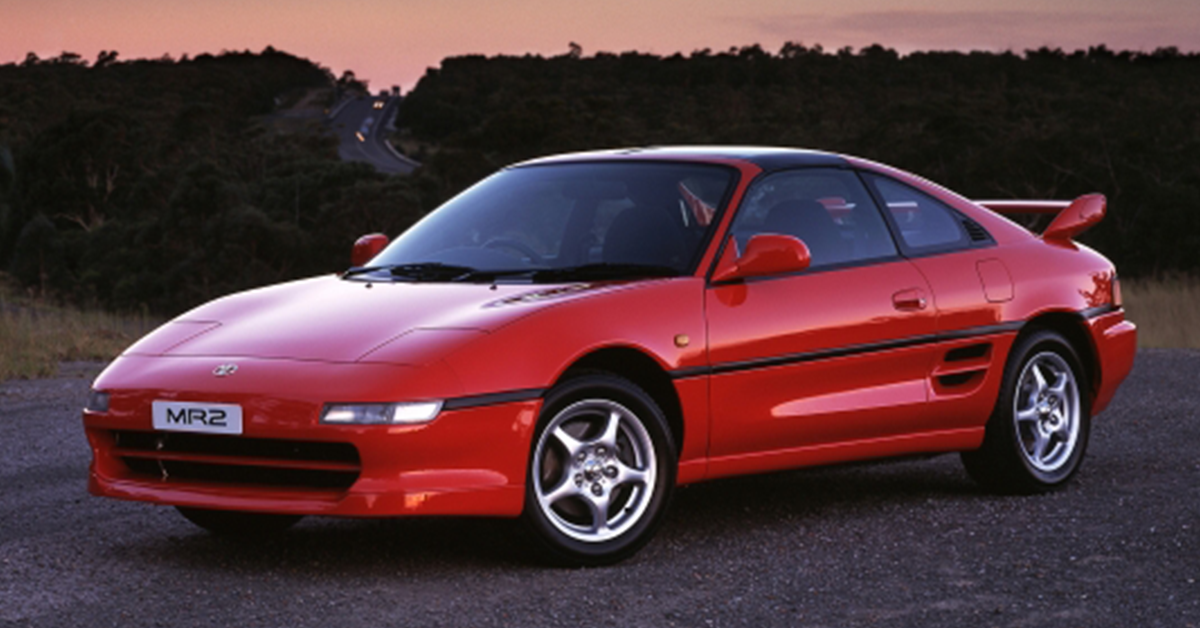
Official press image of the Toyota MR2. | © Toyota Motor Corporation
Toyota built exactly three generations of a genuine mid-engine, rear-wheel-drive two-seater badged MR2 between 1984 and 2007, and then simply stopped. No fourth generation followed. No direct spiritual successor has ever been announced. What remains is one of the most technically interesting small sports cars any mainstream manufacturer has produced — a car that changed its entire personality twice across its lifespan, and left behind an enthusiast and tuning following that has, if anything, grown stronger in the two decades since Toyota walked away from the concept entirely.
The first-generation MR2, internally coded AW11, launched in June 1984 as Toyota’s entry into the early-1980s wave of compact, affordable sports cars alongside rivals like the Pontiac Fiero, Fiat X1/9 and Honda CR-X. Its wedge-shaped body with pop-up headlights concealed something genuinely unusual for a mainstream manufacturer’s sports car of the era — a chassis tuned in direct collaboration with Lotus engineer Roger Becker, giving the AW11 handling characteristics closer to a genuine European sports car than most contemporaries expected from Toyota.
At roughly 2,000 pounds, the AW11 was powered by a 1.6-litre 4A-GE inline-four producing between 112 and 128 horsepower depending on market, with a supercharged 4A-GZE variant introduced in 1986 pushing that to 145 horsepower and requiring a strengthened transaxle to handle the additional torque. 0–60mph arrived in a modest 8.5 to 9.0 seconds — unremarkable by any performance measure, but the AW11’s genuine appeal was never about outright speed. It was about steering feel and mid-corner rotation, delivered by a car light enough and balanced enough to make even modest power feel genuinely engaging. Japanese-market buyers additionally had access to G-Limited and Super Edition trims with higher equipment levels that never crossed the Pacific to US showrooms.
The second-generation MR2, coded SW20, launched in 1989 and represented a significant departure from the AW11’s go-kart simplicity. It grew 350 to 400 pounds heavier, gained a roomier cabin and a stiffer body structure, and adopted styling — led by a design team under Kunihiro Uchida — aggressive and exotic enough that the SW20 quickly earned the enthusiast nickname “baby Ferrari.” At 245mm longer and 30mm wider than the AW11, with an 80mm longer wheelbase and sitting 10mm lower, the SW20 looked considerably more serious than its predecessor — and with the optional 2.0-litre 3S-GTE turbocharged engine, it genuinely was. US-market Turbo and GT-S variants produced around 200 horsepower, while late Japanese-market cars fitted with the upgraded CT20b turbocharger reached as high as 245 horsepower, delivering a genuine 0–60mph time of approximately 5.8 seconds.
The SW20’s enduring reputation problem — and it is a genuine one, well documented by Japanese and American automotive press throughout the early 1990s — was snap oversteer on early Rev1 cars. A rearward weight bias combined with tyres too narrow for the chassis’s actual grip ceiling meant the car could rotate suddenly and unpredictably at the limit, catching unprepared drivers out. Toyota did not ignore the problem: across five separate mid-life chassis revisions between the 1992 facelift and further updates through 1996 and beyond, the company progressively corrected the issue through damper tuning, aerodynamic changes and revised suspension geometry. Later Rev3 through Rev5 Japanese-market cars, running the correct staggered tyre setup with proper alignment, behave in a genuinely predictable manner — though the SW20’s early reputation has followed the car ever since, fairly or not.
The US lost access to the turbocharged 3S-GTE engine entirely after 1995, when Toyota pulled the Turbo variant from the American market while Japan continued offering it through the end of SW20 production in 1999. The rarest factory-built SW20 variant is the TRD2000GT — a widebody conversion Toyota Racing Development sold as a kit through Japanese dealers to SW20 owners willing to commit to the upgrade, now considered the single most collectible factory-blessed MR2 variant in existence.
The third generation was intended to break the cycle of growth seen with the SW20 — to recapture the spirit of the nimble original by shedding weight, complexity and even practicality.
Revealed in October 1999, the third-generation MR2, coded ZZW30, was a deliberate reset. Under chief engineer Tadashi Nakagawa, Toyota made the explicit decision to move against the industry-wide trend toward larger, heavier cars, instead stripping the concept back toward the AW11’s original lightweight philosophy. The rear trunk and the fifth structural bulkhead were removed entirely to simplify construction and reduce weight, and for the first time in the model’s history, the MR2 became convertible-only — the coupe and T-top body styles Toyota had offered on both previous generations were dropped completely. At under 960 kilograms (2,116 lbs), the W30 was genuinely lighter than the SW20 that preceded it, powered by a 1.8-litre 1ZZ-FE inline-four producing 138 horsepower — no turbocharged variant was ever offered for this generation.
The car was sold under three different names depending on market: MR-S in Japan, following the 1997 MR-S concept that previewed its design, MR2 Spyder in the United States, and MR2 Roadster in Europe — all the same car under different regional badging conventions. Positioned against rivals like the Porsche Boxster and Mazda MX-5, the W30 earned the informal nickname “Baby Boxster” among enthusiasts and press alike. Toyota’s strategic bet on simplicity and lightness against Honda’s rival S2000 — a 240-horsepower, redline-chasing engineering showcase — ultimately did not pay off commercially. North American sales totalled just 27,941 units before Toyota discontinued the model in the US market in 2005, with Japan and Europe continuing sales through July 2007, at which point MR2 production ended entirely and has never resumed.