 Brands
Toyota GT-One — The Race Car Disguised as a Road Car
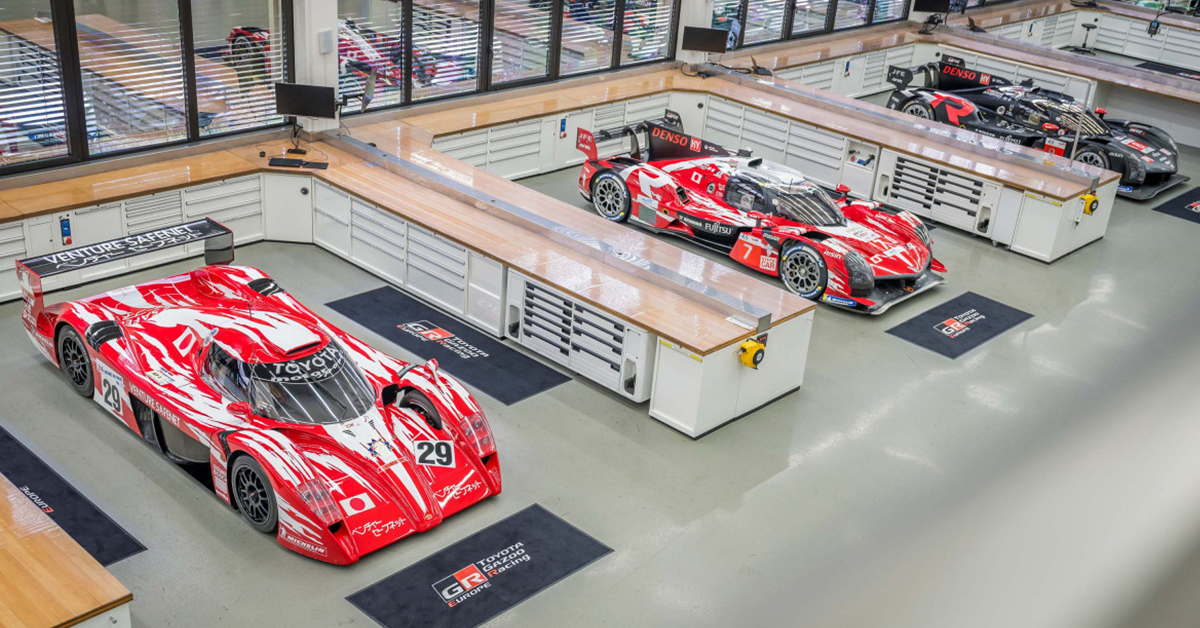
Official archival image of the Toyota GT-One (TS020). | © 24 Hours of Le Mans / Automobile Club de l'Ouest
Somewhere in a vault beneath the wind tunnel at Toyota’s motorsport division headquarters in Cologne, Germany, sits what may be the most extreme “road car” Toyota has ever built — a machine with a licence plate, a horn, and blinkers, produced in a run of just one or two examples, and never genuinely intended to be driven on a public road by anyone outside Toyota’s own engineering team. The GT-One exists because of a loophole in 1998 Le Mans regulations, and the story of how Toyota exploited that loophole says as much about the company’s competitive instincts as any production car it has ever sold.
By the mid-1990s, Toyota had already spent years chasing outright victory at the 24 Hours of Le Mans without success. Following the end of the Group C prototype era around 1994, Toyota shifted its approach to competing in production-based GT classes for 1995, pursuing two parallel strategies. The first was a heavily modified Toyota Supra, raced as the Supra LM with a turbocharged inline-four engine. The second was a purpose-built racing machine, developed from the underpinnings of the Toyota MR2 and known as the SARD MC8-R, requiring a small number of road-going versions to satisfy the homologation rules governing GT-class competition at the time.
Neither approach delivered the result Toyota was chasing. In late 1996, the company launched a dedicated programme with a singular goal: win Le Mans outright, whatever it took. That programme was based in Cologne under Toyota Team Europe, previously best known as Toyota’s rally division rather than its sports car racing arm, and was placed under the direction of French engineer Andre de Cortanze — the same designer responsible for the successful Peugeot 905 Le Mans prototype. Toyota Team Europe collaborated with the Italian constructor Dallara on the resulting car, a genuine departure from Toyota’s previous prototype and GT programmes, which had typically been built by Dome or SARD.
They developed consistent racing cars and designed the necessary road version so radically that it just barely received a licence, then rolled straight into their own museum.
The GT1 class regulations governing Le Mans in 1998 required that any competing manufacturer produce a genuine road-going version of its race car — complete with a second seat, blinkers, a horn and a licence plate, precisely the kind of everyday equipment a pure racing prototype has no use for. Other series enforcing GT1 rules, including the FIA GT Championship, mandated a full run of 25 road-legal examples before a manufacturer could compete. Le Mans, organised separately by the Automobile Club de l’Ouest (ACO), imposed no such volume requirement — instead demanding just a single road-legal example, with a homologation deadline vague enough that it was ultimately pushed to months after the race itself had already taken place.
Toyota, alongside rivals including Porsche and Nissan, exploited this loophole directly. Rather than genuinely developing a car intended for customer sale, Toyota built a dedicated racing machine first, and treated the single mandatory road car as an afterthought — engineered specifically to satisfy the letter of the regulation rather than any real intention of selling it to the public. The road version was unveiled during the last week of April 1998, mere weeks before that year’s race.
To make the race car street-legal, Toyota’s engineers made a series of deliberately minimal changes. Suspension pushrods were lengthened to increase ride height for public roads. Steel brake discs replaced the race car’s carbon units. A smaller 60-litre fuel tank, which doubled as a storage compartment, replaced the racing fuel cell. The engine received softer camshafts, revised inlet manifolds, remapped engine management software, two catalytic converters and a silenced exhaust system — bringing claimed output down to 550 horsepower, still an extraordinary figure for anything wearing number plates. Meshed grilles, required by law, were fitted over the car’s larger intake apertures, and custom helical gears replaced the race car’s straight-cut racing gearset to make the transmission tolerable for road use.
The race version, by contrast, used a 3.6-litre twin-turbocharged V8 producing figures reported between 600 and 651 horsepower depending on the specific year and configuration, paired with a genuine six-speed sequential semi-automatic transmission — conceptually similar to Formula 1 gearboxes of the era, though regulations still required a mechanical shift lever alongside the electronic system. The chassis was a single-moulded carbon-fibre composite structure with pushrod-actuated double-wishbone suspension front and rear. For the 1999 season, the car’s body evolved further — a larger front fender cutout, the removal of rear fender louvres, and a reduction in tyre size from 19 to 18 inches following regulation changes, alongside the removal of ABS, which had been present on the 1998 car.
The GT-One made its Le Mans debut in 1998, and came agonisingly close to delivering the victory Toyota had built the entire programme to achieve — ultimately, the best-placed GT-One that year finished ninth overall after reliability issues affected the leading cars. Toyota returned in 1999 with the revised TS020, and came even closer: car number 3, driven by Ukyo Katayama, Keiichi Tsuchiya and Toshio Suzuki, finished second overall — the closest the GT-One programme would ever come to the outright win it was purpose-built to deliver. Toyota’s disappointment at falling short a second time was, by contemporary accounts, considerable, particularly given how close the margin had been.
The GT-One never returned to Le Mans after 1999. Toyota’s prototype programme lay dormant for over a decade before the company committed to a fresh Le Mans effort, eventually returning with the hybrid-powered TS030 in 2012 — a car that would itself lead, years later, to Toyota’s first genuine Le Mans overall victories in the 2010s, finally delivering the result the GT-One programme had chased and narrowly missed twice.
Exactly how many road-legal GT-Ones exist remains slightly ambiguous depending on the source — most accounts describe a single example, though some references note two cars were built across the 1998 and 1999 homologation cycles. What is consistent across every account is that the car, or cars, were never genuinely offered for public sale. Toyota kept its GT-One road car specifically as a piece of motorsport history rather than a commercial product, storing it in a vault beneath the wind tunnel at its motorsport division’s Cologne headquarters — a fitting resting place for a machine that was always, honestly, a race car wearing the barest possible disguise of a road car.