 Brands
Toyota Land Cruiser — From "Toyota Jeep" to Global Icon
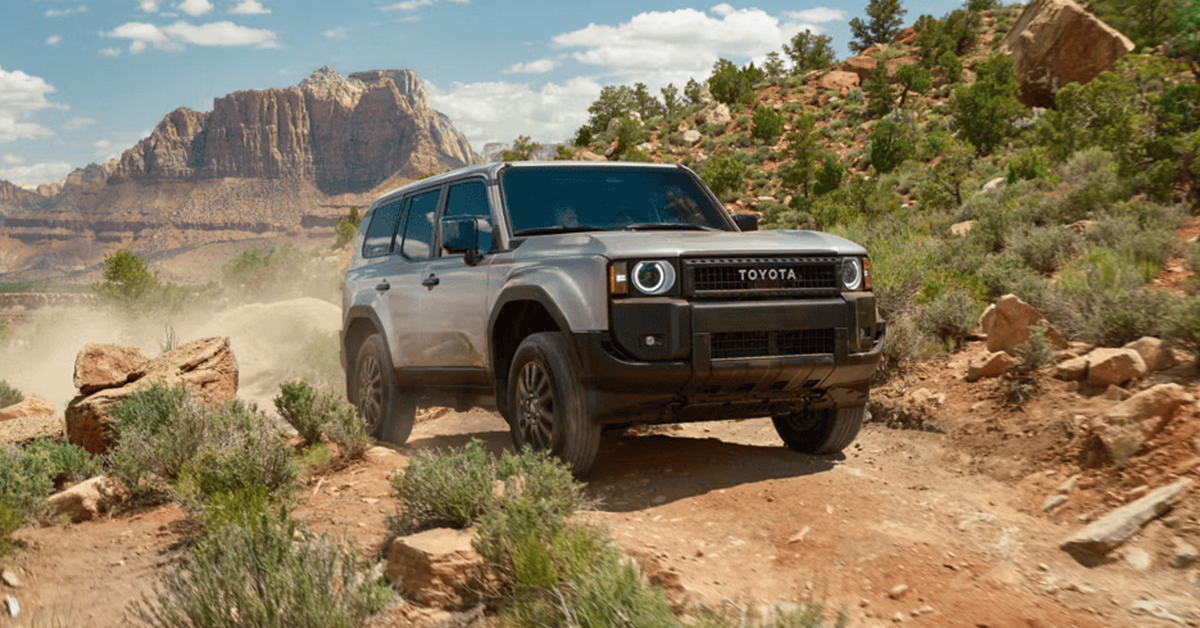
Official press image of the Toyota Land Cruiser. | © Toyota Motor Corporation
Before it was called the Land Cruiser, Toyota genuinely called its first serious off-roader the Toyota Jeep — a name lifted directly from a vehicle Toyota had reverse-engineered from a captured American Bantam during World War II. Willys-Overland, which owned the Jeep trademark, was not amused. Toyota renamed the vehicle, took a subtle nod at Britain’s Land Rover in the process, and spent the next 75 years building one of the most trusted, most globally significant off-road nameplates the automotive industry has ever produced.
The Land Cruiser’s origin traces back to World War II, when Japan captured an American Bantam Jeep during its occupation of the Philippines in 1941. Toyota reverse-engineered the design as the basis for a light military vehicle designated the Model AK, and when the company developed its production successor for Japan’s National Police Reserve in 1951, it initially called the resulting 4x4 the Toyota Jeep — a name that drew an immediate and entirely justified trademark objection from Willys-Overland, the company that actually owned the Jeep name.
Toyota renamed the vehicle in 1954, settling on Land Cruiser — a name that carried its own deliberate reference to the British Land Rover, then the dominant name in rugged 4x4 vehicles internationally. The earliest BJ series Land Cruiser used a 3.4-litre B-type inline-six engine and became, in 1951, the first vehicle to successfully climb to the sixth station of Japan’s Mount Fuji — a genuine feat of off-road capability that led directly to the vehicle’s adoption as an official patrol car by Japan’s National Police Agency, and set the template for the reputation the Land Cruiser has carried ever since.
The 20 Series, introduced in 1955, marked the Land Cruiser’s first deliberate shift toward civilian buyers and export markets — a more rounded, comfortable body replacing the purely utilitarian military-derived original, and the beginning of the Land Cruiser’s reputation spreading internationally as a genuine symbol of Toyota build quality and durability. The 40 Series, running from 1960 to 1986, became genuinely legendary in its own right — widely regarded as the definitive cross-country Land Cruiser of its era, earning international acclaim specifically for the combination of reliability, durability and off-road performance that has defined every subsequent generation.
The 50 Series, launched in 1967, introduced the first genuine station-wagon body style, trading some of the earlier models’ raw utility for meaningfully more interior space and comfort — a direct ancestor of the modern Land Cruiser’s eventual SUV format. The 60 Series that followed widened the vehicle’s track for improved stability and added genuinely comfort-focused equipment aimed squarely at private buyers rather than fleet or military use. Remarkably, the 70 Series, first introduced in 1984 as the direct heavy-duty successor to the original 40 Series, remains in production today in various global markets — a genuinely rare example of a nameplate spanning more than four decades of continuous manufacture without a fundamental structural break.
The full-size 200 Series Land Cruiser, Toyota’s flagship body-on-frame SUV, was discontinued in the United States after the 2021 model year. The decision reflected a genuinely difficult commercial reality: sales volume had declined significantly relative to the vehicle’s high price, and the Land Cruiser overlapped heavily with Toyota’s own Lexus LX, which offered a nearly identical platform with more luxury positioning and, for many buyers, a more compelling ownership proposition. Rather than genuinely disappear, Toyota brought the Land Cruiser nameplate back to the US market in 2024 — in a considerably smaller, more affordable form than the outgoing 200 Series had ever offered.
The current US-market Land Cruiser seats five across two rows rather than the previous generation’s three-row, seven-to-eight-passenger layout, and every 2026 model uses a single i-FORCE MAX hybrid powertrain — a turbocharged 2.4-litre four-cylinder paired with an electric motor, producing 326 horsepower, matched with standard full-time four-wheel drive, genuine locking differentials and a two-speed transfer case. The lineup is deliberately simple: just two trims, the value-focused 1958 — named for the year the Land Cruiser first arrived in America — and the better-equipped Land Cruiser trim.
The 2026 Land Cruiser’s base 1958 trim starts at approximately $57,200 before Toyota’s $1,495 destination charge, with the better-equipped Land Cruiser trim opening at roughly $63,275, and a $4,600 Premium Package available on the upper trim for buyers wanting the full equipment list. Fuel economy sits at approximately 22mpg city and 25mpg highway — genuinely competitive for a body-on-frame off-roader with this level of mechanical capability, thanks entirely to the standard hybrid assistance.
Globally, the Land Cruiser’s scale is genuinely difficult to overstate. Toyota had sold more than 11.3 million Land Cruisers worldwide as of June 2023, making it the company’s longest continuously running model series. The Middle East alone purchases roughly two-thirds of the outgoing 200 Series’s global sales volume — significantly more than the US market ever accounted for — and specialised regional variants exist for genuinely extreme conditions, including versions fitted with balloon tyres and auxiliary fuel tanks for Iceland and Greenland. From Australian outback stations to African farms to Middle Eastern desert crossings, the Land Cruiser’s reputation for going anywhere and simply not breaking down has made it, arguably, the single most globally trusted vehicle nameplate Toyota has ever produced.