 Brands
Toyota RAV4 — The Crossover That Dethroned the Ford F-150
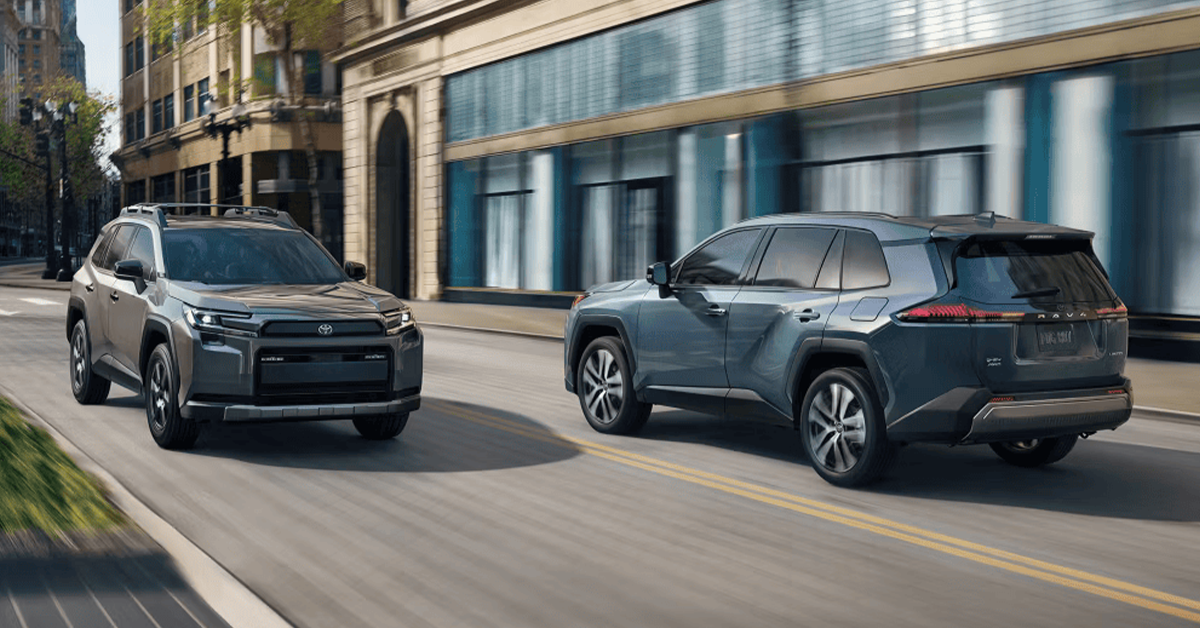
Official press image of the Toyota RAV4. | © Toyota Motor Corporation
For nearly four decades, one vehicle held the title of America’s best-selling: the Ford F-150. Trucks, sedans, entire product categories rose and fell around it, but the F-150 simply did not lose that top spot. In February 2025, it finally did — not to another truck, but to a compact crossover that began life in 1994 as a genuinely odd-looking, bug-eyed concept car nobody was certain would ever reach production. The Toyota RAV4’s rise from that uncertain beginning to America’s single best-selling vehicle is one of the more remarkable stories in the industry’s recent history.
The RAV4’s origin traces back further than most buyers realise — to the 1989 Tokyo Motor Show, where Toyota displayed a concept spelled out as the RAV-Four. It was a genuinely strange-looking thing, closer in spirit to a Suzuki Jimny crossed with a beach cruiser than anything resembling a modern SUV, built around monocoque unibody construction rather than the body-on-frame architecture every other Toyota off-roader used at the time. It took almost five years for that concept to reach production, finally launching in Japan and Europe in May 1994, before arriving in North America for the 1996 model year.
The name itself — RAV4 — is an abbreviation of “Recreational Active Vehicle with 4-Wheel Drive,” a name that has remained unchanged for over three decades despite the fact that, today, not every RAV4 variant actually comes equipped with four-wheel or all-wheel drive. The original three-door model launched with a 2.0-litre, 127-horsepower engine and permanent four-wheel drive running through a five-speed manual or four-speed automatic. Genuinely unusual for the era, Toyota also offered a proper two-door convertible variant with a soft-top roof — a body style discontinued after the first generation and never revived in any generation since.
What made the RAV4 genuinely significant is not simply that it sold well — it is that it is widely credited as the first modern compact crossover SUV, a body style that did not meaningfully exist before it and that virtually every manufacturer now competes in. Sharing its unibody platform with contemporary Corolla, Corona and Celica components rather than a heavy-duty truck chassis, the RAV4 delivered SUV-like ride height, cargo space and available four-wheel drive with genuinely car-like handling and efficiency — a combination that simply hadn’t been packaged this way before.
Growth was steady and substantial across every subsequent generation. The second generation, launched in 2000, retired the two-door body style entirely and introduced a more powerful 161-horsepower engine for 2004. The third generation added roughly 14 inches of length and more than 3 inches of width, alongside an optional third row for larger families — a genuine departure from the RAV4’s originally compact footprint. By 2020, global RAV4 sales had crossed 10 million units; today, that figure exceeds 15 million units sold across more than 180 countries, a scale matched by very few nameplates in automotive history.
In February 2025, the RAV4 achieved something genuinely unprecedented in modern American automotive history: it replaced the Ford F-150 as the best-selling vehicle in the United States, ending nearly four decades of the F-150 holding that position uninterrupted. The moment reflected a genuine, structural shift in American buying habits — away from full-size trucks and toward efficient, practical, right-sized crossovers — and cemented the RAV4’s position not merely as a successful SUV, but as the single most representative vehicle of what American car buyers actually want today.
The current, sixth-generation RAV4 debuted on 21 May, marking a full reset for the nameplate. The most significant change is also the simplest to state: Toyota dropped the gas-only engine entirely. Every 2026 RAV4 is sold exclusively as a hybrid or plug-in hybrid, with no conventional gasoline-only option available anywhere in the lineup for the first time in the model’s history. The standard hybrid produces 226 horsepower in front-wheel-drive form — 23 horsepower more than the outgoing gas-only model — or 236 horsepower with all-wheel drive, up meaningfully from the previous hybrid’s 219 horsepower.
Buyers wanting genuinely stronger performance can step up to the plug-in hybrid, now simply called the RAV4 PHEV after Toyota dropped the “Prime” naming convention used on the previous generation. It delivers 324 horsepower and an estimated 50 miles of electric-only driving range — making it, by a considerable margin, the most powerful RAV4 Toyota has ever built. The redesign brings a boxier, more upright exterior with improved aerodynamics, a 12.3-inch digital instrument cluster across every trim, Toyota’s new Arene software platform with 5G connectivity and a built-in drive recorder, and standard Toyota Safety Sense 4.0. Production continues on the TNGA-K platform, with targeted chassis reinforcements improving overall structural rigidity.
The 2026 RAV4 spans six trims. The base LE Hybrid starts at approximately $33,350 including destination charge, front-wheel drive standard, with all-wheel drive available as a $1,400 option across most trims. The SE starts around $36,150, followed by the XLE Premium at approximately $37,550. The off-road-oriented Woodland trim, standard with all-wheel drive, starts at roughly $41,350, while the sportier XSE opens around $42,750. The range-topping Limited trim starts at approximately $44,750. Toyota's own analysis positions the mid-range SE Hybrid as the strongest overall value in the lineup, available in both front-wheel and all-wheel-drive configurations. Hybrid models reached US dealerships from December 2025, with PHEV models following in spring 2026.