 Brands
Honda Electric Cars — Models, Prices and Range in 2026
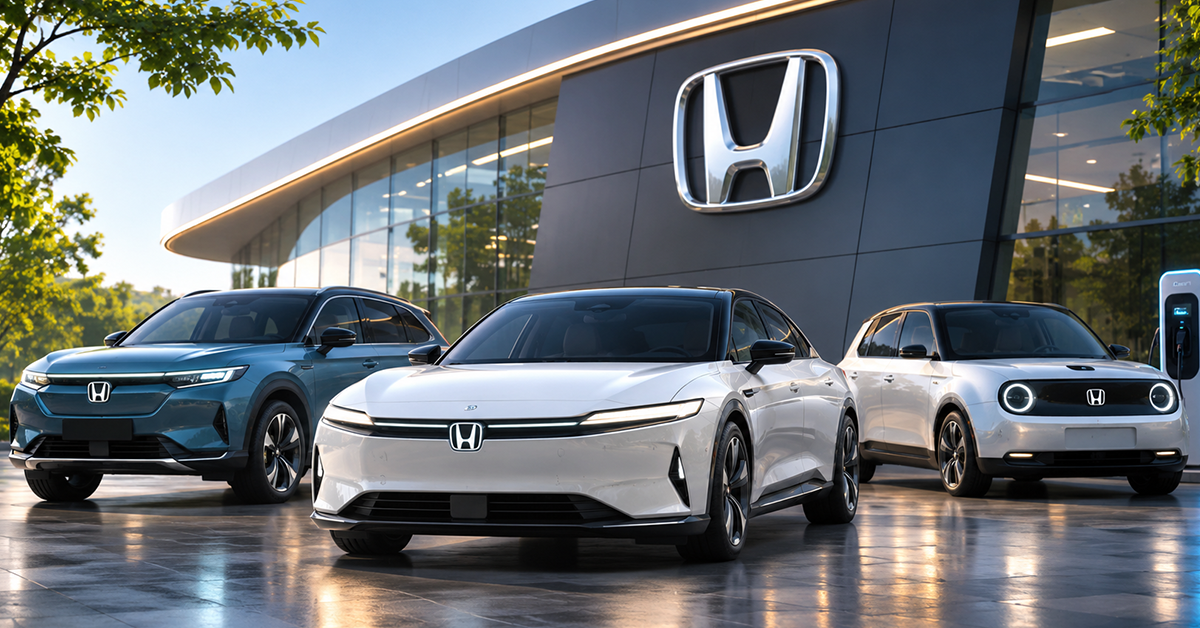
AI-generated illustration of Honda electric cars, not an official Honda image. | Rev N Rise
Honda sells four electric cars in Japan, from the N-VAN e: to the Insight EV, after cancelling its 0 Series. Here are Honda's own yen prices, ranges and strategy changes.
Honda sells four electric cars in Japan as of this article, and Honda says so itself. Its May 2026 Super-ONE release says the Super-ONE joins the N-VAN e: commercial mini-EV, the N-ONE e: mini-EV and the all-new Insight passenger EV (Honda). Those four are the current Honda EVs in Japan on the pages we read. We use Honda’s Japanese yen prices, include tax as Honda lists it and do not convert currencies. Prices and availability may have changed since publication, and exchange rates are not applied.
| Honda EVs on sale in Japan | N-VAN e:, N-ONE e:, Super-ONE, Insight (Honda) |
| Cheapest | N-VAN e: G, 2,439,800 yen (Honda) |
| Dearest | Insight, 5,500,000 yen (Honda) |
| Longest range | Insight, 535 km WLTC (Honda) |
| Shortest range | N-VAN e:, 245 km WLTC (Honda) |
| Ended | Honda e, July 2024 per archive (Honda) |
| Cancelled | 0 SUV, 0 Saloon, Acura RSX, March 12, 2026 (Honda) |
| Planned | N-BOX EV in 2028 (Honda) |
| Spread, Japan prices | 3,060,200 yen (our calculation) |
| Prologue | Sales ending after 2026 model year (reported) |
Honda’s earlier electric cars are mostly gone. Honda’s archive page lists the Honda e as a model announced in August 2020 and ended in July 2024 (Honda). Honda’s March 12, 2026 release cancelled the development and market launch of the Honda 0 SUV, the Honda 0 Saloon and the Acura RSX, which were planned for production in the United States (Honda). Reports say Honda will end sales of the Prologue after the 2026 model year (reported). Our Honda Models article covers the rest of the range, and our Honda history article covers the brand.
The Japanese lineup spans a wide price range. The N-VAN e: starts at 2,439,800 yen for the one-seat e: G and reaches 2,919,400 yen for the e: FUN (Honda). Reports give 2,699,400 yen and 3,198,800 yen for the N-ONE e: G and e: L (reported). The Super-ONE costs 3,390,200 yen in a single grade (Honda). The Insight costs 5,500,000 yen in a single grade, limited to 3,000 units (Honda). The spread from the cheapest to the dearest is 3,060,200 yen (our calculation).
Range figures also vary. Honda gives a WLTC range of 245 km for the N-VAN e: and 295 km for the N-ONE e: (Honda). It gives 274 km for the Super-ONE and 535 km for the Insight (Honda). The Honda e, now ended, had 259 km on the WLTC cycle for the Advance grade (Honda). All five figures use the same Japanese WLTC test cycle, so they can be compared with each other. Honda warns that real range depends on weather, traffic and driving style (Honda).
Honda’s own direction has changed. Its March 2026 release says initiatives toward future EV introduction will be implemented flexibly from a long-term perspective (Honda). Its Japanese business briefing page of May 2026 says Honda will expand EVs centered on kei cars and plans an N-BOX EV in 2028 (Honda). It also says Honda will launch next-generation hybrid models from 2027, reaching 15 models globally by fiscal 2029 (Honda). Our Honda N-VAN and Honda N-ONE articles cover the two electric kei cars in detail.
We tag every claim by its source. A claim tagged Honda comes from a Honda-owned page we read, such as Honda’s global newsroom, its Japanese product sites or its German brochure. A claim tagged reported comes from a news outlet, a catalog site, and we do not name the outlets. A claim tagged our calculation is a figure we worked out from published numbers. Where Honda’s pages are silent, we say so. This article covers Japan, Europe, North America and India, but not Honda’s China-only EVs, which we did not research.
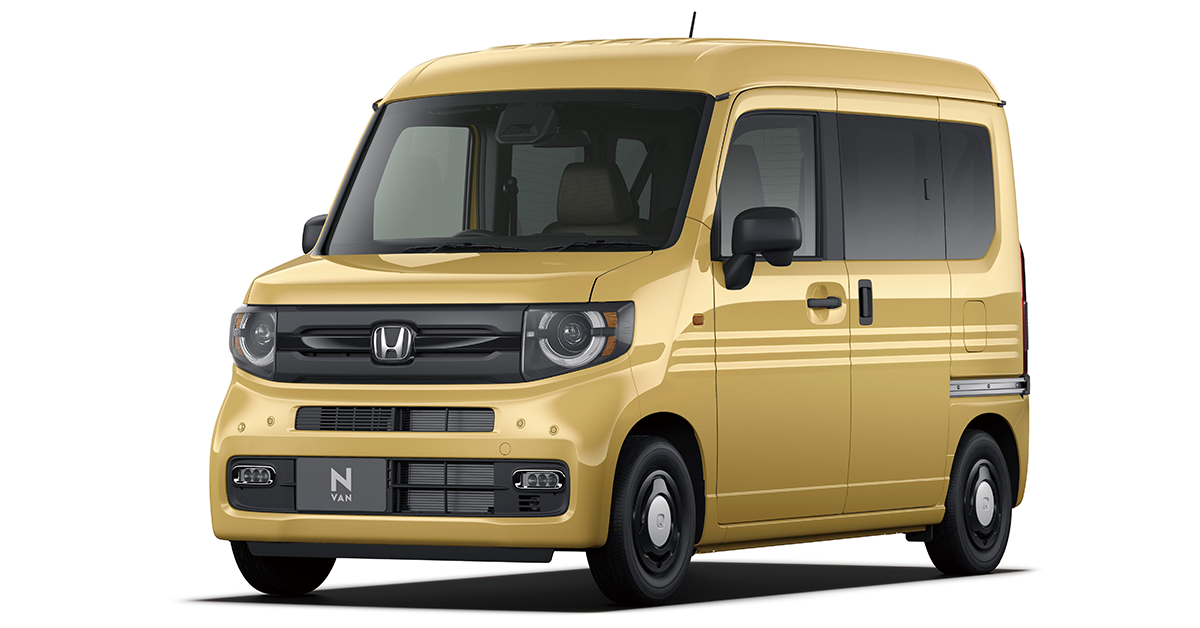
Official press image of the Honda N-VAN, the petrol version of the electric N-VAN. | © Honda Motor Co., Ltd.
Honda’s electric kei cars are the core of its Japanese EV lineup. The N-VAN e: was announced on June 13, 2024 and went on sale on October 10, 2024, with a WLTC range of 245 km (Honda). It has four types, the e: G with one seat, the e: L2 with two seats, and the four-seat e: L4 and e: FUN (Honda). Honda’s N-VAN e: prices run from 2,439,800 yen to 2,919,400 yen (Honda). Our Honda N-VAN article covers the electric van and its petrol sibling in full.
| N-VAN e: on sale | October 10, 2024 (Honda) |
| N-VAN e: range | 245 km WLTC (Honda) |
| N-VAN e: price | 2,439,800 to 2,919,400 yen (Honda) |
| N-ONE e: on sale | September 12, 2025 (Honda) |
| N-ONE e: range | 295 km WLTC (Honda) |
| N-ONE e: price | 2,699,400 and 3,198,800 yen (reported) |
| Super-ONE on sale | May 22, 2026 (Honda) |
| Super-ONE range | 274 km WLTC (Honda) |
| Super-ONE price | 3,390,200 yen (Honda) |
| Super-ONE power | 47 kW, 70 kW in BOOST mode (Honda) |
The N-ONE e: followed on September 12, 2025. Honda’s English release says it began sales of the all-new N-ONE e: mini-EV that day, with a WLTC range of 295 km, which Honda calls reassuring for everyday use (Honda). Honda describes the grand concept as e:Daily Partner and says the car inherits the man-maximum, machine-minimum approach of the Honda N360 (Honda). Honda’s Japanese release says there are two types, the e: G and the e: L (Honda). Our Honda N-ONE article covers the car.
Reports give the N-ONE e: prices as 2,699,400 yen for the e: G and 3,198,800 yen for the e: L, both front-wheel drive with four seats (reported). A report gives the motor as 47 kW and 162 Nm and the minimum turning radius as 4.5 m (reported). A report says the e: G has normal charging only, while the e: L adds rapid charging (reported). Honda’s Japanese release says the e: L is the upper grade with a 9-inch Honda CONNECT display, 14-inch aluminum wheels, a leather-wrapped steering wheel and rapid charging (Honda). The gap between the grades is 499,400 yen (reported, our calculation).
The Super-ONE is the newest. Honda announced it on May 21, 2026, and Honda’s Japanese release says sales start on May 22, 2026 (Honda). Honda says it is based on the N-ONE e:, with a dedicated chassis wider than the N-ONE e: (Honda). Honda gives the tread as 1,345 mm, widened by 40 mm from the N-ONE e: platform (Honda). It costs 3,390,200 yen in a single front-wheel-drive grade with four seats (Honda). Honda gives no monthly sales plan, battery capacity or torque on that page (Honda).
The Super-ONE is built for fun. Honda gives a normal-mode output of 47 kW and a BOOST-mode output of 70 kW, a gain of 23 kW, or about 49 percent (Honda, our calculation). It has a 7-speed virtual shift control and active sound control that plays a simulated engine sound (Honda). It has five drive modes, ECON, CITY, NORMAL, SPORT and BOOST, and CITY mode offers single-pedal control (Honda). Honda gives a WLTC range of 274 km and a weight of 1,090 kg, which it says is the lightest in the small EV class (Honda).
Honda ties the kei EVs to its charging and power services. Honda’s Super-ONE release gives normal charging at 6 kW or more in about 4.5 hours and rapid charging at 50 kW or more in about 30 minutes to 80 percent (Honda). It says a dealer-option Honda Power Supply Connector provides up to 1,500 W of external power (Honda). Honda’s Japanese N-ONE e: release gives the same 1,500 W figure and says the car supports V2H, which supplies a home (Honda). A report says Honda also introduced a charging network service, Honda Charge, with the N-ONE e: (reported).
The Insight returned as an electric crossover in 2026. Honda announced the fourth-generation Insight on April 16, 2026, and Honda’s English release says sales began in Japan on April 17, 2026 (Honda). Honda calls it a crossover passenger EV with a distinctive character, a strong presence and exceptional comfort (Honda). Honda’s Japanese release recalls that the first Insight launched in 1999 as Honda’s first mass-production hybrid car (Honda). The new Insight carries that name into the EV era.
| Announced | April 16, 2026 (Honda) |
| On sale | April 17, 2026 (Honda) |
| Generation | Fourth, first as an EV crossover (Honda) |
| Volume | 3,000 units, limited (Honda) |
| Price | 5,500,000 yen (Honda) |
| Drive and seats | FF, five maximum (Honda) |
| WLTC range | 535 km (Honda) |
| Fast charge | About 40 minutes to 80 percent (Honda) |
| Honda SENSING | 15 listed functions (Honda) |
| Battery and motor figures | Not stated by Honda |
The Insight is limited and expensive. Honda’s English release says it is available in a limited quantity of 3,000 units (Honda). Honda’s product page gives a manufacturer’s suggested retail price of 5,500,000 yen, tax included, with one grade, front-wheel drive and a maximum of five occupants (Honda). Honda lists extra-cost colors, with Diamond Dust Pearl at 66,000 yen more and Slate Gray Pearl and Aqua Topaz Metallic II at 44,000 yen more (Honda). Crystal Black Pearl and Obsidian Blue Pearl carry no surcharge (Honda).
The range is the headline number. Honda gives 535 km on the WLTC cycle (Honda). That is almost twice the Super-ONE’s 274 km, at about 1.95 times (our calculation). Honda’s earlier March 5, 2026 preview said a WLTC range of more than 500 km, and pre-orders opened on March 19, 2026 (Honda). Honda says a fast charger of more than 50 kW takes about 40 minutes to reach 80 percent from the low-charge warning, and that charging may take longer in summer and winter (Honda).
Honda gives few powertrain numbers. Its English release describes a large-capacity yet thin battery and a high-power, high-torque compact drive unit, with no kWh, kW or Nm figure (Honda). It lists four drive modes, Normal, Sport, Econ and Snow, and says Sport mode can engage Active Sound Control (Honda). It does not give dimensions or a country of manufacture (Honda). A report says the subsidy for the 2026 fiscal year is 1.3 million yen (reported), and Honda’s product page notes that applications close when the subsidy budget runs out (Honda).
The cabin features set it apart. Honda lists an Intelligent Heating System with radiant heater panels and an AUTO mode, and an aroma diffuser with six cartridge options (Honda). It lists ambient lighting linked to door operation and climate settings, a BOSE Premium Sound System with twelve speakers and a head-up display (Honda). It lists a walk-through center console, reclining rear seats, a luggage board and a fold-down rear seatback (Honda). A Honda ON Limited Edition with white interior is offered in Diamond Dust Pearl and Crystal Black Pearl (Honda).
Safety and power supply follow Honda’s kei EVs. Honda SENSING is standard with 15 listed functions, including collision mitigation braking, adaptive cruise control with low-speed follow, lane keeping assist, traffic jam assist and Honda Parking Pilot (Honda). The dealer-option Honda Power Supply Connector outputs up to 1,500 W for external use (Honda). The Insight’s 5,500,000 yen price is 2,109,800 yen above the Super-ONE (Honda, our calculation). Honda’s Japanese release lists a sales plan of 3,000 units, limited (Honda).
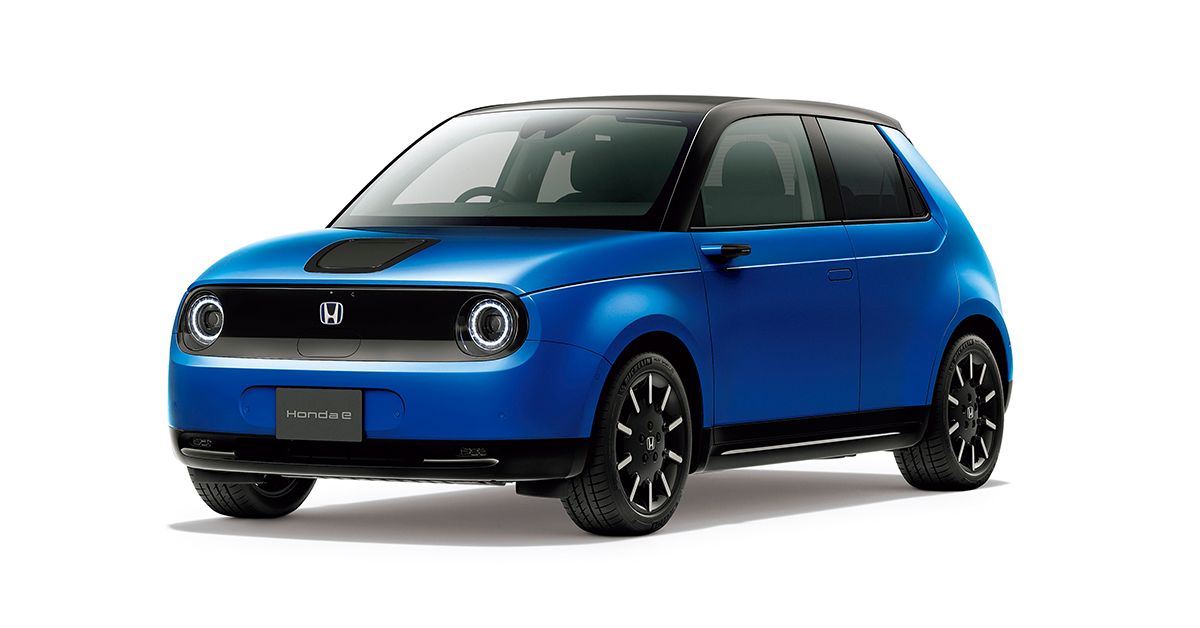
Official press image of the Honda e. | © Honda Motor Co., Ltd.
The Honda e was Honda’s first dedicated small electric car for sale in Japan and Europe. Honda’s Japanese release announced it on August 27, 2020 and put it on sale on October 30, 2020, with an annual plan of 1,000 units (Honda). It came in two grades, the Honda e at 4,510,000 yen and the Honda e Advance at 4,950,000 yen, both four-seat and rear-wheel drive (Honda). The Advance costs 440,000 yen more (our calculation). Our Honda e article covers the car in full.
| Announced | August 27, 2020 (Honda) |
| On sale in Japan | October 30, 2020 (Honda) |
| Grades | Honda e, Honda e Advance (Honda) |
| Price | 4,510,000 and 4,950,000 yen (Honda) |
| Layout | Rear motor, RWD, four seats (Honda) |
| Battery | 35.5 kWh (Honda) |
| Range, Advance | 259 km WLTC in Japan (Honda) |
| Weight, Advance | 1,540 kg (Honda) |
| Archive page | Ended model, July 2024 (Honda) |
| Sales | About 12,000 worldwide (reported) |
Its technology was the point. Honda’s release names a five-screen dashboard, which Honda calls a world first for a mass-produced car, and a side camera mirror system with 6-inch monitors (Honda). Honda Europe’s January 2020 sheet lists a 35.5 kWh battery, a WLTP range of 222 km, or 210 km on 17-inch wheels, and 80 percent rapid charging in 30 minutes (Honda). Honda’s Japanese sheet gives 259 km WLTC for the Advance (Honda). The two figures use different test cycles and are not directly comparable.
The motor was modest by later standards. Honda’s Frankfurt 2019 release gives two outputs, 100 kW and 113 kW, with 315 Nm of torque, rear-wheel drive and a range of up to 220 km (Honda). Honda’s Japanese specification sheet for the Advance gives 113 kW, or 154 PS, and a weight of 1,540 kg (Honda). Compared with the 1,090 kg Super-ONE, the Honda e Advance is 450 kg heavier (Honda, our calculation). Honda’s later Japanese EVs cost less than the Honda e Advance, apart from the Insight (Honda, reported).
The Honda e did not last. Reports quote a notice on Honda’s Japanese site that production would end in January 2024 and that the car would be discontinued once the production run sold out (reported). Honda’s archive page for the model says it was announced in August 2020 and ended in July 2024 (Honda). A report says Honda sold about 12,000 units worldwide and about 1,800 in Japan (reported). Honda’s own pages give no sales total.
Honda’s later releases treat the Honda e as the start of its European EV effort. Honda’s May 2023 release on the e:Ny1 calls that car the second EV model Honda introduced in Europe after the Honda e (Honda). The feature lists we read for the Super-ONE and the Insight do not mention camera mirrors or a five-screen dashboard (Honda). The Super-ONE lists a 9-inch Honda CONNECT display and the Insight lists a head-up display (Honda).
Its design lives on in reports and used cars rather than in Honda’s new models. A report says the Honda e was a rear-motor city car with a 4.3 m turning radius, which matches Honda’s own figure (reported, Honda). Honda gives a minimum turning radius of 4.3 m in its Japanese specification sheet for the Advance (Honda). Honda’s sheet also lists a length of 3.895 m, a width of 1.750 m and a wheelbase of 2.530 m (Honda). The N-ONE e: and Super-ONE are kei-based or kei-derived cars, and Honda gives no turning radius for the Super-ONE on the page we read (Honda). The Super-ONE’s turning radius is not stated on the page we read (Honda). Treat any figure tagged reported as a lead to verify.
The e:Ny1 is Honda’s European electric crossover. Honda’s May 12, 2023 release describes it as an all-electric compact SUV built on the new e:N Architecture F platform, with a 68.8 kWh battery and a range of 412 km (Honda). The English release gives that range as 412 km, or 256 miles (Honda). Honda’s Japanese release of the same date calls it the second EV model in Europe after the Honda e and gives 412 km on the WLTC cycle, while the English release says WLTP (Honda).
| e:Ny1 announced | May 12, 2023 (Honda) |
| e:Ny1 battery | 68.8 kWh (Honda) |
| e:Ny1 range | 412 km, WLTP or WLTC (Honda) |
| e:Ny1 DC charge | 10 to 80 percent in about 45 minutes (Honda) |
| e:Ny1 consumption | 18.2 kWh per 100 km, combined (Honda) |
| e:Ny1 motor | 150 kW, 310 Nm (reported) |
| Prologue launch | March 2024 in the United States (reported) |
| Prologue 2026 EPA range | 308 miles on the EX (reported) |
| Prologue end | After 2026 model year (reported) |
| Prologue build | Mexico, GM platform (reported) |
Honda gives more detail in its German brochure. The brochure gives a 68.8 kWh battery, a range of up to 412 km, and a combined consumption of 18.2 kWh per 100 km (Honda). It says the car adds 100 km of range in only 11 minutes of charging (Honda). Honda’s English release says DC fast charging can go from 10 to 80 percent in about 45 minutes (Honda). Reports give the motor as 150 kW and 310 Nm, which Honda’s English release snippet does not show (reported).
The e:Ny1 has a Chinese lineage. A report says it grew out of the e:NP1 and e:NS1 that Honda developed in China with Dongfeng and GAC, and that it looks like the HR-V but sits on a different platform (reported). Reports give European pricing from 47,990 euros in 2025 and a price just over 52,000 euros in Germany (reported). A report says the car is being withdrawn from some European markets in 2026, with only 74 sales in 2025 in the country that report covers (reported). Honda’s pages we read do not confirm this.
Honda’s European range will rely on hybrids. Our Honda Models article covers the hybrid models that Honda sells in Europe. Honda’s May 2026 Japanese briefing page says Honda will deploy next-generation hybrid models from 2027 and expand them to 15 models globally by fiscal 2029 (Honda). That plan sits beside, not instead of, a long-term EV commitment that Honda’s March release says will be implemented flexibly (Honda). Honda’s pages give no new European EV for the period.
The Prologue was Honda’s North American EV, and reports say it is ending. A report says it entered the United States market in March 2024 as the first volume-production battery-electric Honda in North America (reported). Reports quote a Honda spokesperson saying that Honda will conclude sales of the Prologue later in 2026 following completion of the 2026 model year (reported). A report adds that sales will continue into early 2027 based on expected inventory (reported). Honda’s own pages we read do not carry that statement.
The Prologue’s numbers come from reports. A report gives the 2026 base EX at 39,900 dollars before destination and 41,395 dollars with it, with an EPA range of 308 miles (reported). The same report gives the front-drive models 220 hp and 243 lb-ft and the dual-motor models 300 hp and 355 lb-ft (reported). A report says it was built in Mexico on a General Motors platform (reported). Reports say first-half 2026 sales fell 48 percent, though another report gives 40 percent, so we use neither (reported).
The 0 Series was meant to be Honda’s next global EV family. A report says Honda first showed the 0 Series Saloon and SUV concepts at CES in January 2024 and the production-intent prototypes at CES 2025 (reported). Honda’s October 2025 release describes the Honda 0 Saloon prototype as the flagship, built on a low-floor platform dedicated to EVs, with sporty styling and a spacious cabin (Honda). A report says seven 0 Series models were planned before the end of the decade (reported).
| Cancelled | 0 SUV, 0 Saloon, Acura RSX (Honda) |
| Cancellation date | March 12, 2026 (Honda) |
| Stated reason | Declining EV demand, tariffs, Asian competition (Honda) |
| Planned build site | Ohio, United States (reported) |
| Total losses, all years | Up to 2.5 trillion yen (Honda) |
| Operating expenses | 820 billion to 1.12 trillion yen (Honda) |
| Afeela 1 | Cancelled, March 2026 (reported) |
| Afeela 1 price | 89,990 dollars (reported) |
| 0 Alpha debut | December 2, 2026, India (reported) |
| 0 Alpha build | Tapukara, Rajasthan (reported) |
Honda cancelled three of them on March 12, 2026. Honda’s release says it will cancel development and market launch of three EVs planned for U.S. production, the Honda 0 SUV, the Honda 0 Saloon and the Acura RSX (Honda). Honda says starting them in the current environment, where EV demand is declining significantly, would likely cause further long-term losses (Honda). It also cites a decline in its profitability from U.S. tariff changes and weaker competitiveness in Asia (Honda). Reports say the cars were to be built in Ohio (reported).
Honda put numbers on the decision. Its release gives expected losses for the fiscal year ending March 2026 of 820 billion to 1.12 trillion yen in operating expenses, 110 billion to 150 billion yen from equity-method investments and 340 billion to 570 billion yen in non-consolidated special losses (Honda). It gives a total of up to 2.5 trillion yen across current and future years (Honda). It revised its operating profit forecast from 550.0 billion yen to a loss of 270.0 billion to 570.0 billion yen (Honda). The net-profit line in that table looks inconsistent, so we do not use it.
The Afeela project fell with them. A report says Sony Honda Mobility, the joint venture, announced in March 2026 that it would discontinue development and launch of the Afeela 1 sedan and a follow-up SUV (reported). Reports say reservation fees would be refunded in full, that the Afeela 1 was priced from 89,990 dollars and that it had reached pre-production in Ohio (reported). A report quotes the venture saying it could not use certain technologies and assets that Honda had planned to provide (reported). Honda’s pages we read do not mention the Afeela.
One 0 Series model survives. Reports say the 0 Alpha, a smaller electric SUV, will have its global debut in India on December 2, 2026, and will be built at the Tapukara plant in Rajasthan for India and export (reported). A report calls it comparable to the HR-V in size and positioning (reported). Reports say Honda has not announced a price or a sales start, and one report expects sales in early 2027 (reported). A report puts the expected price at 18 to 24 lakh rupees, which is only an estimate (reported). The debut is days away at the time of writing.
Reports disagree on the Alpha’s name. One report says Honda named it the Honda Alpha, while others keep calling it the 0 Alpha (reported). Honda’s own Alpha pages are not among those we read. Reports expect a battery of 65 to 75 kWh and more than 500 km of range, which are estimates and not Honda figures (reported). We will update this article after the December 2 event. Honda’s Super-ONE release, which we did read, says Honda will keep expanding EVs suited to the Japanese market (Honda).
Honda’s EV strategy changed in three steps. In May 2025 it held a business briefing that said it would realign its electrification strategy, still calling EVs the optimal solution for small mobility in the long term (Honda). In March 2026 it cancelled three U.S.-built EVs and booked large losses (Honda). In May 2026 it held a briefing on rebuilding its automobile business (Honda). Honda’s May 2025 release says it would also further advance its two-motor e:HEV hybrid system (Honda).
| 2025 briefing | May 20, 2025 (Honda) |
| 2026 briefing | May 14, 2026 (Honda) |
| Next-gen hybrids | From 2027, 15 models by fiscal 2029 (Honda) |
| N-BOX EV | Planned for 2028 (Honda) |
| Carbon neutral goal | 2050 (Honda) |
| Three-year investment | 6.2 trillion yen (reported) |
| Hybrid and gasoline share | About 71 percent (reported, our calculation) |
| EV share | About 13 percent (reported, our calculation) |
| Fiscal 2025 net loss | 423.9 billion yen (reported) |
| EV goal for 2040 | 100 percent withdrawn (reported) |
Honda’s May 14, 2026 briefing set the new direction. Honda’s story page says Honda will focus intensively on rebuilding its automobile business structure over three years, improving profitability (Honda). Its Japanese page says Honda will launch next-generation hybrid models from 2027, reaching 15 global models by fiscal 2029, and will expand EVs centered on kei cars, with an N-BOX EV in 2028 (Honda). It also says Honda will pursue carbon neutrality in 2050 through EVs, hybrids, carbon-neutral fuels and offset technologies (Honda).
Reports give the money. A report says Honda plans total investment of 6.2 trillion yen over three years, including 4.4 trillion yen for combustion and hybrid models, about 1.0 trillion yen for software and about 0.8 trillion yen for EVs (reported). That puts hybrids and gasoline at about 71 percent and EVs at about 13 percent (reported, our calculation). A report says Honda withdrew its goal of 100 percent EV and fuel-cell sales by fiscal 2040 and will center on hybrids until fiscal 2030 (reported). Honda’s pages we read give none of these totals.
Reports give the losses. A report says Honda posted a consolidated net loss of 423.9 billion yen for the fiscal year ended March 2026 (reported). A report says the 2026 fiscal forecast included about 500 billion yen of EV-related losses (reported). A report says an 11 billion dollar Canadian EV value chain project was put on hold indefinitely (reported). Honda’s March release gives a total of up to 2.5 trillion yen in losses across years, which is larger than any single-year figure in these reports (Honda, reported).
Not every EV plan was cancelled. Honda’s Super-ONE release in May 2026 adds a new EV to the lineup and repeats the N-BOX EV plan for 2028 (Honda). Honda’s Insight release in April 2026 adds a passenger EV (Honda). Reports say the 0 Alpha will debut in India on December 2, 2026 (reported). The pattern is small, local, and low-cost EVs, while the expensive global EV family was cut. Honda’s March release says EV introductions will be implemented flexibly while monitoring profitability and market trends (Honda).
The strategy changes the buying picture. In Japan, buyers can choose among four Honda EVs, and Honda says it will add the N-BOX EV in 2028 (Honda). In the United States, a report says Honda will have no EV on sale once Prologue stock sells through (reported). In Europe, reports say the e:Ny1 is being withdrawn from some markets (reported). In India, the 0 Alpha is the only new Honda EV, and Honda has not announced its price (reported). Our Honda Models article covers the hybrid alternatives.
Honda’s Japanese EV prices climb with ambition. The N-VAN e: G is 2,439,800 yen, the Super-ONE is 3,390,200 yen, the Honda e Advance was 4,950,000 yen and the Insight is 5,500,000 yen (Honda). The N-ONE e: L is 3,198,800 yen (reported). The Super-ONE costs 690,800 yen more than the N-ONE e: G and 191,400 yen more than the e: L (reported, our calculation). The Insight costs 2,109,800 yen more than the Super-ONE (Honda, our calculation). Prices and availability may have changed since publication.
| N-VAN e: G | 2,439,800 yen, 245 km (Honda) |
| N-ONE e: G | 2,699,400 yen, 295 km (reported, Honda) |
| Super-ONE | 3,390,200 yen, 274 km (Honda) |
| Insight | 5,500,000 yen, 535 km (Honda) |
| Honda e Advance | 4,950,000 yen, 259 km, ended (Honda) |
| Insight over Super-ONE | 2,109,800 yen (our calculation) |
| Yen per km, Insight | About 10,280 (our calculation) |
| Yen per km, N-VAN e: G | About 9,958 (our calculation) |
| Super-ONE sale date | May 22, 2026 in Japanese release (Honda) |
| 0 Alpha debut | December 2, 2026 (reported) |
Ranges do not rise with price in a straight line. The Insight’s 535 km at 5,500,000 yen works out at about 10,280 yen per kilometer of range (Honda, our calculation). The Super-ONE’s 274 km at 3,390,200 yen is about 12,373 yen per kilometer (Honda, our calculation). The N-VAN e: G’s 245 km at 2,439,800 yen is about 9,958 yen per kilometer (Honda, our calculation). The three figures span about 2,400 yen per kilometer (our calculation).
Source conflicts are listed here. Honda’s English Super-ONE release is dated May 21, 2026 but says sales begin on April 22, 2026, while the Japanese release says May 22, 2026, so we use May 22 (Honda). Honda’s English e:Ny1 release says WLTP and its Japanese release says WLTC for the same 412 km (Honda). Reports disagree on Prologue sales declines of 48 and 40 percent (reported). Reports disagree on the Honda e’s production end, January or July 2024 (reported, Honda).
Other conflicts concern money. Honda’s March 2026 table lists an upper net-profit bound that looks inconsistent with the other figures, so we omit it (Honda). A report gives the cancellation loss as a ceiling of 2.5 trillion yen across years, and other reports give the annual range in dollars, which we do not convert (reported). A report says Honda cut EV investment by 20.7 billion dollars through 2030 in May 2025, while the Honda page we read does not give that number (reported, Honda). We use Honda’s figures where they exist.
Several items are not confirmed. Honda gives no battery capacity or torque for the Super-ONE or the Insight on the pages we read (Honda). It gives no country of manufacture for the Insight (Honda). We did not read Honda’s own pages on the 0 Alpha, the Prologue, the Afeela or the China-only EVs, so those facts are reported only. We did not confirm the N-ONE e: prices on a Honda page, so they are tagged reported. The 0 Alpha debut on December 2, 2026 has not yet happened.
To check this article, start with Honda’s releases of May 21, 2026 on the Super-ONE, April 16, 2026 on the Insight, March 12, 2026 on the cancellation and May 14, 2026 on the business briefing (Honda). Then read Honda’s N-VAN e: release of June 13, 2024 and its N-ONE e: release of September 11, 2025 (Honda). Our Honda N-VAN, Honda N-ONE and Honda e articles cover those cars in depth, and our Honda Models article covers the rest. Treat any figure tagged reported as a lead to verify. Honda’s own pages are the better source for prices, so check the dealer for the current figure.
