 Brands
Honda N-VAN — Prices, Electric Version and Generations
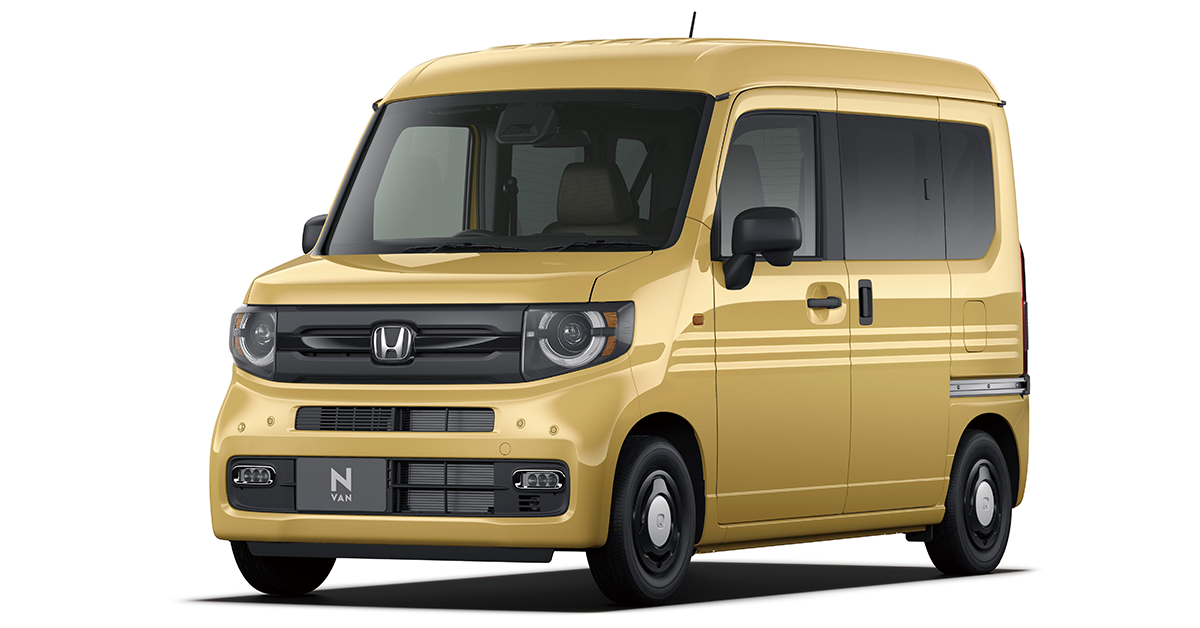
Official press image of the Honda N-VAN. | © Honda Motor Co., Ltd.
The N-VAN is Honda's kei van, sold in Japan since July 2018, with a pillarless passenger side and an electric version. Here are Honda's own yen prices and updates from 2018 to 2026.
The Honda N-VAN is a Japanese kei van, a light commercial vehicle with a 660 cc engine, that Honda added to its N Series in 2018. Honda announced it on July 12, 2018, and sales in Japan began on July 13, 2018 (Honda). Honda’s timeline lists the N-VAN in July 2018 and the electric N-VAN e: in October 2024 (Honda). Every Honda page we read for this article is a Japanese-market page, so prices are in Japanese yen with consumption tax included, and we do not convert currencies. Prices and availability may have changed since publication, and exchange rates are not applied.
| Body style | Kei van (Honda) |
| First sale | July 13, 2018, Japan (Honda) |
| Electric version | N-VAN e:, October 10, 2024 (Honda) |
| Latest petrol update | March 20, 2026 (Honda) |
| Engine | 660 cc DOHC, NA or turbo (Honda) |
| Transmission | CVT, 6MT on G and FUN (Honda) |
| Drive | FF or 4WD (Honda) |
| Seating | Four (Honda) |
| 2026 price range | 1,498,200 to 2,269,300 yen (Honda) |
| N-VAN e: range | 245 km WLTC (Honda) |
Honda developed the N-VAN by studying the daily lives of working people, according to its 2018 release (Honda). Honda’s Japanese release says it aimed to set a new standard for kei vans, with usability in many kinds of work, strong driving performance and safety (Honda). Honda calls the passenger-side opening without a center pillar, together with the large tailgate opening, a “double big opening”, and says the pillarless passenger side was a first for a kei van (Honda). Our Honda N-BOX article covers the passenger kei car in the same series.
The petrol lineup that Honda’s March 19, 2026 release lists has four grades and a special edition. They are the G, the L, the FUN, the FUN Turbo, and the FUN special edition NATURE STYLE in naturally aspirated and turbo forms (Honda). All use a 660 cc DOHC engine, and the turbo versions are CVT only (Honda). The G and FUN also come with a 6-speed manual (Honda). Front-wheel drive and four-wheel drive are offered, and the table lists seating for four (Honda).
Prices in that table run from 1,498,200 yen for the front-drive G to 2,269,300 yen for the four-wheel-drive FUN Turbo NATURE STYLE (Honda). The difference is 771,100 yen (our calculation). Honda’s N-VAN product page shows the same range, 1,498,200 to 2,269,300 yen (Honda). The electric N-VAN e: is sold separately, from 2,439,800 yen for the one-seat e: G to 2,919,400 yen for the e: FUN (Honda). Honda says prices exclude insurance, registration costs and the recycling fee, and that dealers set actual selling prices (Honda).
The history is one generation with regular updates. Honda made partial changes on February 5, 2021, April 19, 2024 and March 20, 2026, and revised prices from August 1, 2025 (Honda). It launched the N-VAN e: on October 10, 2024 (Honda). Honda’s October 6, 2026 topic says the N Series passed 4.5 million cumulative units (Honda). We found no Honda release for a second-generation N-VAN, and we did not read Honda releases for every change between 2018 and 2021.
We tag every claim by its source. A claim tagged Honda comes from a Honda-owned page we read, such as Honda’s global newsroom, its product site or its archived product pages. A claim tagged reported comes from a news outlet or a car-catalog site, and we do not name the outlets. A claim tagged our calculation is a figure we worked out from published numbers. Where Honda’s pages are silent on a figure, we say so instead of filling the gap. Our Honda Models article covers the rest of Honda’s range and our Honda history article covers the brand.
Honda put the N-VAN on its website on April 20, 2018, as a new kei van joining the N Series (Honda). That release says the car was designed to support the daily loading, unloading and carrying of working people (Honda). It describes a dive-down function that folds the passenger seat flat as well as the rear seat, which, with the low N Series floor, creates a flat space from the passenger area to the tailgate (Honda). The car went on sale on July 13, 2018, after Honda’s July 12 announcement (Honda). Honda’s English release says the N-VAN uses the N-BOX platform and is aimed at commercial use with a large cargo area and efficient loading (Honda).
| Website preview | April 20, 2018 (Honda) |
| Announced | July 12, 2018 (Honda) |
| On sale | July 13, 2018 (Honda) |
| Monthly sales plan | 3,000 units (Honda) |
| Orders by August 20, 2018 | Over 14,000 units (Honda) |
| Grade split of orders | G/L 41%, FUN 44%, COOL 15% (Honda) |
| Signature feature | Double big opening, pillarless passenger side (Honda) |
| G Honda SENSING, base price | 1,267,920 yen, 8 percent tax (Honda) |
| FUN Turbo, top price | 1,799,280 yen, 8 percent tax (Honda) |
| JC08, FF CVT G | 23.8 km/L (Honda) |
Honda announced the N-VAN on July 12, 2018, with a monthly sales plan of 3,000 units in Japan (Honda). The release lists the G and L grades, which pursue the functionality of a kei van, and the +STYLE grades, which stand out with a higher-quality interior, convenient equipment and a fuller color range (Honda). Honda says the car can be used for more than commercial work (Honda). Honda’s timeline places the N-VAN’s launch in July 2018 (Honda).
Early orders were strong. Honda’s August 21, 2018 release says cumulative orders passed 14,000 units by August 20, 2018, against the monthly plan of 3,000 units (Honda). That is more than four times one month’s plan (our calculation). By grade, the G and L took 41 percent, the +STYLE FUN 44 percent and the +STYLE COOL 15 percent (Honda). Honda says buyers ranged from commercial vehicle owners to people using the van for hobbies (Honda).
The type mix was spread out. The G Honda SENSING took 19 percent, the L Honda SENSING 22 percent, the +STYLE FUN Honda SENSING 22 percent and the +STYLE FUN Turbo Honda SENSING 22 percent (Honda). The +STYLE COOL Honda SENSING took 9 percent and the +STYLE COOL Turbo Honda SENSING 6 percent (Honda). Honda lists the purchase points as the double big opening, the large cargo space from the low floor and dive-down seat, standard Honda SENSING and class-leading fuel economy (Honda).
The 2018 price table, with 8 percent tax, lists the G Honda SENSING at 1,267,920 yen and 1,377,000 yen, and the L Honda SENSING at 1,341,360 yen and 1,450,440 yen (Honda). The +STYLE FUN Honda SENSING is 1,560,600 yen and 1,691,280 yen, and the +STYLE FUN Turbo Honda SENSING 1,668,600 yen and 1,799,280 yen (Honda). The +STYLE COOL has the same prices as the FUN (Honda). A report maps the lower price in each pair to front-drive and the higher to four-wheel drive (reported). Premium colors cost 32,400 yen extra (Honda).
Some 2018 details come from reports. A report says the 6-speed manual and the CVT cost the same on each grade, that the turbo is CVT only, and that the G, L and +STYLE FUN are high-roof while only the +STYLE COOL is low-roof (reported). Honda’s Japanese release does not mention a low roof for the COOL (Honda). A report gives JC08 fuel economy of 23.8 km/L for the front-drive CVT G and 18.6 km/L for the 6-speed manual (reported). Honda’s archive page for the model, which ended in January 2021, gives 23.8 km/L for the front-drive CVT G and +STYLE FUN (Honda).
The N-VAN’s main idea is access. Honda says the passenger side has a pillarless opening and the tailgate has a large opening, which together make the double big opening (Honda). A door-in-pillar structure lets the closed doors act as the center pillar, according to Honda’s English release (Honda). Honda adds that the passenger seat dives down like the rear seat, so the floor is flat from the passenger side to the tailgate and long items fit (Honda). The release gives no opening or cargo dimensions, and the low floor comes from the N Series layout Honda describes (Honda).
| Passenger side | Pillarless opening, a kei van first (Honda) |
| Tailgate | Large opening (Honda) |
| Passenger seat | Dive-down, flat floor to tailgate (Honda) |
| Engines | 660 cc DOHC, NA and turbo (Honda) |
| Transmissions | CVT, 6MT (Honda) |
| Honda SENSING | Ten functions at launch (Honda) |
| Length and width | 3,395 mm and 1,475 mm (reported) |
| Height | 1,945 to 1,960 mm (reported) |
| Wheelbase | 2,520 mm (reported) |
| External power kit | AC 100 V, up to 1,500 W (Honda) |
The engines and gearboxes are simple. Honda lists a naturally aspirated 660 cc DOHC engine and a turbocharged 660 cc DOHC engine, with front-wheel drive and four-wheel drive on selected trims (Honda). The transmission is a 6-speed manual or a CVT, and turbo versions are CVT only (Honda). Honda says the engine delivers strong torque at low speeds and that the car has class-leading fuel economy (Honda). The release gives no power or torque figures (Honda).
Honda SENSING was a first for a Honda kei van. Honda’s Japanese release says it was fitted as standard on all types, with some versions without it available except the turbo (Honda). The English release lists ten functions, among them collision mitigation braking, false start prevention, pedestrian collision mitigation steering, lane keeping assist, adaptive cruise control, false backward start prevention and auto high beam (Honda). False start prevention and adaptive cruise control were not available with the 6-speed manual (Honda).
The driver’s seat was designed for long hours and frequent entry and exit. Honda says it has stronger lumbar support and a seat frame the same size as in a passenger car, to reduce strain on the driver (Honda). Honda’s English release describes interior seat and trim design, but gives no list of interior measurements (Honda). Honda’s Honda Access accessory release for the car lists an external power input kit rated at AC 100 V and up to 1,500 W (Honda).
Size comes from reports. A 2026 report on the base G front-drive gives a length of 3,395 mm, a width of 1,475 mm, a height of 1,945 to 1,960 mm and a wheelbase of 2,520 mm (reported). Honda’s pages we read give none of those figures for the petrol van. A report on the electric N-VAN e: gives 3,395 mm by 1,475 mm by 1,960 mm, with the same 2,520 mm wheelbase (reported). Our Honda N-BOX article covers the passenger kei car that shares the platform.
Fuel economy is also limited. Honda’s 2018 release says only that the van has class-leading fuel economy and gives no figure (Honda). Honda’s own pages are the better source, but for the rest a report gives JC08 values of 23.8 km/L for the front-drive naturally aspirated CVT, 21.2 km/L for four-wheel drive, 23.6 km/L for the front-drive turbo and 17.6 to 18.6 km/L for the manual (reported). Honda’s 2026 release gives no WLTC value (Honda). A catalog-style report lists WLTC values of 17.0 to 18.8 km/L for the 2025 G, but we treat that as unconfirmed (reported).
Honda made its first partial change on February 5, 2021 (Honda). The release says Honda SENSING became standard on every grade, with false start prevention, adaptive cruise control, lane keeping assist and rear false start prevention not fitted to 6-speed manual cars (Honda). The G and L gained auto light and auto high beam, and the +STYLE FUN gained two colors, Frame Red and Surf Blue (Honda). Honda notes the 6-speed manual was set on the G, L and +STYLE FUN, though not on the +STYLE FUN Turbo (Honda).
| 2021 partial change | February 5, 2021 (Honda) |
| 2021 change | Honda SENSING on all grades (Honda) |
| 2024 partial change | April 19, 2024 (Honda) |
| 2024 new function | Unintended acceleration mitigation (Honda) |
| Setup fee | 5,500 yen per smart key (Honda) |
| Special edition | STYLE+ NATURE (Honda) |
| 2024 G, FF | 1,365,100 yen (Honda) |
| 2024 FUN, FF | 1,764,400 yen (Honda) |
| 2024 FUN Turbo, 4WD | 2,016,300 yen (Honda) |
| 4WD premium, G | 133,100 yen (our calculation) |
Honda’s archive page for the 2018 model, which ended in January 2021, lists 1,291,400 yen for the front-drive CVT G and 1,589,500 yen for the +STYLE FUN (Honda). Honda’s February 2021 table lists the +STYLE FUN Turbo at 1,739,100 yen front-drive and 1,872,200 yen four-wheel drive (Honda). A report puts the 2021 range at 1,276,000 to 1,872,200 yen (reported). The top of that range matches Honda’s turbo four-wheel-drive price, and we did not read Honda’s own low end for 2021 (Honda, reported).
Honda announced the next partial change on April 18, 2024, with sales from April 19, 2024 (Honda). The release does not state a monthly sales plan, and it describes the N-VAN as popular with both commercial users and hobby users (Honda). Honda SENSING gained an unintended acceleration mitigation function, standard on the FUN with a CVT only, and the 6-speed manual got no added function (Honda). It ships switched off and needs dealer setup, at 5,500 yen including tax per smart key (Honda). Honda also added heated door mirrors to the G and L four-wheel-drive grades (Honda).
The FUN gained two colors, Autumn Yellow Pearl and Botanical Green Pearl (Honda). Honda added the STYLE+ NATURE special edition, the fourth model of its N STYLE+ series, based on the FUN grade (Honda). It has a matte black and piano-black-look front grille, black outer door handles, a black rear license garnish, silver-and-black wheel caps and a khaki-based interior (Honda). The 6-speed manual stayed on the G and FUN grades, and Honda says the N-VAN keeps its large cargo space and pillarless passenger side (Honda). Four colors on the FUN cost 33,000 yen extra, and Nighthawk Black Pearl and the G and L colors carry no surcharge (Honda).
The 2024 price table, with 10 percent tax, started at 1,365,100 yen for the front-drive G and 1,498,200 yen for four-wheel drive (Honda). The L was 1,510,300 yen front-drive and 1,643,400 yen four-wheel drive (Honda). The FUN was 1,764,400 and 1,897,500 yen, the FUN Turbo 1,883,200 and 2,016,300 yen, and the STYLE+ NATURE 1,859,000 and 1,991,000 yen (Honda). Four-wheel drive added 133,100 yen on the G (our calculation). The turbo adds 118,800 yen to the front-drive FUN (our calculation).
The 2024 update also sat beside Honda’s electric plans. Honda’s December 7, 2022 release said it would sell a new commercial EV based on the N-VAN in spring 2024, and that it planned 30 EV models worldwide by 2030 (Honda). The N-VAN e: instead went on sale on October 10, 2024 (Honda). We cover the electric van in the next section. Our Honda N-ONE article covers the other Honda electric kei car, the electric N-ONE.
Honda announced the N-VAN e: on June 13, 2024, and sales began on October 10, 2024 (Honda). Honda describes it as the start of its full-scale EV rollout in Japan from a familiar kei commercial van (Honda). It keeps the flat low floor, high roof and wide opening without a passenger-side center pillar of the petrol N-VAN (Honda). Honda gives a WLTC range of 245 km (Honda). It had said on December 7, 2022 that it would sell the van in spring 2024 (Honda).
| Announced | June 13, 2024 (Honda) |
| On sale | October 10, 2024 (Honda) |
| WLTC range | 245 km (Honda) |
| Normal charging | About 4.5 hours, 6.0 kW (Honda) |
| Fast charging | About 30 minutes to 80%, 50 kW (Honda) |
| e: G, one seat | 2,439,800 yen (Honda) |
| e: L2, two seats | 2,549,800 yen (Honda) |
| e: L4, four seats | 2,699,400 yen (Honda) |
| e: FUN, four seats | 2,919,400 yen (Honda) |
| Battery capacity | Not stated by Honda |
Honda’s pages give limited technical data. The battery is described only as large capacity, with no kWh figure, and motor output and torque are not stated (Honda). Normal charging at 6.0 kW takes about 4.5 hours, and fast charging at 50 kW reaches 80 percent in about 30 minutes (Honda). Battery heating and cooling are said to improve winter charging time and range (Honda). A report gives the body as 3,395 mm by 1,475 mm by 1,960 mm on a 2,520 mm wheelbase (reported).
Four types are offered, all front-wheel drive. The e: L4 is the standard four-seat type, and the e: FUN has leisure styling, LED headlights and standard fast charging (Honda). The e: G has one seat and is aimed at commercial use, with an interior 95 mm longer than the petrol N-VAN and a floor 120 mm lower than the four-seat versions (Honda). The e: L2 has two seats in tandem (Honda). The e: G and e: L2 are sold only through Honda’s corporate sales department and the Honda ON online store, on lease contracts (Honda).
Prices are listed by type and by fast-charge option. The e: G costs 2,439,800 yen without fast charging and 2,549,800 yen with it as an option (Honda). The e: L2 costs 2,549,800 yen and 2,659,800 yen, and the e: L4 costs 2,699,400 yen and 2,809,400 yen (Honda). The e: FUN costs 2,919,400 yen with fast charging standard (Honda). The fast-charge option adds 110,000 yen on each type that offers it (our calculation). The e: FUN is 110,000 yen above the e: L4 with fast charging (our calculation).
Safety includes two firsts. Honda says the N-VAN e: is the first kei commercial van with side curtain airbags for the driver and front passenger, and the first kei car with a post-collision braking system that reduces secondary crashes (Honda). Honda SENSING is standard on the e: L4 and e: FUN with 12 listed functions, while the e: G and e: L2 have a reduced set (Honda). Honda CONNECT, free with a Honda Total Care ID, offers departure timers, charging schedules and charge limits of 80 to 100 percent (Honda).
Some figures come from reports. A report gave the starting price as about 2.44 million yen when the van was announced, which matches the e: G at 2,439,800 yen (reported, Honda). Reports also say subsidies bring prices under 2 million yen for businesses, which we cannot confirm from Honda’s pages (reported). Honda gives no monthly sales plan for the van (Honda). Honda’s own timeline lists the N-VAN e: in October 2024 (Honda). Our Honda N-ONE article covers Honda’s second electric kei car.
Honda announced a price revision for the N-VAN on May 19, 2025 (Honda). New-price orders began on May 26, 2025 at Honda Cars across Japan, and the new prices took effect on August 1, 2025 (Honda). Honda gave worldwide increases in raw material prices and logistics costs as the reason (Honda). The same release revised the N-BOX JOY from October 2, 2025 (Honda). Honda’s N-VAN product page lists the notice dated May 19, 2025 (Honda). Honda says all prices are manufacturer’s suggested retail prices, which exclude insurance, taxes other than consumption tax, registration fees and the separate recycling fee (Honda).
| Announced | May 19, 2025 (Honda) |
| Orders at new prices from | May 26, 2025 (Honda) |
| Effective | August 1, 2025 (Honda) |
| Stated reason | Raw material and logistics costs (Honda) |
| G, FF | 1,365,100 to 1,392,600 yen (Honda) |
| L, FF | 1,510,300 to 1,541,100 yen (Honda) |
| FUN, FF | 1,764,400 to 1,835,900 yen (Honda) |
| FUN Turbo, 4WD | 2,016,300 to 2,092,200 yen (Honda) |
| Largest rise | 75,900 yen, FUN Turbo (Honda, our calculation) |
| New range | 1,392,600 to 2,092,200 yen (Honda) |
The revision raised the G from 1,365,100 yen to 1,392,600 yen front-drive, and from 1,498,200 yen to 1,525,700 yen four-wheel drive, with the same prices on the 6-speed manual (Honda). The L rose from 1,510,300 yen to 1,541,100 yen front-drive and from 1,643,400 yen to 1,674,200 yen four-wheel drive (Honda). The increases were 27,500 yen on the G and 30,800 yen on the L (our calculation). The 6-speed manual stayed at the same price as the CVT on the G (Honda).
The FUN rose more. The FUN went from 1,764,400 yen to 1,835,900 yen front-drive and from 1,897,500 yen to 1,969,000 yen four-wheel drive, with the same prices on the manual (Honda). The FUN Turbo went from 1,883,200 yen to 1,959,100 yen and from 2,016,300 yen to 2,092,200 yen (Honda). The STYLE+ NATURE went from 1,859,000 yen to 1,933,800 yen and from 1,991,000 yen to 2,066,900 yen (Honda). The FUN and NATURE rose by 71,500 and 74,800 yen front-drive, and the FUN Turbo by 75,900 yen (our calculation).
A report says the largest increase was 75,900 yen on the four-wheel-drive FUN Turbo, which matches Honda’s table (reported, Honda). The same report gives an average increase of about 29,000 yen, which we could not reproduce from the fourteen lines Honda lists, whose average is higher (reported, our calculation). We use Honda’s table for every price. Honda’s release does not say why the FUN and turbo grades rose more than the G and L (Honda).
The new range ran from 1,392,600 yen for the front-drive G to 2,092,200 yen for the four-wheel-drive FUN Turbo (Honda). That is 699,600 yen from cheapest to dearest (our calculation). A report puts the new range at 1,392,600 to 2,092,200 yen, which matches Honda (reported, Honda). Four-wheel drive added 133,100 yen on the G and on the FUN Turbo (our calculation). The 2025 prices are also the base for the 2026 update, covered next.
The 2025 revision is the first N-VAN price revision in the Honda pages we read, and we found no earlier Honda price revision for the van. Honda lists all fourteen price lines in one table, covering the G, L, FUN, FUN Turbo and STYLE+ NATURE, with the 6-speed manual priced the same as the CVT on the G and FUN (Honda). Honda says all models use a 660 cc DOHC engine except the FUN Turbo, which uses the turbo version (Honda). Honda’s 2025 release also says dealers set actual selling prices (Honda). Prices and availability may have changed since publication.
Honda announced a partial change on March 19, 2026, with sales from Friday, March 20, 2026 (Honda). The release does not state a monthly sales plan, dimensions or WLTC fuel economy (Honda). Front parking sensors and a post-collision braking system became standard on all grades, and a 7-inch TFT meter shows the Honda SENSING status (Honda).
| Announced | March 19, 2026 (Honda) |
| On sale | March 20, 2026 (Honda) |
| All grades | Front parking sensor, post-collision braking (Honda) |
| Meter | 7-inch TFT (Honda) |
| G and L | Unintended acceleration mitigation, push start (Honda) |
| Special edition | NATURE STYLE, now with turbo (Honda) |
| G, FF | 1,498,200 yen (Honda) |
| FUN, FF | 1,900,800 yen (Honda) |
| FUN Turbo NATURE STYLE, 4WD | 2,269,300 yen (Honda) |
| G rise since 2025, FF | 105,600 yen (our calculation) |
The grades changed in detail. The FUN changed its USB port from Type-A to Type-C and gained Autumn Yellow Pearl and Botanical Green Pearl as options (Honda). The G and L gained the unintended acceleration mitigation function, on CVT cars only, and a push engine start and stop switch (Honda). The function ships switched off and needs dealer setup at 5,500 yen including tax per smart key (Honda). Honda renamed the FUN special edition from STYLE+ NATURE to NATURE STYLE and added a turbo version (Honda).
The 2026 price table starts at 1,498,200 yen for the front-drive G and 1,643,400 yen for four-wheel drive, with the same prices on the manual (Honda). The L is 1,648,900 yen front-drive and 1,794,100 yen four-wheel drive (Honda). The FUN is 1,900,800 and 2,046,000 yen, and the FUN Turbo 2,024,000 and 2,169,200 yen (Honda). The NATURE STYLE is 2,000,900 and 2,146,100 yen, and the NATURE STYLE Turbo 2,124,100 and 2,269,300 yen (Honda). Four-wheel drive adds 145,200 yen on the G (our calculation).
Compared with the August 2025 prices, the front-drive G rose 105,600 yen, the L rose 107,800 yen and the FUN rose 64,900 yen (our calculation). The FUN Turbo also rose 64,900 yen, and the NATURE STYLE rose 67,100 yen (our calculation). Honda’s 2026 release did not announce a price revision, and the added equipment may account for part of the rise (Honda). We cannot tell how much of each increase is equipment, and Honda does not say. The G and L gained the push-start switch and the acceleration mitigation function (Honda).
Premiums between grades can be worked out. The FUN is 251,900 yen above the L on front-drive (our calculation). The NATURE STYLE adds 100,100 yen to the FUN, and the NATURE STYLE Turbo adds 100,100 yen to the FUN Turbo (our calculation). The turbo adds 123,200 yen to the front-drive FUN (our calculation). The range from the cheapest to the dearest line is 771,100 yen (our calculation). Honda’s product page shows the same 1,498,200 to 2,269,300 yen range (Honda).
Colors again carry surcharges. The G and L come in Taffeta White III and Lunar Silver Metallic (Honda). The FUN, FUN Turbo and both NATURE STYLE editions come in Botanical Green Pearl, Autumn Yellow Pearl, Platinum White Pearl, Sonic Grey Pearl and Nighthawk Black Pearl, and the first four cost 33,000 yen extra (Honda). Honda’s N-VAN product page lists the March 19, 2026 notice and the October 6, 2026 N Series milestone (Honda). Honda adds that the four colors marked with an asterisk are the only surcharged ones, and that prices exclude insurance, registration and recycling fees (Honda). We found no later Honda release for the petrol N-VAN. Our Honda N-BOX article covers the best-selling kei car in the series.
Prices rose in every Honda table we read. The front-drive G cost 1,267,920 yen in 2018 with 8 percent tax, and 1,291,400 yen before 2021 with 10 percent tax (Honda). It cost 1,365,100 yen in 2024, 1,392,600 yen after August 2025 and 1,498,200 yen in 2026 (Honda). The G therefore rose 230,280 yen from 2018 to 2026 (our calculation), but the tax rate and equipment differ, so the comparison is rough. The 2026 G has more safety equipment than the 2018 G, including front parking sensors and post-collision braking (Honda).
| 2018 G, FF | 1,267,920 yen, 8 percent tax (Honda) |
| 2024 G, FF | 1,365,100 yen (Honda) |
| 2025 G, FF | 1,392,600 yen (Honda) |
| 2026 G, FF | 1,498,200 yen (Honda) |
| G rise, 2018 to 2026 | 230,280 yen (our calculation) |
| 4WD premium, 2024 and 2026 | 133,100 and 145,200 yen (our calculation) |
| Turbo premium on FUN, 2018 and 2026 | 108,000 and 123,200 yen (our calculation) |
| 2026 petrol range | 1,498,200 to 2,269,300 yen (Honda) |
| N-VAN e: range | 2,439,800 to 2,919,400 yen (Honda) |
| EV timing | Spring 2024 planned, October 2024 actual (Honda) |
The four-wheel-drive premium on the G changed little until 2026. A report’s mapping gives 109,080 yen for 2018 (reported, our calculation), and the figure was 133,100 yen in 2024 and 2025 (our calculation). It reached 145,200 yen in 2026 (our calculation). The turbo premium on the front-drive FUN was 108,000 yen in 2018, 118,800 yen in 2024 and 123,200 yen in 2026 (our calculation). The 2018 figures use Honda’s table with the report’s mapping of pairs to drive types, so treat them as approximate. The 2024 and 2026 figures come straight from Honda’s tables, which label every drive type (Honda).
The petrol range widened. It ran from 1,267,920 to 1,799,280 yen in 2018 (Honda). It ran from 1,365,100 to 2,016,300 yen in 2024 and from 1,392,600 to 2,092,200 yen after August 2025 (Honda). It runs from 1,498,200 to 2,269,300 yen in 2026 (Honda). The electric N-VAN e: starts at 2,439,800 yen for the one-seat e: G and reaches 2,919,400 yen for the e: FUN (Honda). The e: FUN is 650,100 yen above the dearest 2026 petrol N-VAN (our calculation).
Several conflicts exist. Honda’s December 2022 release planned the N-VAN based EV for spring 2024, while the N-VAN e: went on sale on October 10, 2024 (Honda). Honda’s 2018 price table is flattened, so the drive pairings come from a report (Honda, reported). A report says only the +STYLE COOL had a low roof, which Honda’s page does not mention (reported, Honda). A report puts the 2025 average price rise at about 29,000 yen, which we could not reproduce (reported, our calculation).
Several items are not confirmed. Honda’s releases give no power, torque, cargo dimensions, load capacity or WLTC fuel economy for the petrol N-VAN, so the size and JC08 figures are reported only (reported). Honda gives no battery capacity, motor output or monthly plan for the N-VAN e: (Honda). We did not read Honda releases for every change between 2018 and 2021, or for any change in 2022 or 2023. We found no Honda release for a second-generation N-VAN.
To check this article, start with Honda’s newsroom releases of July 12, 2018, February 2021, April 18, 2024, June 13, 2024, May 19, 2025 and March 19, 2026. Honda’s October 6, 2026 N Series timeline lists the N-VAN in July 2018 and the N-VAN e: in October 2024 (Honda). Our Honda N-BOX article covers the best seller of the series, our Honda N-ONE article covers the retro hatchback and its electric version, and our Honda Models article covers the rest of the range. Treat any figure tagged reported as a lead to verify.
