 Brands
Honda e — Prices, Specs and Production End
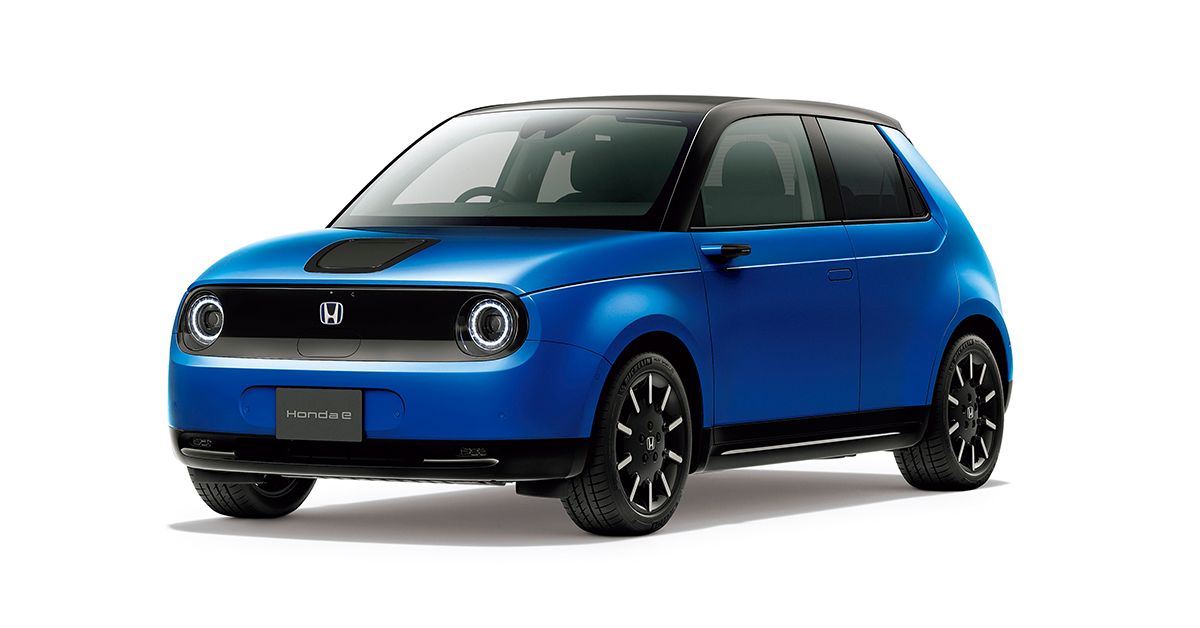
Official press image of the Honda e. | © Honda Motor Co., Ltd.
The Honda e is Honda's small electric hatchback, sold in Japan from October 2020 with a five-screen dashboard and camera mirrors. Here are Honda's own yen prices, specs and production-end facts.
The Honda e is a small electric hatchback that Honda sold in Japan from October 30, 2020, and in Europe from 2020 (Honda). Honda’s Japanese release announced it on August 27, 2020, in two grades, the Honda e and the Honda e Advance (Honda). Both have four seats, a rear-mounted motor and rear-wheel drive (Honda). Honda’s archive page for the car says the 2020 model ended in July 2024 (Honda). We use Honda’s Japanese yen prices, include tax as Honda lists it, and do not convert currencies. Prices and availability may have changed since publication, and exchange rates are not applied.
| Body style | Five-door electric hatchback (Honda) |
| Announced in Japan | August 27, 2020 (Honda) |
| On sale in Japan | October 30, 2020 (Honda) |
| Grades | Honda e, Honda e Advance (Honda) |
| Layout | Rear motor, rear-wheel drive (Honda) |
| Seats | Four (Honda) |
| Battery | 35.5 kWh lithium-ion (Honda) |
| Japan price range | 4,510,000 to 4,950,000 yen (Honda) |
| Range, Advance | 259 km WLTC (Honda) |
| Model ended | July 2024 per Honda archive (Honda) |
Honda’s own pages describe the Honda e as a car built around technology. Its dashboard has five screens in a row, which Honda calls a world first for a mass-produced car (Honda). Two 12.3-inch screens sit side by side in the center for Honda CONNECT, and cameras replace the door mirrors, with 6-inch monitors inside the dashboard (Honda). Honda lists V2H and V2L power supply, a digital key and Honda SENSING with 11 functions as standard (Honda). Our Honda Models article covers the rest of the range.
The numbers are modest. Honda’s Frankfurt 2019 release gives a 35.5 kWh battery, two motor outputs of 100 kW and 113 kW, 315 Nm of torque and a range of up to 220 km (Honda). Honda’s Japanese specification sheet for the Advance gives 113 kW, 315 Nm, 35.5 kWh and a WLTC range of 259 km (Honda). Honda Europe’s preliminary sheet gives a WLTP range of 222 km, or 210 km for the Advance on 17-inch wheels (Honda). The cycles differ, so the three ranges are not directly comparable.
Japanese prices were 4,510,000 yen for the Honda e and 4,950,000 yen for the Honda e Advance, including consumption tax (Honda). The Advance costs 440,000 yen more, or about 9.8 percent (our calculation). Honda planned to sell 1,000 units a year in Japan (Honda). A report puts total sales at about 12,000 units worldwide and about 1,800 in Japan (reported). Honda gives no sales totals in the pages we read.
The car was short-lived. A notice on Honda’s Japanese website said production would end in January 2024 and that the car would be discontinued once the production run sold out (reported). Honda’s archive page for the model ends in July 2024 and gives no exact final date (Honda). A report says Honda has no plans for a second generation (reported). Honda’s later electric cars include the N-VAN e: and the N-ONE e:, which our Honda N-VAN and Honda N-ONE articles cover.
We tag every claim by its source. A claim tagged Honda comes from a Honda-owned page we read, such as Honda’s global newsroom, its Japanese product site, its archive or its Europe newsroom. A claim tagged reported comes from a news outlet or a car-catalog site, and we do not name the outlets. A claim tagged our calculation is a figure we worked out from published numbers. Where Honda’s pages are silent, we say so. Our Honda history article covers the brand and its earlier electric attempts.
Honda showed the mass-production Honda e at the Frankfurt International Motor Show on September 10, 2019 (Honda). Honda’s global release said the 35.5 kWh battery was one of the most compact in its class and gave a range of up to 220 km (Honda). It said fast charging could reach 80 percent in 30 minutes (Honda). The release lists two motor outputs, 100 kW and 113 kW, with 315 Nm of torque and a 0 to 100 km/h time of about 8 seconds (Honda).
| Frankfurt debut | September 10, 2019 (Honda) |
| Europe release, preliminary specs | January 27, 2020 (Honda) |
| Japan announcement | August 27, 2020 (Honda) |
| Japan on-sale date | October 30, 2020 (Honda) |
| Japan annual plan | 1,000 units (Honda) |
| 2019 claimed range | Up to 220 km (Honda) |
| 2019 fast charge | 80 percent in 30 minutes (Honda) |
| Motor outputs | 100 kW and 113 kW (Honda) |
| Germany price before incentive | 33,850 and 36,850 euros (reported) |
| Interest registered by 2019 | 40,000 expressions (reported) |
The Frankfurt release also described the services around the car. Honda planned to introduce its first commercial energy services in 2020, to align with the Honda e launch, with the UK and Germany as the first targeted markets (Honda). It listed the Honda Power Charger for home use, rated at 7.4 kW single-phase or 22 kW three-phase, and said a full charge takes 4.1 hours on a 32-amp supply (Honda). It also described a Power Manager prototype for vehicle-to-grid use, planned for the early 2020s (Honda).
European pricing was reported at the show. A report gives 33,850 euros for the base car and 36,850 euros for the Advance in Germany before an incentive of 4,380 euros (reported). The same report gives 29,660 pounds and 32,760 pounds in the UK before a 3,500-pound grant (reported). Subtracting the incentive gives 29,470 and 32,470 euros in Germany, which match the subsidised figures that reports quote (reported, our calculation). A report says Honda had 40,000 expressions of interest at that point (reported).
Honda Europe’s January 27, 2020 release carried preliminary specifications, which it says are subject to change (Honda). It lists a 100 kW base car and a 113 kW Advance, both with 315 Nm (Honda). It gives a top speed of 145 km/h and 0 to 100 km/h in 9.0 seconds for the base car and 8.3 seconds for the Advance (Honda). It gives no European price and no exact on-sale date for the car (Honda).
Honda’s Japanese release followed on August 27, 2020. It says Honda would launch the Honda e on October 30, 2020, a Friday (Honda). It plans 1,000 sales a year in Japan and gives no monthly figure (Honda). It lists the Honda e at 4,510,000 yen and the Honda e Advance at 4,950,000 yen, both with four seats and rear-wheel drive (Honda). It says prices exclude insurance, registration-related fees and the recycling fee (Honda).
The Japanese release stresses features over performance. It names the five-screen layout, the side camera mirror system, a subscription connected service, a digital key and a parking assist system (Honda). It also lists a rear-mounted high-torque motor, four-wheel independent suspension, NORMAL and SPORT modes and a minimum turning radius of 4.3 m (Honda). Honda says Honda SENSING is standard with 11 functions and that V2H and V2L power supply are supported (Honda). The release calls the Honda e the new electric vehicle Honda launches on October 30, 2020 (Honda). It does not give motor output, battery capacity, range, charging times or dimensions on that page (Honda). We take those from Honda’s other pages, which are the Frankfurt release, the Europe release and the Japanese specification sheet (Honda). The release’s footnotes say its domestic-first and world-first claims rest on Honda’s own research as of August 2020 (Honda). Our Honda Models article covers where the car sat in the 2020 range.
Honda sold two grades in Japan. The Honda e cost 4,510,000 yen and the Honda e Advance cost 4,950,000 yen, with 10 percent consumption tax included (Honda). Both are four-seat, rear-wheel-drive cars (Honda). Honda says its listed prices exclude insurance, taxes other than consumption tax, registration-related fees and the recycling fee (Honda). Its archive page adds that dealers set actual selling prices, and that body colors marked with a symbol cost 38,500 yen more, or 35,000 yen before tax (Honda).
| Honda e | 4,510,000 yen (Honda) |
| Honda e Advance | 4,950,000 yen (Honda) |
| Grade gap | 440,000 yen, about 9.8 percent (our calculation) |
| Tax in listed price | 10 percent consumption tax (Honda) |
| Extra-cost body colors | 38,500 yen (Honda) |
| Center camera mirror | Advance only (Honda) |
| Wheels | 16-inch base, 16 or 17-inch Advance in Europe (Honda) |
| Subscription service | Honda Total Care Premium (Honda) |
| Spare tire | None, puncture repair kit (Honda) |
| Japan base-car motor | 100 kW (reported) |
The grade gap is 440,000 yen (our calculation). Honda’s Japanese release says the center camera mirror is on the Advance only (Honda). Honda Europe’s sheet says the Advance has 16-inch or 17-inch alloy wheels, a 376 W premium audio system with eight speakers and a subwoofer, a center camera mirror system, a heated windscreen and steering wheel, and Honda Parking Pilot (Honda). The base car has 16-inch alloy wheels and six speakers rated at 180 W (Honda).
Honda’s Frankfurt release says the car comes with two motor outputs (Honda). Reports give the base car 100 kW and the Advance 113 kW in Japan, matching Honda’s Frankfurt figures (reported, Honda). Honda’s Japanese specification sheet for the Advance gives 113 kW, or 154 PS, between 3,497 and 10,000 rpm, and 315 Nm between 0 and 2,000 rpm (Honda). Reports put the base car’s range at 283 km WLTC and the Advance at 259 km (reported). Honda’s sheet gives 259 km for the Advance (Honda).
Honda’s Japanese release names the subscription service Honda Total Care Premium, which can be taken for a minimum of one month (Honda). It says the digital key lets owners switch the car on with a smartphone, which Honda calls a first for a domestic car (Honda). It says Honda Parking Pilot is Honda’s first parking assist system and supports six parking and exit patterns (Honda). Honda Europe’s sheet says five parking patterns for Europe (Honda).
Honda’s archive page confirms what a buyer received and what was extra. It lists a puncture repair kit instead of a spare tire, with no jack or wrench included (Honda). It says an ETC2.0 unit needs a separate payment card and setup (Honda). It says option prices and installation fees are not in the listed price (Honda). Honda adds that photos show operating images and that some screens are composites (Honda). It also points buyers to separate equipment and specification lists for the full detail (Honda). It says range figures are test-condition values that vary with weather, traffic and driving style, such as hard acceleration or air conditioning use (Honda).
European prices appear only in reports. A report gives 29,470 euros and 32,470 euros in Germany after an incentive, and 26,160 pounds and 28,660 pounds in the UK after a grant (reported). A report gives the UK pre-grant price of the Advance as 32,760 pounds, but 28,660 pounds plus the 3,500-pound grant is 32,160 pounds (reported, our calculation). We cannot resolve that gap. Honda Europe’s sheet gives no price (Honda). Prices and availability may have changed since publication.
The Honda e uses a single motor on the rear axle. Honda’s Japanese release calls it a rear-mounted high-torque motor, and the Frankfurt release says the car is rear-wheel drive (Honda). Honda’s specification sheet for the Advance names the motor type MCF5, an AC synchronous motor, with a rated output of 60 kW, a maximum output of 113 kW, or 154 PS, and 315 Nm of torque (Honda). Honda gives the Advance’s maximum output between 3,497 and 10,000 rpm and its torque from 0 to 2,000 rpm (Honda). The final reduction ratio is 9.545 (Honda).
| Motor, Advance | 113 kW (154 PS), 3,497 to 10,000 rpm (Honda) |
| Torque | 315 Nm, 0 to 2,000 rpm (Honda) |
| Rated output, Advance | 60 kW (Honda) |
| Battery | 35.5 kWh lithium-ion (Honda) |
| Total voltage, Advance | 355.2 V (Honda) |
| WLTC range, Advance | 259 km (Honda) |
| WLTP range, Europe | 222 km, 210 km on 17-inch (Honda) |
| Rapid charge | 80 percent in 30 minutes, 100 kW CCS2 (Honda) |
| Full AC charge | 4.1 hours at 7.4 kW (Honda) |
| Efficiency, Advance | About 7.3 km per kWh (our calculation) |
The battery is a 35.5 kWh lithium-ion pack, according to Honda’s Frankfurt release, its archive page and its Europe release (Honda). Honda’s sheet for the Advance gives a total voltage of 355.2 V (Honda). Honda’s archive page calls it a high-output battery and Honda Europe says a thermal management system helps range in hot and cold weather (Honda). Honda’s Frankfurt release does not give a weight for the pack (Honda).
Range depends on the test cycle. Honda’s Frankfurt release says up to 220 km (Honda). Honda Europe’s preliminary sheet gives 222 km WLTP for the base car and the Advance on 16-inch wheels, and 210 km for the Advance on 17-inch wheels (Honda). Honda’s Japanese sheet gives 259 km WLTC for the Advance (Honda). Dividing 259 km by 35.5 kWh gives about 7.3 km per kWh (our calculation). Reports give 283 km WLTC for the base car in Japan (reported).
Charging is covered by Honda Europe’s sheet. The on-board charger is rated at 6.6 kW AC (Honda). An 80 percent rapid charge takes 30 minutes on a 100 kW CCS2 charger and 31 minutes on a 50 kW charger (Honda). A full charge takes 4.1 hours on a 7.4 kW public Type 2 point and 18.8 hours on a 2.3 kW home Type 2 connection (Honda). Honda’s Japanese release does not give charging times (Honda). The Frankfurt release says the Honda Power Charger needs 4.1 hours for a full charge on a 32-amp supply (Honda).
Performance figures are modest. Honda’s Frankfurt release says 0 to 100 km/h takes about 8 seconds (Honda). Honda Europe’s sheet gives 9.0 seconds for the base car and 8.3 seconds for the Advance, with a top speed of 145 km/h (Honda). The sheet gives a kerb weight of 1,514 kg for the base car, 1,527 kg for the Advance on 16-inch wheels and 1,542 kg on 17-inch wheels (Honda). Honda’s Japanese sheet gives 1,540 kg for the Advance (Honda).
The release also describes power supply. Honda’s Japanese release says the car supports V2H, which supplies a home, and V2L, which supplies a load, and gives no output rating (Honda). Honda’s Frankfurt release describes bidirectional vehicle-to-grid use as a prototype for the early 2020s (Honda). Our Honda N-VAN article covers the later electric kei van that carries the same idea of power supply, and our Honda N-ONE article covers the electric N-ONE. Honda gives no battery warranty terms in the pages we read, and it gives no motor weight or battery weight either (Honda).
Honda’s Japanese release puts the screens first. The dashboard has five screens in a horizontal row, which Honda calls a world first for a mass-produced car (Honda). Two 12.3-inch screens sit side by side in the center as the Honda CONNECT display (Honda). Honda’s archive page repeats the five-screen claim and lists Honda CONNECT connected technology, which requires dealer terms and conditions (Honda). Honda’s Europe release says the car keeps owners in sync with everyday life through connectivity and lists a 12.3-inch dual touchscreen setup as standard on both grades (Honda). Honda’s Frankfurt release also describes dual 12.3-inch touchscreens as part of a full-width digital dashboard (Honda).
| Screens | Five in a row, world first (Honda) |
| Center displays | Two 12.3-inch (Honda) |
| Mirror screens | Two 6-inch (Honda) |
| Camera system | 1.7 megapixel, standard (Honda) |
| Center camera mirror | Advance only (Honda) |
| Voice assistant | Honda Personal Assistant, OK Honda (Honda) |
| Smartphone app | My Honda+ (Honda) |
| Digital key | Phone power-on, a domestic first (Honda) |
| Drive modes | NORMAL and SPORT, one-pedal control (Honda) |
| Door handles | Flush outer handles (Honda) |
The mirrors are cameras. Honda’s Japanese release says the side camera mirror system replaces door mirrors with cameras and 6-inch monitors in the dashboard (Honda). It says the 1.7-megapixel system is a world first as standard equipment on a mass-produced car (Honda). The center camera mirror is on the Advance only (Honda). Honda Europe’s sheet lists a width of 1,750 mm and, in its own words, 1,752 mm including door mirrors (Honda). Honda’s Frankfurt release says the cameras send live images to two six-inch screens inside the car (Honda).
Honda’s archive page lists the Honda Personal Assistant and flush outer door handles (Honda). Honda’s Frankfurt release says the assistant is activated by saying “OK Honda” (Honda). It also lists the My Honda+ smartphone app for remote climate control, security and location monitoring and battery charge control (Honda). The digital key locks and unlocks the car from a smartphone (Honda). Honda’s Japanese release says it is the first domestic car that allows power-on with the phone key (Honda).
Driving controls are simple. Honda’s Japanese release lists NORMAL and SPORT modes and one-pedal control (Honda). Honda Europe’s sheet lists Single Pedal Control and the same two modes (Honda). It lists the Honda Personal Assistant, My Honda+ app and digital key as standard on both grades (Honda). Honda’s Japanese release says the car has four-wheel independent suspension (Honda).
The connected service is a subscription. Honda’s Japanese release says Honda Total Care Premium can be subscribed to for a minimum of one month (Honda). Honda’s Frankfurt release says Honda planned its first commercial energy services for 2020, with the UK and Germany first (Honda). Honda’s archive page says Honda CONNECT needs dealer terms and conditions and that photos show operating images, some with composite screens (Honda). Honda gives no data allowance or price for the service in the pages we read. The Japanese release says the service needs an application, and that owners can choose the period from a minimum of one month (Honda).
Styling comes from reports and Honda’s own words. A catalog report describes a simple, modern design and a two-box shape (reported). A report says the 2017 Urban EV Concept previewed the production car (reported). A report says the car won a city car award in 2020 (reported), while Honda’s pages we read name no award (Honda). Honda’s pages we read do not list design awards, designers or the concept’s name. Our Honda Models article covers Honda’s other small cars.
Honda’s Japanese specification sheet for the Advance gives a length of 3.895 m, a width of 1.750 m and a height of 1.510 m (Honda). The wheelbase is 2.530 m, the front tread is 1.510 m and the rear tread is 1.505 m (Honda). Ground clearance is 0.145 m and the weight is 1,540 kg (Honda). The wheelbase is about 64.9 percent of the length (our calculation). Honda Europe’s sheet gives 3,895 mm by 1,750 mm by 1,512 mm, which differs from Japan by 2 mm in height (Honda).
| Length, Japan | 3,895 mm (Honda) |
| Width | 1,750 mm (Honda) |
| Height, Japan and Europe | 1,510 mm and 1,512 mm (Honda) |
| Wheelbase | 2,530 mm (Honda) |
| Ground clearance | 145 mm (Honda) |
| Weight, Advance, Japan | 1,540 kg (Honda) |
| Turning radius | 4.3 m at the wheels (Honda) |
| Boot, seats up | 171 liters, VDA (Honda) |
| Boot, seats down to roof | 861 liters, VDA (Honda) |
| Honda SENSING | 11 functions in Japan (Honda) |
Honda’s sheet gives the cabin as 1.845 m long, 1.385 m wide and 1.120 m high (Honda). The car has four seats (Honda). Honda’s Japanese release gives a minimum turning radius of 4.3 m (Honda). Honda Europe’s sheet gives 4.3 m at the wheels and 4.6 m at the body (Honda). A report notes the figure is close to that of a kei car, and gives the N-BOX front-drive figure as 4.5 m for comparison, but Honda’s Honda e pages do not make that comparison (reported). Our Honda N-VAN article covers a car on the N-BOX platform.
The Advance rides on 17-inch wheels in Japan. Honda’s sheet lists 205/45ZR17 tires at the front and 225/45ZR17 at the rear (Honda). The sheet lists vented front discs and solid rear discs, both hydraulic (Honda). It lists the final reduction ratio as 9.545 and the steering as electric rack-and-pinion (Honda). The sheet lists MacPherson strut suspension and torsion-bar stabilizers (Honda). Honda’s archive page says there is no spare tire, only a puncture repair kit with no jack or wrench (Honda).
Boot space comes from Honda Europe’s sheet, which uses the VDA method. It gives 171 liters with the rear seats up, 571 liters with them folded to window height and 861 liters folded to the roof (Honda). Folding the seats adds 400 liters at window height (our calculation). Folding to the roof adds 290 liters more (our calculation). Honda’s Japanese pages do not give a boot volume (Honda). The sheet says the figures use the VDA method, a liter-based standard measure (Honda).
Safety equipment is Honda SENSING. Honda’s Japanese release says it is standard with 11 functions and qualifies as Supporting Car S Wide (Honda). Honda Europe’s sheet lists the collision mitigation brake system, adaptive cruise control, lane keep assist, intelligent speed limiter, road departure mitigation, traffic sign recognition and auto high-beam (Honda). It lists lead car departure notification, collision mitigation throttle control and a low-speed brake function as new for Europe (Honda). Blind spot information with cross-traffic monitoring is on the Advance only (Honda).
Crash ratings are not in Honda’s pages. A report says the car received four stars from Euro NCAP in 2020 in its standard European configuration (reported). Honda’s archive page says only that the car has a strong body structure for crash safety (Honda). A catalog report gives a height of 1,503 mm and a length of 3,894 mm, which differ from Honda’s sheets (reported, Honda). We use Honda’s figures. Our Honda Models article covers rivals within the range.
Honda planned modest volumes from the start. Its Japanese release gives an annual plan of 1,000 units for Japan (Honda). A report says Honda planned 10,000 a year in Europe and 1,000 a year in Japan, and that cumulative sales reached about 12,000 units (reported). Another report says about 1,800 were sold in Japan and about 12,000 worldwide (reported). A third report gives about 12,500 units worldwide over three years (reported).
| Japan annual plan | 1,000 units (Honda) |
| Europe annual target | 10,000 units (reported) |
| Global sales | About 12,000 to 12,500 units (reported) |
| Japan sales | About 1,800 units (reported) |
| Europe 2021 sales | 3,752 or 3,436 units (reported) |
| Europe 2022 sales | 2,110 units (reported) |
| Production end notice | January 2024 stated (reported) |
| Archive page | Ended model, July 2024 (Honda) |
| Successor in Europe | e:Ny1 announced May 12, 2023 (Honda) |
| Kei electric van | N-VAN e: on sale October 10, 2024 (Honda) |
European sales are reported year by year. One report says 3,752 were sold in Europe in 2021 against the 10,000 target, which is about 37.5 percent (reported, our calculation). Another report says sales peaked at 3,436 in 2021 and fell to 2,110 in 2022 (reported). The two reports disagree on the 2021 figure, so we do not use either as fact. Honda’s pages we read give no sales totals by year (Honda).
The end of production was announced on Honda’s Japanese site in December 2023. Reports quote the notice as saying that production would end in January 2024 and that the car would be discontinued once the production run was sold out (reported). A report says some colors might already be unavailable, quoting the notice (reported). Reports date the notice to December 12 or 13, 2023 (reported). Reports say orders closed in Europe at the same time (reported). Honda’s archive page for the model, current as of July 2024, lists it as an ended model and gives no exact final date (Honda). The page is headed as a model announced in August 2020 and ended in July 2024 (Honda).
Reports give reasons that Honda does not. They cite a high price, a limited range and little luggage space (reported). A report says Honda Europe said the car had not met its sales target but had brought new customers to the brand (reported). A report says there were no plans for a second generation (reported). A report says Honda planned to expand its lineup beginning with a light electric van the next year (reported). Honda’s own pages we read state no reason. The archive page says only that range figures are test-condition values and that real range varies with weather, traffic and driving style (Honda).
Honda moved to other electric models. Honda’s Japanese release of May 12, 2023 announced the e:Ny1 for Europe, a WLTC range of 412 km, with sales from autumn 2023 (Honda). It calls the e:Ny1 the second EV model in Europe after the Honda e (Honda). Honda announced the N-VAN e: on June 13, 2024, and it went on sale on October 10, 2024 (Honda). Our Honda N-VAN article covers that van and our Honda N-ONE article covers the electric N-ONE.
The sales life ran from October 30, 2020 in Japan to a notice in December 2023 and an ended-model archive page dated July 2024 (Honda, reported). That is about three years from launch to the notice (our calculation). Honda’s archive page still lists the car’s specifications and features (Honda). Used-car prices are outside Honda’s pages and this article. Treat any figure tagged reported as a lead to verify.
Japan’s Honda e started at 4,510,000 yen and the Advance at 4,950,000 yen (Honda). Honda’s later electric kei van, the N-VAN e:, started at 2,439,800 yen and reached 2,919,400 yen (Honda). The Honda e Advance costs 2,030,600 yen more than the N-VAN e: FUN, the dearest electric N-VAN (our calculation). The two are different cars, a kei van against a small hatchback, so the comparison is only for scale. Prices and availability may have changed since publication, and exchange rates are not applied.
| Honda e price, Japan | 4,510,000 yen (Honda) |
| Honda e Advance price, Japan | 4,950,000 yen (Honda) |
| Grade gap | 440,000 yen (our calculation) |
| Range, Japan Advance | 259 km WLTC (Honda) |
| Range, Europe | 222 km WLTP (Honda) |
| Range, Europe 17-inch | 210 km WLTP (Honda) |
| Base-car range, Japan | 283 km WLTC (reported) |
| Height, Japan and Europe | 1,510 mm and 1,512 mm (Honda) |
| Parking patterns | Six in Japan, five in Europe (Honda) |
| Production end | January 2024 notice, July 2024 archive (reported, Honda) |
Range conflicts are the biggest issue. Honda quotes up to 220 km at Frankfurt, 222 km WLTP in Europe, 210 km WLTP on 17-inch wheels and 259 km WLTC in Japan for the Advance (Honda). Reports give 283 km WLTC for the base car and, in another place, a range of 256 km and about 218 km (reported). The cycles differ, and Honda’s own pages do not reconcile them. We use Honda’s figure and label the cycle. Honda’s sheet also warns that range depends on weather, traffic, driving style and air conditioning use (Honda).
Dimension conflicts are small. Honda Japan gives a height of 1,510 mm and Honda Europe gives 1,512 mm (Honda). A catalog report gives 1,503 mm, another gives 1,495 mm, and a third gives a length of 3,894 mm (reported). Honda Japan gives 1,540 kg for the Advance and Honda Europe gives 1,527 kg or 1,542 kg depending on wheels (Honda). Honda’s Japanese release lists six parking patterns, while Honda Europe lists five (Honda).
Production-end conflicts matter for buyers. Reports quote Honda’s notice as saying production would end in January 2024 (reported). Honda’s archive page gives July 2024 as the end of the model (Honda). The two can both be true if the notice covered production and the archive covered sales, but Honda’s pages do not say so. We found no Honda release stating a final sale date, and Honda’s archive page says the same, giving only the month of July 2024 (Honda). A buyer should therefore treat the end date as unconfirmed.
Several items are not confirmed. Honda’s pages give no battery weight, battery warranty, V2H output, Honda Total Care Premium price or sales totals (Honda). We did not read Honda’s Japanese specification sheet for the base grade, so its 283 km range, 100 kW output and weight are reported only (reported). The UK Advance price conflict in reports is unresolved. We did not read Honda Europe’s European pricing release, and its on-sale date is not stated in the sheet we read. Honda gives no figure for Japanese sales by year, no total for how many cars were built, and no reason for ending production on the pages we read.
To check this article, start with Honda’s Japanese release of August 27, 2020, its Frankfurt release of September 10, 2019 and its Japanese specification sheet. Then read Honda Europe’s January 27, 2020 release and Honda’s archive page for the ended model (Honda). Our Honda Models article covers the current range, our Honda history article covers the brand and our Honda N-VAN and Honda N-ONE articles cover Honda’s later electric kei cars. Treat any figure tagged reported as a lead to verify.
