 Brands
Hyundai Grandeur — The New Grandeur, Prices and Engines
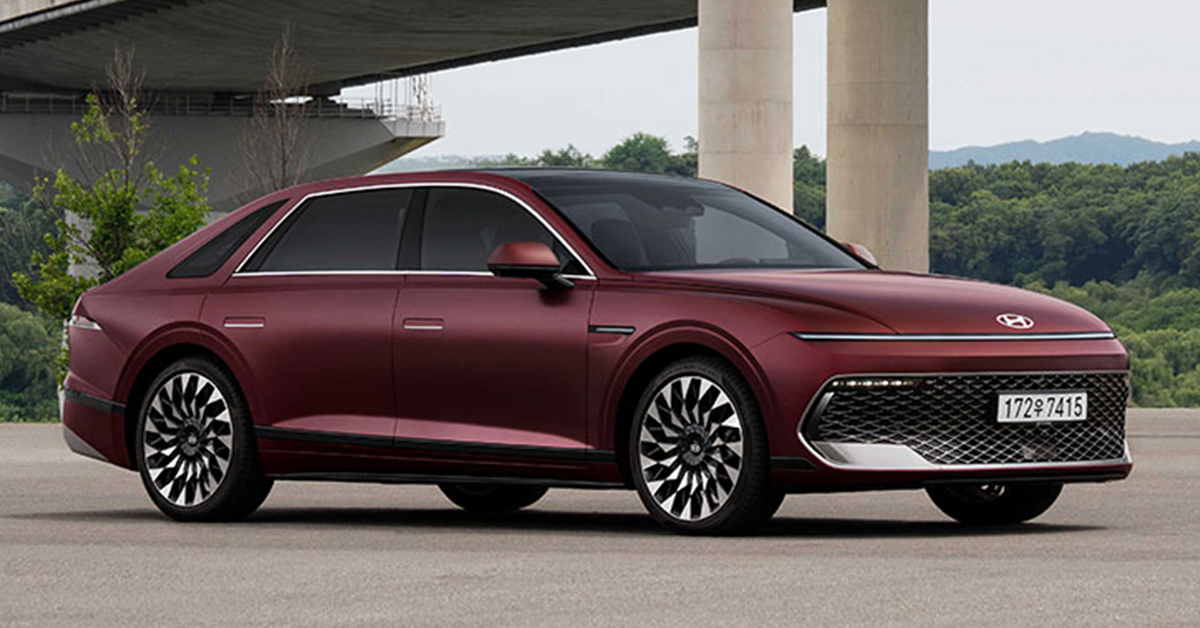
Official image of the Hyundai Grandeur. | © Hyundai Motor Company
Hyundai Grandeur. The 1986 flagship, the May 2026 New Grandeur, 5,050 mm length, Pleos Connect, four engines and Korean prices from 41.85 million won.
The Grandeur is Hyundai’s flagship sedan in South Korea. Hyundai’s Korean launch release says the first generation went on sale in July 1986 and that the car has been the brand’s flagship for more than 40 years (Hyundai). From July 1986 to July 2026 is 40 years (our calculation). Outside Korea the same car is badged Azera, and our Hyundai Azera article covers that export history, the Middle East and the American years.
| First generation | July 1986 (Hyundai) |
| Export name | Azera (Hyundai) |
| Seventh generation debut | November 2022 (Hyundai) |
| Facelift design reveal | April 28, 2026 (Hyundai) |
| Facelift launch | May 14, 2026 (Hyundai) |
| Facelift length | 5,050 mm (Hyundai) |
| Length over previous | 15 mm (Hyundai) |
| Starting price, 2.5 gasoline | 41.85 million won (Hyundai) |
| Starting price, hybrid | 48.64 million won (Hyundai) |
| Powertrains | 2.5 gasoline, 3.5 gasoline, 3.5 LPG, 1.6 turbo hybrid (Hyundai) |
The newest version is called The New Grandeur. Hyundai launched it in South Korea on May 14, 2026 as a facelift of the seventh generation, which debuted in November 2022 (Hyundai). Hyundai’s design reveal on April 28, 2026 said the gap was about three years and five months (Hyundai). The reveal came 16 days before the launch, since April 28 to May 14 is 16 days (Hyundai, our calculation).
Hyundai lists four powertrains for the new car, a 2.5-liter gasoline, a 3.5-liter gasoline, a 3.5-liter LPG and a 1.6-liter turbo hybrid (Hyundai). Starting prices are 41.85 million won, 44.29 million won, 43.31 million won and 48.64 million won, based on a 3.5 percent individual consumption tax rate (Hyundai). The hybrid price is before tax incentives and its final figure was to follow the eco-friendly vehicle designation (Hyundai). Prices and availability may have changed since publication, and exchange rates are not applied.
We read Hyundai’s own pages first. They were the Hyundai Korea price and specification pages, the Hyundai Korea hybrid price list, the Hyundai Motor Group newsroom design reveal of April 28, 2026, the launch release of May 14, 2026 and the Pleos Connect release of April 30, 2026. Reports supply power figures, sales and earlier model-year prices. They carry the reported tag, and we do not name them in the text. Where sources disagree we show both values.
The new car is 5,050 mm long, 15 mm longer than the car it updates (Hyundai). It has a 17-inch central display running Pleos Connect, which Hyundai says is based on Android Automotive OS, and a Gleo AI voice assistant built on a large language model (Hyundai). A report says the hybrid makes 240 PS and the V6 300 PS (reported). Hyundai said hybrid output and economy figures would follow certification (Hyundai).
This guide covers the history from 1986, the seventh generation of 2022, the 2026 design and features, the engines, Korean prices across several model years, sales and the conflicts between sources. Our Hyundai Models article lists the current range and our Hyundai history article covers the company. We found no Hyundai page that lists the facelift’s trims, so trim prices for it are not given here. Hyundai held a media day on May 13, 2026 at Grand Walkerhill in Seoul, one day before the launch, and ran a showroom exhibition through Sunday, May 17, which is 3 days after the launch, since 17 minus 14 is 3 (Hyundai, our calculation). The Pleos Connect release was dated April 30, 2026, 14 days before the launch, since April 30 to May 14 is 14 days (Hyundai, our calculation).
Hyundai’s worldwide history page says the Grandeur has been produced since 1986 and moved from an icon of wealth for middle-aged and elderly customers to a car for young adults (Hyundai). Hyundai’s Korean launch release says the first generation arrived in July 1986 and that each generation brought the newest design and technology of its day (Hyundai). The page names the fifth generation of 2011, which combined Fluidic Sculpture design with the Grand Glide concept (Hyundai).
| First generation | July 1986 (Hyundai) |
| Fifth generation | 2011, Fluidic Sculpture (Hyundai) |
| Fifth generation Korea engine | 3.0 GDI, 270 ps (reported) |
| Sixth generation release | October 31, 2016 (Hyundai) |
| Sixth generation in Europe | Not offered (Hyundai) |
| Hybrid unveiled | March 30, 2017 (reported) |
| Facelift 2.5 gasoline | 198 PS, 25.3 kg.m (Hyundai) |
| Facelift 3.3 gasoline | 290 PS, 35.0 kg.m (Hyundai) |
| Facelift LPi 3.0 | 235 PS, 28.6 kg.m (Hyundai) |
| 2023 sales | 113,047 (reported) |
The fifth generation had a clear size and power target. A reprinted Hyundai release says the 2011 Grandeur used a Lambda II 3.0 GDI of 270 ps and 31.6 kg.m, and Hyundai aimed to sell 100,000 cars that year, 80,000 in Korea and 20,000 abroad (reported). Exports were therefore planned at 20 percent of the total, since 20,000 divided by 100,000 is 0.2 (reported, our calculation). Our Hyundai Azera article covers the American years in detail. From the 2011 fifth generation to the 2016 sixth is 5 years and from 2016 to the 2022 seventh is 6 years (Hyundai, our calculation).
The sixth generation followed in 2016. Hyundai Motor Deutschland’s release of October 31, 2016 said it would start in Korea the next month, with a coupe-like silhouette and a cascading grille shared with the new i30 (Hyundai). It said the car would not be offered in Europe, Australia or North America (Hyundai). A report says Korean launch engines were a 3.0 GDi of 266 PS, a 2.4 GDi of 190 PS, a 2.2 diesel of 202 PS and a 3.0 LPi for fleets (reported).
A hybrid came in 2017. A report says Hyundai unveiled the Grandeur Hybrid at the Seoul Motor Show on March 30, 2017 and began sales (reported). Hyundai Korea’s hybrid price list for that car names highway driving assist among the Exclusive trim’s base safety items, with forward collision assist covering cyclists and oncoming vehicles at junctions (Hyundai).
Hyundai Korea’s specification page for the facelifted sixth generation lists three engines. The 2.5 gasoline makes 198 PS and 25.3 kg.m, the 3.3 gasoline 290 PS and 35.0 kg.m, and the LPi 3.0 235 PS and 28.6 kg.m (Hyundai). All three share a 4,990 mm length, a 1,875 mm width, a 1,470 mm height and a 2,885 mm wheelbase (Hyundai). The page says output figures are net values, which are usually somewhat lower than the older gross figures (Hyundai).
The car became a sales leader. A 2026 report says the Grandeur was the best-selling vehicle of any kind in South Korea from 2017 through 2020, which is 4 years, since 2020 minus 2017 plus 1 is 4 (reported, our calculation). A 2024 report says it sold 113,047 units in 2023, making it the best-selling car domestically (reported). Hyundai’s pages do not give sales figures (Hyundai). Early customers were mainly executives and businessmen, according to a report (reported). Korean launch prices for the 2016 car ran from 26.2 million won for the LPi to 38.7 million won for the 3.0 GDi Exclusive Special, a spread of 12.5 million won (reported, our calculation). The 2.5 makes 79.3 PS per liter and the 3.3 makes 86.8, since 198 divided by 2.497 and 290 divided by 3.342 give those values (Hyundai, our calculation).
Hyundai unveiled the seventh-generation Grandeur on October 19, 2022 and gave its specifications on November 14, 2022 (Hyundai). The two releases are 26 days apart, since November 14 minus October 19 is 26 (Hyundai, our calculation). The car is badged Azera outside Korea. Hyundai says it came six years after the sixth generation launched in 2016, and quotes SangYup Lee, head of the Hyundai Design Center (Hyundai).
| Unveiled | October 19, 2022 (Hyundai) |
| Specifications released | November 14, 2022 (Hyundai) |
| Length | 5,035 mm (Hyundai) |
| Previous length | 4,990 mm (Hyundai) |
| Wheelbase over previous | 10 mm (Hyundai) |
| 3.5 GDi | 300 ps, 36.6 kgf.m (Hyundai) |
| 1.6 turbo hybrid | 180 ps, 27.0 kgf.m (Hyundai) |
| Cluster | 12.3 inch (Hyundai) |
| 2025 model announced | June 5, 2024 (reported) |
| 2026 model announced | May 21, 2025 (reported) |
The design used a Seamless Horizon Lamp across the front, a parametric jewel grille, a single horizontal character line from the headlamps to the rear lamp and frameless doors with auto-flush handles (Hyundai). The one-spoke steering wheel was inspired by the first-generation Grandeur (Hyundai). Hyundai says the cabin used quilted Napa leather in a traditional Korean pattern, real wood and aluminum (Hyundai).
Hyundai’s November 2022 release gave a length of 5,035 mm, 45 mm longer than the previous generation, with a 10 mm longer wheelbase and a 50 mm longer rear overhang (Hyundai). That implies 4,990 mm for the previous car, since 5,035 minus 45 is 4,990, and Hyundai Korea’s own specification page lists 4,990 mm for the sixth generation, so the two Hyundai pages agree (Hyundai, our calculation). The 45 mm gain is 15 mm less than the 60 mm that the wheelbase and rear overhang add together, since 10 plus 50 is 60, which implies the front overhang shrank by 15 mm (Hyundai, our calculation).
Hyundai lists two powertrains in that release. The 3.5-liter GDi makes 300 ps and 36.6 kgf.m and the 1.6-liter turbo hybrid makes 180 ps and 27.0 kgf.m (Hyundai). The V6 has 120 ps more than the hybrid, since 300 minus 180 is 120 (Hyundai, our calculation). It says the car was the first with the Connected Car Navigation Cockpit, which combines a 12.3-inch cluster with navigation and a 10.25-inch full-touch climate controller (Hyundai). Hyundai Korea’s price page of January 1, 2024 lists 2.5 and 3.5 gasoline cars and a 3.5 LPG car for the Korean market (Hyundai).
Model-year updates followed. The 2025 model, announced on June 5, 2024, made Lane Keeping Assist 2 standard and added a Black Exterior Package, and the Calligraphy gained a head-up display and quilted Nappa leather, according to reports (reported). Its 3.5 prices were 40.15 million won for Premium, 45.05 million won for Exclusive and 49.68 million won for Calligraphy, which makes Calligraphy 9.53 million won above Premium, since 49.68 minus 40.15 is 9.53 (reported, our calculation). The same report says prices rose 250,000 won for Premium and Exclusive and 830,000 won for Calligraphy, so the 2024 prices were 39.90, 44.80 and 48.85 million won, since each increase is subtracted (reported, our calculation).
The 2026 model year, announced on May 21, 2025, added a special Honors trim and made natural leather seats, ventilated front seats and a smart power trunk base features on Premium, according to reports (reported). Hyundai Korea’s hybrid price list is dated to that launch and lists trims named Premium, Exclusive, Honors, Calligraphy, Black Exterior and Black Ink (Hyundai). Our Hyundai Sonata article covers the mid-size car that sits below the Grandeur in Hyundai’s range.
Hyundai revealed The New Grandeur on April 28, 2026, calling the update new-car-level (Hyundai). The front has a longer hood, a more pronounced shark-nose shape and a new mesh-pattern grille (Hyundai). The lighting is slimmer, with bezel-less Seamless Horizon lamps, new side repeaters on the front fenders, slimmer rear combination lamps and hidden turn signals on the upper trim (Hyundai).
| Design reveal | April 28, 2026 (Hyundai) |
| Length | 5,050 mm (Hyundai) |
| Front overhang change | 15 mm longer (Hyundai) |
| Previous length implied | 5,035 mm (Hyundai, our calculation) |
| 2020 length | 4,990 mm (Hyundai) |
| Front | Shark nose, mesh grille (Hyundai) |
| Lamps | Seamless Horizon, bezel-less (Hyundai) |
| Antenna | Hidden, first Hyundai sedan (Hyundai) |
| New color | Burgundy, pearl and matte (Hyundai) |
| Pre-launch sign-ups | More than 30,000 (reported) |
Hyundai gives the length as 5,050 mm, 15 mm more than before (Hyundai). The launch release says the front overhang is 15 mm longer (Hyundai). The previous car is therefore 5,035 mm long, since 5,050 minus 15 is 5,035, which matches Hyundai’s 2022 figure (Hyundai, our calculation). The 2020 sixth generation was 4,990 mm, so the car has grown 60 mm over two generations, since 5,050 minus 4,990 is 60 (Hyundai, our calculation).
The lower body is changed. Hyundai describes a wing-type trim on the lower bumper and more black cladding along the lower body (Hyundai). The launch release adds that this is the first Hyundai sedan with a hidden antenna instead of a protruding shark-fin one (Hyundai). The page says aerodynamic work reduces wind noise and improves efficiency but gives no drag coefficient (Hyundai). A report adds new alloy wheel options (reported). At 5,050 mm the car is about 198.8 inches long, since 5,050 divided by 25.4 is 198.8 (our calculation). The update came after about 41 months, since 3 years times 12 plus 5 is 41 (Hyundai, our calculation).
Hyundai introduced a new color, which its design reveal calls Artisanal Burgundy and offers in pearl and matte finishes, inspired by traditional Korean lacquerware (Hyundai). The same page spells the interior tone as Artisan Burgundy, and a report calls the color Artistic Burgundy (Hyundai, reported). The exact name is therefore not settled between sources, and we use Burgundy alone where we can.
The interior is described as a premium lounge. Hyundai lists a 17-inch center display, physical buttons below it, electric air vents, couch-pattern door trim and indirect ambient lighting (Hyundai). Materials include quilted patterns with knot piping, natural wood-texture trim and metal-pattern trim (Hyundai). A report says the new screen replaces the earlier 12.3-inch display and the separate 10.25-inch climate panel, which together are 22.55 inches of diagonal, since 12.3 plus 10.25 is 22.55 (reported, our calculation). Hyundai Korea listed a width of 1,875 mm and a height of 1,470 mm for the 2020 car, and we found no width, height or wheelbase for the facelift on a Hyundai page (Hyundai).
Hyundai says the design reveal was backed by an Early Pass pre-registration campaign that ran until May 13, with prizes of a Bose speaker for 50 winners and a 50,000 won fuel voucher for 100 winners (Hyundai). A report says more than 30,000 people signed up for launch notifications and that delivery waits of six months to a year were expected (reported). The campaign slogan was DONE. YET. GRANDEUR. (Hyundai). The raffle covers 150 winners, since 50 plus 100 is 150, and the 100 fuel vouchers total 5 million won (Hyundai, our calculation).
The headline feature is Pleos Connect. Hyundai Motor Group unveiled it on April 30, 2026, saying it would debut on the new Grandeur in Korea and then roll out globally, with the IONIQ 3 the first European model to carry it (Hyundai). The group targets about 20 million Hyundai, Kia and Genesis vehicles by 2030 (Hyundai). Hyundai says it is built on Android Automotive OS and that the Grandeur is the first Hyundai vehicle to carry it (Hyundai).
| Infotainment | Pleos Connect on Android Automotive OS (Hyundai) |
| Central display | 17 inch (Hyundai) |
| Voice assistant | Gleo AI (Hyundai) |
| Pleos Connect unveiled | April 30, 2026 (Hyundai) |
| Group rollout target | About 20 million vehicles by 2030 (Hyundai) |
| Air vent modes | 4 (Hyundai) |
| Roof zones | 6 (Hyundai) |
| Pedal safety | Pedal Misoperation Safety Assist (Hyundai) |
| Reversing | Memory Reversing Assist (Hyundai) |
| Hybrid convenience | Hybrid Stay Mode (Hyundai) |
Gleo AI is a voice assistant built on a large language model. Hyundai says it handles continuous conversation, navigation, trip suggestions and general knowledge questions, and that the Pleos App Market offers third-party video and music streaming and games (Hyundai). The system can split the screen so several functions show at once (Hyundai). Hyundai’s Pleos Connect release credits Jongho Lee, Team Lead of the Gleo AI Group at 42dot, with presenting Gleo AI at the Pleos Connect Media Day (Hyundai). The slim driver display shows speed, gear and route information (Hyundai). A report says the system launched in May 2026 on the Grandeur (reported). From 2026 to the 2030 target is 4 years (Hyundai, our calculation).
Electric air vents are hidden in the dashboard and have four airflow modes, which Hyundai names passenger focus, passenger avoidance, automatic circulation and free control (Hyundai). The Smart Vision Roof uses a PDLC film instead of a mechanical blind, with transparency adjustable across six zones, quiet operation and heat blocking (Hyundai). Hyundai’s two pages describe these as a first for the Grandeur and a first for Hyundai, so the claims differ in scope (Hyundai).
The safety additions are specific. Pedal Misoperation Safety Assist detects sudden accelerator pressure at low speed or when stopped, then limits drive force and applies braking, and Hyundai calls it a first for an internal combustion vehicle (Hyundai). Memory Reversing Assist remembers the path driven and steers automatically when reversing (Hyundai). An in-cabin monitoring camera in the mirror tracks driver gaze, seatbelt use and abnormal front passenger posture (Hyundai).
Controls changed too. Hyundai says the turn signals and wipers are combined in one left-side stalk, the shift lever moved from a rotary dial to an up-down lever, and the sun visor mirror is wider (Hyundai). A Hybrid Stay Mode lets the climate control and infotainment run while stationary without the engine (Hyundai). Hyundai says rear-seat reclining and ventilated seats are a first in class for a hybrid sedan (Hyundai). A report adds an Ergo Motion driver seat, reclining ventilated rear seats with neck pillows, three-zone climate, a Bose system and a rear-seat air purifier on higher trims (reported).
The chassis was reworked. Hyundai lists a thicker cowl crossbar, reinforced front strut towers and hydraulic rebound stoppers (Hyundai). Preview electronic control suspension, which reads the road ahead, now extends from 20-inch to 19-inch wheels, and Highway Body Motion Control works with Highway Driving Assist to damp vertical motion during acceleration and braking (Hyundai). A report says an Active Load Noise Control system is included for a quieter ride (reported).
Hyundai lists four engines for The New Grandeur, but the release does not give power, torque or fuel economy for any of them (Hyundai). A report gives the 2.5-liter gasoline as 198 PS, the 3.5-liter V6 as 300 PS with optional HTRAC all-wheel drive and the hybrid as 240 PS combined (reported). The V6 has 60 PS more than the hybrid, since 300 minus 240 is 60 (reported, our calculation). The older Hyundai Korea page lists a 70-liter tank for the gasoline cars and an 80-liter tank for the LPi, which is 64 liters when filled to 80 percent (Hyundai).
| Engines, 2026 facelift | 2.5, 3.5, 3.5 LPG, 1.6 turbo hybrid (Hyundai) |
| 2.5 gasoline | 198 PS (reported) |
| 3.5 V6 | 300 PS (reported) |
| Hybrid, facelift | 240 PS combined (reported) |
| Hybrid, 2022 | 180 ps (Hyundai) |
| Hybrid layout | P2 plus P1 motors in parallel (Hyundai) |
| Earlier hybrid motor | 44.2 kW (Hyundai) |
| Earlier hybrid gearbox | 6-speed automatic (Hyundai) |
| Earlier hybrid economy, 18 inch | 18.0 km/L (Hyundai) |
| Earlier hybrid economy, 20 inch | 15.7 km/L (Hyundai) |
The 2.5 and the V6 carry earlier numbers. Hyundai Korea listed the 2.5 at 198 PS in its sixth-generation specification, so the reported figure is unchanged (Hyundai, reported). The earlier 3.3 made 290 PS, so the V6 now has 10 PS more, since 300 minus 290 is 10, and a larger 3.5-liter displacement (Hyundai, reported, our calculation). In kilowatts 300 PS is about 221 kW, since 300 times 0.7355 is 220.7 (our calculation). The older 3.3’s 35.0 kg.m is 9.7 more than the 2.5’s 25.3, since 35.0 minus 25.3 is 9.7, and about 343 Nm, since 35.0 times 9.807 is 343 (Hyundai, our calculation). The older LPi’s 235 PS is 37 PS above the 2.5, since 235 minus 198 is 37 (Hyundai, our calculation).
The hybrid is the main change. Hyundai says it is the first sedan with Hyundai Motor Group’s next-generation hybrid system, which uses a P2 drive and regenerative motor and a P1 starter-generator motor in parallel (Hyundai). A report says the system first appeared on the Palisade (reported). The reported 240 PS is 42 PS above the 198 PS of the 2.5, since 240 minus 198 is 42 (reported, our calculation).
Hyundai’s 2022 release gave the earlier hybrid as 180 ps, so the reported new figure is 60 more, a rise of 33 percent, since 60 divided by 180 is 0.333 (Hyundai, reported, our calculation). We could not confirm that both figures describe the same thing, such as engine output or system output, so treat the comparison as indicative. Hyundai said the new hybrid’s specifications would follow certification by the Ministry of Trade, Industry and Energy (Hyundai).
Hyundai Korea’s hybrid price list for the 2026 model year, launched May 21, 2025, gives the previous hybrid hardware. It is a Smartstream 1.6 turbo of 1,598 cc with a 44.2 kW motor, a lithium-ion battery and a 6-speed automatic (Hyundai). Combined economy is 18.0 km/L on 18-inch wheels, 16.7 on 19-inch and 15.7 on 20-inch, with CO2 of 88, 96 and 103 g/km and curb weights of 1,700, 1,715 and 1,735 kg (Hyundai).
Wheel size matters. The 20-inch car uses 2.3 km/L more fuel than the 18-inch car, since 18.0 minus 15.7 is 2.3, which is 12.8 percent (Hyundai, our calculation). In liters per 100 km that is about 5.56, 5.99 and 6.37, since 100 divided by each figure gives those values (Hyundai, our calculation). The 20-inch car is 35 kg heavier than the 18-inch one, since 1,735 minus 1,700 is 35 (Hyundai, our calculation). These figures are for the earlier model year, not the facelift.
The New Grandeur starts at 41.85 million won for the 2.5 gasoline, 43.31 million won for the 3.5 LPG, 44.29 million won for the 3.5 gasoline and 48.64 million won for the hybrid, based on a 3.5 percent consumption tax rate (Hyundai). The 3.5 gasoline is 2.44 million won above the 2.5, which is 5.8 percent, since 44.29 minus 41.85 is 2.44 (Hyundai, our calculation). The LPG is 0.98 million won below the 3.5 gasoline (Hyundai, our calculation).
| 2.5 gasoline, facelift | 41.85 million won (Hyundai) |
| 3.5 gasoline, facelift | 44.29 million won (Hyundai) |
| 3.5 LPG, facelift | 43.31 million won (Hyundai) |
| Hybrid, facelift | 48.64 million won (Hyundai) |
| Top trim, all options | 64 million won (reported) |
| 2026 model 2.5 Premium | 37.98 million won (reported) |
| 2026 model 2.5 Calligraphy | 47.10 million won (reported) |
| 2024 gasoline Premium | 37.43 million won (Hyundai) |
| 2026 model hybrid Premium | 45.23 million won before benefit (Hyundai) |
| 2020 2.5 Premium, 5 percent tax | 33.55 million won (Hyundai) |
The hybrid costs 6.79 million won more than the 2.5 gasoline, which is 16.2 percent, since 48.64 minus 41.85 is 6.79 (Hyundai, our calculation). Hyundai says the hybrid figure is before tax incentives and that the final price follows the eco-friendly vehicle designation (Hyundai). A report puts the top Black Ink trim with the AWD V6 and every option at 64 million won, which is 22.15 million won above the base car (reported, our calculation).
Earlier prices come from several model years. A report says the 2026 model, announced May 21, 2025, started the 2.5 at 37.98 million won for Premium, 42.87 million won for Exclusive, 45.13 million won for Honors and 47.10 million won for Calligraphy (reported). The facelift’s 41.85 million won is 3.87 million won above that Premium, which is 10.2 percent, since 41.85 minus 37.98 is 3.87 (Hyundai, reported, our calculation). A report puts the same rise at 3.87 million won (reported).
Hyundai Korea’s English price page dated January 1, 2024 lists the 2.5 and 3.5 gasoline at 37.43 million won for Premium, 42.33 million won for Exclusive and 46.38 million won for Calligraphy (Hyundai). LPG 3.5 was 38.91 million won and 43.81 million won for Premium and Exclusive, which makes LPG Premium 1.48 million won above gasoline Premium, since 38.91 minus 37.43 is 1.48 (Hyundai, our calculation). Calligraphy was 8.95 million won above Premium, since 46.38 minus 37.43 is 8.95 (Hyundai, our calculation).
The hybrid price list for the 2026 model year shows how tax and incentives change the number. Premium is 45.23 million won before the benefit and 44.54 million won with the 3.5 percent tax, a difference of 0.69 million won (Hyundai, our calculation). After the benefit it is 44.23 million won, which is exactly 1 million won lower than before, since 45,230,000 minus 44,230,000 is 1,000,000 (Hyundai, our calculation). Black Ink is 55.78 million won, which is 10.55 million won above Premium, since 55.78 minus 45.23 is 10.55 (Hyundai, our calculation).
The facelift hybrid at 48.64 million won is 4.10 million won above the earlier Premium hybrid at 44.54 million won on the same tax basis, a rise of 9.2 percent, since 48.64 minus 44.54 is 4.10 (Hyundai, our calculation). Hyundai Korea’s page for the 2020 car listed the 2.5 Premium at 33.55 million won with 5 percent tax and 32.12 million won with 1.5 percent tax, a gap of 1.43 million won (Hyundai, our calculation). Hyundai Korea’s English page also lists prices for disabled drivers, with Premium Plus from 37.55 million won to 37.75 million won (Hyundai). Prices and availability may have changed since publication, and exchange rates are not applied.
The Grandeur is a sales leader at home. A report says it sold 113,047 units in 2023, the best-selling car in South Korea (reported). Another report says the seventh generation has been the country’s best-selling sedan and its second-best-selling vehicle overall, behind only the Sorento (reported). Hyundai’s own pages do not give sales figures, so these remain reported only (Hyundai). The 113,047 sales average about 9,421 a month, since 113,047 divided by 12 is 9,420.6 (reported, our calculation). The 30,000 sign-ups are about 26.5 percent of that year’s sales, since 30,000 divided by 113,047 is 0.265 (reported, our calculation).
| 2023 sales | 113,047 (reported) |
| Domestic rank | Best-selling sedan (reported) |
| Overall rank, per report | Second to the Sorento (reported) |
| Class label, Hyundai | Flagship sedan (Hyundai) |
| Electric vent claim | First for Hyundai or first for Grandeur (Hyundai) |
| Smart Vision Roof claim | First for Hyundai or first for Grandeur (Hyundai) |
| Burgundy name | Artisanal, Artisan or Artistic (Hyundai, reported) |
| Hybrid output | 180 ps in 2022, 240 PS reported for 2026 (Hyundai, reported) |
| Length change | 5,035 mm to 5,050 mm (Hyundai) |
| Facelift trim prices | Not found on a Hyundai page (Hyundai) |
Pricing places it above the Sonata. A report says the top Black Ink AWD V6 with every option costs more than the entry Genesis G80 in Korea (reported). Our Hyundai Sonata article covers the car below it, and our Hyundai Models article lists the wider range. Hyundai calls the car a flagship sedan, while one report calls it a midsize sedan and another a large-size sedan, so the class label differs by source. Delivery waits of six months to a year were expected after launch, according to a report (reported).
Several Hyundai statements overlap. The design reveal calls the electric air vents a first for Hyundai, while the launch release calls them a first for the Grandeur (Hyundai). The Smart Vision Roof is described as the first with adjustable tint and zones in one place and as a first for the Grandeur in the other (Hyundai). The design page uses two spellings of the burgundy name and a report uses a third (Hyundai, reported).
Power figures conflict across years rather than sources. Hyundai’s 2022 release gives the hybrid as 180 ps, a report gives the facelift hybrid as 240 PS, and Hyundai said at launch that figures were not yet disclosed (Hyundai, reported). The V6 is 300 ps in 2022 and 300 PS in the report, which agree (Hyundai, reported). Length is 5,035 mm in 2022 and 5,050 mm for the facelift, a 15 mm change that Hyundai states (Hyundai).
Several items are not confirmed. We found no Hyundai page for the facelift’s trim prices, fuel economy, torque, curb weight or all-wheel-drive option, and no Hyundai figure for hybrid output. We found no Korean crash-test rating for the facelift, and no Hyundai statement of export plans for it. We found no Hyundai boot-space or interior-size figure for it, and no Hyundai statement on whether it will be sold as the Azera in the Middle East. We list each figure with its source tag. Hyundai’s Korean launch release says the next-generation hybrid’s figures follow certification (Hyundai).
To check this guide, start with the Hyundai Motor Group releases of April 28, April 30 and May 14, 2026, and compare dates before comparing numbers, because model years and facelifts overlap. The 2025 model was announced on June 5, 2024, the 2026 model on May 21, 2025 and the facelift launched on May 14, 2026, gaps of 350 and 358 days (reported, our calculation). Prices and availability may have changed since publication, and exchange rates are not applied.