 Brands
Hyundai Veloster — Veloster N, Specs, Prices and Generations
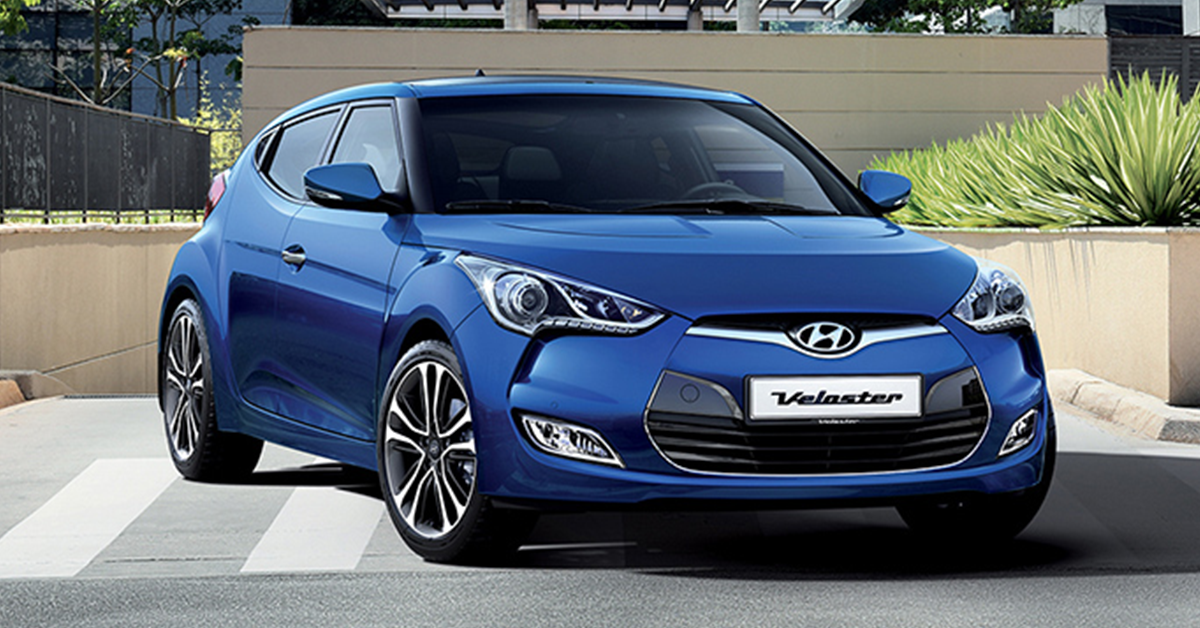
Official image of the Hyundai Veloster. | © Hyundai Motor Company
Hyundai Veloster. The three-door hatchback since 2011, the 250 and 275 hp Veloster N, the N DCT, U.S. prices, crash ratings and the end of sales in 2022.
The Veloster is Hyundai’s three-door sports hatchback. Hyundai’s worldwide history page says the Veloster and Veloster Turbo were born in 2011 and became known for their unconventional layout of two doors on the right side and one on the left (Hyundai). The same page says the Veloster Turbo launched in 2012 with a Gamma Turbo GDi engine and that the second generation launched in 2018 (Hyundai). The car left the U.S. market after 2022 (reported).
| Born | 2011 (Hyundai) |
| Door layout | Two right, one left (Hyundai) |
| Turbo launched | 2012 (Hyundai) |
| Turbo engine | Gamma Turbo GDi (Hyundai) |
| Second generation | 2018 (Hyundai) |
| First U.S. generation | 2012 to 2017 (reported) |
| Second U.S. generation | 2019 to 2022 (reported) |
| Veloster N power | 250 hp, 275 hp with package (Hyundai) |
| N gearbox from 2021 | 8-speed wet dual-clutch (Hyundai) |
| Total U.S. sales | 204,000 (reported) |
We read Hyundai’s own pages first. They were the Hyundai worldwide history page, the Hyundai N brand press page for the 2019 Veloster N, the Hyundai Australia release on the Veloster N with the 8-speed dual-clutch gearbox, the Hyundai Canada Veloster N product card and the Hyundai worldwide newsroom entry for that gearbox. Reports supply prices, sales, earlier-generation specifications and the end of production, and they carry the reported tag. Prices and availability may have changed since publication, and exchange rates are not applied.
The car has two U.S. generations in most sources. A report says the first ran from the 2012 model year through 2017, that Hyundai skipped the 2018 model year and that the redesigned second generation ran from 2019 through 2022 (reported). From 2012 to 2022 is 10 model years, since 2022 minus 2012 is 10 (reported, our calculation). A report puts total U.S. sales over the run at 204,000 units (reported). From the 2011 birth to the 2022 end is 11 years, since 2022 minus 2011 is 11 (Hyundai, reported, our calculation).
The most important version is the Veloster N. Hyundai calls the 2019 Veloster N the first U.S. market N brand high-performance model (Hyundai). Its 2.0-liter turbo makes 250 hp as standard and 275 hp with the Performance Package (Hyundai). Hyundai says the 2021 car added an 8-speed wet dual-clutch gearbox, and that the car is an everyday sports car with racetrack capability (Hyundai). A report says every 2021 car has 275 hp (reported). The N’s 250 hp is 1.7 times the 147 hp of the second generation’s base engine, since 250 divided by 147 is 1.70, and 275 hp is 1.87 times it (Hyundai, reported, our calculation).
This guide covers the first generation and its turbo, the second generation of 2018, the Veloster N of 2019 and 2021, U.S. prices, crash ratings and the end of sales. Our Hyundai i30 article covers the hatchback that shares the N badge in Europe, and our Hyundai Elantra article covers the N sedan that continued Hyundai’s performance line. We mark every figure Hyundai, reported or our calculation.
We found no Hyundai page that lists Veloster prices for any market, and no Hyundai statement of its reasons for ending the car. Those items rely on reports. Our Hyundai Models article lists the current range and our Hyundai history article covers the company. Where sources disagree we show both values, and we do not convert between units that sources use differently. Hyundai’s own pages give the 2011, 2012 and 2018 dates, and its N pages give the 2018 and 2020 details (Hyundai).
The first Veloster arrived with a direct-injected 1.6-liter engine. A reprinted Hyundai release says the Gamma 1.6 was the smallest Hyundai engine to use gasoline direct injection, with an estimated 138 horsepower at 6,300 rpm and up to 40 mpg on the highway (reported). The same release says the car had a proprietary six-speed manual and Hyundai’s first dual-clutch transmission, which Hyundai’s history page also notes (reported, Hyundai). A report says the standard Veloster was introduced at the 2011 Detroit show (reported). The Turbo came about a year after the standard car and was due at dealerships in summer 2012 (reported).
| Launch engine | 1.6 GDI, 138 hp (reported) |
| Launch torque | 123 lb-ft (reported) |
| Highway economy, launch | Up to 40 mpg (reported) |
| Turbo engine | 1.6 twin-scroll turbo (reported) |
| Turbo power | 201 hp at 6,000 rpm (reported) |
| Turbo torque | 195 lb-ft at 1,750 rpm (reported) |
| Turbo highway economy | 38 mpg manual (reported) |
| Output per liter | 125.6 hp (reported) |
| Turbo gain over base | 63 hp, 45.7 percent (reported, our calculation) |
| First dual-clutch gearbox | Veloster (Hyundai) |
The Turbo followed in 2012. Hyundai introduced the 2013 Veloster Turbo at the Detroit show in January 2012, according to a report (reported). A reprinted Hyundai Motor America release of June 6, 2012 says its twin-scroll 1.6 turbo makes 201 horsepower at 6,000 rpm and 195 lb-ft of torque at 1,750 rpm, with an estimated 26 mpg city and 38 highway on the manual (reported). A first-look report gave 27 mpg city instead, so the city figure differs by 1 mpg (reported, our calculation). A 2014 listing gives the Turbo 24 city and 31 highway with the manual, which is 7 mpg lower on the highway than the launch estimate, since 38 minus 31 is 7 (reported, our calculation).
The step up was large. The Turbo has 63 more horsepower than the 138 hp car, a rise of 45.7 percent, since 201 minus 138 is 63 and 63 divided by 138 is 0.457 (reported, our calculation). Torque rose from 123 lb-ft to 195 lb-ft, which is 72 more, or 58.5 percent (reported, our calculation). Hyundai claimed 125.6 horsepower per liter, which matches 201 divided by 1.6 (reported, our calculation), and a weight-to-power ratio of 14 lb per horsepower (reported).
Weights are reported by catalogs. A listing gives a curb weight of 2,584 pounds for the base car and 2,800 pounds for the Turbo (reported). Dividing 2,800 by 201 gives 13.9 pounds per horsepower, which is consistent with Hyundai’s 14 (reported, our calculation). The base car works out at 18.7 pounds per horsepower, since 2,584 divided by 138 is 18.7 (reported, our calculation). A report lists the Turbo’s cargo space as 15.5 cubic feet with the seats up and 34.7 with them folded (reported).
The three-door layout was the point of the car. A report says the layout gave rear passengers an exit away from traffic, and that it filled the void left by the Tiburon, which ended after the 2008 model year (reported). Another report says the car evolved from a 2007 concept called the HND-3 (reported). The second-generation Veloster kept the small third door, which a Hyundai Motor America product manager called iconic (reported).
Later first-generation years changed little. A report says the 2017 base engine was a non-turbocharged 1.6 of 132 hp, which is 6 hp below the 138 hp of the launch car, since 138 minus 132 is 6 (reported, our calculation). A 2014 listing also gives 132 horsepower for the base engine with the automatic (reported). We found no Hyundai page that lists first-generation specifications or crash ratings (Hyundai).
Hyundai unveiled the second-generation Veloster at the Detroit show on January 15, 2018, according to a reprinted release (reported). It says production would begin in March 2018 in Ulsan, Korea, with U.S. availability in the second quarter (reported). Hyundai’s history page says the second generation offers a more expressive design, dynamics and cutting-edge infotainment for young and young-at-heart enthusiasts (Hyundai). A report says the N shown there used a tuned 2.0 turbo with 275 hp and 260 lb-ft (reported).
| Second generation unveiled | January 15, 2018 (reported) |
| Production start | March 2018, Ulsan (reported) |
| U.S. availability | Second quarter 2018 (reported) |
| Base engine | 2.0, 147 hp (reported) |
| Previous base engine | 1.6, 132 hp (reported) |
| Turbo engine | 1.6 turbo, 201 hp (reported) |
| Turbo torque | 195 lb-ft (reported) |
| 2019 starting price | 18,500 dollars (reported) |
| Length over previous | 20.3 mm (reported) |
| 2020 audio | JBL premium (Hyundai) |
The new base engine was a 2.0-liter. Reports give it as 147 hp, with a 6-speed manual or automatic, against 132 hp for the previous 1.6 (reported). That is 15 hp more, since 147 minus 132 is 15 (reported, our calculation). The 1.6 turbo kept its 201 hp and 195 lb-ft, with torque peaking sooner, at an estimated 1,500 rpm against 1,750 rpm before (reported). A listing gives the 2.0 as 147 hp and 179 Nm and the turbo as 201 hp and 264 Nm (reported). The turbo has 54 hp more than the 2.0, or 36.7 percent, since 201 minus 147 is 54 and 54 divided by 147 is 0.367 (reported, our calculation). A report says the 2.0 makes 179 Nm and the 1.6 turbo 264 Nm, which is 85 Nm more, since 264 minus 179 is 85 (reported, our calculation).
The reprinted release puts the starting price of the 2019 car at 18,500 dollars for the 2.0 manual (reported). That is 1,050 dollars above the 17,450 dollars reported for the 2013 manual, a rise of 6.0 percent over six model years, since 18,500 minus 17,450 is 1,050 and 1,050 divided by 17,450 is 0.06 (reported, our calculation). A trim-by-trim 2021 listing names 2.0, 2.0 Premium, Turbo R-Spec, Turbo, Turbo Ultimate and N (reported).
The body is almost the same size. A report says the second generation is 20.3 mm longer and 10 mm wider than before, with unchanged height and 15 mm more headroom (reported). Another report says the dimensions, layout and profile are almost identical, though the design reflects Hyundai’s newer design language (reported). We found no Hyundai page with the second generation’s dimensions, curb weight or wheelbase (Hyundai).
Equipment grew. Hyundai Australia’s release lists SmartSense features, including Front Collision-Avoidance Assist, Driver Attention Warning, Lane Following Assist, Lane Keeping Assist, High Beam Assist, Blind-Spot Collision Warning and Rear Cross-Traffic Collision Warning, for the 2020 Veloster N (Hyundai). It also lists an 8-inch high-definition screen and a JBL premium sound system (Hyundai). Hyundai’s history page also mentions a 2013 Beats audio sound system on the first generation (Hyundai).
The second generation skipped a model year in the U.S. A report says there was no 2018 Veloster, so the 2017 car was followed by the 2019 model (reported). Another report says there were no plans to launch the second generation in the United Kingdom (reported). A reveal report for Australia gave the 1.6 turbo as 150 kW and 265 Nm, with an overboost raising torque to 273 Nm (reported). The markets we can document are the United States, Canada, Korea and Australia.
Hyundai introduced the 2019 Veloster N at a U.S. media drive at Thunderhill Raceway in Willows, California, on October 24, 2018, after showing it at the 2018 Detroit show (Hyundai). The release calls it the first U.S. market N brand high-performance model and quotes Albert Biermann, president of Hyundai’s Performance Development and High Performance Vehicle Division (Hyundai). Sales were due in the fourth quarter of 2018 (Hyundai).
| Media drive | October 24, 2018 (Hyundai) |
| Engine | 2.0 turbo, 9.5:1 compression (Hyundai) |
| Standard output | 250 hp at 6,000 rpm (Hyundai) |
| Performance Package output | 275 hp at 6,000 rpm (Hyundai) |
| Torque | 260 lb-ft (Hyundai) |
| Transmission | 6-speed manual (Hyundai) |
| Differential | N Corner-Carving, electronic (Hyundai) |
| Standard rotors | 13.0 front, 11.8 rear inch (Hyundai) |
| Upgraded rotors | 13.6 front, 12.4 rear inch (Hyundai) |
| Drive modes | Normal, Sport, N, Eco, N Custom (Hyundai) |
The engine is a 2.0-liter direct-injected turbo with a 9.5:1 compression ratio (Hyundai). Standard output is 250 hp at 6,000 rpm and 260 lb-ft from 1,450 to 4,000 rpm, and the Performance Package makes 275 hp with the same torque from 1,450 to 4,700 rpm (Hyundai). The 275 hp car’s torque band is 3,250 rpm wide and the standard car’s 2,550 rpm wide, so the package widens it by 700 rpm, since 4,700 minus 1,450 is 3,250 and 4,000 minus 1,450 is 2,550 (Hyundai, our calculation). The package adds 25 hp, or 10 percent, since 275 minus 250 is 25 and 25 divided by 250 is 0.1 (Hyundai, our calculation).
Against the 201 hp 1.6 turbo the N has 49 hp more, or 24.4 percent, since 250 minus 201 is 49, and with the package 74 more, or 36.8 percent (Hyundai, reported, our calculation). Output per liter is 125 hp at 250 hp and 137.5 hp at 275 hp, since each is divided by 2.0 (Hyundai, our calculation). A report says the engine is a tuned version of the Sonata Turbo’s 2.0-liter (reported).
The chassis is specific. The only transmission is a close-ratio six-speed manual with rev-matching, carbon-coated synchro rings and a double-layer clutch (Hyundai). An electronically controlled N Corner-Carving limited-slip differential adds torque vectoring, and a multi-mode electronically controlled suspension has a track-focused N mode, load-transfer control and a rear strut brace (Hyundai). Steering is motor-driven, rack-mounted and secured at three points (Hyundai). The exhaust is a multi-mode high-flow active sport system with a variable actuator and an Electronic Sound Generator, and N mode adds over-run crackle on upshifts and rev-matched downshifts (Hyundai).
Brakes and wheels are listed. Standard rotors are 13.0 inches in front and 11.8 inches at the rear, and the upgraded set is 13.6 and 12.4 inches, which is 0.6 inch larger at each end (Hyundai, our calculation). Wheels are 18-inch with 225/40R18 Michelin Pilot SuperSport tires, or optional 19-inch with 235/35R19 Pirelli P-Zero tires (Hyundai). There are five drive modes, Normal, Sport, N, Eco and N Custom, and N Custom sets throttle, rev matching, exhaust, differential, suspension, steering and yaw control individually (Hyundai).
Styling and cabin changes are listed. Hyundai names an N-design front fascia, brake-cooling ducts, N side sills, a larger rear spoiler, a diffuser and dual high-flow exhaust (Hyundai). Inside are N cloth sport seats, an N steering wheel and shift knob, an electroluminescent cluster and a sequential shift indicator near redline (Hyundai). Colors were Ultra Black, Chalk White, Racing Red and Performance Blue (Hyundai). The page gives no weight, dimensions, 0 to 60 time or price (Hyundai).
Hyundai unveiled the Veloster N with the N 8-speed wet dual-clutch transmission in April 2020, according to Hyundai Australia, which describes the gearbox as all-new (Hyundai). Hyundai says electronic actuators operate the double clutch and that the wet design uses oil for lubrication and cooling, which suits higher torque than a dry unit (Hyundai). N Power Shift engages above 90 percent throttle and uses upshifts to avoid losing torque, and N Track Sense Shift selects gear and shift timing automatically when road conditions suit dynamic driving (Hyundai). The company calls the car a Corner Rascal and an everyday sports car with racetrack capability (Hyundai).
| N DCT unveiled | April 2020 (Hyundai) |
| Gearbox | N 8-speed wet dual-clutch (Hyundai) |
| 0 to 100 km/h with N DCT | 5.6 seconds (Hyundai) |
| N Grin Shift torque | 36.0 to 38.5 kgf-m (Hyundai) |
| N Grin Shift duration | 20 seconds (Hyundai) |
| 2021 power, Canada | 275 hp, 260 lb-ft (Hyundai) |
| Wheels, Canada | 19 inch, P235/35R19 (Hyundai) |
| Airbags, Canada | 6 (Hyundai) |
| Seat weight saving | About 2 kg (Hyundai) |
| Curb weight, test | 3,117 pounds (reported) |
Hyundai gives the 0 to 100 km/h time as 5.6 seconds with the N DCT (Hyundai). A report says that is 0.5 seconds quicker than the manual, which implies 6.1 seconds for the manual, since 5.6 plus 0.5 is 6.1 (reported, our calculation). A U.S. road test gave an estimated 0 to 60 mph time of 5.8 seconds, a different benchmark that we do not compare with the 5.6 (reported). The same test lists a curb weight of 3,117 pounds, or 11.3 pounds per horsepower at 275 hp (reported, our calculation).
N Grin Shift raises torque from 36.0 to 38.5 kgf-m for 20 seconds by allowing turbocharger overboost, which is 2.5 kgf-m or 6.9 percent more (Hyundai, our calculation). In newton-meters that is about 353 and 378, since 36.0 times 9.807 is 353 and 38.5 times 9.807 is 378 (Hyundai, our calculation). The 36.0 figure matches the 260 lb-ft that Hyundai gives for the U.S. car, which is about 352.5 Nm (Hyundai, our calculation). Hyundai also names Rev Matching, Launch Control and Overboost as features of the new gearbox (Hyundai).
Hyundai Canada’s product card for the 2021 Veloster N lists a 275 hp engine with 260 lb-ft, a 6-speed manual with rev matching and the optional N DCT with paddle shifters, which is not available with the manual (Hyundai). It adds launch control, an electronically controlled mechanical limited-slip differential with torque vectoring, 19 by 8.0 inch wheels with P235/35R19 Pirelli tires and six airbags (Hyundai). The card lists an 8.0-inch navigation screen and an Infinity audio system with eight speakers (Hyundai).
N Light sport bucket seats were new. Hyundai says they are about 2 kg lighter than standard seats and have an illuminated N logo (Hyundai). Two kilograms is about 4.4 pounds, since 2 times 2.205 is 4.41 (Hyundai, our calculation), and a report gives the same 4.4 pounds saving (reported). Canadian colors were Performance Blue, Atlas White, Phantom Black, Ignite Flame, Cyber Grey and the matte Shooting Star (Hyundai).
The Canadian warranty is a comprehensive 5 years or 100,000 km, with a powertrain warranty of 100,000 km and roadside assistance for 5 years (Hyundai). A reprinted U.S. release lists complimentary maintenance for 3 years or 36,000 miles (reported). Hyundai Australia said the N DCT would reach the i30 N and i30 Fastback N from early 2021, which links the Veloster N to our Hyundai i30 article (Hyundai). The page says nothing about a successor (Hyundai).
Veloster prices come from reports and reprinted releases. The 2013 Veloster started at 17,450 dollars for the manual and 18,700 dollars for the automatic, and the Turbo at 21,950 dollars, according to one report (reported). Another report puts the baseline at 18,225 dollars and the Turbo at 22,725 dollars (reported). Both differ by 775 dollars, since 18,225 minus 17,450 and 22,725 minus 21,950 are each 775, and we could not confirm what that gap covers (reported, our calculation).
| 2013 base, manual | 17,450 dollars (reported) |
| 2013 base, other report | 18,225 dollars (reported) |
| 2013 Turbo | 21,950 dollars (reported) |
| 2013 Turbo, other report | 22,725 dollars (reported) |
| 2019 base | 18,500 dollars (reported) |
| 2019 Veloster N | 26,900 dollars (reported) |
| Performance Package | 2,100 dollars (reported) |
| 2021 Veloster N, manual | 32,250 dollars (reported) |
| 2021 Veloster N, N DCT | 33,750 dollars (reported) |
| 2021 Turbo Ultimate | 29,425 dollars (reported) |
The Turbo costs 4,500 dollars more than the manual base car on the first list, since 21,950 minus 17,450 is 4,500, which is 25.8 percent (reported, our calculation). The 2019 base price of 18,500 dollars is 1,050 dollars above the 2013 base (reported, our calculation). Prices and availability may have changed since publication, and exchange rates are not applied.
Veloster N prices start with the 2019 car. A report lists the original MSRP at 26,900 dollars, while Hyundai said the base car would start below 28,000 dollars including destination (reported). The difference of 1,100 dollars is consistent with a destination charge, but the reports do not state one for that year (reported, our calculation). The Performance Package cost 2,100 dollars, which lifted output from 250 to 275 hp, according to a report (reported).
The 2021 Veloster N started at 32,250 dollars for the manual and 33,750 dollars for the N DCT (reported). The DCT adds 1,500 dollars, which is 4.7 percent, since 33,750 minus 32,250 is 1,500 (reported, our calculation). The N DCT car is 6,850 dollars above the 2019 N, or 25.5 percent, since 33,750 minus 26,900 is 6,850 (reported, our calculation). A review gives the base price as 33,255 dollars including a 1,005 dollar destination charge, and 33,255 minus 1,005 is 32,250, so the two reports agree (reported, our calculation).
The 2021 car costs 5,350 dollars more than the 2019 list price, or 19.9 percent, since 32,250 minus 26,900 is 5,350 (reported, our calculation). The comparison is loose, because 2021 cars had the Performance Package, navigation and extra safety equipment as standard (reported). A report says the 2021 price is 2,550 dollars above the 2020 car with the then-optional package, which implies 29,700 dollars for that car, since 32,250 minus 2,550 is 29,700 (reported, our calculation).
On that basis the 2020 base car without the package was 27,600 dollars, since 29,700 minus 2,100 is 27,600 (reported, our calculation). A 2021 price listing gives the non-N bases as 19,875 dollars for the 2.0, 24,075 for the 2.0 Premium, 24,425 for the Turbo R-Spec, 26,725 for the Turbo and 29,425 for the Turbo Ultimate (reported). The Ultimate is 9,550 dollars above the 2.0, since 29,425 minus 19,875 is 9,550 (reported, our calculation). The 2021 manual N is 12,375 dollars above the 2.0, or 62.3 percent, since 32,250 minus 19,875 is 12,375 (reported, our calculation). The 2.0 at 19,875 dollars is 1,375 above the 2019 launch price of 18,500, though the two figures come from different reports (reported, our calculation). The 2013 Turbo at 21,950 dollars is 7,475 dollars below the 2021 Turbo Ultimate at 29,425, since 29,425 minus 21,950 is 7,475, across eight years and different equipment (reported, our calculation).
The Insurance Institute for Highway Safety rated the second-generation Veloster Good in driver-side and passenger-side small overlap, moderate overlap front, side, roof strength and head restraints, for 2019 to 2022 models (reported). The passenger-side small overlap and moderate overlap tests were conducted by Hyundai, and the Institute assigned the ratings (reported). The Institute’s Top Safety Pick award applies only to cars with specific headlights (reported). The 2019 award applied to cars built after August 2018 with specific headlights (reported).
| IIHS small overlap, driver | Good (reported) |
| IIHS small overlap, passenger | Good, Hyundai test (reported) |
| IIHS moderate overlap | Good, Hyundai test (reported) |
| IIHS side | Good (reported) |
| IIHS roof strength ratio | 5.26 (reported) |
| IIHS headlights, Performance | Acceptable (reported) |
| IIHS headlights, 2.0 trims | Poor (reported) |
| IIHS front crash prevention | Superior (reported) |
| Award | Top Safety Pick, specific headlights (reported) |
| Airbags, Canada N | 6 (Hyundai) |
The roof test used a 2019 Veloster 2.0 with a 2,709 pound curb weight and a peak force of 14,248 pounds, giving a strength-to-weight ratio of 5.26 (reported). Dividing 14,248 by 2,709 gives 5.26, so the figures are consistent (reported, our calculation). Headlights rate Acceptable on the Performance trim with LED projector low beams and high-beam assist, and Poor on the 2.0 and 2.0 Premium trims with halogen projector lights (reported).
Front crash prevention rated Superior. The optional system, standard on the Turbo Ultimate and including pedestrian detection, rated Superior with optional equipment, and the standard system rated Superior as well (reported). Both avoided a collision in the 12 mph and 25 mph tests (reported). Pedestrian front crash prevention in daylight rated Advanced with optional equipment on the 2019 to 2021 Turbo Ultimate (reported). Child seat anchors rated Acceptable on the Turbo Ultimate (reported).
The side test had a problem. The Institute says its first test saw the driver door open, which could allow occupant ejection in some crashes, while Hyundai’s second test on a modified car did not show it opening (reported). Hyundai changed 2019 cars built after January 2019 and recalled earlier ones, according to the Institute (reported). Both results inform the rating (reported). The Institute lists lane departure warning and prevention as standard and says the car has two rear seating positions with child seat anchors (reported). The 2021 N’s test weight of 3,117 pounds is 408 pounds above the 2,709 pound cars the Institute tested, or 15.1 percent, though the tests used different trims (reported, our calculation). The reports do not say how many cars were recalled.
Equipment lists come from Hyundai pages for the N. The Canadian 2021 card names six airbags, anti-lock brakes with brake assist, stability and traction control, blind-spot and rear cross-traffic warnings, forward collision-avoidance with pedestrian detection, lane keeping assist, lane following assist, driver attention warning, high beam assist and a rearview camera (Hyundai). The Australian release names the same SmartSense group for the 2020 car (Hyundai). The Institute lists blind-spot detection as optional on the regular car (reported). A report says the 2019 Veloster was the 11th Hyundai to win a Top Safety Pick (reported). The Australian release names seven SmartSense features, since the list has seven items (Hyundai, our calculation).
We did not find a rating for the first-generation car. One report says the earlier cars had so-so crash ratings and the second generation had fewer complaints and recalls (reported). Another says the car earned Top Safety Pick from 2019 through the 2021 model year (reported). Hyundai’s pages we read do not give crash ratings (Hyundai).
Hyundai dropped the regular Veloster first. A report says a Hyundai spokesperson told one outlet that the non-N trims were discontinued because of Hyundai’s expanding crossover lineup, and another says Hyundai prioritized the Venue and Kona (reported). The N alone continued for 2022, and a later report says Hyundai confirmed that Veloster N production would end in July 2022 with no 2023 model (reported). We found no Hyundai page for either statement (Hyundai).
| Non-N U.S. trims ended | After 2021 (reported) |
| Veloster N production end | July 2022 (reported) |
| U.S. sales, January 2019 | 855 (reported) |
| U.S. sales, January 2020 | 665 (reported) |
| U.S. sales, January 2021 | 193 (reported) |
| U.S. sales, January 2022 | 86 (reported) |
| Fall, 2019 to 2022 January | 89.9 percent (reported, our calculation) |
| Total U.S. sales | 204,000 (reported) |
| Reason given | SUV and crossover focus (reported) |
| Hyundai statement found | None on a Hyundai page (Hyundai) |
Sales fell steeply. A report says 86 Velosters were sold in the U.S. in January 2022, against 855 in January 2019, 665 in January 2020 and 193 in January 2021 (reported). January 2022 was 769 below January 2019, a fall of 89.9 percent, since 855 minus 86 is 769 and 769 divided by 855 is 0.899 (reported, our calculation). It was 107 below January 2021, or 55.4 percent, since 193 minus 86 is 107 (reported, our calculation).
The same report says monthly declines in 2021 were 69 percent in June, 70 percent in May and 40 percent in April (reported). A report says the Veloster N was replaced in Hyundai’s lineup by the Elantra N and the Kona N (reported). The report that put total U.S. sales at 204,000 units says the rise of SUVs killed demand for non-utility vehicles (reported). Hyundai gives no sales figures on the pages we read (Hyundai). The Veloster N ran four model years, since 2022 minus 2019 plus 1 is 4, against six for the first generation, since 2017 minus 2012 plus 1 is 6 (reported, our calculation). Reports on the end of the N agree on a July 2022 production end (reported).
Several figures conflict. Early prices differ by 775 dollars between two reports, the Turbo’s city mileage is 26 in one release and 27 in another, and one reprinted torque range for the N runs to 4,700 rpm while a review says peak torque holds to near 6,750 rpm, the fuel cut-off (reported). Hyundai gives torque ranges to 4,000 rpm for the 250 hp car and 4,700 rpm for the 275 hp car (Hyundai). Generation counts also differ, with some listings giving four generation entries and Hyundai giving two (Hyundai, reported).
Several items are not confirmed. We found no Hyundai page for Veloster prices, first-generation specifications, dimensions, curb weights or sales, and no Hyundai statement of why the car ended. We did not verify any Korean market sales or any Korean price. We found no direct successor announcement. The car’s European history is also not covered here, because the pages we found were about the U.S., Canada, Korea and Australia. Hyundai Canada’s product card shows that a 2021 Veloster N was sold in Canada (Hyundai).
To check this guide, begin with the Hyundai N press release of October 24, 2018, the Hyundai Australia release of April 2020 and the Hyundai Canada product card, and compare model years before comparing numbers. Prices and availability may have changed since publication, and exchange rates are not applied. The Veloster N shows how Hyundai’s N brand began in the U.S., and our Hyundai Models article shows where N cars sit in the current range.
