 Brands
Hyundai Azera — Grandeur, Specs, Generations and Prices
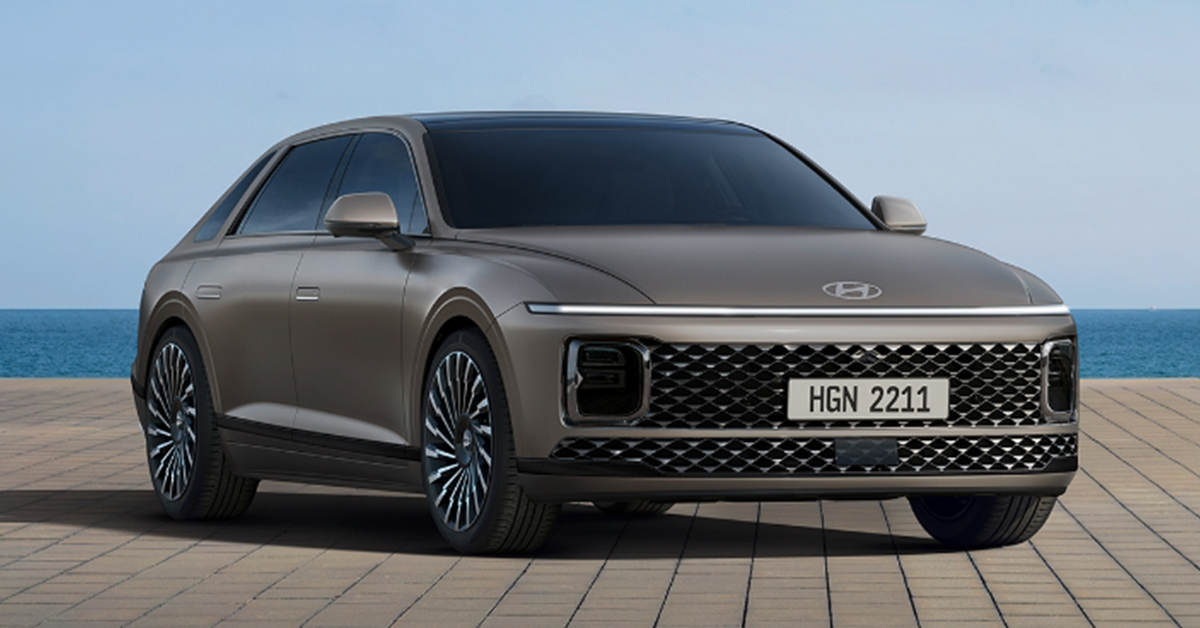
Official image of the Hyundai Azera. | © Hyundai Motor Company
Hyundai Azera. The Grandeur flagship since 1986, the 5,035 mm seventh generation, 300 ps V6 and hybrid, the U.S. exit in 2017 and Middle East prices.
The Azera is Hyundai’s flagship sedan outside South Korea, where the same car is called the Grandeur. Hyundai’s worldwide history page says it has been produced since 1986 and is known as Grandeur in selected countries (Hyundai). Hyundai’s newsroom says the seventh generation is badged Azera outside Korea and that specifications vary by market (Hyundai). From 1986 to 2026 is 40 years (our calculation). The two 2022 releases are 26 days apart, since November 14 minus October 19 is 26 (Hyundai, our calculation).
| Produced since | 1986 (Hyundai) |
| Korean name | Grandeur (Hyundai) |
| Latest generation | Seventh (Hyundai) |
| Seventh generation unveiled | October 19, 2022 (Hyundai) |
| Seventh generation length | 5,035 mm (Hyundai) |
| Length over previous | 45 mm (Hyundai) |
| 3.5 GDi | 300 ps, 36.6 kgf.m (Hyundai) |
| 1.6 turbo hybrid | 180 ps, 27.0 kgf.m (Hyundai) |
| Sales start of seventh generation | Second quarter 2023 (Hyundai) |
| U.S. sale | 2006 to 2017 (reported) |
We read Hyundai’s own pages first. They were the Hyundai worldwide history page, the Hyundai worldwide newsroom releases of October 19 and November 14, 2022, a Hyundai Bahrain Azera page and a Hyundai Germany release of October 31, 2016. Reports supply the early generations, the American market, the Middle East prices and the crash ratings and carry the reported tag, and we do not name them. Prices and availability may have changed since publication, and exchange rates are not applied.
The latest car is big and powerful. Hyundai says the seventh-generation Azera is 5,035 mm long, which is 45 mm longer than the car it replaces, and that it has a 3.5-liter GDi engine of 300 ps and 36.6 kgf.m (Hyundai). It also has a 1.6-liter turbo hybrid of 180 ps and 27.0 kgf.m (Hyundai). The V6 has 120 ps more than the hybrid, since 300 minus 180 is 120 (Hyundai, our calculation). The hybrid’s 180 ps is 60 percent of the V6’s 300 ps, since 180 divided by 300 is 0.6 (Hyundai, our calculation).
The Azera has been sold in the United States, but not for years. A report says Hyundai sold it there from 2006 until 2017, and that it was confirmed as discontinued for the 2018 model year (reported). Hyundai Germany said in October 2016 that the sixth generation would not be offered in Europe, Australia or North America (Hyundai). A report says the car continued to be offered in South Korea and the Middle East after 2017 (reported).
This guide covers the names and early history, the fifth and sixth generations, the American Azera and its end, the seventh-generation design, engines and safety equipment, Middle East prices, crash ratings and the conflicts between sources. We mark every figure Hyundai, reported or our calculation, and we show both values where sources disagree. We found no Hyundai page for Middle East prices, so those are reported only. Our Hyundai Models article lists the current range, and our Hyundai history article covers the company.
Check a Hyundai dealer for the exact car, because specifications vary by market. Hyundai’s Bahrain page lists a single Premium SE trim, while price catalogs list several trims in the UAE, Saudi Arabia and Qatar (Hyundai, reported). We could not find a Hyundai page that lists every market’s trims, and we treat the catalogs as reported figures. Hyundai says sales of the seventh generation began in select global markets in the second quarter of 2023 (Hyundai). The sixth generation launched in 2016 and the seventh in 2022, which is 6 years apart (Hyundai, our calculation).
The Azera name is a market badge for the Grandeur. Hyundai’s history page says the car has been produced since 1986 and has gone from an icon of wealth for middle-aged and elderly customers to a car for young adults (Hyundai). It says the third generation was the first full-size sedan that Hyundai sold in the U.S. market and gives no year (Hyundai). A report says the first two generations were essentially rebadged Mitsubishi Debonairs, and the third was developed entirely by Hyundai (reported).
| Original launch | 1986 (Hyundai) |
| Model in Korea | Grandeur (Hyundai) |
| Third generation | First full-size sedan sold in U.S. (Hyundai) |
| Fifth generation design | Fluidic Sculpture, Grand Glide (Hyundai) |
| Customer shift | From middle-aged and elderly to young adults (Hyundai) |
| First two generations | Rebadged Mitsubishi Debonairs (reported) |
| North American third generation | XG300 and XG350 (reported) |
| Name Azera from | Fourth generation (reported) |
| 2006 U.S. engine | 3.8 V6, 263 horsepower (reported) |
| 2011 U.S. engine | 3.8 V6, 280 horsepower (reported) |
Reports date the model. One says the Grandeur debuted in 1986 as the successor to the Hyundai Granada and has run over five generations in one count and seven in another (reported). A page on the car’s history says the name changed to Azera from the fourth generation, and that the sedan then added heated and ventilated seats and modern safety features (reported). The generation counts differ because sources count the facelifted cars differently, and Hyundai’s own page names a seventh generation (Hyundai, reported).
The first American cars were badged differently. A report says the third-generation car was known in North America as the XG300 and then the XG350, and that Hyundai Motor America tried to build a premium image with it (reported). Another report says only two generations of the Azera name were sold in the U.S., and that it ran from 2006 until 2017 (reported). From 2006 to 2017 is 11 years (reported, our calculation).
The early Azera was a V6 sedan. A report says the 2006 car had a 3.8-liter V6 of 263 horsepower in SE and Limited trims, and that 2007 added a GLS with a 3.3-liter V6 (reported). By 2011 the 3.3 made 260 horsepower and the 3.8 made 280, with a six-speed automatic, according to the same report (reported). The 3.8 gained 17 horsepower from 2006 to 2011, since 280 minus 263 is 17 (reported, our calculation). From the 2006 U.S. car to the 2011 fifth generation is 5 years (reported, our calculation).
The car was a status symbol at home. A report says the Grandeur was driven mainly by executives and businessmen at first and later became South Korea’s best-selling car (reported). A 2026 report says it was the best-selling vehicle of any kind in South Korea from 2017 through 2020, which is 4 years, since 2020 minus 2017 plus 1 is 4 (reported, our calculation). Hyundai’s own page does not give sales figures (Hyundai). From 1986 to the fifth generation in 2011 is 25 years, and to the seventh in 2022 is 36 years, so the six gaps average 6 years, since 36 divided by 6 is 6 (Hyundai, our calculation).
Hyundai’s history page also names the fifth generation, saying the 2011 car synthesized Hyundai’s Fluidic Sculpture design with its Grand Glide concept (Hyundai). It gives no detail for the first, second, fourth or sixth generations (Hyundai). We therefore cover the fifth and sixth generations from the 2011 and 2016 launches in the next sections. A report calls the Azera Hyundai’s most expensive and best-selling car in the U.S. before the Genesis arrived (reported).
The fifth generation arrived in 2011. A Hyundai release reprinted on a third-party site says the Grandeur, badged Azera in some markets, rolled out in Seoul under the Grand Glide concept with a Lambda II 3.0 GDI engine (reported). It gives the 3.0 GDI as 270 ps, 31.6 kg.m and 11.6 km/l (reported). Hyundai’s history page says this car synthesized Fluidic Sculpture with Grand Glide (Hyundai).
| Fifth generation year | 2011 (Hyundai) |
| Korea 3.0 GDI | 270 ps, 31.6 kg.m (reported) |
| U.S. engine | 3.3 GDI V6, 293 horsepower (reported) |
| U.S. gearbox | 6-speed automatic (reported) |
| U.S. combined economy | 23 mpg (reported) |
| Output per liter | 88.8 horsepower (reported) |
| 2012 U.S. start price | 32,000 dollars (reported) |
| 2012 Technology Package | 36,000 dollars (reported) |
| U.S. sale start | April 2012 (reported) |
| Korea 2011 sales target | 100,000 (reported) |
Hyundai set sales targets. The reprinted release says Hyundai aimed to sell 100,000 Grandeurs that year, 80,000 in Korea and 20,000 outside it, and 120,000 globally in 2012 (reported). Exports were therefore planned at 20 percent of the total, since 20,000 divided by 100,000 is 0.2 (reported, our calculation). The 2012 target was 20,000 above the 2011 one, since 120,000 minus 100,000 is 20,000 (reported, our calculation).
The North American car debuted at the Los Angeles show in November 2011. A report of Hyundai Motor America’s release says the 2012 Azera had a 3.3-liter Lambda II GDI V6 of 293 horsepower at 6,400 rpm, a six-speed automatic and a combined 23 mpg (reported). Hyundai claimed 88.8 horsepower per liter, the highest in the segment, and the smallest V6 in it (reported). Dividing 293 by 3.3 gives 88.8, so the claim is consistent (reported, our calculation). The Korean 3.0 GDI’s 270 ps from 3.0 liters is 90 ps per liter, since 270 divided by 3.0 is 90, but ps and horsepower are different units and we do not compare the two figures (reported, our calculation). The 293 horsepower 3.3 makes 33 more than the 260 horsepower 2011 3.3 and 13 more than the 280 horsepower 2011 3.8, since 293 minus 260 is 33 and 293 minus 280 is 13 (reported, our calculation).
The price announcement came in early 2012. A reprinted Hyundai Motor America release says the 2012 Azera started at 32,000 dollars and the Technology Package version at 36,000 dollars, with sales beginning in April (reported). The 2012 standard equipment included gasoline direct injection, Blue Link telematics, push-button start, heated rear seats and 18-inch wheels (reported). The package costs 4,000 dollars, since 36,000 minus 32,000 is 4,000 (reported, our calculation). The Technology Package version is a 12.5 percent step up, since 4,000 divided by 32,000 is 0.125 (reported, our calculation).
The fifth generation shared its basis with the Sonata. The Insurance Institute for Highway Safety says the Azera was redesigned for 2012 and is derived from the 2011 to 2014 Hyundai Sonata (reported). Our Hyundai Sonata article covers the mid-size sedan. A report says the 2012 car looked like a Sonata with a Jaguar-style tail and competed with the Chrysler 300, Ford Taurus and Toyota Avalon (reported).
Later years kept the same V6. A reprinted brochure for the 2014 model lists a 293 horsepower V6, heated and ventilated seats, a panoramic sunroof, a rearview camera and a rear window sunshade (reported). A report says the 2012 car weighed 3,605 pounds, which Hyundai said was hundreds of pounds less than some rivals (reported). The Institute’s roof test used a 2012 Azera at 3,626 pounds, which is 21 pounds more than Hyundai’s figure, since 3,626 minus 3,605 is 21 (reported, our calculation).
The American Azera lived 11 years. A report says Hyundai confirmed its end in a 2018 model-year lineup release on July 5, 2017, listing U.S. availability as discontinued (reported). The same report says U.S. sales had plunged 82 percent over the previous decade (reported). An 82 percent fall leaves sales at about 18 percent of the earlier level, since 100 minus 82 is 18 (reported, our calculation). Hyundai Germany had said in October 2016 that the sixth generation would not be offered in North America, Europe or Australia (Hyundai).
| End confirmed | July 5, 2017 (reported) |
| Last U.S. model year | 2017 (reported) |
| U.S. sales, Sept 2016 | 419 (reported) |
| U.S. sales, Jan to Sept 2016 | 3,775 (reported) |
| U.S. sales, Jan to Sept 2015 | 4,639 (reported) |
| Nine-month change | Down 864, about 19 percent (reported, our calculation) |
| Sales over ten years | Down 82 percent (reported) |
| 2017 base price | 34,100 dollars (reported) |
| 2017 top price | 39,300 dollars (reported) |
| Unsold cars at one point | 964 (reported) |
Late sales were small. A report says Hyundai Motor America sold 419 Azeras in September 2016 and 3,775 in the first nine months of 2016, against 281 in September 2015 and 4,639 in the first nine months of 2015 (reported). The nine-month figure fell 864, or about 19 percent, since 4,639 minus 3,775 is 864 and 864 divided by 4,639 is 0.186 (reported, our calculation). That is a loss of about 96 cars a month, since 864 divided by 9 is 96 (reported, our calculation). The September figure rose 138, since 419 minus 281 is 138 (reported, our calculation). The nine-month 2016 total averages about 419 a month, which matches September, since 3,775 divided by 9 is 419.4 (reported, our calculation). The 2015 nine-month average was about 515 a month, since 4,639 divided by 9 is 515.4 (reported, our calculation).
The 2017 car kept the 3.3-liter V6. A report gives it as 293 horsepower and 255 pound-feet, with front-wheel drive and a six-speed automatic with a manual mode (reported). A catalog lists the 2017 price as 34,100 to 39,300 dollars and the cargo capacity as 16.3 cubic feet (reported). The top price is 5,200 dollars above the base, since 39,300 minus 34,100 is 5,200, about 15 percent (reported, our calculation). The 16.3 cubic feet is about 462 liters, since 16.3 times 28.317 is 461.6 (reported, our calculation). The base price was 2,100 dollars above the 2012 start, since 34,100 minus 32,000 is 2,100, which is about 6.6 percent (reported, our calculation).
Reasons for the end are reported, not stated by Hyundai. A report says the Genesis sedan confused the Azera’s positioning and that SUVs drew buyers away (reported). Another says Hyundai wanted to emphasize its luxury brand and simplify the line-up for 2018 (reported). We found no Hyundai statement of its reasons (Hyundai).
Dealer stock lingered. A report says 964 discontinued Azeras were still on dealer lots at one point (reported). A report lists Chevrolet Impala U.S. sales falling from 171,434 in 2011 to 97,006 in 2016 (reported). That is a drop of 74,428, or about 43 percent, since 171,434 minus 97,006 is 74,428 and 74,428 divided by 171,434 is 0.434 (reported, our calculation).
The American Azera had good crash ratings. A report says a J.D. Power initial quality study named it a segment winner (reported). The Insurance Institute for Highway Safety rated its crashworthiness Good, as we explain in the safety section. Hyundai’s history page does not list any U.S. sales figures or the reasons for the end of U.S. sales (Hyundai). Prices and availability may have changed since publication, and exchange rates are not applied.
Hyundai Motor Deutschland’s release of October 31, 2016 announced the sixth generation, saying it would start in Korea the next month (Hyundai). It describes an elegant, coupe-like silhouette with a cascading grille shared with the new i30 and the updated i10, and a continuous light bar at the rear (Hyundai). It says the car would not be offered in Europe, Australia or North America, so Hyundai did not seek German homologation (Hyundai).
| Sixth generation release | October 31, 2016 (Hyundai) |
| Korea launch, per report | November 22, 2016 (reported) |
| Korea 3.0 GDi | 266 PS (reported) |
| Korea 2.4 GDi | 190 PS (reported) |
| Korea 2.2 diesel | 202 PS (reported) |
| Korea start price | 26.2 million won (reported) |
| Offered in Europe, Australia, North America | No (Hyundai) |
| Middle East launch | May 2017 (reported) |
| Middle East V6 power | 240 HP or 290 PS (reported) |
| 2020 Saudi 3.5 | 290 ps, 34.5 kgf.m (reported) |
A report says the Korean launch was on November 22, 2016, with a 3.0 GDi of 266 PS, a 2.4 GDi of 190 PS, a 2.2 diesel of 202 PS and a 3.0 LPi for fleets (reported). It says the 3.0 GDi and the diesel had a new 8-speed automatic and the others a 6-speed (reported). Korean prices ran from 26.2 million won for the LPi to 38.7 million won for the 3.0 GDi Exclusive Special, a spread of 12.5 million won (reported, our calculation).
Later in 2017 the car was to get a 3.3-liter GDi and a hybrid, and it was due in export markets in the first half of that year (reported). A catalog lists the 3.3 GDi V6 at 297 hp and 346 Nm with a 546-liter boot, and the 3.0 GDi at 4,930 mm long and 1,865 mm wide (reported). Hyundai’s own figure for the seventh generation implies a previous length of 4,990 mm, which is 60 mm longer than the catalog, so the sources differ (Hyundai, reported, our calculation).
The Middle East was the main export. Reports say Hyundai launched the sixth-generation Azera there in May 2017 with a 3.5-liter V6 and an eight-speed automatic, a specification unique to the region (reported). An April 2017 report gave the V6 as 240 HP, and a May 2017 report gave it as 290 PS (286 HP), which is 46 HP higher, since 286 minus 240 is 46 (reported, our calculation). The 290 PS equals about 286 HP, since 290 times 0.986 is 286 (reported, our calculation). Hyundai’s regional head said the Azera had been very successful in the Middle East (reported).
Our Hyundai i40 article covers the car that filled the Sonata gap in Europe, where the Azera was never sold. Hyundai says the i40 was based on the chassis of the Sonata of its time, and the Azera of 2012 was also derived from the Sonata (Hyundai, reported). Hyundai Germany said the sixth-generation Azera would not come to Europe (Hyundai). A report says the Middle East version competes with the Nissan Maxima and Toyota Avalon (reported).
A 2020 facelift followed. A report from June 2020 says Hyundai launched the facelifted Azera in Saudi Arabia with a 2.5 GDI and a 3.5 MPI, the 3.5 making 290 ps at 6,000 rpm and 34.5 kgf.m, both with an 8-speed automatic (reported). The seventh generation’s 3.5 makes 300 ps and 36.6 kgf.m, which is 10 ps and 2.1 kgf.m more, since 300 minus 290 is 10 and 36.6 minus 34.5 is 2.1 (Hyundai, reported, our calculation). From 2016 to 2022 is 6 years, as Hyundai says (Hyundai).
Hyundai Motor unveiled the seventh-generation Grandeur, badged Azera outside Korea, on October 19, 2022 in Seoul (Hyundai). It came six years after the sixth generation launched in 2016, according to Hyundai (Hyundai). The release says the car honors the past while looking ahead, and quotes SangYup Lee, Executive Vice President and Head of Hyundai Design Center, saying it expresses respect for the past and a commitment to move on to the future (Hyundai).
| Unveiled | October 19, 2022 (Hyundai) |
| Specifications revealed | November 14, 2022 (Hyundai) |
| Length | 5,035 mm (Hyundai) |
| Length over previous | 45 mm (Hyundai) |
| Previous length implied | 4,990 mm (Hyundai, our calculation) |
| Wheelbase over previous | 10 mm (Hyundai) |
| Rear overhang over previous | 50 mm (Hyundai) |
| Front lamp | Seamless Horizon Lamp (Hyundai) |
| Doors | Frameless, auto-flush handles (Hyundai) |
| Steering wheel | One-spoke, four LED lights (Hyundai) |
The front has a Seamless Horizon Lamp, a horizontal lamp inspired by the first light of dawn, paired with a parametric jewel grille (Hyundai). A single horizontal character line runs from the headlamps to the rear combination lamp, and the doors are frameless with auto-flush handles (Hyundai). Hyundai describes a stretched wheelbase, a boldly receding cowl point and rearward-pulled C-pillars for a spacious and sporty look (Hyundai). Hyundai says the horizontal character line runs from the headlamps to the rear combination lamp (Hyundai).
The interior borrows from the first car. The one-spoke steering wheel is inspired by the first-generation Grandeur, and the gear selector is a column-type lever behind it (Hyundai). The cabin has real wood, aluminum and naturally dyed Napa leather quilted in a traditional Korean pattern, with eco-process and anti-bacterial leather at touchpoints (Hyundai). The steering wheel horn cover has four LED lights that respond to driving and voice recognition (Hyundai).
Hyundai’s November 14, 2022 release gives the size. The Azera is 5,035 mm long, 45 mm longer than the previous generation, with a wheelbase 10 mm longer and a rear overhang 50 mm longer (Hyundai). That implies the previous car was 4,990 mm long, since 5,035 minus 45 is 4,990 (Hyundai, our calculation). The front overhang must therefore be 15 mm shorter, since 45 minus 10 minus 50 is minus 15 (Hyundai, our calculation).
The release gives no width, height or absolute wheelbase, and no wheel size (Hyundai). Listings give different numbers. One lists 4,990 mm by 1,875 mm by 1,470 mm with a 2,885 mm wheelbase and a 515-liter trunk, another 4,990 mm long, and a third 5,030 mm by 1,880 mm by 1,460 mm (reported). The length differs from Hyundai’s 5,035 mm by 45 mm for the first and 5 mm for the third, since 5,035 minus 4,990 is 45 and 5,035 minus 5,030 is 5 (Hyundai, reported, our calculation).
Hyundai says the interior has eco-friendly materials, including a bamboo-based color coating, antibacterial-treated seats and frequently touched surfaces, and mood lighting on the crash pad that changes color for ignition, drive modes and voice recognition (Hyundai). The Middle East version was revealed by Hyundai’s regional headquarters with the same length, wheelbase and overhang figures, according to a report (reported). The Middle East version was revealed by Hyundai’s regional headquarters with the same length, wheelbase and overhang figures, according to a report (reported). Hyundai says design features and equipment vary by trim and market (Hyundai). Hyundai Singapore also hosts the October 2022 design release (Hyundai). Our Hyundai Models article covers the rest of the range.
Hyundai lists two powertrains. The 3.5-liter GDi makes 300 ps and 36.6 kgf.m, and the 1.6-liter gasoline turbo hybrid makes 180 ps and 27.0 kgf.m (Hyundai). In newtons that is about 359 Nm and 265 Nm, since 36.6 times 9.807 is 359 and 27.0 times 9.807 is 265 (Hyundai, our calculation). In kilowatts the 300 ps is about 221 kW and the 180 ps about 132 kW, since 300 times 0.7355 is 220.7 and 180 times 0.7355 is 132.4 (Hyundai, our calculation). The V6 therefore has 9.6 kgf.m more torque than the hybrid, since 36.6 minus 27.0 is 9.6 (Hyundai, our calculation). Hyundai names four Smart Sense items in the release, which is 4 (Hyundai, our calculation).
| 3.5 GDi | 300 ps, 36.6 kgf.m (Hyundai) |
| 1.6 turbo hybrid | 180 ps, 27.0 kgf.m (Hyundai) |
| Hybrid system name | E-Motion Drive (Hyundai) |
| Collision assist | FCA 1.5 and parking collision assist (Hyundai) |
| Parking | Remote Smart Parking Assist (Hyundai) |
| Navigation cockpit | ccNC, first model with it (Hyundai) |
| Cluster | 12.3 inch (Hyundai) |
| Head-up display, Bahrain | 12 inch (Hyundai) |
| Rear seats | Reclining, ventilated (Hyundai) |
| Audio, Bahrain | Bose, 14 speakers (Hyundai) |
The hybrid system is called E-Motion Drive, which includes E-Comfort Drive and E-Dynamic Drive (Hyundai). The release does not name a gearbox, and it does not mention a 2.5 GDi or LPi engine (Hyundai). Reports say the Middle East car has the 3.5-liter V6 with an eight-speed automatic and front-wheel drive, with a 2026 Saudi catalog listing only the V6 (reported). A UAE catalog also lists a Comfort Hybrid trim (reported).
Safety equipment is long. Hyundai Smart Sense includes Forward Collision-Avoidance Assist 1.5, Reverse Parking Collision-Avoidance Assist, a Blindspot View Monitor and Safe Exit Assist (Hyundai). Remote Smart Parking Assist helps with parking and leaving a space, and Reverse Guide Lighting shines on the ground behind the car (Hyundai). The release does not mention airbags (Hyundai). Seats and touched surfaces use antibacterial-treated materials (Hyundai).
Technology centers on the Connected Car Navigation Cockpit. Hyundai says this was the first model with it, combining navigation, the instrument cluster and a head-up display (Hyundai). The cabin has a 12.3-inch cluster with integrated navigation above a 10.25-inch full-touch climate controller (Hyundai). Hyundai Bahrain lists a 12.3-inch cluster, a 12.3-inch navigation screen, a 12-inch head-up display and the 10.25-inch climate unit (Hyundai).
Comfort features target rear passengers. Hyundai says second-row seats recline and the window curtains are electric (Hyundai). Hyundai Bahrain lists electrically reclining and ventilated rear seats, electric side and rear sunshades, a UVC sterilization light in the console, wireless charging and a hands-free electric trunk that opens after three seconds of standing behind the car with the key (Hyundai). The Bose system there has 14 speakers and an external speaker, and Hyundai says Bose Centerpoint 360 and SoundTrue are included (Hyundai). The 12 inch head-up display is smaller than the 12.3 inch screens by 0.3 inch, since 12.3 minus 12 is 0.3 (Hyundai, our calculation). The 12.3-inch cluster is 2.05 inches larger than the 10.25-inch climate controller, since 12.3 minus 10.25 is 2.05 (Hyundai, our calculation).
Quietness is a design goal. Hyundai says sound-proof glass, separable carpet and noise-cancelling tires make the cabin quieter (Hyundai). The Bahrain page lists a single Premium SE trim and a figure of 16,500 in dirhams that we could not interpret, so we do not use it as a price (Hyundai). The release gives no price and no market list (Hyundai). The Bahrain page also offers a test drive within 90 days, an e-brochure and a dealer finder (Hyundai).
The Insurance Institute for Highway Safety rated the American Azera Good in moderate overlap front, side, roof strength and head restraints, and says most ratings apply to 2012 to 2017 models (reported). It rated front crash prevention Basic for 2015 to 2017 with optional forward collision warning and no autobrake (reported). The page lists no small overlap or headlight rating, and says the front and side ratings come from tests conducted by Hyundai (reported).
| IIHS moderate overlap front | Good (reported) |
| IIHS side | Good (reported) |
| IIHS roof strength | Good, ratio 4.76 (reported) |
| IIHS front crash prevention | Basic, 2015 to 2017 (reported) |
| Top Safety Pick | 2012 and 2013 (reported) |
| UAE 2026, catalog one | 180,000 to 200,000 dirhams (reported) |
| UAE 2026, catalog two | 160,000 to 255,000 dirhams (reported) |
| Saudi 2026 | 155,900 to 221,650 riyals (reported) |
| Qatar 2026 | 134,900 to 182,000 riyals (reported) |
| Length, Hyundai and listings | 5,035, 4,990 or 5,030 mm (Hyundai, reported) |
The Azera was named a Top Safety Pick for 2012 in Hyundai Motor America’s launch release and again for 2013 in a dealer brochure (reported). The roof test gave a strength-to-weight ratio of 4.76 at a curb weight of 3,626 pounds, according to the Institute (reported). We found no Euro NCAP, Global NCAP or other rating for the Middle East cars, and one catalog lists the Euro NCAP rating as not available (reported).
Middle East prices come from catalogs, not Hyundai. One lists the 2026 Azera in the UAE at 180,000 dirhams for the base V6 and up to 200,000 for the Calligraphy, another at 160,000 to 255,000 dirhams and a third at 168,945 to 212,625 dirhams (reported). The widest of these spans 95,000 dirhams, since 255,000 minus 160,000 is 95,000 (reported, our calculation). The first catalog spans 20,000 dirhams, since 200,000 minus 180,000 is 20,000, and the third spans 43,680 dirhams, since 212,625 minus 168,945 is 43,680 (reported, our calculation). Prices and availability may have changed since publication, and exchange rates are not applied.
Saudi and Qatari catalogs give ranges too. A Saudi catalog lists the 2026 car from 155,900 to 221,650 riyals across Exclusive, Premium and Calligraphy trims, a span of 65,750 riyals, since 221,650 minus 155,900 is 65,750 (reported, our calculation). A Qatari catalog lists 134,900 to 182,000 riyals (reported). That spans 47,100 riyals, since 182,000 minus 134,900 is 47,100 (reported, our calculation). A Saudi catalog lists a 2022 starting price of 119,000 riyals, so the 2026 base is 36,900 riyals higher, about 31 percent, since 155,900 minus 119,000 is 36,900 (reported, our calculation).
Specification conflicts matter. Hyundai gives 300 ps for the V6, and catalogs list 296 hp, 295 hp and 286 hp for different Middle East years, which are different units that we do not convert (Hyundai, reported). Length is 5,035 mm for Hyundai and 4,990 or 5,030 mm in listings (Hyundai, reported). The Hyundai Bahrain page shows a 12.3-inch navigation screen while Hyundai’s release names a 12.3-inch cluster with integrated navigation, and the two may describe the same screen (Hyundai).
Several items are not confirmed. Prices differ by catalog, trim and year. We found no Hyundai page for Middle East prices, trims or warranty, and no Hyundai page for the 2017 and 2020 Middle East cars (Hyundai, reported). The American discontinuation reasons are reported only. We did not check any Korean Grandeur update after 2022, and we list each source with its date. To check this article, start with the Hyundai worldwide newsroom releases of October 19 and November 14, 2022, and compare dates before comparing numbers because the sixth and seventh generations differ.