 Brands
Rolls-Royce — History, Models and Everything You Need to Know
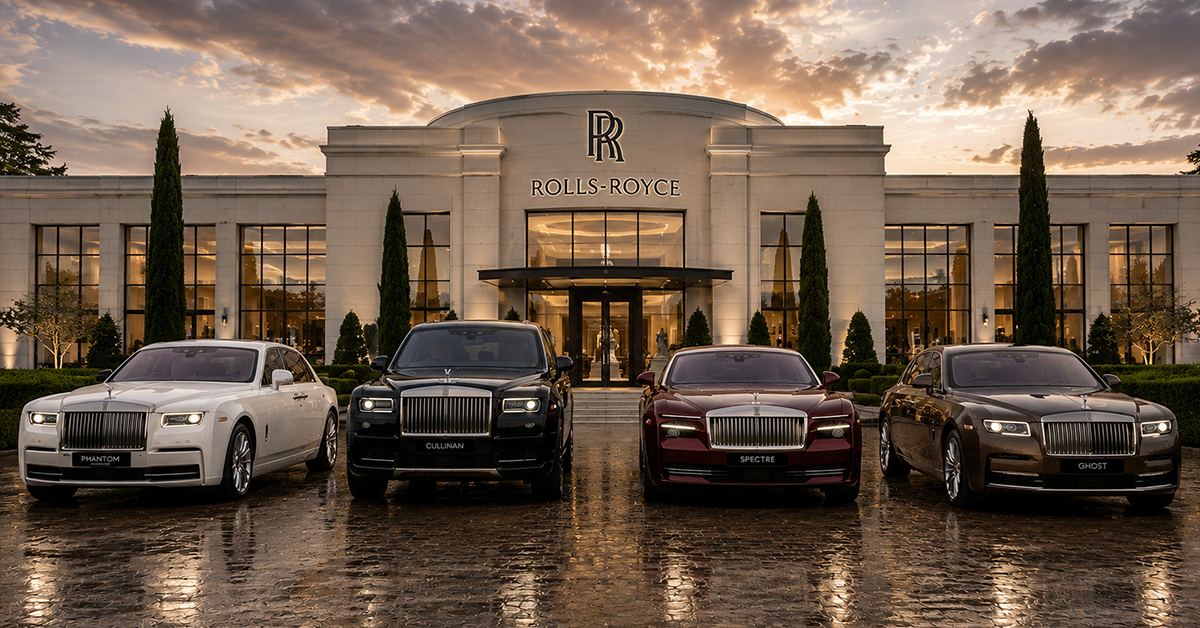
AI-generated concept illustration — Rolls-Royce brand overview. | Rev N Rise
Rolls-Royce is the most prestigious automotive brand in the world — the name that has meant the absolute pinnacle of luxury, craftsmanship and exclusivity since 1906. Built by hand at Goodwood in West Sussex, each Rolls-Royce represents hundreds of hours of skilled artisanship, the finest materials available on earth and a level of personalisation that makes every car genuinely unique. From the Silver Ghost to the Phantom, and now the Spectre electric, Rolls-Royce has never compromised its position at the very top.
Charles Stewart Rolls was a wealthy motorist and aviation pioneer. Henry Royce was a self-taught engineer of extraordinary precision and obsessive perfectionism. They met in 1904 through a mutual acquaintance and immediately recognised that their complementary qualities — Rolls' commercial connections and enthusiasm, Royce's engineering genius — could produce something exceptional. Rolls-Royce Limited was formally incorporated on March 15 1906. Their guiding principle was simple: to build the best car in the world.
The Silver Ghost of 1906 — a 40/50hp six-cylinder car of extraordinary smoothness, silence and reliability — earned the brand its legend in the first decade. In 1907 it completed a 15,000-mile reliability trial without mechanical failure. The Autocar described it as the best car in the world. The name stuck. For the next century, Rolls-Royce built its reputation on the same foundation: engineering so refined that the only sound at speed was the clock on the dashboard ticking.
Rolls-Royce diversified into aero engines during World War I — the Rolls-Royce Merlin engine powered the Spitfire, Hurricane and Lancaster bomber in World War II and is one of the most celebrated engines in history. The automotive and aerospace businesses remained linked until 1971 when Rolls-Royce plc went bankrupt — the aerospace division was nationalised while the automotive business eventually became part of Vickers. BMW Group acquired the Rolls-Royce name, brand and logo in 1998 for £40 million — one of the most valuable brand acquisitions in automotive history — and relaunched Rolls-Royce Motor Cars as a standalone company operating from a new purpose-built facility at Goodwood in West Sussex from 2003.
The Rolls-Royce Phantom is the brand's flagship — the most prestigious production car in the world and the vehicle against which all other luxury saloons are ultimately measured. The eighth-generation Phantom — launched in 2017 — uses a spaceframe aluminium architecture, a 6.75-litre twin-turbocharged V12 and a suspension system so sophisticated that Rolls-Royce describes the ride quality as a magic carpet. The Gallery dashboard — a continuous glass panel spanning the full width of the cabin, behind which bespoke objects d'art can be sealed — is the most extraordinary interior feature in any production car. Owners have had their cars' dashboards filled with butterfly collections, hand-painted porcelain, musical instruments and personal memorabilia. The Phantom Extended adds 170mm to the wheelbase for an even more lavish rear cabin experience.
The Rolls-Royce Spectre, launched in 2023, is the most significant Rolls-Royce since the modern Phantom of 2003. It is the brand's first fully electric vehicle — a two-door grand tourer producing 584 horsepower from twin electric motors with approximately 320 miles of range. Rolls-Royce's decision to launch electrification with a grand tourer rather than an SUV or saloon was deliberate — the Spectre's silent power delivery, instant torque and absence of mechanical vibration are entirely aligned with Rolls-Royce's core values of effortless, whisper-quiet luxury. The Spectre uses an aluminium spaceframe — the Architecture of Luxury — shared with the Phantom and Ghost, adapted for an electric drivetrain. Early reviews have been almost universally ecstatic. Rolls-Royce has committed to becoming a fully electric brand by 2030.
Rolls-Royce occupies a position in the automotive world that no other brand can claim — it is the uncontested pinnacle of luxury, the name that every other luxury manufacturer acknowledges as above them. The Bespoke programme — which enables buyers to specify virtually any material, colour, feature or personal element they can imagine — means that no two Rolls-Royces are identical unless the owner specifically requests it. The lambswool floor mats are deeper than any competitor's. The paint is applied in more layers than any competitor's. The wood veneer is hand-matched from the same log. The leather is hand-stitched by craftspeople who spend years mastering a single technique. This obsessive attention to material quality and craft, maintained at a volume of just over 6,000 cars per year, is what makes Rolls-Royce genuinely irreplaceable. The Spectre's critical success suggests that electrification, far from threatening Rolls-Royce's identity, may actually enhance it — silence and effortlessness are exactly what a Rolls-Royce should deliver.