 Brands
Tesla — History, Models and Everything You Need to Know
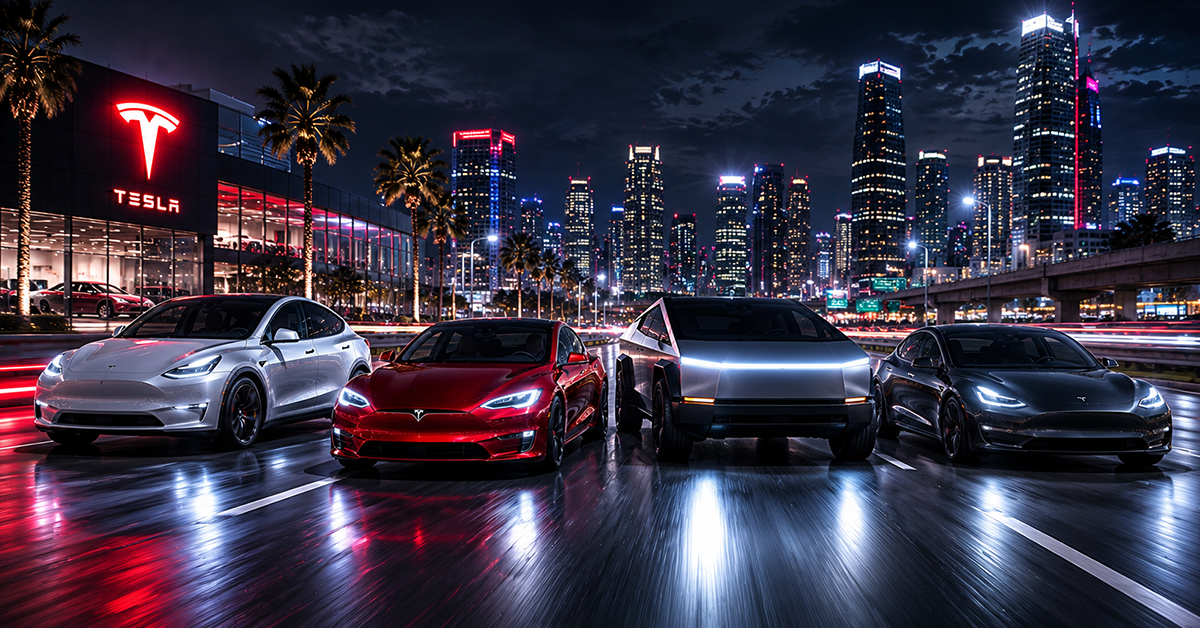
AI-generated concept illustration — Tesla brand overview. | Rev N Rise
Tesla is the company that made electric vehicles desirable. Founded in 2003 in California, Tesla proved that EVs did not have to be slow, ugly or boring — and in doing so forced every other car manufacturer on earth to accelerate its electrification plans. The Model S, Model 3, Model Y and Cybertruck have redefined segments and expectations. Tesla remains the most disruptive automotive brand since Ford introduced the moving assembly line.
Tesla Motors was founded on July 1 2003 by Martin Eberhard and Marc Tarpenning in San Carlos, California. The company was named after Serbian-American inventor Nikola Tesla, whose work on alternating current electrical systems forms the theoretical basis for electric motor technology. Elon Musk joined in 2004 as chairman and the largest investor, contributing $6.5 million of the initial $7.5 million Series A funding round. JB Straubel and Ian Wright joined around the same time. Musk became CEO in 2008 following a boardroom dispute with Eberhard.
The first Tesla vehicle — the Roadster — was delivered in 2008. Based on a Lotus Elise body with an entirely new electric powertrain, it demonstrated 0-60mph in under 4 seconds and a range of over 200 miles at a time when critics insisted neither was achievable in an electric car. Only 2,450 were produced. The Roadster was never a volume product — it was a proof of concept. The proof worked.
The Model S of 2012 was Tesla's true breakthrough — a full-size luxury saloon with over 200 miles of range, over-the-air software updates and a 17-inch touchscreen that made every other car's infotainment system look prehistoric overnight. It won Motor Trend Car of the Year unanimously — the first time the award had been given to an electric vehicle. The Model X SUV followed in 2015. The Model 3 of 2017 — designed to be affordable enough for mass-market adoption at around $35,000 — became the best-selling electric car in history and in 2021 briefly became the best-selling premium car globally of any kind. The Model Y went further still — becoming the best-selling vehicle globally of any powertrain type in 2023.
Tesla's Gigafactory concept — enormous integrated manufacturing facilities that produce both vehicles and battery cells under one roof — has been one of the most significant industrial innovations of the 21st century. The first Gigafactory, opened in Nevada in 2016 in partnership with Panasonic, produces battery cells and packs for Tesla vehicles. Gigafactory Shanghai — opened in 2019 and built in under a year — produces Model 3 and Model Y for the Chinese market and export. Gigafactory Berlin serves the European market. Gigafactory Texas produces the Cybertruck and Model Y for North America.
The scale of these facilities is extraordinary — Gigafactory Texas alone covers over 10 million square feet. The integration of battery production with vehicle assembly under one roof eliminates the logistics costs and complexity of sourcing cells externally, giving Tesla a structural cost advantage that traditional manufacturers are still working to replicate.
Tesla's Autopilot driver assistance system — introduced in 2014 — was the first consumer-grade system capable of automatic steering, lane changing, braking and acceleration on highways. It changed the public conversation about autonomous driving permanently. The more advanced Full Self-Driving package — a subscription option — adds automatic navigation on city streets, traffic light recognition and automatic lane changing on surface roads. Tesla has been working toward full autonomy since 2016, when it began equipping all vehicles with the hardware necessary for eventual fully autonomous operation.
Tesla's approach to autonomous driving — using camera-only systems rather than lidar — has been controversial among engineers. Most competitors use lidar sensors for their autonomous systems. Tesla's position is that cameras combined with neural network AI can achieve human-level driving without lidar, at lower cost. As of 2026, Full Self-Driving requires active driver supervision. Tesla's autonomous taxi — Robotaxi — launched in limited markets in 2025 and represents the next step toward commercial autonomy.
Tesla's most significant competitive advantage is not the range of its batteries or the power of its motors — it is software. Tesla's vehicles receive over-the-air software updates that add new features, improve existing ones and fix problems without requiring a visit to a dealer. No other mainstream manufacturer had this capability when Tesla introduced it in 2012. The result is a car that improves over time — a fundamental shift in what it means to own a vehicle. Tesla's Supercharger network — now partially opened to other brands — remains the most extensive and reliable fast-charging infrastructure in most markets. And Tesla's vertically integrated approach — designing its own chips, software, battery cells and manufacturing equipment — gives it flexibility and cost control that traditional automotive supply chains cannot match.