 Brands
BYD — History, Models and Everything You Need to Know
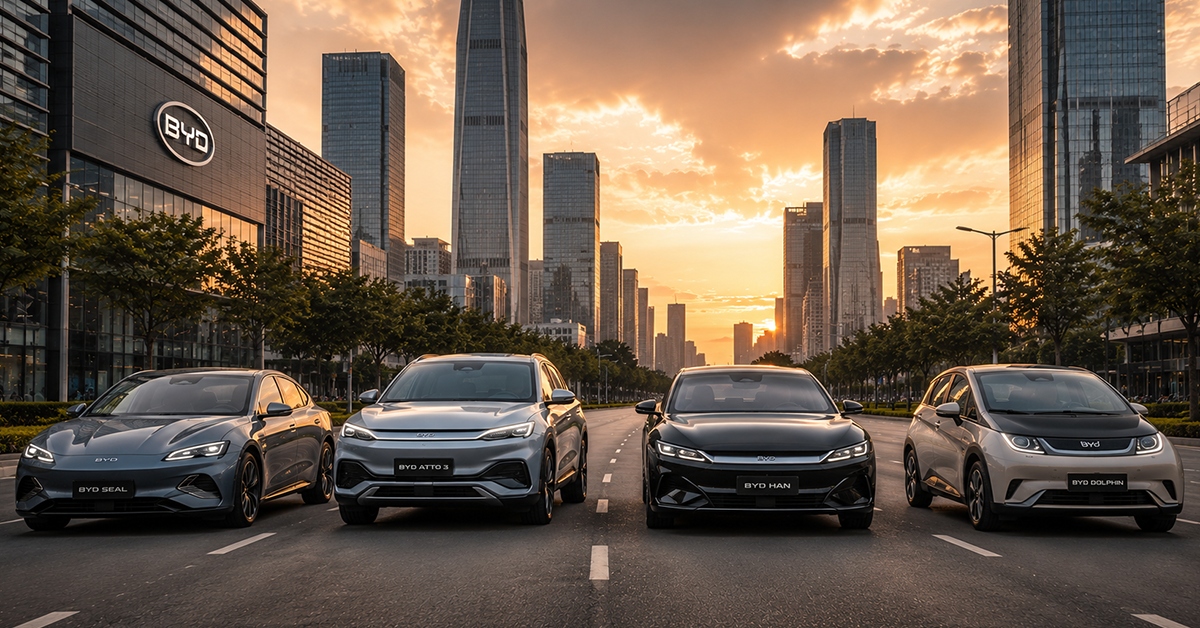
AI-generated concept illustration — BYD brand overview. | Rev N Rise
BYD — Build Your Dreams — is the Chinese electric vehicle giant that overtook Tesla to become the world's largest EV manufacturer in 2023. Founded in Shenzhen in 1995 as a battery company, BYD has transformed into a vertically integrated automotive and technology powerhouse — building its own batteries, chips, motors and bodies. It is the most important new force in global automotive manufacturing since Toyota industrialised the hybrid car.
Wang Chuanfu founded BYD — Bi Ya Di — in Shenzhen, China in 1995 with 20 employees and a loan of approximately $300,000 from a cousin. The company's initial business was manufacturing rechargeable batteries — nickel-cadmium cells for mobile phones and other consumer electronics. Wang had identified that Japanese battery manufacturers were producing cells in clean rooms to avoid contamination, dramatically increasing costs. BYD developed a cheaper method using dry rooms and humidity-controlled processes that achieved comparable quality at a fraction of the cost. The strategy worked — within a decade BYD was supplying batteries to Nokia, Motorola and other major mobile phone manufacturers.
BYD entered the automotive industry in 2003 by acquiring Xi'an Qinchuan Automobile — a small Chinese car manufacturer. The acquisition gave BYD manufacturing facilities, regulatory approvals and a workforce experienced in vehicle production. The first BYD car — the F3 saloon — launched in 2005 and sold strongly in the Chinese domestic market. Warren Buffett's Berkshire Hathaway acquired a 10% stake in BYD in 2008 for $232 million — a vote of confidence from the world's most respected investor that dramatically raised BYD's international profile.
The decisive shift came with the development of the Blade Battery in 2020 — a lithium iron phosphate cell design so structurally advanced that it passed the nail penetration test without catching fire, demonstrating a level of thermal safety that lithium-ion batteries had not previously achieved. The Blade Battery became the foundation of BYD's entire EV range and the technology that differentiated it from every competitor. BYD's sales grew explosively from 2021 onwards — passing 1 million vehicles in 2022, 3 million in 2023 and continuing to accelerate through 2024 and 2025 as the brand expanded aggressively into Europe, Australia and the Middle East.
The BYD Blade Battery is the most significant battery innovation since lithium-ion technology itself. Traditional battery packs use cylindrical or prismatic cells grouped into modules, which are then assembled into packs. The Blade Battery eliminates the module layer entirely — long, flat cells are arranged in a blade-like configuration and inserted directly into the pack structure, which also serves as a structural component of the vehicle floor. The result is a battery pack that is simultaneously more energy-dense, more thermally stable, lighter and structurally stronger than conventional designs.
The thermal safety advantage is dramatic. Lithium iron phosphate chemistry — the chemistry used in all Blade Batteries — does not undergo thermal runaway in the same way as the nickel-manganese-cobalt chemistry used by many competitors. Combined with the Blade's structural design, which prevents heat from propagating between cells, BYD's batteries are genuinely among the safest available in any production vehicle. The Blade Battery underpins every BYD passenger car and is also being supplied to other manufacturers including Toyota, which uses it in some of its China-market vehicles.
BYD's international expansion has been one of the most aggressive and successful industrial campaigns of the 2020s. The brand entered Europe in 2022 with the Atto 3 and has rapidly expanded its European presence with the Seal, Dolphin and Sealion range. In Australia — where BYD arrived in 2022 — the Atto 3 and Seal have consistently ranked among the best-selling electric vehicles. In 2026 BYD dispatched its own purpose-built car carrier ship to Australia carrying 5,000 vehicles — a statement of logistical ambition that signalled the brand's long-term commitment to the market.
BYD has also established manufacturing facilities outside China — plants in Thailand and Brazil are operational, with facilities planned for Europe and other markets. This local manufacturing strategy reduces exposure to import tariffs — a significant issue as European and American governments have introduced substantial duties on Chinese-made electric vehicles — and shortens supply chains for key markets.
BYD's vertical integration is its defining competitive advantage. The company produces its own battery cells, battery management systems, electric motors, power electronics, semiconductors and vehicle bodies — a level of self-sufficiency that makes Apple's supply chain look dependent by comparison. This integration gives BYD cost control, quality control and technological flexibility that traditional automotive manufacturers sourcing components from dozens of suppliers simply cannot match. Combined with China's mature EV supply chain ecosystem and BYD's massive scale, the result is electric vehicles that deliver competitive technology at prices European and American manufacturers cannot profitably match. The global automotive industry is still working out how to respond.