 Brands
Ford Escape — From the 2000 Debut to the Last Build
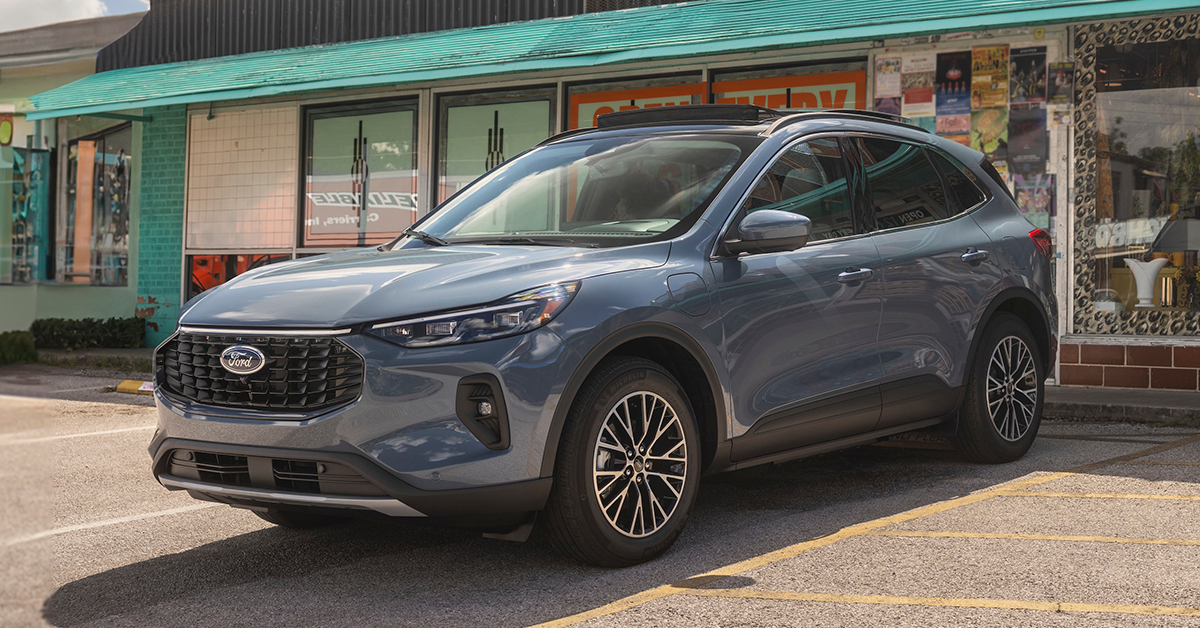
Official press image of the Ford Escape. | © Ford Motor Company
The Ford Escape from the 2000 debut to the last build in 2025: the Mazda partnership, four generations, hybrids and plug-in hybrids, trims, engines, sizes, prices where sources give them and sales.
The Ford Escape is Ford’s compact SUV. Ford says it went on sale in 2000 and began production 25 years before the summer of 2025 (Ford). Ford says it quickly became America’s top-selling small SUV, outselling the Honda CR-V and Toyota RAV4 in its first year (Ford). Ford also says it has sold more than 4.5 million Escapes in North America (Ford). A reported history counts four generations across model years 2001 to 2026, starting with the first in 2001 and ending with the fourth, which ran from 2020 (reported).
| Class | Compact SUV (reported) |
| On sale | 2000 (Ford) |
| Model years | 2001 to 2026 (reported) |
| Last build | December 17, 2025 (reported) |
| Final plant | Louisville Assembly Plant (reported) |
| Sold in North America | More than 4.5 million (Ford) |
| US sales peak | 308,296 in 2017 (reported) |
| 2025 powertrains | 1.5L, 2.0L, hybrid, plug-in hybrid (Ford) |
| 2025 trims | Six, from Active to Platinum and Plug-In Hybrid (Ford) |
| Lincoln twin | Corsair (reported) |
The Escape is no longer on sale as a new vehicle to order. Ford’s own Escape pages now say that while it is the end of the road for the Escape, support for it and for all of Ford’s vehicles is still going strong, and a footnote says the 2026 Escape is unavailable for purchase in California, Massachusetts, Oregon, New York, Washington and Vermont (Ford). A reported account says the last Escape was built at Louisville Assembly Plant on December 17, 2025, alongside its Lincoln twin, the Corsair (reported). Ford announced the end in August 2025, according to a reported history (reported).
The final lineup was wide for a compact SUV. Ford’s materials for 2025 list six trims: Active, ST-Line, ST-Line Select, ST-Line Elite, Platinum and Plug-In Hybrid (Ford). Power came from a 1.5L EcoBoost with 180 horsepower, a 2.0L EcoBoost with 250 horsepower, a 2.5L hybrid, and a 2.5L plug-in hybrid rated at 210 total system horsepower (Ford). Transmissions were an 8-speed automatic on the EcoBoost models and an eCVT on the hybrids (Ford).
The numbers that matter to buyers are modest and clear. Ford lists a 106.7-inch wheelbase, up to 65.4 cubic feet of maximum cargo space, and towing of 2,000 pounds with the 1.5L or 3,500 pounds with the 2.0L and the Class II Trailer Tow Package (Ford). Section six gives the trim detail, section seven the sizes and efficiency, and section eight the prices and sales. Ford’s page excerpts list 101 combined MPGe for the plug-in hybrid (Ford), and a reported listing gives an electric range of 37 miles (reported).
The Escape also made history. Ford says it was the world’s first hybrid SUV, launched in 2005, and that it won North American Truck of the Year (Ford). Ford adds that it was the first hybrid model from an American-based automaker (Ford). On sales, a reported history gives a US peak of 308,296 in 2017 and 139,387 in 2025 (reported). Between those years the Escape went from a Mazda-developed twin to a Kuga-based design and then to a sleeker fourth generation, as the next sections show.
Some limits apply. Ford’s current Escape pages show a discontinuation notice rather than a specification table, so the 2025 and 2026 figures here come from excerpts of Ford’s own spec pages found through search, plus Ford Canada’s page for the dimensions. Almost all engine, trim and recall detail for earlier generations comes from a reference history and is tagged (reported). The Escape is sold as the Kuga in various international markets, which we do not cover (reported). Use the history and models pages linked below for the wider Ford range.
Ford has told how the first Escape came together with Mazda. Mazda had been developing its own small SUV in the late 1990s, and about 30 Ford designers and engineers visited Japan to study its prototype (Ford). Ford then combined the two programs, which also brought the Mazda Tribute to market (Ford). Ford says the small SUV segment had roughly doubled in sales volume in the years before 2000, while the Ford Explorer was already the top SUV (Ford). The Explorer that set that benchmark has its own article, linked below.
| Partner | Mazda; the Tribute was the twin (Ford) |
| Ford visit to Japan | About 30 designers and engineers (Ford) |
| Shared sheet metal | Roof panel only (Ford) |
| Platform | All-new unibody (Ford) |
| Four-wheel drive | Control Trac II (Ford) |
| Kansas City expansion | Started June 2000 (Ford) |
| Model years | 2001 to 2007 (reported) |
| 3.0L V6 | 200 hp (reported) |
| Hybrid launch | 2005 (Ford) |
| Hybrid output | 155 hp combined (reported) |
Ford’s account stresses that the two vehicles were meant to be different. A joint team handled the basic architecture while separate brand teams gave each vehicle its own identity (Ford). The two shared only the roof panel as sheet metal and had no common interior parts visible to owners (Ford). Paul Linden, the Escape project management supervisor, told Ford World in July 2000: “We wanted to keep the Ford a Ford and make the Mazda a Mazda” (Ford). He described the Ford as a “tough truck” and the Mazda as an “elegant sports sedan” (Ford).
On engineering, Ford says the Escape used an all-new unibody platform (Ford). It offered the most powerful V-6 in its class and the then-new Control Trac II four-wheel-drive system (Ford). A reported history names the platform Ford CD2, developed with Mazda, with independent suspension and rack-and-pinion steering (reported). Another reference gives the same platform name and says it was based on Mazda GF underpinnings (reported). The first generation went on sale in 2000 as a 2001 model, and a reported history gives production from April 2000 to December 2006 (reported).
Plants and markets were split. Ford says Kansas City Assembly Plant went through a major expansion and renovation starting in June 2000 to build the Escape and Tribute (Ford). A reported history lists assembly at Avon Lake, Ohio, and Claycomo, Missouri, near Kansas City, plus Mazda in Japan for other markets and several Asian plants (reported). It says the hybrid was built in Kansas City (reported). Model years ran 2001 to 2007, with some Asia-Pacific versions continuing later (reported).
Reported engines were three. The 2.0L Zetec four-cylinder made 127 horsepower before 2005, the 2.3L Duratec four-cylinder became the base engine from 2005, and the 3.0L Duratec V6 made 200 horsepower (reported). Ford says Mercury launched the Escape-based Mariner when Ford introduced the Escape Hybrid, and Mercury was discontinued in 2010 (Ford). A reported history gives the Mariner’s introduction as model year 2005, with the Mariner Hybrid following in 2006 and about 12,300 built (reported). Its infobox gives different Mariner years, so we do not state exact ones.
The first generation had a safety and reliability record worth noting. A reported history says an April 2014 recall covered about 386,000 Escape and Tribute models from model years 2001 to 2004 for subframe rust in salt-belt states, and that 2005 to 2007 models were not affected (reported). It also says the 2001 to 2004 models were rated marginal in the IIHS frontal offset test (reported). The same history uses the name Maverick for a related Escape-based SUV sold in Europe and elsewhere, with start and end years that differ between passages, so we give none (reported).
The second generation arrived with restyled exterior and interior but still on the CD2 platform, according to a reported history (reported). It debuted at the 2006 Los Angeles Auto Show (reported). Reported engines were the 2.3L Duratec four-cylinder in 2008, then from 2009 a 2.5L Duratec four-cylinder with 171 horsepower and 171 lb-ft, and a 3.0L Duratec V6 with 240 horsepower and 223 lb-ft, with a 6-speed 6F35 automatic from 2009 (reported). Ford says production moved to Louisville Assembly Plant in 2012 (Ford).
| Second generation debut | 2006 Los Angeles Auto Show (reported) |
| 2.5L four-cylinder | 171 hp, 171 lb-ft, from 2009 (reported) |
| 3.0L V6 | 240 hp, 223 lb-ft, from 2009 (reported) |
| Hybrid EPA, 2010 | 34 city, 31 highway, front-wheel drive (reported) |
| Production moved | To Louisville in 2012 (Ford) |
| Third generation basis | Ford Kuga (reported) |
| Third generation ranking | Second-best-selling SUV, early 2010s (Ford) |
| 2.0L EcoBoost | 237 hp, 250 lb-ft (reported) |
| 1.5L EcoBoost | 179 hp, 2017 refresh (reported) |
| US sales peak | 308,296 in 2017 (reported) |
The second-generation hybrid used a 2.5L Atkinson-cycle four-cylinder (reported). A reported history gives 2010 EPA ratings of 34 city and 31 highway for front-wheel drive, says the hybrid added about 300 pounds, and says electric air conditioning was added (reported). The same history says a plug-in version used a 10 kWh lithium-ion pack for a 30-mile electric range (reported). We did not find whether that version reached customers, so treat it as unconfirmed. Ford says Mercury was discontinued in 2010 (Ford), and the reference says the Mariner ended in October 2010 and the Tribute in November 2011 (reported).
Safety for the second generation was mixed in reported ratings. A reported history says the IIHS rated frontal, side and rear crash protection good, but rated roof strength marginal, or poor for hybrids (reported). It adds that electronic stability control became standard (reported). The second generation ran to 2012, when Ford says production moved to Louisville Assembly Plant (Ford). A reported history lists the second-generation model years as 2008 to 2012 (reported).
The third generation changed the Escape’s identity. A reported history says it was based on the Ford Kuga from Ford of Europe, with production beginning in April 2012 (reported). Assembly was at Louisville, with Kuga versions built in Valencia, Spain, Chongqing, China, Chungli, Taiwan and Yelabuga, Russia (reported). Ford says the third generation made the Escape America’s second-best-selling SUV in the early 2010s (Ford). A reported history gives the US sales peak of 308,296 in 2017, during this generation (reported).
Reported third-generation engines changed over the run. The 2.5L Duratec made 168 horsepower and 167 lb-ft, rising to 170 lb-ft from 2015, the 1.6L EcoBoost made 173 horsepower and 177 lb-ft, and the 2.0L EcoBoost made 237 horsepower and 250 lb-ft (reported). The 1.5L EcoBoost with 179 horsepower replaced the 1.6L in the 2017 refresh, which was announced in November 2015 with production starting in March 2016 and added Sync 3 and Sync Connect (reported). The hybrid and V6 were dropped (reported). Trims were S, SE, SEL and Titanium, with SEL discontinued after 2013 and returning for 2018 (reported).
The third generation’s weak spots were recalls. A reported history lists a December 2012 recall of over 70,000 vehicles for 1.6L overheating and fire risk, a November 2013 recall of over 160,000 for 1.6L oil and fuel leaks, and a March 2017 recall of 692,700 for 2014 model-year door latches (reported). It adds that a March 2017 recall for 2014 1.6L coolant circulation fire risk partly drove a $300 million charge (reported). It also says NHTSA gave five stars in all tests, while the IIHS small-overlap driver rating was poor for 2013 to 2016 and acceptable for 2017 to 2019 (reported).
A reported history says the fourth-generation Escape debuted on April 2, 2019, and went on sale in the third quarter of 2019 as a 2020 model (reported). Ford says the fourth generation launched in 2019 and that the Escape was Ford’s second-best-selling US vehicle behind the F-Series as recently as 2019 (Ford). The reference says it was related to the Kuga, was more than 200 pounds lighter than the third generation, and had a longer and wider footprint (reported).
| Debut | April 2, 2019 (reported) |
| On sale | Fall 2019, as a 2020 model (reported) |
| Weight versus third generation | More than 200 lb lighter (reported) |
| 1.5L at reveal | 180 hp, 177 lb-ft (reported) |
| 2.0L at reveal | 250 hp, 275 lb-ft (reported) |
| Hybrid | 198 hp or 200 hp (reported) |
| Plug-in hybrid | 209 hp (reported) |
| Cargo at reveal | Up to 37.5 cu ft (reported) |
| 2023 refresh | New grille, headlights, infotainment (reported) |
| IIHS | 2020 Top Safety Pick (reported) |
Reports at the reveal described a deliberate styling change. They said designers turned to Ford sports cars, with the shield-shaped trapezoidal grille inspired by the sixth-generation Mustang and the lower front end borrowing from the Ford GT (reported). They said the new Escape stood lower, wider and longer than before (reported). A reported history gives maximum cargo space of 37.5 cubic feet, and the reveal also described new sliding second-row seats with best-in-class second-row legroom (reported).
Reported reveal powertrains were four. The standard 1.5L three-cylinder EcoBoost made 180 horsepower and 177 lb-ft, the 2.0L four-cylinder made 250 horsepower and 275 lb-ft, the hybrid made 198 horsepower and the plug-in hybrid made 209 horsepower (reported). The EcoBoost engines used an 8-speed automatic, and the 2.0L was rated to tow 3,500 pounds (reported). One reference lists 181 horsepower and 190 lb-ft for the 1.5L and 200 horsepower for the hybrid, so those ratings differ between sources (reported).
Trims changed over the run. A reported account says the 2020 lineup had S, SE, SE Sport, SEL and Titanium trims (reported). A reported history says that from 2023 the US lineup was Base, Active and Platinum plus ST-Line variants, with the plug-in hybrid becoming its own trim (reported). It describes a 2023 refresh with an updated grille, headlights and infotainment, reworked EcoBoost engines for emissions, and slightly lower hybrid power ratings under new SAE J2908 methods (reported).
Plug-in hybrid timing is a conflict. Reports at the reveal said it would arrive in spring 2020, six months after the other models, and be sold in all 50 states (reported). A reported history instead says the plug-in hybrid arrived in the US in October 2021 for model year 2021 (reported). We could not reconcile the two. The same history says Mexico launched in 2019, and that Australia and the Gulf region were discontinued in 2023 and 2022 respectively (reported).
Safety and weight are reported too. The IIHS named the 2020 Escape a Top Safety Pick, though its side test was rated marginal under the updated test (reported). Reported weights are 3,554 to 3,706 pounds for the hybrid and 3,884 pounds for the plug-in hybrid (reported). Ford’s 2025 materials still list the plug-in hybrid as its own Plug-In Hybrid model, so that separate trim lasted to the end of the run (Ford). The same history says the 2026 model year was a final inventory phase-out and that it was not certified for CARB states. Ford’s own footnote lists six states where the 2026 Escape could not be bought (Ford).
Hybrids are the Escape’s biggest first. Ford says the Escape was the world’s first hybrid SUV, launched in 2005, and the first hybrid model from an American-based automaker (Ford). It adds that the Escape Hybrid won North American Truck of the Year (Ford). A reported history says the hybrid was introduced for model year 2005, that Ford built about 17,000 in the second half of 2004, and that many were used as taxis (reported). We tag the world-first claim as Ford’s own.
| First hybrid SUV claim | World’s first, launched 2005 (Ford) |
| Award | North American Truck of the Year (Ford) |
| First hybrid output | 155 hp combined (reported) |
| First hybrid EPA, front-wheel drive | 30 city, 28 highway, 29 combined (reported) |
| Hybrids sold before 2012 | More than 100,000 (Ford) |
| Hybrid return | 2020 model year (Ford) |
| Current hybrid engine | 2.5L Atkinson-cycle four-cylinder (Ford) |
| Hybrid transmission | eCVT (Ford) |
| Plug-in output | 210 total system hp (Ford) |
| Plug-in efficiency | 101 combined MPGe (Ford) |
The first hybrid combined a 133-horsepower Atkinson-cycle four-cylinder with an electric motor for 155 horsepower combined, according to a reported history (reported). It gives EPA ratings of 30 city, 28 highway and 29 combined for front-wheel drive, and 28, 26 and 27 for all-wheel drive (reported). Its efficiency gain over the gasoline Escape is given as approximately 75% in one place and 70% in another, so we do not state one (reported). One section also names a 2.3L Duratec with a CVT while another names a 2.5L Atkinson, so the engine is disputed (reported).
Hybrid volumes are disputed. Ford says the Escape Hybrid sold more than 100,000 units before being discontinued in 2012 and that it returned for the 2020 model year (Ford). A reported history says 122,850 hybrids were built from 2005 onward, yet its own table sums to roughly 193,790 for 2005 to 2010 alone (reported). We cannot reconcile these totals, so the article gives Ford’s figure as a minimum. An auto history also says a Mazda Tribute Hybrid was produced in extremely low numbers between 2007 and 2009 (reported).
The fourth generation brought two hybrid choices back. Ford’s 2025 materials list an available 2.5L iVCT Atkinson Cycle I-4 hybrid, with an eCVT transmission, on the ST-Line, ST-Line Select, ST-Line Elite and Platinum trims (Ford). Reported output at the reveal was 198 horsepower, with a reference giving 200 horsepower and a 1.1 kWh battery (reported). A listing gives 39 combined mpg for the 2025 Platinum hybrid with front-wheel drive (reported). Gas models and the standard hybrid were available with all-wheel drive at the reveal (reported).
The plug-in hybrid is the most efficient Escape. Ford’s 2025 page lists the 2.5L iVCT Atkinson Cycle I-4 plug-in hybrid at 210 total system horsepower and an EPA-estimated 101 combined MPGe, and its 2026 page repeats the 210 figure (Ford). A reported history gives 209 horsepower, 100 MPGe, a 14.4 kWh battery with 10.7 kWh usable, and a 37-mile electric range (reported). A listing agrees on 37 miles, adds that fuel economy is 42 city and 37 highway on gasoline, and says regular fuel is used (reported).
Estimates changed between the reveal and later listings. At the reveal, reports said the plug-in would offer at least 30 miles of electric range, which was a pre-launch estimate (reported). The later 37-mile figure is an EPA estimate in listings (reported). A separate China-market plug-in used a 1.5L three-cylinder with 165 horsepower combined and a 15.1 kWh battery, with a 77 km range on a different test cycle, so it is not comparable (reported). In the US, the plug-in hybrid is front-wheel drive in the listings we read (reported).
Ford’s materials list six trims for 2025 (Ford). The Active has a 1.5L EcoBoost I-3 with Auto Start-Stop, front-wheel drive with available all-wheel drive, 17-inch Shadow Silver-painted wheels, Ford Co-Pilot360 with a rear view camera, and wireless Apple CarPlay and Android Auto (Ford). A brochure excerpt adds a 6-way manual driver seat and a blind spot information system with rear cross-traffic braking (Ford). Reported changes for 2025 include black upper window molding on the Active and a power driver’s seat that changed from standard to optional (reported).
| 2025 trims | Active, ST-Line, ST-Line Select, ST-Line Elite, Platinum, Plug-In Hybrid (Ford) |
| 1.5L EcoBoost | 180 hp at 6,000 rpm (Ford) |
| 2.0L EcoBoost | 250 hp at 5,500 rpm (Ford) |
| Transmission | 8-speed automatic; eCVT on hybrids (Ford) |
| Active wheels | 17-inch Shadow Silver (Ford) |
| ST-Line wheels | 18-inch Rock Metallic (Ford) |
| ST-Line Select | Standard AWD, power liftgate, remote start (Ford) |
| Elite and Platinum screen | 13.2-inch LCD (Ford) |
| Towing, 1.5L | 2,000 lb (Ford) |
| Towing, 2.0L | 3,500 lb with Class II package (Ford) |
The ST-Line adds sporty touches. Ford lists an EcoBoost or hybrid engine, available all-wheel drive, an 8-way power driver seat with red stitching and 18-inch Rock Metallic-painted wheels (Ford). The ST-Line Select adds standard all-wheel drive, heated front seats and steering wheel, a power liftgate and a remote start system, with the 2.0L EcoBoost and an available hybrid (Ford). A reported listing says the ST-Line trims gained black lower body cladding and revised black bumpers for 2025 (reported). Ford says the ST-Line trim led the Escape’s second-quarter 2025 sales growth (Ford).
The ST-Line Elite and Platinum sit at the top of the range. Ford lists both with an EcoBoost or hybrid engine, standard all-wheel drive, a 13.2-inch LCD touchscreen and Ford Co-Pilot360 Assist+ with adaptive cruise control (Ford). The Platinum adds 18-inch machined-face wheels with magnetic-painted pockets and an available PHEV Premium Package (Ford). A conflict appears here. Ford’s brochure says standard all-wheel drive on the Platinum, yet price guides list a Platinum with front-wheel drive for the hybrid, so check the build for your market (reported).
Engine ratings come from Ford’s own pages. The 1.5L engine makes 180 horsepower at 6,000 rpm and the available 2.0L EcoBoost makes 250 horsepower at 5,500 rpm (Ford). The EcoBoost models use an 8-speed automatic and the hybrid and plug-in use an eCVT (Ford). Torque for the 1.5L is given three ways in other sources: 177 lb-ft at the reveal, 190 lb-ft in a reference history, and 199 lb-ft in a trim comparison for 2025 (reported).
Towing is limited, as for most compact SUVs. Ford lists 2,000 pounds with the 1.5L EcoBoost, and 3,500 pounds with the available 2.0L EcoBoost and the Class II Trailer Tow Package (Ford). Ford Canada’s page also lists 907 kilograms, or 2,000 pounds, for the 1.5L (Ford). The 3,500-pound figure matches the figure reported for the 2020 reveal (reported). Ford’s pages did not give a payload figure in the excerpts we read, so none is stated here.
For 2026, Ford’s pages carry the same powertrain figures as 2025: 180 and 250 horsepower, 210 total system horsepower for the plug-in hybrid, up to 65.4 cubic feet of cargo and 3,500 pounds of towing (Ford). The 2026 year was a final run of leftover inventory, according to a reported history, and Ford’s own footnote says the 2026 Escape could not be bought in six states (Ford). Ford did not state 2026 trim prices in the excerpts we read. For other compact Ford SUVs from the same period, the Bronco Sport article covers that model in detail.
Ford lists a 106.7-inch wheelbase for the Escape (Ford). Ford Canada’s page gives the same exterior dimensions for all six 2025 trims: length 4,574 millimeters, height 1,676 millimeters and width 2,174 millimeters (Ford). The page does not say whether the width includes mirrors, so we give it as listed. Reported weights are 3,554 to 3,706 pounds for the hybrid and 3,884 pounds for the plug-in hybrid (reported). Seating is for five, according to a listing (reported).
| Wheelbase | 106.7 in (Ford) |
| Length | 4,574 mm (Ford) |
| Height | 1,676 mm (Ford) |
| Width | 2,174 mm (Ford) |
| Maximum cargo | 65.4 cu ft (Ford) |
| Front leg room | 42.4 in maximum (Ford) |
| Second-row leg room | 40.7 in maximum (Ford) |
| Hybrid weight | 3,554 to 3,706 lb (reported) |
| Plug-in weight | 3,884 lb (reported) |
| Basic warranty | 3 years or 36,000 miles (reported) |
Cargo figures need care. Ford lists a maximum cargo space of 65.4 cubic feet, shown against the 1.5L EcoBoost on one page and the 2.0L EcoBoost on another (Ford). Ford Canada lists 1,851 liters, or 65.4 cubic feet, behind the first row for the 1.5L (Ford). At the reveal, reports gave as much as 37.5 cubic feet of cargo space, and a listing gives 34.4 cubic feet for the 2025 Platinum hybrid (reported). The sources do not say what each figure measures, so they cannot be compared directly.
Passenger room is listed by Ford. Maximum front-row leg room is 42.4 inches and maximum second-row leg room is 40.7 inches for the 1.5L EcoBoost (Ford). The fourth generation also introduced sliding second-row seats, which reports at the reveal said gave best-in-class second-row legroom (reported). Ford’s brochure excerpt lists a 13.2-inch touchscreen on the ST-Line Elite and Platinum, and the Active has a rear view camera as standard (Ford). Ford does not give a headroom figure in the excerpts we read, so none is stated.
Wheels and tires step up with the trim. The Active has 17-inch Shadow Silver-painted aluminum wheels, the ST-Line and ST-Line Select have 18-inch Rock Metallic-painted wheels, and the Platinum has 18-inch machined-face wheels with magnetic-painted pockets (Ford). Ford does not list tire sizes in the excerpts we read. A reported trim comparison says the Active and ST-Line use the 1.5L three-cylinder with 180 horsepower, paired with an eight-speed automatic and front-wheel drive, with all-wheel drive optional (reported).
Efficiency depends on the powertrain. Ford lists 101 combined MPGe for the plug-in hybrid (Ford). A listing gives an electric range of 37 miles, 40 combined mpg when the battery is drained, and 42 city and 37 highway mpg on gasoline, with regular fuel (reported). A listing gives 39 combined mpg for the Platinum hybrid with front-wheel drive (reported). At the reveal, reports said every model would manage at least 400 miles per tank and the front-wheel-drive hybrid over 550 miles, which were pre-launch claims (reported). We found no Ford EPA table for the EcoBoost models.
Ownership details are only partly covered. A listing gives a 3-year or 36,000-mile basic warranty and says final assembly was in the United States (reported). Ford’s pages did not list payload, fuel tank size or turning circle in the excerpts we read. A reported history says the 2023 refresh changed the grille, headlights and infotainment, so exterior details differ before and after that year (reported). Owners should check the owner’s manual for the exact specification of a particular Escape, especially for older generations.
Ford’s pages did not give trim prices in the excerpts we read, so these come from price guides (reported). One guide lists the 2025 Active with front-wheel drive at $29,515 and another lists it at $28,400, a $1,115 difference (reported). The ST-Line with front-wheel drive is $30,360 in one and $29,395 in the other, a $965 difference (reported). The Platinum hybrid with front-wheel drive is $35,615 in both, and the plug-in hybrid is $38,400 in one (reported). We cannot say why the first two differ.
| 2025 Active, front-wheel drive | $29,515 or $28,400 (reported) |
| 2025 Platinum hybrid, front-wheel drive | $35,615 (reported) |
| 2025 Plug-In Hybrid | $38,400 (reported) |
| 2025 US sales | 139,387 or 139,396 (reported) |
| 2024 US sales | 157,331 or nearly 147,000 (reported) |
| First quarter 2025 | 37,357, up 2.08% (reported) |
| Second quarter 2025 | 45,232, up 19.21% (reported) |
| Third quarter 2026 | 4,714, down 85.33% (reported) |
| Last build | December 17, 2025 (reported) |
| Direct replacement | None announced (reported) |
Ford’s own sales story starts with volume. Ford says it has sold more than 4.5 million Escapes in North America (Ford). Ford says Escape sales rose nearly 30% in the second quarter of 2025, led by the ST-Line trim (Ford). A reported breakdown instead gives US second-quarter sales of 45,232, up 19.21%, so the two figures differ (reported), and we cannot say why. The same report gives 37,357 for the first quarter, up 2.08%, and 82,589 for the first half, up 10.8% (reported).
Annual figures differ by source. A reported history gives a US peak of 308,296 in 2017 and 139,387 for 2025 (reported). A tracker gives 139,396 for 2025 and 157,331 for 2024, while another report says about 141,000 in 2023 and nearly 147,000 in 2024 (reported). The 2024 values conflict, and we show both. A report also says 132,471 Escapes were sold through the first 11 months of 2025 (reported). Ford’s release lets us check one comparison: Bronco family sales of 280,500 less Bronco sales of 146,007 leave 134,493 Bronco Sport, which a report says the Escape outsold in 2025 (reported).
Sales in 2026 were leftover stock. A report puts the third quarter at 4,714, down 85.33% (reported). A tracker gives 20,874 for 2026, without a clear month range (reported). Another report says the remaining Escape and Corsair stock accounted for about 37,000 units combined, mostly in the first and second quarters (reported). Ford’s own pages carry only the discontinuation notice and the six-state footnote on 2026 availability (Ford). We did not find a Ford statement of total 2026 Escape sales.
The end was a plant decision. At an August 2025 event on Ford’s Universal EV Platform, a Ford official told media: “Production will stop for Escape and Corsair later this year when we start retooling the plant,” and added that Ford would have enough inventory to sell them well into 2026 (reported). Reports say Louisville Assembly Plant, which first opened in 1955, is being retooled for a $2 billion program to build a midsize electric pickup in 2027 at about $30,000 (reported). A reference history names that truck the Ford Fathom, and a report says the plant employs about 2,800 hourly workers (reported).
Ford has not named a direct replacement. A report says Ford said only that it would have more news on how it would serve the small SUV market (reported). A commentary calls the Bronco Sport the Escape’s spiritual replacement, but the Ford sources we read do not say so (reported). Our Bronco Sport article covers that SUV, and the models page covers the wider Ford range, both linked below. Prices and availability of leftover stock change by dealer and state, so check Ford’s site or a dealer for what remains.
