 Brands
Ford Ranger — Raptor, Payload, Prices and Global Sales
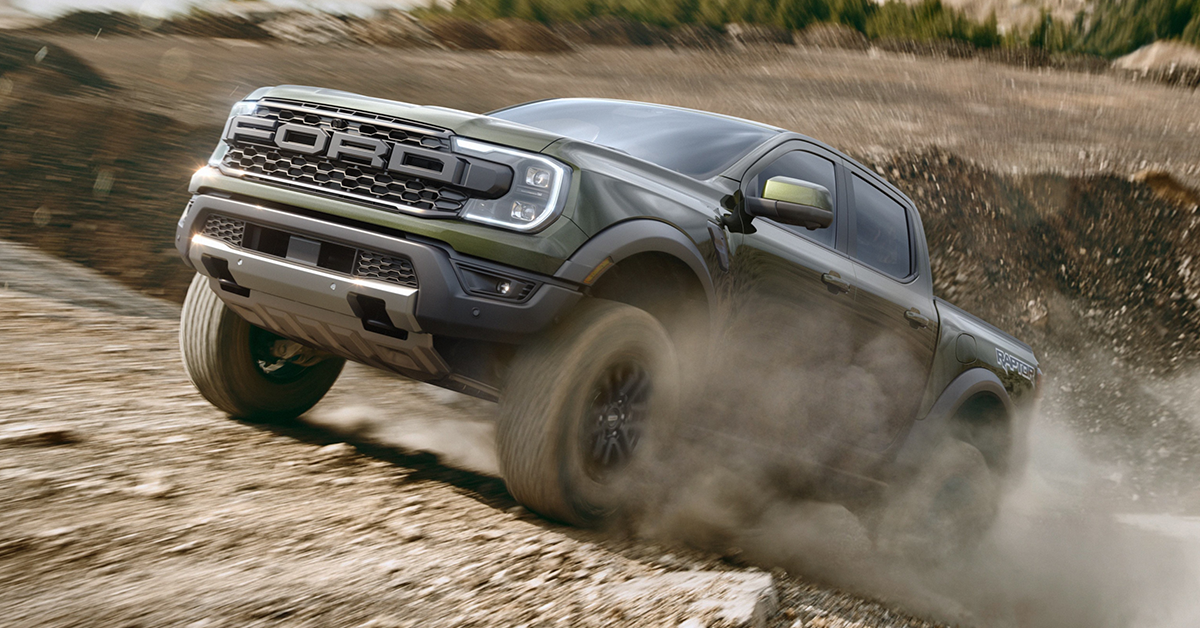
Official press image of the Ford Ranger. | © Ford Motor Company
The Ford Ranger from the Edsel-era name and the 1983 compact to the 2019 return and 2024 redesign, covering the 2.3L, 2.7L and Raptor 3.0L engines, towing, payload, trims, prices and sales in the US, Europe and beyond, showing what Ford says and what is only reported.
The Ford Ranger is the mid-size pickup below the F-150 in Ford’s North American truck range. Ford’s 2026 specification sheet lists a SuperCrew body-on-frame truck with five seats, in XL, XLT, Lariat and Raptor trims (Ford). A reference history calls the Ranger a compact or mid-size pickup that Ford has marketed globally over a series of generations, with a hiatus in North America from 2011 to 2018 (reported). It sits well below the full-size truck that our F-150 article covers.
| Class | Mid-size pickup (reported) |
| Body | SuperCrew, body-on-frame, five seats (Ford) |
| 2026 trims | XL, XLT, Lariat, Raptor (Ford) |
| Standard engine | 2.3L EcoBoost I-4, 270 hp, 310 lb-ft (Ford) |
| Available engine | 2.7L EcoBoost V6, 315 hp, 400 lb-ft (Ford) |
| Raptor engine | 3.0L EcoBoost V6, 405 hp, 430 lb-ft (Ford) |
| Transmission | 10-speed SelectShift automatic (Ford) |
| Max towing | 7,500 lb; Raptor 5,510 lb (Ford) |
| Max payload | 1,767 lb spec sheet; 1,788 lb FAQ (Ford) |
| 2025 US sales | 70,960, up 53.6% (Ford) |
Ford’s page for the 2026 model year shows three engines. The standard 2.3-litre EcoBoost four-cylinder makes 270 horsepower and 310 lb-ft, the 2.7-litre EcoBoost V6 makes 315 horsepower and 400 lb-ft, and the 3.0-litre EcoBoost V6 in the Raptor makes 405 horsepower and 430 lb-ft (Ford). All three use a 10-speed SelectShift automatic (Ford). Rear-wheel drive is standard on the XL, XLT and Lariat, and electronic shift-on-the-fly four-wheel drive is optional (Ford).
Ford lists a maximum conventional towing figure of 7,500 pounds for the 2.3-litre and 2.7-litre trucks, and 5,510 pounds for the Raptor (Ford). Maximum payload is 1,767 pounds on the spec sheet, with the highest figure for a 2.3-litre four-wheel-drive truck at 1,763 pounds (Ford). Ford’s own FAQ gives 1,788 pounds for maximum payload, which conflicts with the 1,767 pounds in its specification section, so we show both (Ford).
The Ranger was a best-seller in its first life. Ford says it was the best-selling compact pickup for 15 consecutive years through 2001, and that more than seven million were built in the United States, including the Ranger EV, before North American production ended (Ford). Ford says production restarted in North America in 2019 (Ford). The truck is also a global product, and Ford says the Ranger is sold in 180 markets worldwide (Ford).
Ford’s January 2026 sales release says Ranger sales rose 53.6 per cent in 2025, to 70,960 pickups, and calls it Ford’s second most affordable truck (Ford). The same release says sales of the entry-level XL were up 82.3 per cent for the year (Ford). A retail research page gives 2026 starting prices from $33,550 for the XL 2WD to $57,270 for the Raptor, before destination, which we cover in the prices section (reported).
This article is about the Ranger sold in North America, with notes on the global truck where Ford has published figures. Ford’s Ranger page for 2026 does not mention a 2027 Ranger, so we treat 2027 as unconfirmed and cover only what has been reported (Ford). We found no Ford fuel-economy figure for the Ranger and give none. We found no reliability ranking worth repeating, and we give none. Where sources disagree, we show both values and say what kind of source each one is. We also give no claim about resale value, owner satisfaction or crash-test results, because the sources we read give no Ford-owned figures for them. We leave out comparisons with rival mid-size pickups for the same reason, since the only rival figures we found were on third-party listing pages.
The Ranger name is older than the truck. Ford says it first appeared on a series of Edsel sedans in the late 1950s, a short-lived lineup of 18 models that included two- and four-door Ranger sedans (Ford). For 1965 the F-100 Ranger was an option with bucket seats and plush carpeting, and in 1966 a Ranger II concept pickup could convert to a sedan (Ford). In 1967 Ranger became an upscale F-Series series, and in the 1970s and 1980s it was a popular trim series on Ford Broncos (Ford).
| First Ranger use | Edsel sedans, late 1950s (Ford) |
| Edsel Ranger lineup | 18 models in all (Ford) |
| F-100 Ranger option | 1965 model year (Ford) |
| Ranger II concept | 1966 (Ford) |
| Upscale F-Series series | 1967 (Ford) |
| Standalone compact pickup | 1982 for 1983 model year (Ford) |
| Replaced | Mazda-built Ford Courier (reported) |
| Best-selling compact pickup | 15 consecutive years through 2001 (Ford) |
| US-built Rangers to 2011 | More than 7 million (Ford) |
| Final North American truck | December 2011; day conflicts (reported) |
The standalone truck came in 1982 for the 1983 model year (Ford). A reference history says it was the first compact pickup designed by Ford, and that it replaced the Mazda-produced Ford Courier (reported). A parts-retailer history says Ford had planned a compact pickup resembling the F-Series as early as 1976 (reported). A reference history says it ran across three generations on a single chassis architecture until the 2012 model year, and ended retail sales after the 2011 model year (reported).
There is a conflict about how many generations those years contain. A reference history counts three generations from 1983 to 2012, and the current truck as the fourth (reported). A fan-community history counts five body styles between 1983 and 2011, naming 1983 to 1988, 1989 to 1992, 1993 to 1997 and 1998 to 2003 among them (reported). A buying guide and a retail research site count the current truck as the fifth generation (reported). We use styling-based names where we need to and avoid a hard generation number for the early trucks.
Production sites are reported rather than Ford-sourced. A reference history says the first three generations were produced at Louisville Assembly in Kentucky, Edison Assembly in New Jersey and Twin Cities Assembly in Saint Paul, Minnesota (reported). The last Ranger built for North America came off the Twin Cities line in December 2011, but the date conflicts: one history says December 22 and a fan-community history says December 16 (reported). The reference history calls it the final vehicle assembled at that facility (reported).
One footnote is unusual. A retail history says Ford released a Ranger Electric in 1998 with a 65-mile range and 65 horsepower (reported). Ford’s own heritage article mentions the Ranger EV only in passing, as part of the more than seven million Rangers built in the United States through 2011 (Ford). We found no Ford page with the EV’s range or output, so the figures stay reported, and we give no sales count for it.
Some limits apply. Ford’s heritage article is dated April 2024, and it points readers to Ford’s archive sites for deeper product history, which we did not open (Ford). We found no Ford page giving sales for individual early model years, so we give no yearly figures. We also give no claim about reliability of the early trucks, because the buying guides we read give owner-level opinions and Ford publishes no ranking. For the wider company story, see our Ford history article. We also give no claim about how many Rangers were sold in any single early year, and we leave out the Ranger’s sales ranking against rivals in those years.
The Ranger came back to North America for the 2019 model year as a mid-size truck. A reference history says it returned as a 2019 model-year vehicle after the hiatus (reported). Ford’s own heritage article says production restarted in North America in 2019 (Ford). A copy of Ford’s October 22, 2018 release, hosted on a fan site, says Ford invested $850 million to retool the Michigan Assembly Plant for the Ranger and the Bronco due in 2020 (reported).
| Return to North America | 2019 model year (Ford) |
| Plant retool investment | $850 million (reported) |
| Plant | Michigan Assembly, Wayne (reported) |
| Plant opened | 1957 (reported) |
| Production start, 2019 Ranger | October 22, 2018 (reported) |
| 2024 testing | 4.9 million customer miles (Ford) |
| 2024 base engine | 2.3L, 270 hp, 310 lb-ft (Ford) |
| 2024 optional engine | 2.7L V6 shared with F-150, Bronco (Ford) |
| 2024 Raptor engine | 3.0L V6, 405 hp, 430 lb-ft (Ford) |
| 2024 starting price | $34,160 with destination (reported) |
That plant is in Wayne, Michigan. A reference history says it was built in 1957, and that the Focus ended there earlier in 2018 to make room for the Ranger (reported). A trade report from 2018 says Ford began building the 2019 Ranger there on October 22, 2018 (reported). A 2017 trade report gave the same $850 million for the Wayne plant and said Ford would spend a further $150 million at the Romeo Engine Plant to support Ranger and Bronco (reported). We found no Ford page that lists those figures today.
Ford’s corporate page for the 2024 truck calls it all-new and says it was tested with the equivalent of more than 4.9 million customer miles before launch (Ford). Ford says the 2.3-litre EcoBoost continued as the standard engine with 270 horsepower and 310 lb-ft, and that an available 2.7-litre EcoBoost V6 was shared with the F-150 and Bronco (Ford). A buying guide says the current truck is known inside Ford as the P703 or T6 Ranger (reported).
The Raptor was the new headline. A news report on the launch says Ranger Raptor raised the top-end starting price by 34 per cent, with ordering opening in May 2023 and vehicles arriving from late summer (reported). Ford’s launch figure for the Raptor engine was 405 horsepower and 430 lb-ft from a 3.0-litre twin-turbo V6 (Ford). One launch report gave the 2.7-litre V6 as 325 horsepower and 430 lb-ft, which conflicts with Ford’s 315 and 400, and another said the Raptor made 400 horsepower (reported).
The launch reports also conflict on the 2.3-litre torque. Ford gives 310 lb-ft (Ford). One report gave 300 lb-ft and another gave 320 lb-ft for the same engine (reported). A launch report put the 2024 Ranger at a starting price of $34,160 including destination, and another gave $32,565 for the rear-drive 2.3-litre before destination, which is a different basis rather than a true conflict (reported). The Raptor started at about $57,000 with destination, or $55,365 before it (reported).
Some limits apply. Ford’s page does not say which generation number the 2024 truck carries, and the sources we read count it differently, as described in the history section. We found no Ford page covering the 2019 to 2023 trims in detail. We give no claim about reliability for the 2019 to 2023 trucks. Ford’s 2021 page lists the same 7,500-pound towing and 1,767-pound payload as the current sheet, so the headline ratings did not change in that span (Ford). We also give no claim about the 2019 to 2023 engines, because we did not find a Ford page that lists them.
Ford’s 2026 specification sheet gives full engine data. The 2.3-litre EcoBoost makes 270 horsepower at 5,500 rpm and 310 lb-ft at 3,000 rpm, and uses regular 87 fuel (Ford). The 2.7-litre V6 makes 315 horsepower at 5,000 rpm and 400 lb-ft at 3,000 rpm, also on regular fuel (Ford). The 3.0-litre V6 in the Raptor makes 405 horsepower at 5,750 rpm and 430 lb-ft at 4,500 rpm, and Ford recommends premium 91 or higher for it (Ford).
| 2.3L EcoBoost I-4 | 270 hp at 5,500; 310 lb-ft at 3,000 (Ford) |
| 2.7L EcoBoost V6 | 315 hp at 5,000; 400 lb-ft at 3,000 (Ford) |
| 3.0L EcoBoost V6 | 405 hp at 5,750; 430 lb-ft at 4,500 (Ford) |
| Fuel, 2.3L and 2.7L | Regular 87 (Ford) |
| Fuel, 3.0L | Premium 91 or higher (Ford) |
| Fuel tank | 18.7 gal; Raptor 20.3 gal (Ford) |
| Curb weight, 2.3L 4x2 and 4x4 | 4,240 lb and 4,462 lb (Ford) |
| Curb weight, 2.7L and Raptor | 4,610 lb and 5,363 lb (Ford) |
| GCWR, 2.3L 4x2 and Raptor | 12,370 lb and 11,465 lb (Ford) |
| Transmission | 10-speed SelectShift automatic (Ford) |
Ford lists the physical details too. The 2.3-litre is an inline four with dual overhead cams and 140 cubic inches, and takes 5.6 quarts of oil (Ford). The 2.7-litre is a 60-degree V6 of 165 cubic inches that takes 6.0 quarts, and the 3.0-litre is also a 60-degree V6, of 180 cubic inches, taking 7.0 quarts (Ford). Fuel tanks hold 18.7 gallons on the 2.3-litre and 2.7-litre trucks and 20.3 gallons on the Raptor (Ford).
All engines use the 10-speed SelectShift automatic, with first gear at 4.71, tenth at 0.64 and reverse at 4.89 (Ford). Ford lists a two-speed planetary transfer case on every four-wheel-drive truck, with a high ratio of 2.72:1 on XL, XLT and Lariat and 3.06:1 on the Raptor (Ford). The Raptor uses an advanced four-wheel-drive system with automatic on-demand engagement and a maximum crawl ratio of 67.88:1 (Ford). The other trims use shift-on-the-fly four-wheel drive with an open or electronic-locking rear differential (Ford).
Weight and rating figures differ by engine. Ford lists a base curb weight of 4,240 pounds for the 2.3-litre 4x2, 4,462 pounds for the 2.3-litre 4x4 and 4,610 pounds for the 2.7-litre 4x4 (Ford). The Raptor is 5,363 pounds (Ford). Gross vehicle weight ratings are 6,050, 6,270, 6,170 and 6,790 pounds in the same order, and gross combined weight ratings are 12,370, 12,590, 12,745 and 11,465 pounds (Ford). The Raptor therefore has the lowest combined rating despite the biggest engine.
The 2027 engine is a rumour rather than a fact. An order guide reported by an automotive site says the 2027 Ranger drops the 2.7-litre V6 for a detuned 3.0-litre EcoBoost V6 (reported). A second report says the order guide gives no output, and notes the Bronco’s 3.0-litre makes 380 horsepower and 440 lb-ft (reported). A third calls it a leaked guide (reported). We found no Ford statement, and Ford’s Ranger page names no 2027 truck, so we treat it as unconfirmed (Ford).
A few limits apply. Ford says horsepower, torque, payload and towing are independent attributes and may not be achieved at the same time (Ford). We found no Ford page with fuel economy by engine, so we give none. We also found no Ford statement on how long the 2.7-litre will stay on sale. One report compares the Raptor’s 405 horsepower with the 380 horsepower Bronco engine, which is a reported comparison and not a Ford claim (reported). The premium-fuel recommendation for the 3.0-litre is Ford’s own (Ford). We also give no 0 to 60 time for any engine, because Ford’s sheet lists none.
Ford’s 2026 model page gives a maximum towing capacity of 7,500 pounds when the truck has the available Trailer Tow Package, which it says is required for towing (Ford). XL, XLT and Lariat can reach that figure and the Raptor is rated at 5,510 pounds (Ford). Ford’s page lists the XL with the 2.3-litre only, and the XLT and Lariat with either the 2.3-litre or the 2.7-litre V6 (Ford). The Raptor has the 3.0-litre as its only engine (Ford).
| Max towing, XL, XLT, Lariat | 7,500 lb with Trailer Tow Package (Ford) |
| Max towing, Raptor | 5,510 lb (Ford) |
| Payload, 2.3L 4x2 | 1,767 lb (Ford) |
| Payload, 2.3L 4x4 | 1,763 lb (Ford) |
| Payload, 2.7L 4x4 | 1,513 lb (Ford) |
| Payload, Raptor | 1,373 lb (Ford) |
| Payload, Ford FAQ and gallery | 1,788 lb (Ford) |
| Payload, retail listing, 2027 | 1,807 to 1,809 lb (reported) |
| Bed length at floor | 59.6 in (Ford) |
| Bed volume | 43.5 cu ft (Ford) |
Payload is listed by configuration. Ford lists 1,767 pounds for the 2.3-litre 4x2, 1,763 pounds for the 2.3-litre 4x4, 1,513 pounds for the 2.7-litre 4x4 and 1,373 pounds for the Raptor (Ford). The 2.7-litre therefore gives up 250 pounds of payload against the four-cylinder 4x4, which is our own subtraction from Ford’s numbers (Ford). A Ford gallery page for 2026 gives 1,788 pounds as the maximum, which conflicts with the 1,767 pounds on the spec sheet (Ford).
The payload conflict is worth taking seriously. Ford’s 2021 page quotes a maximum payload of 1,767 pounds and the same 7,500 pounds of towing, so 1,767 has been Ford’s figure for several years (Ford). A retail research page for the 2027 Ranger lists 1,807 to 1,809 pounds for some 2WD and 4WD trims, and 3,500 pounds of towing, which conflicts with Ford’s 7,500 pounds (reported). We do not know why the figures differ, and the door-jamb label is the right source for a particular truck.
The bed matters for how much a Ranger can carry. Ford lists a 4.97-foot box with an inside length at the floor of 59.6 inches, and 57.9 inches at the top (Ford). The width between wheelhouses is 48.2 inches and the maximum inside width is 62.4 inches (Ford). Bed volume is 43.5 cubic feet, and the inside height at the molding is 20.8 inches (Ford). The open tailgate stands 34.7 inches off the ground on a standard truck and 36.1 inches on the Raptor (Ford).
Ford’s 2025 page states that the XL, XLT and Lariat reach 7,500 pounds and the Raptor 5,510 pounds, so the 2026 ratings carry over (Ford). Ford’s sheet shows the Raptor at 5,363 pounds of curb weight against 4,240 to 4,610 pounds for the others (Ford). For heavier hauling Ford sells the Super Duty line, covered in our F-350 article and not the Ranger.
Some limits apply. Ford says payload varies with accessories and vehicle configuration, and that the label on the door jamb gives the carrying capacity of a specific truck (Ford). We found no Ford statement on tongue weight or on a towing rating without the package, so we give none. We also found no Ford payload figure for the FX4 Off-Road Package or the Tremor. Ford’s Ranger page does not mention a Tremor, so we do not describe one for North America (Ford). We also give no claim about trailer-brake or hitch options beyond the package named, because the Ford pages we read do not list them.
Ford’s 2026 page lists four trims. The XL has the 2.3-litre only, the XLT and Lariat offer the 2.3-litre or the 2.7-litre, and the Raptor has the 3.0-litre (Ford). Wheels are 17-inch black steel on the XL, with 17-inch silver aluminium optional, 17-inch gray aluminium on the XLT, and 18-inch machined aluminium with dark pockets on the Lariat (Ford). Tires are 255/70R17 all-terrain on the XL and XLT, and 255/65R18 all-terrain on the Lariat (Ford).
| XL wheels | 17-in black steel (Ford) |
| XLT wheels | 17-in gray aluminium (Ford) |
| Lariat wheels | 18-in machined aluminium (Ford) |
| Raptor tires | LT285/70R17 all-terrain (Ford) |
| Raptor shocks | 2.5-in FOX Live Valve (Ford) |
| Ground clearance | 9.3 in; Raptor 10.7 in (Ford) |
| Approach angle | 30.2 deg; Raptor 33.0 deg (Ford) |
| Departure angle | 25.8 deg; Raptor 26.4 deg (Ford) |
| Raptor crawl ratio | 67.88:1 (Ford) |
| Wheelbase, all | 128.7 in (Ford) |
Off-road equipment depends on the trim. Ford lists an optional FX4 Off-Road Package for the XLT with LT255/70R17 all-terrain tires and owl lettering (Ford). A used-car valuation site says the FX4 became available on the base XL for 2026, along with a power moonroof for XLT and Lariat and Black Appearance Graphics (reported). Ford’s sheet also lists Black and Chrome Appearance Packages with 18-inch black or chrome-like PVD aluminium wheels (Ford).
The Raptor is a different truck. Ford lists 2.5-inch FOX Internal Bypass shocks with Live Valve Technology at the front and rear, and a Watts-link rear suspension (Ford). It has 341 by 34 millimetre front rotors and 332 by 24 millimetre rear rotors, and LT285/70R17 all-terrain tires on 17-inch gray aluminium wheels, with forged beadlock-capable wheels optional (Ford). Its track is 67.3 inches against 63.8 inches on the other trims (Ford).
The geometry shows the difference. Ford gives a ground clearance of 9.3 inches on the XL, XLT and Lariat, and 10.7 inches on the Raptor (Ford). Approach angles are 30.2 and 33.0 degrees, ramp breakover angles 23.0 and 24.2 degrees, and departure angles 25.8 and 26.4 degrees (Ford). The Raptor is also wider, at 79.8 inches without mirrors against 75.5 inches, and taller at 75.9 inches against 74.4 inches (Ford). Its turning circle is 43.3 feet against 42.0 feet (Ford).
The cabin is the same across trims in basic size. Ford lists 54.7 cubic feet of front passenger volume, 43.5 cubic feet at the rear and 98.3 cubic feet in total (Ford). The wheelbase is 128.7 inches on every version, and the overall length is 210.6 inches, or 210.9 inches on the Raptor (Ford). The Raptor has a 3.06:1 high-range transfer case, against 2.72:1 on the others (Ford). Ford’s sheet lists a SuperCrew with a 4.97-foot box only (Ford).
Some limits apply. A retail research page says the 2026 Ranger is a crew cab with a five-foot bed only, which agrees with Ford’s SuperCrew sheet, and we found no regular cab or SuperCab in the North American range (reported). We found no Ford statement on interior trim contents by trim, and no Ford price for the packages named here. Ford’s Ranger page for 2026 names no Tremor or Wildtrak for North America, though those exist in other markets, so we give none here (Ford). We also give no claim about seat, screen or driver-assistance contents by trim, and we leave out colour options, because the Ford pages we read do not list them in a form we could check against a source. A buyer should check the Ford configurator for the trim contents on a specific truck.
Ford’s 2026 Ranger page does not list starting prices, and directs buyers to its Build and Price tool, which needs a ZIP code (Ford). All prices here are therefore reported. A car-buying site gives 2026 prices including a $1,895 destination charge of $35,245 for the XL, $37,770 for the XLT, $45,650 for the Lariat and $58,965 for the Raptor (reported). Four-wheel drive is a $3,500 option on the XL, XLT and Lariat, and standard on the Raptor (reported).
| 2026 XL, incl. destination | $35,245 (reported) |
| 2026 XLT, incl. destination | $37,770 (reported) |
| 2026 Lariat, incl. destination | $45,650 (reported) |
| 2026 Raptor, incl. destination | $58,965 (reported) |
| 2026 XL 2WD, retail research | $33,550 (reported) |
| 2026 XL, price-comparison site | $33,350 (reported) |
| 2026 Raptor, retail research | $57,270 (reported) |
| 4WD option, XL, XLT, Lariat | $3,500 (reported) |
| 2027 XL 4WD, retail research | $37,520 (reported) |
| 2027 Lariat 4WD, retail research | $46,225 (reported) |
The same prices before destination are in two other listings, and they conflict by $200. A price-comparison site gives $33,350 for the XL and $57,070 for the Raptor, which with $1,895 gives $35,245 and $58,965 (reported). A retail research page gives $33,550 for the XL 2WD and $57,270 for the Raptor, which is $200 higher in both cases (reported). It also lists $36,075 for the XLT 2WD, $39,575 for the XLT 4WD, $37,050 for the XL 4WD, $43,955 for the Lariat 2WD and $47,455 for the Lariat 4WD (reported).
There is a further spread on dealer listings. One dealer site lists 2026 XL trucks at $35,885 and $35,685 MSRP, which is different from both figures above, and we do not know why (reported). A price tool gives a 2026 base price range of $33,550 to $57,270 (reported). We show these as a range of reported starting prices, not as a single price, because cab, drive, packages and destination all change the total.
Launch prices show the trend. A launch report gave the 2024 Ranger at $34,160 including destination and the Raptor at about $57,000 (reported). Another report gave $32,565 for the rear-drive 2.3-litre and $55,365 for the Raptor, before destination (reported). Putting the 2024 and 2026 figures side by side gives about $1,085 more for the 2026 XL with destination included, which is our own arithmetic from different kinds of source, and we do not state a price trend from it.
Some 2027 prices are reported. A retail research page lists the 2027 Ranger XLT 2WD at $36,340, the XL 4WD at $37,520 and the Lariat 4WD at $46,225 (reported). Compared with the 2026 listings, that is $470 more for the XL 4WD and $1,230 less for the Lariat 4WD on the same site, which is our own calculation, and we do not know why they differ (reported). Ford’s own page does not mention a 2027 Ranger, so these are unconfirmed (Ford).
Some limits apply. None of these prices include taxes, incentives or dealer fees unless we say so, and we give no used-truck value. Ford’s page does not give a starting MSRP, and prices change through the year (Ford). One dealer listing advertised 0.0 per cent financing for 36 months and $1,000 in manufacturer offers on select Ford models, which we do not rely on because offers expire (reported). Check Ford’s Build and Price tool for a specific truck before you buy. We also give no financing or lease figure, because those change by region and month.
Ford’s January 2026 sales release says total sales rose 6.0 per cent in 2025 to 2,204,124 vehicles, and that Ranger sales rose 53.6 per cent to 70,960 pickups (Ford). It says XL sales were up 62.9 per cent in the fourth quarter and 82.3 per cent for the year (Ford). In the second quarter of 2025 Ford said Ranger sales were up 36.3 per cent, supported by the new Raptor (Ford). We found no Ford Ranger sales figure for 2026.
| Ford total US sales, 2025 | 2,204,124, up 6.0% (Ford) |
| Ranger US sales, 2025 | 70,960, up 53.6% (Ford) |
| XL sales, 2025 | Up 82.3% (Ford) |
| Q2 2025 Ranger sales | Up 36.3% (Ford) |
| Michigan Assembly third crew | Nearly 900 new jobs (Ford) |
| Europe pickup leader | 11 consecutive years (Ford) |
| Europe share, 2024 | 43.6% (Ford) |
| Europe registrations, 2024 | 60,400 (Ford) |
| PHEV build site | Silverton, South Africa (Ford) |
| Ranger Super Duty, Europe | 1,982 kg payload; 4,500 kg towing (Ford) |
Production is at Michigan Assembly Plant in Wayne. Ford’s January 2024 release said it would create nearly 900 new jobs there with a third crew, in a 1,600-person crew, to meet demand for the Bronco, Bronco Raptor, Ranger and Ranger Raptor (Ford). About 700 of those employees would come from Ford’s Rouge Complex (Ford). A trade report says the plant moved to seven-day production with three crews on two shifts (reported). Our F-350 article covers the Super Duty trucks built elsewhere.
Overseas the Ranger is a bigger story. Ford says the Ranger was Europe’s best-selling pickup for ten consecutive years in 2024, with a 43.6 per cent segment share (Ford). A Ford release gives 60,400 Rangers registered across Europe that year (Ford). For 2025 Ford says it was best-selling for an 11th year with a share above 47 per cent (Ford). Ford also says more than 200,000 Rangers have been sold in the United Kingdom since its 1998 launch there (Ford).
The plug-in hybrid is Ford’s big addition outside North America. Ford says Ranger PHEV production is underway at Silverton, South Africa, with first deliveries to European customers underway by June 2025 (Ford). It says the PHEV was named International Pick-up Award winner for 2026 and 2027 (Ford). Ford says it is the first pickup in Europe to offer BlueCruise hands-off driving (Ford). A Ford executive said the PHEV, if it were its own nameplate, would be the fifth best-selling vehicle in its segment (Ford).
The Ranger Super Duty is another global model. Ford’s May 2026 release says it offers a payload of up to 1,982 kilograms and a maximum towing weight of 4,500 kilograms for the most demanding jobs in Europe (Ford). Ford says it is the first appearance of the Super Duty nameplate in Europe, after the North American line and an earlier introduction in Asia-Pacific (Ford). We found no Ford statement that the Ranger Super Duty is coming to the United States, so we say nothing on that. We also give no claim about when any new Ranger model will arrive in North America.
In Australia a trade report says the Ranger topped sales for a third consecutive year in 2025, but sales fell 9.6 per cent (reported). It says the Ranger and its Everest SUV made up 87.6 per cent of Ford Australia’s sales (reported). Some limits apply: these overseas figures cover different trucks and engines from the North American Ranger, and we found no Ford global Ranger sales total. For Ford’s other trucks and SUVs, see our Ford models page.