 Brands
Hyundai i40 — Specs, Engines, Facelifts and Sales
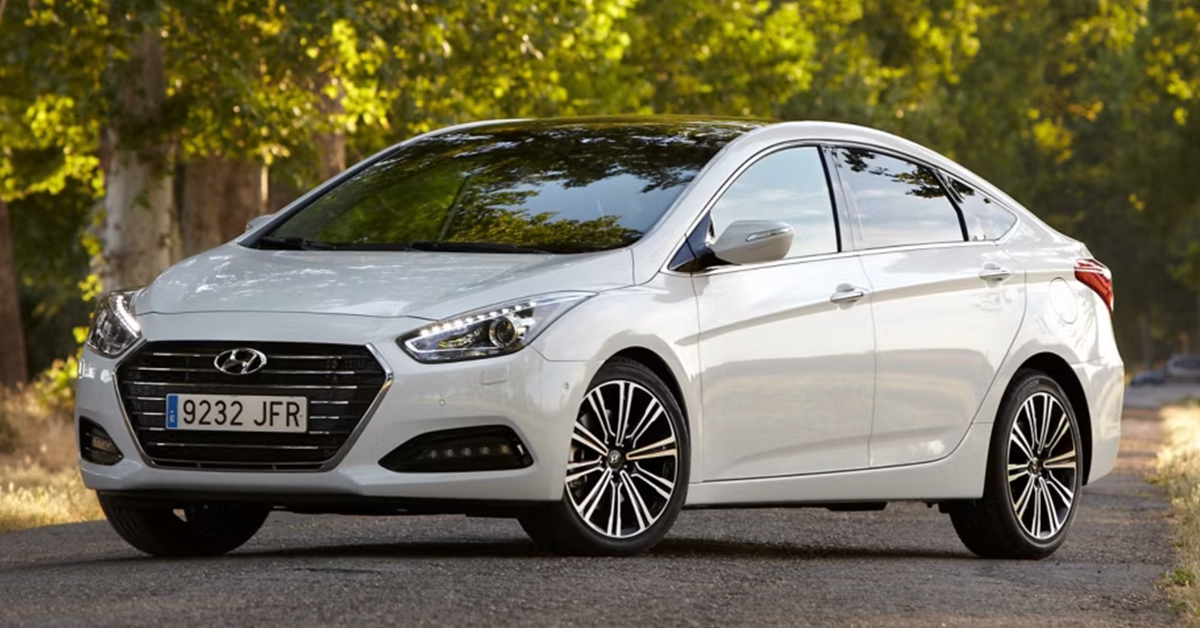
Official image of the Hyundai i40. | © Hyundai Motor Netherlands
Hyundai i40. The 2011 launch, 553 liter Wagon boot, 1.7 and 1.6 diesels, the 2015 and 2018 facelifts, European sales and why it ended in 2019.
The i40 was Hyundai’s mid-size car for Europe, sold as a Wagon and a Sedan from 2011 to 2019. Hyundai’s Dutch page says it was introduced in Europe in 2011 as the successor to the Sonata, developed at the Rüsselsheim center in Germany, and that production ended in 2019 (Hyundai). Hyundai Slovakia also says it was discontinued in 2019 (Hyundai). From 2011 to 2019 is 8 years (our calculation). The Wagon’s 553 liter boot is 28 liters larger than the 525 liter Sedan boot, since 553 minus 525 is 28 (Hyundai, our calculation).
| Years on sale | 2011 to 2019 (Hyundai) |
| Body styles | Wagon and Sedan (Hyundai) |
| Developed at | Russelsheim, Germany (Hyundai) |
| Wagon boot | 553 liters seats up (Hyundai) |
| Wheelbase | 2,770 mm (Hyundai) |
| Sold by July 2015 | Nearly 100,000 (Hyundai) |
| Company buyers | Six in ten (Hyundai) |
| 2015 diesel power | 115 PS and 141 PS (Hyundai) |
| 2018 diesel power | 115 PS and 136 PS (Hyundai) |
| Euro NCAP, 2011 | 5 stars (reported) |
We read Hyundai’s own pages first. They were the Hyundai Netherlands and Hyundai Slovakia model pages, the Hyundai Motor Deutschland release of March 20, 2015, the Hyundai Motor Europe press kit of July 2015, the Hyundai Spain release of October 11, 2018 and a Hyundai Switzerland media sheet of December 11, 2018. The 2011 launch figures come from a press release reprinted on a third-party site, so we tag them reported. Sales, crash-rating and Australian facts are also reported, and we do not name the outlets.
The i40 was a D-segment car. Hyundai’s 2015 press kit says nearly 100,000 had been sold since the July 2011 launch, a segment share of just over 5 percent, and that six in ten buyers were companies (Hyundai). The Wagon is 4.7 m long, has a 2,770 mm wheelbase and holds 553 liters of luggage with the rear seats up (Hyundai). Prices and availability may have changed since publication, and exchange rates are not applied.
Engines were mostly diesel. The 2015 press kit lists a 1.7 CRDi of 115 PS, a 1.7 CRDi High Power of 141 PS, a 1.6 GDi of 135 PS and a 2.0 GDi of 166 PS (Hyundai). The 2018 Hyundai Spain release lists a new 1.6 Smartstream diesel of 115 PS and 136 PS and a 1.6 GDI petrol of 135 PS (Hyundai). The 141 PS diesel was 5 PS above the 136 PS diesel it replaced, since 141 minus 136 is 5 (Hyundai, our calculation). The 2015 range of 115 to 166 PS spans 51 PS, since 166 minus 115 is 51 (Hyundai, our calculation).
The i40 had a long shadow in Hyundai’s range. Hyundai’s Dutch page says no direct successor was launched, and presents the Tucson and Santa Fe as alternatives (Hyundai). Hyundai Slovakia instead calls the i30 Kombi the perfect replacement (Hyundai). Our Hyundai Models article lists the current range, and our Hyundai history article covers the company.
This guide covers the 2011 launch, size and boot space, engines across three model years, the 2015 and 2018 facelifts, European and Australian sales, crash ratings and the conflicts between sources. We mark every figure Hyundai, reported or our calculation, and we show both values where sources disagree. We found no Hyundai page that names the plant, so the build location is reported only. Check a Hyundai dealer for used stock, because the car has been out of production since 2019. We could not find a Hyundai page that gives a final production count, so the sales figures come from reports.
The i40 launched in two steps. A press release reprinted on a third-party site says the Sedan was unveiled on May 12, 2011 at the Barcelona Motor Show, following the Wagon’s reveal at Geneva in March 2011 (reported). It says sales of the Sedan would start in the fourth quarter of 2011 and that it was designed and engineered at the Rüsselsheim headquarters (reported). Hyundai’s 2015 press kit dates the launch to July 2011 (Hyundai).
| Wagon reveal | Geneva, March 2011 (reported) |
| Sedan unveil | Barcelona, May 12, 2011 (reported) |
| Launch, per Hyundai | July 2011 (Hyundai) |
| Sedan sales start, per release | Fourth quarter 2011 (reported) |
| Sales target, full year | 60,000 units (reported) |
| Market share target | 3 percent by end of 2011 (reported) |
| Diesel and petrol split | 65 and 35 percent (reported) |
| Chief designer | Thomas Burkle (Hyundai) |
| Sedan drag coefficient | 0.28 (Hyundai) |
| Warranty | 5 years, unlimited mileage (Hyundai) |
Hyundai set targets. The reprinted release says Hyundai expected 60,000 units in a full year, a 3 percent market share by the end of 2011, and a diesel and petrol split of roughly 65 and 35 percent (reported). It says diesel cars were over 75 percent of D-segment sales in Europe and that the 136 ps diesel would be the most popular engine (reported). A 60,000 unit target with a 65 percent diesel share implies about 39,000 diesels, since 60,000 times 0.65 is 39,000 (reported, our calculation).
The design was led from Germany. Thomas Bürkle, Chief Designer at the Hyundai Motor Europe Technical Centre, said the team wanted to move away from the typical three-box sedan (reported). Hyundai’s 2015 press kit also names Bürkle as chief designer and says the car was designed and developed at the European Technical Centre in Rüsselsheim (Hyundai). The Sedan has a drag coefficient of 0.28 according to that kit (Hyundai).
The warranty was a selling point. The reprinted release describes a Five Year Triple Care package with a five-year unlimited warranty, five years of roadside assistance and five years of vehicle health checks (reported). Hyundai’s 2015 press kit still lists a 5-year warranty with no mileage limit (Hyundai). A five-year warranty on a July 2011 launch car would have run to July 2016, since 2011 plus 5 is 2016 (Hyundai, our calculation). Allan Rushforth, then Senior Vice President and COO of Hyundai Motor Europe, said the Sedan was the next step of the i40’s introduction (reported).
The timeline of availability varies by source. Hyundai says the launch was in July 2011 (Hyundai). A report says the Wagon went on sale in the UK in July 2011 with the Sedan planned for October (reported). Another report says the Wagon was released in Europe and South Korea in September 2011 and the Sedan in January 2012, which is 4 months apart, while the UK plan of July and October is 3 months apart (reported, our calculation). We show the dates side by side because we found no Hyundai page that settles them. The Barcelona unveil came 2 months after Geneva, since May minus March is 2 (reported, our calculation).
The name and the idea came first. A report says Hyundai announced the car would be called i40 and described it as a new D-segment flagship for Europe, and another says it filled the Sonata-shaped gap in Hyundai’s European range (reported). The Hyundai Dutch page says the i40 was the Sonata’s successor in Europe and used the Sonata chassis of the time (Hyundai). Our Hyundai Sonata article covers the car that shared that platform.
Hyundai’s 2015 press kit gives the Wagon a length of 4.7 m, a wheelbase of 2,770 mm and a width of 1,815 mm (Hyundai). The reprinted 2011 release gives the Sedan a length of 4,740 mm, a width of 1,815 mm without mirrors, a height of 1,470 mm and a wheelbase of 2,770 mm (reported). A fuel tank of 70 liters is listed for the Sedan in that release (reported). The two sources agree on width and wheelbase. The Wagon is 4.7 m, or 4,700 mm, so the Sedan at 4,740 mm is about 40 mm longer, though Hyundai rounds the Wagon figure (Hyundai, reported, our calculation).
| Wagon length | 4.7 m (Hyundai) |
| Sedan length | 4,740 mm (reported) |
| Width, no mirrors | 1,815 mm (Hyundai) |
| Height, Sedan | 1,470 mm (reported) |
| Wheelbase | 2,770 mm (Hyundai) |
| Wagon boot, seats up and folded | 553 and 1,719 liters (Hyundai) |
| Sedan boot, 2015 kit | 525 liters (Hyundai) |
| Sedan boot, 2011 release | 503 liters (reported) |
| Turning circle | 10.94 m (Hyundai) |
| Front and rear discs, 17 or 18 inch | 320 and 300 mm (Hyundai) |
Boot space is the Wagon’s strength. Hyundai lists 553 liters with the rear seats up and up to 1,719 liters with them folded and luggage loaded to the roof (Hyundai). Folding the seats adds 1,166 liters, since 1,719 minus 553 is 1,166 (Hyundai, our calculation). The Wagon’s load floor is 592 mm high, which Hyundai calls the lowest in the D-segment, and the rear seat splits 60 to 40 (Hyundai).
The Sedan has less luggage space, and the sources disagree on how much. Hyundai’s 2015 press kit gives 525 liters (Hyundai). The reprinted 2011 release gives 503 liters, and a motoring club report gives 530 liters against 553 for the Wagon (reported). The 2015 figure is 22 liters above the 2011 figure, since 525 minus 503 is 22, and 28 liters below the Wagon, since 553 minus 525 is 28 (Hyundai, reported, our calculation).
Passenger room is listed in the 2015 kit. Front headroom is 1,025 mm, front legroom 1,170 mm, front shoulder room 1,455 mm and rear headroom 990 mm (Hyundai). The 2011 release gives rear headroom of 965 mm for the Sedan, which is 25 mm less than the Wagon’s 990, since 990 minus 965 is 25 (Hyundai, reported, our calculation). It also gives rear legroom of 850 mm and rear shoulder room of 1,420 mm for the Sedan (reported).
The chassis is conventional. The kit lists MacPherson struts at the front and a multi-link independent rear suspension, discs all round and a Flex Steer system with Comfort, Normal and Sport modes (Hyundai). Steering takes 2.88 turns lock to lock and the turning circle is 10.94 m (Hyundai). With 17-inch or 18-inch wheels the front discs are 320 mm and the rear discs 300 mm (Hyundai). The kit claims a 20 percent reduction in interior and exterior noise at idle (Hyundai).
The platform came from the Sonata. Hyundai’s Dutch page says the i40 was based on the chassis of the Sonata of that time, tuned for comfort and long-distance driving (Hyundai). Reports say the car was built in Ulsan, South Korea, though Hyundai’s pages we read do not name a plant (reported). Another report lists Kaliningrad in Russia as a second assembly site (reported). We could not confirm either site from Hyundai. The wheelbase is about 58 percent of the Sedan length, since 2,770 divided by 4,740 is 0.584 (Hyundai, reported, our calculation).
The 2011 line-up had four engines. The reprinted release lists a 1.7 diesel of 1,685 cc with 115 ps and 260 Nm, another with 136 ps and 325 Nm, a 1.6 Gamma GDI petrol of 1,591 cc with 135 ps and 164 Nm, and a 2.0 Nu GDI of 1,999 cc with 177 ps and 208 Nm (reported). All came with a 6-speed manual, and a 6-speed automatic was listed for the 136 ps diesel and the 2.0 petrol (reported). Those figures were tentative and to be confirmed at launch (reported).
| 2011 diesel | 115 ps 260 Nm and 136 ps 325 Nm (reported) |
| 2011 petrol | 135 ps and 177 ps (reported) |
| 2015 diesel | 115 PS 280 Nm, 141 PS 340 Nm (Hyundai) |
| 2015 petrol, press kit | 135 PS and 166 PS (Hyundai) |
| 2015 petrol, German release | 135 PS and 164 PS (Hyundai) |
| 2015 new gearbox | 7-speed dual-clutch (Hyundai) |
| 2015 base diesel CO2 | 110 g/km (Hyundai) |
| 2018 diesel | 115 PS 280 Nm, 136 PS 320 Nm (Hyundai) |
| 2018 petrol | 1.6 GDI 135 PS (Hyundai) |
| 2018 emissions standard | Euro 6d-Temp (Hyundai) |
The 2015 update raised power and torque. Hyundai’s press kit gives the 1.7 CRDi at 115 PS and 280 Nm, up from 260 Nm, and the High Power version at 141 PS and 340 Nm, up from 136 PS and 325 Nm (Hyundai). That is 20 Nm more on the base diesel and 15 Nm more on the High Power, since 280 minus 260 is 20 and 340 minus 325 is 15 (Hyundai, our calculation). A report gives the old High Power torque as 323 Nm, which is 2 Nm below Hyundai’s 325 (reported, our calculation).
The kit gives the petrols as a 1.6 GDi of 135 PS and 164 Nm and a 2.0 GDi of 166 PS and 204 Nm at 4,700 rpm (Hyundai). The Hyundai Germany release of March 20, 2015 lists the 1.6 GDI at 99 kW (135 PS) and the 2.0 GDI at 121 kW (164 PS), so the 2.0 is 164 PS in one Hyundai document and 166 PS in another (Hyundai). The 2011 figure of 177 ps was 13 PS higher than the German figure, since 177 minus 164 is 13 (Hyundai, reported, our calculation).
The big gearbox news was the 7-speed dual-clutch. Hyundai says it replaced the 6-speed torque-converter automatic on the 141 PS diesel and claims it uses about 30 percent less fuel (Hyundai). The kit gives the High Power Sedan 0 to 100 km/h in 10.31 seconds with the manual and the Wagon 10.5 seconds (Hyundai). The 2011 figure for the 136 ps Sedan was 10.6 seconds, so the 2015 car is 0.29 seconds quicker, since 10.6 minus 10.31 is 0.29 (Hyundai, reported, our calculation).
Emissions fell. Hyundai lists 110 g/km and 4.2 l/100 km for the 115 PS diesel and 114 g/km for the 141 PS Wagon with the manual (Hyundai). The 2011 release gave the 115 ps diesel 122 g/km, so the 2015 car is 12 g/km lower, since 122 minus 110 is 12 (Hyundai, reported, our calculation). Hyundai says cars below 115 g/km qualify for 80 percent tax deductibility and several variants now fall below that threshold (Hyundai). The Blue Drive package covers start-stop, intelligent alternator control and an active grille shutter (Hyundai).
The 2018 engines were new again. Hyundai Spain’s release lists a 1.6 Smartstream diesel with 85 kW (115 PS) and 280 Nm with a 6-speed manual, and 100 kW (136 PS) and 320 Nm with the 7-speed dual-clutch (Hyundai). The 1.6 GDI petrol is listed at 97 kW (135 PS) with a 6-speed manual, against 99 kW for the same 135 PS in the German release of 2015, so Hyundai gives two kW figures (Hyundai). The whole line met Euro 6d-Temp (Hyundai).
Hyundai Motor Deutschland issued the facelift release on March 20, 2015 with the headline that the i40 Kombi was safer, more powerful and more refined (Hyundai). It describes a new hexagonal grille with horizontal lines, a modified front bumper, revised headlights with LED daytime running lights and modified LED rear lights (Hyundai). A report dates the first reveal to December 2014 and says the car showed at Geneva in March 2015 (reported). From December 2014 to March 2015 is 3 months (reported, our calculation).
| German release date | March 20, 2015 (Hyundai) |
| German trims | Classic, Trend, Style, Premium (Hyundai) |
| Kombi from | 24,790 euros (Hyundai) |
| Classic airbags | Seven (Hyundai) |
| Style adds | Rear camera, navigation, lane-keeping (Hyundai) |
| Premium adds | Leather, parking assistant, bi-xenon (Hyundai) |
| Consumption range | 7.5 to 4.6 l/100 km (Hyundai) |
| CO2 range | 176 to 119 g/km (Hyundai) |
| Press kit trims | Executive and Business Edition (Hyundai) |
| Front grille | Hexagonal, horizontal lines (Hyundai) |
The release lists four trims for the Kombi. Classic is the entry trim with seven airbags, remote central locking, an alarm, a CD radio with USB and AUX, Bluetooth, air conditioning and electric windows (Hyundai). Trend adds 16-inch alloys, two-zone climate control, cruise control, front seat heating, front and rear parking sensors, a heated steering wheel, a rain sensor and an electric driver’s seat (Hyundai). Style adds 17-inch alloys, a rear camera, navigation, a smart key, lane-keeping assist and rear side airbags, and Premium adds 18-inch alloys, leather and ventilated front seats (Hyundai).
Premium also gains safety and light equipment. It has an automatic parking assistant, traffic sign recognition, adaptive bi-xenon headlights with high-beam assist and cooled front seats (Hyundai). Hyundai says the adaptive bi-xenon lights were available on the i40 estate for the first time and that traction control was extended with torque vectoring (Hyundai). The traffic sign system reads speed limits and overtaking bans and shows them on the display (Hyundai).
The release gives the price. The i40 Kombi started from 24,790 euros and could be ordered immediately (Hyundai). It gives the combined fuel consumption as 7.5 to 4.6 l/100 km and the CO2 as 176 to 119 g/km, in classes D to A (Hyundai). The range of consumption spans 2.9 l/100 km, since 7.5 minus 4.6 is 2.9, and the CO2 spans 57 g/km, since 176 minus 119 is 57 (Hyundai, our calculation). Prices and availability may have changed since publication, and exchange rates are not applied.
The July 2015 press kit adds trims and comfort items. It names Executive as the top trim, with heated seats, a heated steering wheel, a Smart Power tailgate on the Wagon and two extra rear side airbags (Hyundai). It also names a Business Edition, a fleet Wagon with the 1.7 CRDi of 115 PS and 110 g/km (Hyundai). The Executive and Business Edition names differ from the German names Classic to Premium, so the trims depend on the market (Hyundai). The kit lists a 7-inch navigation touchscreen and ventilated front seats, a first in the segment (Hyundai).
Safety equipment was long. The kit says ESP, ABS, Hill Start Assist, VSM, Brake Assist and an Emergency Stop Signal were standard from launch, with seven airbags including a driver’s knee airbag (Hyundai). It adds bi-xenon lights with auto-levelling, Smart High Beam and a Speed Limit Identification Function (Hyundai). The 2011 release said up to nine airbags were available, so the airbag count depended on the version (reported). The kit does not state a Euro NCAP rating for the updated car (Hyundai).
Hyundai Spain announced the second update on October 11, 2018. It says the front was refreshed with Hyundai’s cascading grille and that new 18-inch alloys joined the 16-inch wheels (Hyundai). It lists the new 1.6 Smartstream diesel in two outputs and the 1.6 GDI petrol, all meeting Euro 6d-Temp (Hyundai). The gap from the German release of March 20, 2015 is about 3.5 years (Hyundai, our calculation).
| Second update announced | October 11, 2018 (Hyundai) |
| New diesel | 1.6 Smartstream, 115 and 136 PS (Hyundai) |
| Petrol | 1.6 GDI 135 PS (Hyundai) |
| 115 PS diesel torque | 280 Nm (Hyundai) |
| 136 PS diesel torque | 320 Nm (Hyundai) |
| New wheels | 18 inch alloys (Hyundai) |
| German Space Plus 136 PS | From 39,600 euros (Hyundai) |
| Swiss Amplia Wagon 136 PS | From 34,900 Swiss francs (Hyundai) |
| Emergency braking | 10 to 75 km/h (Hyundai) |
| Production ended | 2019 (Hyundai) |
The release gives consumption on the NEDC conversion. The 115 PS diesel uses 4.6 to 4.3 l/100 km and emits 120 to 113 g/km, and the 136 PS diesel with the dual-clutch uses 4.7 to 4.3 l/100 km (Hyundai). The petrol 1.6 GDI uses 6.7 to 6.2 l/100 km and emits 153 to 142 g/km (Hyundai). The petrol uses 2.1 l/100 km more than the 115 PS diesel at the top of the range, since 6.7 minus 4.6 is 2.1 (Hyundai, our calculation).
The release gives two CO2 ranges for the 136 PS diesel, 115 to 105 g/km in the table and 123 to 112 g/km in the text (Hyundai). The two ranges differ by 8 g/km at the top and 7 g/km at the bottom, since 123 minus 115 is 8 and 112 minus 105 is 7 (Hyundai, our calculation). Hyundai Germany lists the 85 kW diesel at 4.6 l/100 km and 120 g/km, and the 100 kW diesel at 4.6 l/100 km and 122 g/km, both in class A (Hyundai).
Hyundai Germany’s November 1, 2018 press information says the new front design gives a stylish appearance and that SmartSense assistance systems raise active safety (Hyundai). The German release lists the Space Plus trim with the 136 PS diesel from 39,600 euros, with 18-inch wheels and bi-xenon headlights (Hyundai). Hyundai Switzerland lists the 136 PS diesel from 34,900 Swiss francs in the Amplia Wagon (Hyundai). It says the automatic emergency braking was new, with the Vertex trim, and worked from 10 to 75 km/h (Hyundai).
The end came in 2019. Hyundai Netherlands says production ended that year and gives no reason, saying only that Hyundai shifted its focus to SUVs and electrified models (Hyundai). A report says slowing mid-size sales led Hyundai to drop the car in Australia in early 2019 and in Europe the same year (reported). The i40 therefore ran for 8 years, since 2019 minus 2011 is 8 (Hyundai, our calculation). Our Hyundai i30 article covers the hatchback and Tourer that Hyundai Slovakia calls the replacement.
Hyundai Slovakia says the i30 Kombi is the perfect replacement, with a sporty front and an elegant rear (Hyundai). Hyundai Netherlands says there was no direct successor and offers the Tucson and Santa Fe as alternatives (Hyundai). The two Hyundai pages therefore give different answers, and both can be true for different buyers. Hyundai Slovakia also says the i40 had a second facelift that gave it a hexagonal grille and LED fog lights (Hyundai). It gives no date for that facelift, so the 2015 and 2018 dates are from the releases above. Hyundai Netherlands also lists a 2015 facelift with an updated grille, lighting, infotainment and driver assistance (Hyundai).
A catalog of registrations lists the i40’s European sales by year. The totals are 9,154 in 2011, 35,265 in 2012, 29,984 in 2013, 25,016 in 2014 and 25,045 in 2015 (reported). They continue with 20,253 in 2016, 15,251 in 2017, 9,144 in 2018, 3,445 in 2019 and 305 in 2020 (reported). The peak was 2012, the first full year (reported). Sales fell 5,281 in 2013, since 35,265 minus 29,984 is 5,281, and were almost flat from 2014 to 2015, since 25,045 minus 25,016 is 29 (reported, our calculation).
| Europe 2011 | 9,154 (reported) |
| Europe 2012 | 35,265 (reported) |
| Europe 2013 | 29,984 (reported) |
| Europe 2015 | 25,045 (reported) |
| Europe 2018 | 9,144 (reported) |
| Europe 2019 | 3,445 (reported) |
| Europe, ten years | 172,862 (reported, our calculation) |
| Netherlands 2012 | 2,400 (Hyundai) |
| Australia 2012 and 2018 | 2,392 and 633 (reported) |
| Australia dropped | Early May 2019 (reported) |
The ten years add up to 172,862 cars, since the figures sum to that total (reported, our calculation). The first four years add up to 99,419, which is close to Hyundai’s own claim of nearly 100,000 by July 2015 (Hyundai, reported, our calculation). The 2012 total was about 59 percent of Hyundai’s 60,000 target, since 35,265 divided by 60,000 is 0.588 (reported, our calculation). The target was a full year’s goal in the 2011 release (reported).
The decline was steep. Sales in 2019 were about 10 percent of the 2012 peak, since 3,445 divided by 35,265 is 0.098 (reported, our calculation). That is a fall of about 90 percent (reported, our calculation). From 2012 to 2018 the figure fell from 35,265 to 9,144, a drop of 26,121 cars, since 35,265 minus 9,144 is 26,121 (reported, our calculation). Hyundai’s 2015 kit said six in ten buyers were companies, so fleet demand was central (Hyundai). The fall from 2016 to 2017 was 5,002 cars, since 20,253 minus 15,251 is 5,002 (reported, our calculation).
The Netherlands was an early stronghold. Hyundai’s Dutch page says the Wagon and diesel versions were popular with business buyers and that 2,400 units were sold there in 2012, the best year (Hyundai). That is about 6.8 percent of the 35,265 European sales that year, since 2,400 divided by 35,265 is 0.068 (Hyundai, reported, our calculation). Hyundai Slovakia says the car held a steady position in both body styles (Hyundai). The Dutch figure is 8 cars above Australia’s 2,392 for the same year, since 2,400 minus 2,392 is 8 (Hyundai, reported, our calculation).
Australia sold the car from October 2011 to 2019. A report says Hyundai Australia sold 2,392 in 2012 and 633 in 2018, and that the i40 Wagon sold better than the Sedan (reported). The 2018 figure is about 26 percent of the 2012 figure, since 633 divided by 2,392 is 0.265 (reported, our calculation). The same report says mid-size car sales there fell from 87,674 in 2012 to 46,231 in 2018, a fall of 41,443, or about 47 percent (reported, our calculation).
Australian imports ended before the announcement. One report says only five i40s were sold in the first three months of 2019, and another says five by the end of February, so the two reports conflict on timing (reported). The Australian car had a 2.0-liter petrol of 121 kW and 203 Nm and a diesel, according to a report (reported). Hyundai Australia dropped the i40 in early May 2019 and left the Sonata as its mid-size car (reported). A report says Malaysia launched the i40 at its 2013 show (reported). Prices and availability may have changed since publication, and exchange rates are not applied.
Euro NCAP gave the i40 five stars in August 2011 (reported). A report says the tested car was a five-door with the 1.7 diesel and scored 92 percent for adult occupants and 86 percent for children (reported). Euro NCAP’s page says a similar level of safety could be expected from the Sedan (reported). A report says the i40 was the fifth Hyundai in a row to get five stars after the i20, ix20, i30 and ix35 (reported). The adult score was 6 points above the child score, since 92 minus 86 is 6 (reported, our calculation).
| Euro NCAP, 2011 | 5 stars (reported) |
| Adult and child scores | 92 and 86 percent (reported) |
| Euro NCAP rating status | Expired per review (reported) |
| ANCAP, 2011 | 5 stars (reported) |
| 2.0 GDI power | 177 ps, 164 PS or 166 PS (Hyundai, reported) |
| 1.6 GDI kW | 99 kW or 97 kW (Hyundai) |
| Sedan boot | 503, 525 or 530 liters (Hyundai, reported) |
| Launch month | July or September 2011 (Hyundai, reported) |
| Plant | Ulsan, Korea per report (reported) |
| Successor | i30 Kombi or none (Hyundai) |
The rating has aged. A review says the full five stars dated from 2011 and cannot be compared with a modern five-star car, and that the safety body considers the rating expired (reported). ANCAP’s page also lists a 2011 rating that applies to all diesel and petrol variants sold in Australia (reported). Hyundai’s 2015 press kit says the original i40 earned five stars and states no rating for the updated car (Hyundai). We found no later rating for the 2018 car.
Engine figures conflict. The 2.0 GDI is 177 ps in the 2011 release, 164 PS in the German release of 2015 and 166 PS in the 2015 press kit (Hyundai, reported). The 1.6 GDI is 99 kW in the German release and 97 kW in the Spanish one for the same 135 PS (Hyundai). The 2011 release gives the 2.0 petrol’s torque as 213 Nm in the text and 208 Nm in the table, and its CO2 as 159 g/km in the text and 156 g/km in the table (reported).
Other conflicts affect the story. The Sedan boot is 503, 525 or 530 liters (Hyundai, reported). The launch was July 2011 for Hyundai, while a report gives September 2011 for the Wagon (Hyundai, reported). The 2018 release gives 115 to 105 g/km and 123 to 112 g/km for one engine (Hyundai). Hyundai Slovakia names the i30 Kombi as the replacement, and Hyundai Netherlands names no direct successor (Hyundai). We show each value with its source.
Several items are not confirmed. No Hyundai page we read names the plant, and the Ulsan and Kaliningrad facts are reported only (Hyundai, reported). We found no Hyundai page for the UK, the Australian market, the Malaysian launch or the end-of-production decision. The European sales catalog is a third-party compilation, so its totals are reported and we cannot check them against Hyundai Motor Europe (reported). We found no Hyundai statement of the final i40 built.
To check this article, start with the Hyundai Motor Deutschland release of March 20, 2015, the Hyundai Motor Europe press kit of July 2015 and the Hyundai Spain release of October 11, 2018 (Hyundai). Compare the date of each document before you compare numbers, because Hyundai changed the engines in 2015 and 2018. The press kit is hosted on Hyundai Motor Europe’s press platform, and we tag it as Hyundai. The i40 is out of production, so look for used cars and a current dealer warranty. Prices and availability may have changed since publication, and exchange rates are not applied.