 Brands
Hyundai IONIQ 6 N — Specs, Prices, Range and Awards
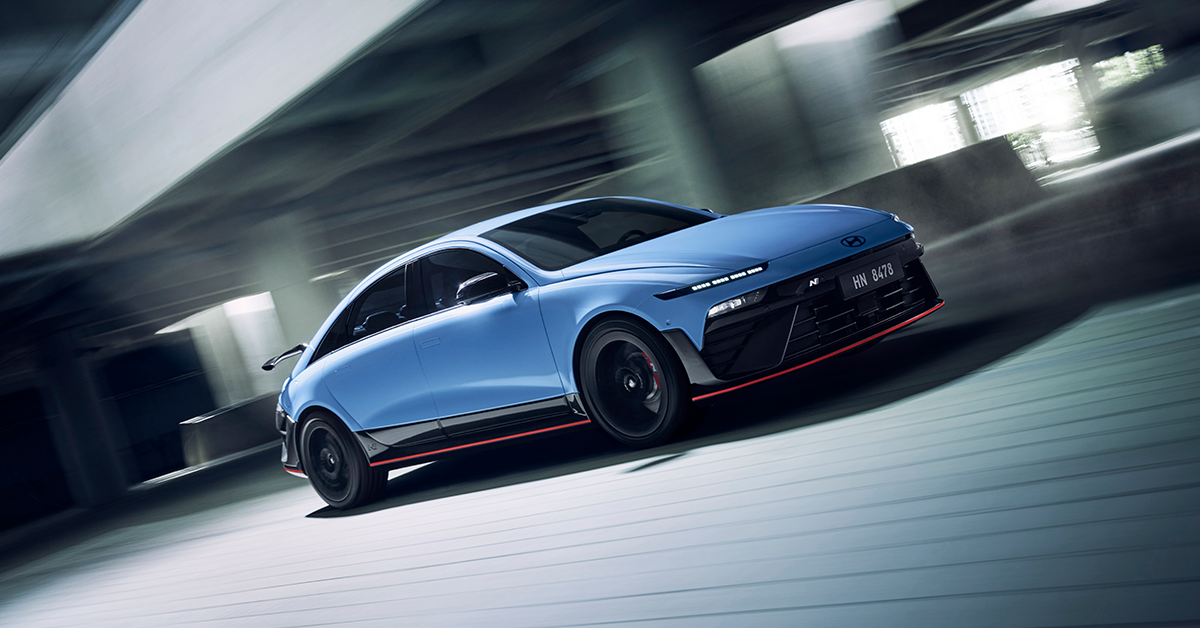
Official image of the Hyundai IONIQ 6 N. | © Hyundai Motor Company
The Hyundai IONIQ 6 N is the high-performance version of the IONIQ 6 electric sedan and Hyundai’s second all-electric N model, unveiled at the Goodwood Festival of Speed on July 10, 2025. Hyundai’s own pages give its power, N features, battery, range and charging, plus the U.K. and Korean prices. This guide reads those pages first and shows where they differ.
The Hyundai IONIQ 6 N is the high-performance version of the IONIQ 6 electric sedan and the second all-electric model from Hyundai’s N performance brand. Hyundai’s U.S. media center says Hyundai Motor Company unveiled it to the world on July 10, 2025 at the Goodwood Festival of Speed, in a release datelined Seoul and West Sussex (Hyundai). Hyundai describes it as its second high-performance EV, after the IONIQ 5 N (Hyundai).
| Body | High-performance electric sedan (Hyundai) |
| World premiere | July 10, 2025 (Hyundai) |
| Battery | 84.0 kWh (Hyundai) |
| Total power, Europe | 609 PS, 650 PS with NGB (Hyundai) |
| Torque with NGB | 770 Nm (Hyundai) |
| 0 to 100, Europe | 3.2 seconds with launch control (Hyundai) |
| Top speed, Europe | 257 km/h (Hyundai) |
| Range, Europe | 487 km WLTP, provisional (Hyundai) |
| U.K. price | 65,800 pounds (Hyundai) |
| Korea price | 84,060,000 won before tax benefits (Hyundai) |
We used Hyundai’s own pages for the figures in this guide: the worldwide newsroom, the European, U.K., Australian, Korean and U.S. sites, the press sites on hyundai.news and hyundainews.com and Hyundai’s technical data documents. Where two Hyundai pages differ we show both values. Prices and availability may have changed since publication, and exchange rates are not applied. U.S. prices are in dollars, U.K. prices in pounds and Korean prices in won.
Hyundai’s European press kit of March 2026 gives a total output of 448 kW (609 PS), rising to 478 kW (650 PS) with N Grin Boost, and 770 Nm of torque with the boost (Hyundai). It gives 0 to 100 km/h in 3.2 seconds with N Launch Control, a top speed of 257 km/h and a drag coefficient of 0.27 (Hyundai). The battery is 84.0 kWh and the provisional WLTP range is 487 km (Hyundai).
Charging uses a 400 V to 800 V multi-charging architecture, and Hyundai says 10 to 80 percent takes about 18 minutes on a 350 kW charger under optimal conditions (Hyundai). The U.K. price is from 65,800 pounds for a single specification (Hyundai). Hyundai Korea lists the car at 84,060,000 won before tax benefits and 79,900,000 won after them, as of September 1, 2026 (Hyundai). The U.K. price is a final on-the-road figure and the Korean price is shown before and after tax benefits, so the three markets are not directly comparable and we do not convert them.
For the U.S., Hyundai says the car makes up to 641 hp and is coming in spring 2027 with extremely limited availability at select dealers (Hyundai). Hyundai’s November 2025 release had said it would be available in limited quantities in the U.S. in 2026, so the timing differs by page (Hyundai). Hyundai says the IONIQ 6 N won 2026 World Performance Car (Hyundai).
Later sections cover the 2025 debut and design, the powertrain and charging, the N performance features, the chassis and interior, U.S. and Korean figures, European and U.K. figures, and awards with the points where Hyundai’s pages conflict. Our Hyundai Models article lists the range, our Hyundai history article covers the company, and our Hyundai Elantra and Veloster articles cover the earlier N models. The standard IONIQ 6 and the IONIQ 5 N have their own guides. In short, the IONIQ 6 N pairs a 609 to 650 PS dual-motor system with an 84 kWh battery, and Hyundai’s pages agree on most figures. The open points are the U.S. price, the exact U.S. on-sale date and the provisional WLTP range, which we flag where they appear.
Hyundai released the first teaser images of the IONIQ 6 N on June 11, 2025 in Seoul, and said they highlighted a streamliner silhouette with advanced aerodynamics and a wide stance (Hyundai). The U.S. page for the car also calls it a car with zero tailpipe emissions and up to 641 hp (Hyundai). The teaser said the sedan was poised to embody N’s three performance pillars, Corner Rascal, Racetrack Capability and Everyday Sportscar (Hyundai). Hyundai had also teased the car during its Seoul Mobility Show presentation in April 2025 (Hyundai).
| Teaser images | June 11, 2025 (Hyundai) |
| World premiere | Goodwood, July 10, 2025 (Hyundai) |
| Hyundai N pillars | Corner Rascal, Racetrack, Everyday (Hyundai) |
| Length | 4,935 mm (Hyundai) |
| Width | 1,940 mm (Hyundai) |
| Height | 1,495 mm (Hyundai) |
| Wheelbase | 2,965 mm (Hyundai) |
| Drag coefficient | 0.27 (Hyundai) |
| Launch color | Performance Blue Pearl (Hyundai) |
| Exterior colors | Six (Hyundai) |
Hyundai’s preview release set the Goodwood premiere for July 10, 2025 at 12:30 BST, or 20:30 KST (Hyundai). Hyundai’s Australian copy gives the debut time as 21:30 KST, which differs by an hour (Hyundai). Hyundai’s U.S. release dated July 10, 2025 says the car was unveiled that day. Hyundai’s release datelined Seoul and West Sussex gave the premiere time in both British and Korean time (Hyundai). We use July 10, 2025 as the premiere date because every Hyundai page we read agrees on the date (Hyundai). Hyundai’s North American debut followed at AutoMobility LA on November 20, 2025, which our U.S. section covers (Hyundai).
Hyundai’s release says the car builds on the award-winning IONIQ 5 N and integrates technologies and capabilities derived from Hyundai N’s motorsport programs and rolling lab initiatives (Hyundai). Hyundai’s U.K. release says the exterior takes its styling from the newly designed IONIQ 6 and IONIQ 6 N Line, adding 5-spoke 20-inch alloy wheels, a high-performance rear wing and widened front and rear fenders (Hyundai).
Hyundai’s European press kit lists the exterior as Performance Blue Pearl with widened fenders, a motorsport-inspired swan-neck rear wing and aero wheels, and a drag coefficient of 0.27 (Hyundai). The other colors are Abyss Black Pearl, Serenity White Pearl, Nocturne Gray Metallic, Nocturne Gray Matte and Gravity Gold Matte (Hyundai). Hyundai’s U.K. page lists the same six colors (Hyundai). Two of the six colors are matte, Nocturne Gray Matte and Gravity Gold Matte, and the other four are pearl or metallic (Hyundai, our count). Hyundai’s U.K. page lists the same six colors (Hyundai). Hyundai’s preview release says the widened fenders and the swan-neck wing are part of the exterior changes, and the car is shown in Performance Blue Pearl in its launch images (Hyundai).
Hyundai gives the dimensions as a length of 4,935 mm, a width of 1,940 mm, a height of 1,495 mm and a wheelbase of 2,965 mm (Hyundai). The wheelbase is about 60 percent of the overall length, by our division, and the width is about 1.3 times the height (Hyundai, our calculation). Those proportions are our reading of Hyundai’s numbers, and Hyundai does not describe them that way.
Hyundai’s release says the IONIQ 6 N’s official 0 to 100 km/h time of 3.2 seconds uses N Launch Control (Hyundai). That works out to an average acceleration of about 8.7 meters per second squared, or roughly 0.89 g, over the 100 km/h run, by our calculation (Hyundai, our calculation). Hyundai’s own pages do not give an intermediate time such as 0 to 60 mph for Europe, and the U.S. text is an estimate. The 257 km/h top speed converts to about 160 mph, which matches the U.S. figure (Hyundai, our calculation). The length of 4,935 mm is about 3.3 times the height of 1,495 mm, by our division (Hyundai, our calculation).
Hyundai’s European press kit gives the front motor 166 kW (226 PS), or 175 kW (238 PS) with the boost, and the rear motor 282 kW (383 PS), or 303 kW (412 PS) with the boost (Hyundai). The system total is 448 kW (609 PS), rising to 478 kW (650 PS) (Hyundai). N Grin Boost therefore adds 30 kW and 41 PS, by our subtraction of the totals (Hyundai, our calculation). That is a gain of about 6.7 percent in kilowatts, by our division (Hyundai, our calculation). The rear motor supplies about 63 percent of the 609 PS base total and about 63 percent of the 650 PS boosted total, by our division (Hyundai, our calculation).
| Front motor | 166 kW, 175 kW with NGB (Hyundai) |
| Rear motor | 282 kW, 303 kW with NGB (Hyundai) |
| System power | 448 kW, 478 kW with NGB (Hyundai) |
| Torque with NGB | 770 Nm (Hyundai) |
| Power, Australian page | 448 kW with NGB (Hyundai) |
| 0 to 100 km/h | 3.2 seconds (Hyundai) |
| Top speed | 257 km/h (Hyundai) |
| WLTP range, provisional | 487 km (Hyundai) |
| WLTP consumption | 18.7 kWh per 100 km (Hyundai) |
| Charging, 350 kW | 10 to 80 percent in 18 min (Hyundai) |
Torque is 770 Nm in the European press kit, which states it with N Grin Boost and gives no base figure (Hyundai). Hyundai’s U.S. release gives 568 lb-ft, which is about 770 Nm by our conversion (Hyundai, our calculation). Hyundai’s U.K. technical guide gives 770 Nm, or 567.9 lb-ft, a maximum power of 650 PS or 478 kW and separate front and rear outputs of 238 PS and 412 PS (Hyundai).
Hyundai’s Australian page says N Battery technology delivers 448 kW of power and 740 Nm of torque, and its headline figure reads 448 kW and 740 Nm with N Grin Boost activated (Hyundai). That conflicts with the European and U.K. pages, where 478 kW and 770 Nm are the boosted figures (Hyundai). We show both and treat the European and U.K. numbers as the Hyundai technical data (Hyundai).
Hyundai gives 0 to 100 km/h in 3.2 seconds with N Launch Control and a top speed of 257 km/h in Europe (Hyundai). Hyundai’s U.S. release estimates 0 to 60 mph in under 3.2 seconds with N Launch Control and a top speed of about 160 mph, and the U.K. guide gives 0 to 62 mph in 3.2 seconds and 160 mph (Hyundai). The U.S. release lists 641 hp as the text figure and 609 PS and 650 PS on the spec sheet, and 650 PS is about 641 hp by our conversion (Hyundai, our calculation). The U.S. text is an estimate, and Hyundai says the production model may vary (Hyundai).
The battery is 84.0 kWh. Hyundai’s European press kit gives a provisional WLTP combined range of 487 km and a provisional consumption of 18.7 kWh per 100 km (Hyundai). Hyundai’s European model page says the car can add 326 km of range in 15 minutes (Hyundai). The 487 km is 39 km, or about 8.7 percent, above the 448 km Hyundai gives for the IONIQ 5 N, by our calculation (Hyundai, our calculation). Hyundai’s 3.2 seconds is also 0.2 seconds quicker than the 3.4 seconds it gives for the IONIQ 5 N with N Grin Boost (Hyundai, our calculation).
Charging uses a 400 V to 800 V multi-charging architecture, with 10 to 80 percent in about 18 minutes on a 350 kW DC charger under optimal conditions (Hyundai). Hyundai’s U.S. release repeats the 18 minutes and the 400 V to 800 V architecture (Hyundai). Hyundai’s European press kit notes that figures may vary by market and homologation status (Hyundai).
Hyundai’s European press kit lists N e-Shift as simulating close, motorsport-style gear ratios and shift feel (Hyundai).
| N e-Shift | Simulated close gear ratios (Hyundai) |
| N Active Sound+ modes | Ignition, Evolution, Lightspeed (Hyundai) |
| N Grin Boost | 10 seconds, then 10 seconds recharge (Hyundai) |
| N Launch Control | Torque managed for wheel slip (Hyundai) |
| N Drift Optimizer | Adjusts drift angle and wheel spin (Hyundai) |
| N Battery modes | Drag, Sprint, Endurance (Hyundai) |
| N Torque Distribution | 11 levels (Hyundai) |
| N Pedal | 3 levels (Hyundai) |
| N Track Manager | Tracks, lap times, ghost car (Hyundai) |
| N Ambient Shift Light | Shift-point cue (Hyundai) |
N Active Sound+ is the sound system. Hyundai says it has selectable modes called Ignition, Evolution and Lightspeed (Hyundai). The three names are the only description Hyundai gives of the modes in the material we read (Hyundai). N Grin Boost delivers extra power for 10 seconds, followed by a recharge period of 10 seconds, according to the European press kit (Hyundai). That is a 50 percent duty cycle if the boost is used repeatedly, by our reading of the two 10-second periods (Hyundai, our calculation). N Launch Control manages motor torque for optimal wheel slip during standing starts, and N Drift Optimizer adjusts drift initiation, angle and wheel spin (Hyundai). Hyundai groups these functions under its N performance technologies, and we have not tested any of them (Hyundai). Hyundai’s preview release says the car integrates technologies derived from N motorsport programs, and the press kit lists the functions in this section as part of the car’s standard N feature set (Hyundai).
N Battery is a revamped battery management system. Hyundai says it preconditions the battery for Drag, Sprint or Endurance use and manages thermal conditions while driving (Hyundai). N Torque Distribution gives variable front-to-rear torque split across 11 levels, and N Pedal sharpens cornering turn-in with three selectable levels (Hyundai). In our count, the three Active Sound modes, three N Battery modes and three N Pedal levels sit alongside the 11 torque distribution levels, so the driver has several separate settings to combine (Hyundai, our count). The N1 and N2 buttons on the steering wheel give the driver quick access to some of them, according to the interior description in Hyundai’s press kit (Hyundai). N Brake Regen provides regenerative braking for improved brake endurance (Hyundai). The N Pedal and N Brake Regen settings work with the regenerative deceleration of up to 0.6 g that Hyundai lists, which our chassis section covers (Hyundai).
N Track Manager lets drivers design custom tracks, monitor lap times and compare against a ghost car, according to Hyundai (Hyundai). The press kit also lists a TPMS Custom Mode that lets the driver set target tyre pressures (Hyundai). Hyundai names no pressure values in the press kit (Hyundai). The feature is aimed at track use, where tyre pressures change with temperature, and that purpose is our reading rather than a Hyundai statement. The N Ambient Shift Light visually indicates the precise shift points for optimal performance (Hyundai). Hyundai lists the light with the interior features, and the car also has the N1 and N2 buttons on the steering wheel for quick mode access (Hyundai).
Hyundai’s U.K. release describes the car as re-defining the high-performance EV driving experience, with enhanced N e-Shift and N Active Sound+ (Hyundai).
We do not name features that Hyundai lists only for the IONIQ 5 N. We only list the features that Hyundai names for the IONIQ 6 N in its own press kit and releases, and we did not test any of them. Hyundai describes N Grin Boost, N Launch Control and N Battery as the functions behind the headline output and the 3.2 second time (Hyundai).
Hyundai’s preview release says the IONIQ 6 N uses bespoke suspension geometry, capitalizing on its low ride height as a sedan (Hyundai). The redesigned geometry has a lowered roll center and enlarged caster trail for improved on-center feel, steering feedback and self-centering behavior, according to Hyundai (Hyundai). The European press kit adds stroke-sensing Electronically Controlled Suspension and an electronic limited-slip differential (Hyundai). The kit lists the stroke-sensing suspension and the electronic limited-slip differential as separate items from the geometry changes (Hyundai).
| Front brakes | 400 mm, four-piston (Hyundai) |
| Rear brakes | 360 mm, single-piston (Hyundai) |
| Regen deceleration | Up to 0.6 g (Hyundai) |
| Wheels, Europe | 20-inch forged aero (Hyundai) |
| Wheels, U.K. | 20-inch 5-spoke alloy (Hyundai) |
| Tyre size | 275/35 R20 (Hyundai) |
| Differential | Electronic limited-slip (Hyundai) |
| Suspension | Stroke-sensing ECS (Hyundai) |
| Seats | Suede-style and leather buckets (Hyundai) |
| Curb weight | Not listed |
The press kit also lists a stiffer rear anti-roll bar, structural underbody reinforcement, new bushing applications and a widened stance (Hyundai). Hyundai’s European page says the front brakes are 400 mm four-piston units and the rear brakes are 360 mm single-piston units, with regenerative deceleration of up to 0.6 g, or 0.35 g during ABS activation (Hyundai). The regenerative figure is 0.25 g higher than the 0.35 g Hyundai gives for ABS activation, by our subtraction (Hyundai, our calculation). The front rotor is 40 mm larger than the rear rotor, by our subtraction (Hyundai, our calculation). A 275/35 R20 tyre has a sidewall of about 96 mm, which gives an overall diameter of about 700 mm, by our calculation from the tyre size (Hyundai, our calculation).
Standard wheels are 20-inch forged aero wheels in Hyundai’s European press kit, wearing 275/35 R20 tyres (Hyundai). Hyundai U.K.’s release lists 5-spoke 20-inch alloy wheels, and its technical guide lists 20-inch five-spoke lightweight alloy wheels (Hyundai). The forged and alloy descriptions differ between pages, and we show both (Hyundai).
Inside, Hyundai lists a black monochrome colorway with Performance Blue accents and bucket seats in suede-style fabric and genuine leather (Hyundai). The N Pasubio steering wheel has a center mark and N1 and N2 mode buttons, and the pedals are N-exclusive metal units with an N knee support pad (Hyundai). Hyundai also lists welcome lighting on the front N logo and real aluminum N emblems (Hyundai). The interior list also includes the N Ambient Shift Light and the N Pasubio wheel as signature N items (Hyundai).
Hyundai lists its SmartSense suite on the car, including Forward Collision-Avoidance Assist, Blind-Spot Collision-Avoidance Assist, Highway Driving Assist 2 and Smart Cruise Control (Hyundai). The U.K. page lists the tilt-and-slide Vision Roof as the only option besides paint (Hyundai). The kit lists Hyundai SmartSense items by name only, and we found no list of the full standard equipment in the pages we read (Hyundai). We read no Hyundai page that lists every standard safety item, so the list here is partial (Hyundai).
The European press kit does not list curb weight or cargo capacity, so we give neither (Hyundai). We also found no separate Euro NCAP or IIHS result for the IONIQ 6 N, and we do not extend the standard IONIQ 6 result to it. Hyundai says the specifications in its European kit may vary by market and homologation status (Hyundai). The same kit gives the vehicle as a sedan with a length of 4,935 mm, so it is a long, low car for an electric performance model (Hyundai).
Hyundai’s North American debut release of November 20, 2025 says the IONIQ 6 N made its North American debut at AutoMobility LA and would be available in limited quantities in the U.S. in 2026 (Hyundai). The release gives 641 hp and 568 lb-ft of torque (Hyundai). The release lists the motors as 166 kW (226 PS) at the front and 282 kW (383 PS) at the rear, for a total of 448 kW (609 PS) (Hyundai).
| U.S. debut | AutoMobility LA, November 20, 2025 (Hyundai) |
| U.S. power | 641 hp (Hyundai) |
| U.S. torque | 568 lb-ft (Hyundai) |
| U.S. timing, 2025 release | Limited quantities in 2026 (Hyundai) |
| U.S. timing, current page | Spring 2027 (Hyundai) |
| U.S. price | Not found |
| Korea price, before benefits | 84,060,000 won (Hyundai) |
| Korea price, after benefits | 79,900,000 won (Hyundai) |
| Benefit difference | 4,160,000 won (our calculation) |
| Australian price | Not found |
Hyundai’s U.S. pages now say the IONIQ 6 N is coming in spring 2027 with extremely limited availability at select dealers, and that the non-U.S. pre-production model shown may differ from the U.S. production model (Hyundai). The same page labels the car shown as a non-U.S. pre-production model (Hyundai). The U.S. page offers a request-a-quote option rather than a price (Hyundai). The gap between the November 2025 debut and spring 2027 is about 16 months, by our count (Hyundai, our calculation). Hyundai has not said why the timing moved, and we do not guess a reason.
We found no Hyundai U.S. price for the IONIQ 6 N. Hyundai’s U.S. page lists zero tailpipe emissions and up to 641 hp (Hyundai). The 641 hp figure is the one Hyundai gives for the U.S. with N Grin Boost engaged (Hyundai). Hyundai says the U.S. production model may vary from the non-U.S. pre-production model shown (Hyundai). The U.S. text gives 641 hp and 568 lb-ft, and our conversion of 568 lb-ft is about 770 Nm, so the U.S. and European torque figures agree (Hyundai, our calculation). Until Hyundai publishes a U.S. price, any dollar figure is a guess, and we do not give one.
For Korea, Hyundai’s Korean N page lists a price of 84,060,000 won before tax benefits and 79,900,000 won after tax benefits, as of September 1, 2026 (Hyundai). The tax benefits are worth 4,160,000 won, by our subtraction (Hyundai, our calculation). We did not read the details of the tax benefits and do not describe them. The after-benefit price is about 95 percent of the pre-benefit price, by our division (Hyundai, our calculation). Hyundai’s Korean page lists the price as of a stated date, and prices may have changed since. The figures are in won and we do not convert them. Hyundai Korea’s page also gives a lower price after tax benefits, and we show the two figures side by side so the difference is visible. Hyundai also lists the car on its Korean site as an on-sale model as of that date (Hyundai).
Hyundai’s Chinese and other regional pages were not read. Our U.S. coverage therefore rests on the November 2025 release, the current U.S. model page and the build page, and we mark each date where it matters (Hyundai).
The IONIQ 6 N is a limited-availability car in the U.S., and Hyundai’s own pages are the only source for these dates and prices. Buyers should confirm dates and prices with a Hyundai dealer. Hyundai’s U.S. page says availability is extremely limited, so allocation may differ by dealer, and that is our reading of the wording rather than a Hyundai statement.
Hyundai Motor UK announced pricing and specification for the IONIQ 6 N with order books open, as a single specification from 65,800 pounds (Hyundai). The only options are the tilt-and-slide Vision Roof and the six exterior colors, and the colors include Performance Blue pearl, Abyss Black pearl, Gravity Gold matte, Nocturne Grey metallic, Nocturne Grey matte and Serenity White pearl (Hyundai).
| U.K. price | 65,800 pounds (Hyundai) |
| U.K. specification | Single specification (Hyundai) |
| U.K. options | Paint and Vision Roof (Hyundai) |
| Power, U.K. | 650 PS, 478 kW (Hyundai) |
| Front and rear, U.K. | 238 PS and 412 PS (Hyundai) |
| 0 to 62 mph, U.K. | 3.2 seconds (Hyundai) |
| Top speed, U.K. | 160 mph (Hyundai) |
| Insurance group, U.K. | 47E (Hyundai) |
| Company-car tax, U.K. | 4 percent (Hyundai) |
| Euro price | Not found |
Hyundai’s U.K. technical guide, effective October 1, 2026 for Model Year 26, lists the IONIQ 6 N 84 kWh 650 PS four-wheel drive with a basic price of 54,175 pounds, VAT of 10,835 pounds, a retail price of 65,010 pounds and a final price column of 65,800 pounds, which we read as the on-the-road price (Hyundai). The retail price is 1.21 times the basic price, by our division, because of the 20 percent VAT (Hyundai, our calculation). We read the 65,010 pound retail figure and the 65,800 pound figure as separate columns, and we use 65,800 pounds as Hyundai’s headline price. It lists an insurance group of 47E and a company-car tax rate of 4 percent (Hyundai). The guide also lists a P11D value of 65,735 pounds (Hyundai).
The U.K. guide gives 650 PS or 478 kW, 770 Nm, 0 to 62 mph in 3.2 seconds and a top speed of 160 mph, with 238 PS at the front axle and 412 PS at the rear (Hyundai). The 238 PS and 412 PS add up to 650 PS, which matches the headline output (Hyundai, our calculation). The guide says Model Year 26, while Hyundai’s U.S. pages call the car a 2027 model, which is another point where the markets differ (Hyundai).
Hyundai’s European model page lists 650 PS, 3.2 seconds, 257 km/h and 770 Nm, and says the car delivers up to 487 km of driving range and can charge 326 km of range in 15 minutes (Hyundai). The same page says IONIQ 6 N was named World Performance Car at the 2026 World Car Awards (Hyundai). We found no Hyundai page with a euro price for a European market. Hyundai’s European press kit says market availability and pricing are not part of that document (Hyundai). The press kit is dated March 23, 2026, and its figures are provisional (Hyundai). The 487 km WLTP range and the 326 km added in 15 minutes imply about 21.7 km of range per minute of charging, by our division (Hyundai, our calculation).
Hyundai U.K. said in 2026 that it had delivered six IONIQ 6 N cars to a U.K. circuit operator for use across its operations that year (Hyundai). That is a fleet delivery, not a sales figure, and we found no Hyundai sales total for the IONIQ 6 N. We also found no statement of where the car is built, so we state none. Hyundai’s pages we read give no production site, so none is stated here. The 10 to 80 percent charge in about 18 minutes implies an average of roughly 196 kW over that window for an 84 kWh battery, by our calculation (Hyundai, our calculation).
Hyundai’s release on the 2026 World Car Awards says the IONIQ 6 N was named World Performance Car at the 22nd annual awards in New York, the second time in three years that Hyundai’s N brand won it after the IONIQ 5 N in 2024 (Hyundai). The release also says it was the fifth consecutive year that Hyundai Motor was honored at the World Car Awards (Hyundai). The release date is April 1 on Hyundai’s U.S. site and April 2 on its Indian site (Hyundai).
| World Performance Car | Won, 2026 (Hyundai) |
| N brand wins | 2024 and 2026 (Hyundai) |
| German car award 2027 | Performance category (Hyundai) |
| Debut time, sources | 20:30 or 21:30 KST (Hyundai) |
| U.S. timing, sources | 2026 or spring 2027 (Hyundai) |
| Power, sources | 448 or 478 kW with NGB (Hyundai) |
| Wheels, sources | Forged or alloy (Hyundai) |
| U.S. price | Not found |
| Euro price | Not found |
| Sales and production | Not found |
Hyundai says the IONIQ 6 N won the Performance category of a German car-of-the-year award for 2027, in a release datelined Seoul on September 22, 2026 (Hyundai). Hyundai also says it won a 2026 design award in the automotive product category (Hyundai). We do not name outside organizers beyond these, and treat the claims as Hyundai’s own reports. and treat the claims as Hyundai’s own reports. Hyundai’s 2026 design award is listed as automotive product, and we do not describe its judging.
Several Hyundai pages conflict. The Goodwood debut is 12:30 BST or 20:30 KST in most releases and 21:30 KST in the Australian copy, and U.S. availability is limited quantities in 2026 in the 2025 release and spring 2027 on the current page (Hyundai). The Australian page says 448 kW and 740 Nm with N Grin Boost active, against 478 kW and 770 Nm elsewhere (Hyundai). The U.S. text gives 641 hp, which matches 650 PS (Hyundai, our calculation). The 18.7 kWh per 100 km consumption figure would imply about 449 km from 84 kWh, against the 487 km range Hyundai lists, by our calculation, which may reflect usable versus total capacity (Hyundai, our calculation). Hyundai’s pages do not explain the difference.
The wheels are forged in the European kit and alloy in the U.K. release and guide, the U.S. top speed is about 160 mph while Europe gives 257 km/h, and the 0 to 60 mph time is under 3.2 seconds in the U.S. text, while the U.K. gives 0 to 62 mph in 3.2 seconds (Hyundai).
Not confirmed: we found no U.S. price, no euro price, no Australian price, no sales total, no production site, no curb weight, no cargo figure and no separate crash rating for the N. The WLTP range of 487 km is provisional in Hyundai’s kit. We did not research the IONIQ 6 N Line, which is a standard-powertrain trim, and we did not read Hyundai’s Chinese pages.
Things to watch are U.S. pricing and the spring 2027 arrival, any change to the provisional WLTP figures, euro prices, Euro NCAP or IIHS results, any software updates to N features and any production or sales news. any software updates to N features and any production or sales news. Hyundai’s N brand has said the IONIQ 6 N is its second high-performance EV, so further N EVs may follow (Hyundai). To check this guide, start with Hyundai’s worldwide newsroom and national press sites and compare dates before numbers. Our Hyundai Models article lists the range and our Hyundai history article covers the company.
