 Brands
Hyundai IONIQ 9 — Range, Prices, Trims, Space and Awards
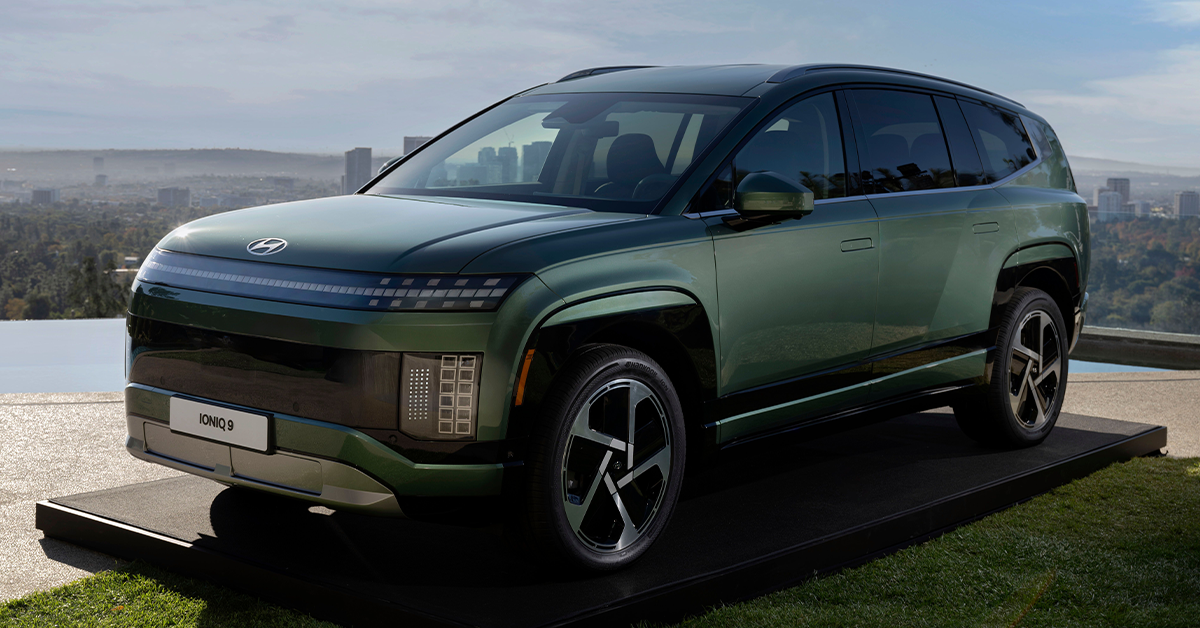
Official image of the Hyundai IONIQ 9. | © Hyundai Motor Company
The Hyundai IONIQ 9 is the large, three-row, all-electric SUV that Hyundai unveiled on November 20, 2024, built on the E-GMP platform with a 110.3 kWh battery and 800 V charging. Hyundai’s own pages give the specifications, seating and cargo space, the U.S. trims and prices, and the European and U.K. figures. This guide reads those pages first and shows where they differ. It also covers safety, awards, sales, production and the points we could not confirm.
The Hyundai IONIQ 9 is a large, three-row, all-electric SUV. Hyundai’s worldwide newsroom says Hyundai Motor Company unveiled it on November 20, 2024, datelined Los Angeles and Seoul, and describes it as a three-row, all-electric SUV with expansive interior space (Hyundai). Hyundai’s U.S. site calls it the company’s first-ever three-row electric SUV (Hyundai). It is the flagship of Hyundai’s IONIQ electric line-up. Hyundai’s U.S. media page said the IONIQ 9 was on sale when we read it (Hyundai). It was a new model for 2026 in the U.S. (Hyundai).
| Body | Large three-row electric SUV (Hyundai) |
| Unveiled | November 20, 2024 (Hyundai) |
| Battery | 110.3 kWh (Hyundai) |
| Charging system | 800 V (Hyundai) |
| Wheelbase | 3,130 mm (Hyundai) |
| Seats | Six or seven (Hyundai) |
| Range, Europe | Up to 620 km WLTP (Hyundai) |
| Range, U.S., 2026 | Up to 335 miles EPA (Hyundai) |
| U.S. start price, 2026 | 58,955 dollars (Hyundai) |
| U.K. start price | 64,995 pounds (Hyundai) |
We used Hyundai’s own pages for the figures in this guide: the worldwide newsroom, the European, U.K., Australian and U.S. sites, the press sites on hyundai.news and hyundainews.com and Hyundai’s technical data documents. Where two Hyundai pages differ we show both values. Prices and availability may have changed since publication, and exchange rates are not applied. U.S. prices are in dollars and U.K. prices are in pounds.
Every version uses a 110.3 kWh battery, according to Hyundai (Hyundai). Hyundai’s European press kit gives up to 620 km of WLTP-estimated range and 10 to 80 percent charging in 24 minutes on 800 V architecture (Hyundai). Hyundai’s U.S. pages give up to 335 miles of EPA-estimated range, a starting MSRP of 58,955 dollars and up to 422 hp (Hyundai). Hyundai’s U.K. page lists up to 385 miles and a starting price of 64,995 pounds (Hyundai). Hyundai’s U.S. site gives 700 Nm of all-wheel drive torque with the 422 hp output (Hyundai). Hyundai’s unveiling release also names Features on Demand and AI voice recognition as headline technologies (Hyundai).
The wheelbase is 3,130 mm, which Hyundai’s worldwide release calls the longest of any Hyundai model (Hyundai). The flat floor allows seating for six or seven occupants, and the first- and second-row Relaxation Seats can fully recline with a leg rest (Hyundai). Hyundai calls the styling Aerosthetic, with a streamlined roof and flush surfaces (Hyundai).
On safety, Hyundai says the 2026 IONIQ 9 earned the IIHS Top Safety Pick+ award and a five-star Euro NCAP rating (Hyundai). Hyundai U.K. says the IONIQ 9 is the first Hyundai model to feature the Hyundai AI Assistant (Hyundai). Hyundai’s U.S. pricing release says it is the second model built at Hyundai Motor Group Metaplant America in Georgia (Hyundai). The IONIQ 9 followed the IONIQ 5 and IONIQ 6, which have their own guides on our site. Hyundai U.K. calls the IONIQ 5 and IONIQ 6 triple winners at the World Car of the Year Awards in 2022 and 2023, and ties the IONIQ 9 to Hyundai Motor’s vision to offer 21 EVs by 2030 (Hyundai).
Later sections cover the 2024 debut and design, interior and cargo space, powertrains and charging, U.S. trims and prices, European, U.K. and Australian figures, safety, awards and sales, and the points where Hyundai’s pages conflict. Our Hyundai Models article lists the range, our Hyundai history article covers the company, and our Hyundai Palisade and Santa Fe articles cover the three-row and mid-size SUVs that sit below the IONIQ 9 in many showrooms.
Hyundai’s release of November 20, 2024 says the IONIQ 9 has the longest wheelbase of any Hyundai model at 3,130 mm, which gives the cabin its expansive feel and grand proportions (Hyundai). Hyundai’s European press kit says the 3.13 meter wheelbase is the longest in any IONIQ model to date and lifts roominess across all three rows (Hyundai). The IONIQ 9 sits on E-GMP, the platform of the IONIQ 5 and IONIQ 6 (Hyundai). Hyundai’s fact sheet calls it a flagship all-electric three-row SUV with expansive interior that fuses cutting-edge design with EV technology (Hyundai).
| Design language | Aerosthetic (Hyundai) |
| Wheelbase | 3,130 mm (Hyundai) |
| Length | 5,060 mm (Hyundai) |
| Width | 1,980 mm (Hyundai) |
| Width, EU data page | 1,790 mm (Hyundai) |
| Height | 1,790 mm (Hyundai) |
| Drag coefficient | 0.259 Cd with digital mirrors (Hyundai) |
| Drag, one U.S. page | 0.269 Cd (Hyundai) |
| Length, U.S. | 199.2 inches (Hyundai) |
| Towing, U.S. | Up to 5,000 pounds (Hyundai) |
The design language is called Aerosthetic. Hyundai’s Australian copy lists a streamlined roof and flush surfaces among the futuristic design elements, and Hyundai’s fact sheet notes vertical headlights that emphasize the bold presence of the design (Hyundai). The European press kit lists a 3D-shaped underbody cover, aerodynamic wheel designs and hidden antennas, which work together to reduce energy consumption (Hyundai).
Active air flap technology is the main aerodynamic device. Hyundai’s European and U.S. releases say it delivers an ultra-low drag coefficient of 0.259 Cd with digital side mirrors, while one U.S. media page gives 0.269 Cd (Hyundai). We show both because Hyundai does not explain the difference in the pages we read. The same release says the low drag helps the Long-Range rear-wheel drive car reach its 620 km WLTP estimate with 19-inch wheels (Hyundai).
Hyundai’s U.K. page gives a length of 5,060 mm, a width of 1,980 mm and a height of 1,790 mm (Hyundai). Hyundai’s U.K. technical guide adds a width of 2,251 mm including the standard side mirrors and 2,040 mm including the digital side mirrors, with the same 3,130 mm wheelbase (Hyundai). Hyundai’s European technical data page lists a width of 1,790 mm, which matches the height and differs from the other pages, so we use 1,980 mm and show both (Hyundai).
Hyundai’s U.S. specifications for the 2027 model give a wheelbase of 123.2 inches, a length of 199.2 inches, a width of 78.0 inches and a height of 70.5 inches, with overhangs of 34.6 inches at the front and 41.3 inches at the rear and a minimum ground clearance of 6.9 inches (Hyundai). The 5,060 mm length equals 199.2 inches, by our conversion (Hyundai, our calculation). The U.S. document lists tread widths of 67.0 inches at the front and 67.5 inches at the rear for 19-inch wheels, and 66.6 and 67.1 inches for the 20- and 21-inch wheels (Hyundai). The tread figures are listed separately for 19-inch wheels and for 20- and 21-inch wheels, which are the wheel sizes in that document (Hyundai). Hyundai’s U.K. page lists 19-inch wheels on the Premium and 20-inch wheels on the Ultimate (Hyundai). Hyundai gives a towing capacity of up to 5,000 pounds (Hyundai).
The U.S. 2026 specification pages give the same four dimensions for all six trims (Hyundai). Hyundai’s fact sheet lists over-the-air updates, 100 W high-output USB-C ports and Features on Demand among the practical technologies (Hyundai). Hyundai’s worldwide release says the car was unveiled with Features on Demand and AI voice recognition as headline features (Hyundai).
Hyundai says the flat floor of the IONIQ 9 accommodates six or seven occupants, and that the Relaxation Seats in the first and second rows can fully recline and offer a leg rest, allowing up to four people to rest while the car charges, depending on the configuration (Hyundai). Hyundai’s U.S. release says the seats come with a slidable Universal Island 2.0 console for comfort and flexibility (Hyundai). Hyundai’s U.S. marketing release says the IONIQ 9 accommodates up to seven occupants and is built to belong, under a campaign called Space to Connect (Hyundai). Hyundai Motor America’s marketing chief calls it a space where life happens (Hyundai). Hyundai’s U.K. page says the car combines performance with innovative electric vehicle technology in a large SUV (Hyundai). Hyundai’s worldwide release says the cabin fuses cutting-edge design with electric vehicle technology (Hyundai).
| Seating | Six or seven (Hyundai) |
| Console | Universal Island 2.0 (Hyundai) |
| Headroom, rows 2 and 3 | 1,899 mm (Hyundai) |
| Legroom, rows 2 and 3 | 2,050 mm (Hyundai) |
| Hip room, 1st row | 58.8 inches (Hyundai) |
| Hip room, 3rd row | 41.7 inches (Hyundai) |
| Cargo, all rows up | 338 liters (Hyundai) |
| Cargo, rows 2 and 3 folded | 2,419 liters (Hyundai) |
| Front cargo area | 52 liters (Hyundai) |
| Audio, U.S. | 14-speaker Bose (Hyundai) |
Hyundai’s worldwide release gives 1,899 mm of headroom and 2,050 mm of legroom when the second and third rows are combined (Hyundai). Hyundai’s U.S. specifications list hip room of 58.8 inches in the first row, 57.7 inches in the second row and 41.7 inches in the third row (Hyundai). The third row is therefore 16.0 inches narrower at the hips than the second, by our subtraction (Hyundai, our calculation).
Hyundai’s Australian page gives cargo capacity of 338 liters with all three rows in use and 2,419 liters with the second and third rows folded, plus 52 liters at the front of the vehicle (Hyundai). The U.K. page notes that capacity follows the VDA standard and that height is measured without the trunk board (Hyundai). Hyundai U.K. lists a heat pump as standard across the range (Hyundai). We did not find a U.S. cubic-foot cargo figure in the pages we read.
Hyundai lists refinement features for the cabin. The U.S. release names ANC-R active noise control, acoustic glass and noise-reducing tires, and a 14-speaker Bose premium stereo (Hyundai). Hyundai U.K. adds that quietness and refinement are maximized through active noise control and acoustic glazing (Hyundai). Hyundai calls the cabin serene and spacious in its worldwide release (Hyundai).
Hyundai U.K. lists the entry Premium trim with 19-inch alloy wheels, full LED lighting, wool and leather upholstery, a heated steering wheel, a heat pump, three-zone climate control, dual 12.3-inch curved screens, six 100 W USB-C ports, Highway Driving Assist 2 and Forward Collision-avoidance Assist 2.0 (Hyundai). The Ultimate trim adds 20-inch wheels, a panoramic glass sunroof, intelligent front-lighting and pure leather seats (Hyundai). The Premium also has a Vehicle-to-Load internal three-pin plug and a long-range 110.3 kWh battery (Hyundai). Hyundai’s fact sheet says the interior is expansive and that the vertical headlights emphasize the bold design (Hyundai). The first-row and second-row seats can recline fully, which Hyundai says suits rest while charging (Hyundai).
Hyundai U.K. says the IONIQ 9 is the first Hyundai model to feature its Hyundai AI Assistant (Hyundai). Hyundai’s U.S. page lists a Vehicle-to-Load outlet inside and outside, standard on the Limited, Calligraphy and Calligraphy Design trims (Hyundai). Hyundai’s worldwide release says the car supports over-the-air updates for in-vehicle controllers (Hyundai).
Hyundai says all models are powered by a 110.3 kWh long-range NCM lithium-ion battery mounted in the floor (Hyundai). Hyundai’s fact sheet says the car is available in rear- and all-wheel drive (Hyundai). Hyundai’s U.S. 2026 model-year document lists drive modes of Normal, Eco, Sport, Snow and MyDrive and towing of up to 5,000 pounds (Hyundai). Three motor layouts are offered. Hyundai’s U.S. 2026 model-year document lists a Long Range rear-wheel drive with a 215 hp (160 kW) rear motor, a Long Range all-wheel drive with 303 hp (226.1 kW) from dual motors and a Performance all-wheel drive with 422 hp (314.6 kW) (Hyundai).
| Battery | 110.3 kWh NCM (Hyundai) |
| RWD, U.S. | 215 hp, 160 kW (Hyundai) |
| AWD, U.S. | 303 hp, 226.1 kW (Hyundai) |
| Performance AWD, U.S. | 422 hp, 314.6 kW (Hyundai) |
| Performance AWD, EU data | 304.6 kW (Hyundai) |
| Torque | 350, 605 and 700 Nm (Hyundai) |
| 0 to 100, Performance | 5.2 seconds (Hyundai) |
| 0 to 60, U.S. | As little as 4.9 seconds (Hyundai) |
| WLTP range, EU data | 620, 606 and 600 km (Hyundai) |
| Charging, 350 kW | 10 to 80 percent in 24 min (Hyundai) |
Hyundai’s U.S. release says the Long-Range all-wheel drive adds a 66.1 kW front motor and that the Performance model has 157.3 kW motors on both axles (Hyundai). The two motors of the Performance model add up to 314.6 kW, by our arithmetic (Hyundai, our calculation). Hyundai’s European technical data lists maximum torque of 350 Nm, 605 Nm and 700 Nm for the three layouts (Hyundai).
Hyundai’s European technical data lists maximum power of 160 kW, 226.1 kW and 304.6 kW, which disagrees with the 314.6 kW in the U.S. pages for the Performance model (Hyundai). The same table lists 0 to 100 km/h in 9.4, 6.7 and 5.2 seconds and a maximum speed of 190 km/h for the rear-wheel drive and 200 km/h for the others (Hyundai). The U.S. fact sheet says 0 to 60 mph in as little as 4.9 seconds (Hyundai).
Range depends on market and version. Hyundai’s European press kit gives up to 620 km WLTP, with 194 Wh per km for the Long-Range rear-wheel drive car on 19-inch wheels (Hyundai). The unveiling release called it a WLTP-estimated range and a WLTP-targeted consumption, since the car was not yet on sale (Hyundai). The European technical data lists 620 km, 606 km and 600 km for the three layouts and consumption of 19.9, 20.4 and 20.6 kWh per 100 km (Hyundai). The 194 Wh per km of the unveiling release is 19.4 kWh per 100 km by our conversion, which differs from the 19.9 in the technical data (Hyundai, our calculation).
Charging uses E-GMP’s 800 V architecture. Hyundai says the IONIQ 9 recharges from 10 to 80 percent in 24 minutes on a 350 kW charger (Hyundai). The IONIQ 6 pages give 18 minutes for the same 10 to 80 percent, so the IONIQ 9 takes 6 minutes longer, by our subtraction (Hyundai, our calculation). The 110.3 kWh pack holds 26.3 kWh, or about 31 percent, more than the 84 kWh pack of the updated IONIQ 6, by our calculation (Hyundai, our calculation). Hyundai’s U.S. pricing release adds that a NACS port and CCS adapters are standard for nationwide charging access (Hyundai). The U.S. release gives an EPA-estimated 92 MPGe combined for the Long-Range rear-wheel drive model (Hyundai).
Hyundai’s U.S. fact sheet says the 110.3 kWh battery delivers a range targeting 300 or more miles in all trims, and the final EPA figures were 335, 320 and 311 miles (Hyundai). Hyundai says actual output varies with options, driving conditions, driving habits and the vehicle’s condition (Hyundai). Hyundai’s U.S. page says the Vehicle-to-Load outlet can recharge gear inside and outside the vehicle (Hyundai).
Hyundai’s U.S. 2026 pages list six trims: the S at 58,955 dollars, the SE at 62,765 dollars, the SEL at 66,320 dollars, the Limited at 71,250 dollars, the Calligraphy at 74,990 dollars and the Calligraphy Design at 76,490 dollars (Hyundai). MSRP excludes freight, tax, title and license fees (Hyundai). Hyundai’s U.S. pages also show an Est. Net Price heading beside the starting MSRP, and we quote only the MSRP (Hyundai). Hyundai’s 2026 model-year document lists the IONIQ 9 as an all-new model for 2026 (Hyundai). The Calligraphy Design is 17,535 dollars above the S, by our subtraction (Hyundai, our calculation).
| U.S. 2026 S | 58,955 dollars (Hyundai) |
| U.S. 2026 SE | 62,765 dollars (Hyundai) |
| U.S. 2026 SEL | 66,320 dollars (Hyundai) |
| U.S. 2026 Limited | 71,250 dollars (Hyundai) |
| U.S. 2026 Calligraphy | 74,990 dollars (Hyundai) |
| U.S. 2026 Calligraphy Design | 76,490 dollars (Hyundai) |
| Start, with destination | 60,555 dollars (Hyundai) |
| Top, with destination | 78,090 dollars (Hyundai) |
| EPA, S | 335 miles (Hyundai) |
| EPA, Limited and above | 311 miles (Hyundai) |
Hyundai’s pricing release gave a start price of 60,555 dollars including destination and 78,090 dollars including destination for the AWD Performance Calligraphy Design (Hyundai). Destination is therefore 1,600 dollars on both the base and top trims, by our subtraction of the MSRPs (Hyundai, our calculation). The release also said the car was eligible for the full 7,500 dollar federal tax credit at that time, which we cannot confirm today (Hyundai).
EPA-estimated range is 335 miles for the rear-wheel drive S, 320 miles for the all-wheel drive SE and SEL and 311 miles for the Limited, Calligraphy and Calligraphy Design (Hyundai). The rear-wheel drive range is listed only for the S, and the other trims are all-wheel drive (Hyundai). The 422 hp output is standard on the Limited, Calligraphy and Calligraphy Design, and the S has a 160 kW, 215 hp rear-wheel drive powertrain (Hyundai). Hyundai’s U.S. page also advertised an Est. Net Price and monthly offers on the S trim, which depend on date and region and which we do not repeat (Hyundai). The S therefore has 24 more miles than the top trims, by our subtraction (Hyundai, our calculation). Hyundai says all models offer 300 or more miles of EPA-estimated range (Hyundai).
Production is in the United States. Hyundai says the IONIQ 9 is the second model manufactured at the Hyundai Motor Group Metaplant America in Georgia, after the IONIQ 5 (Hyundai). The pricing release says all models offer 300 or more miles of EPA-estimated range and a standard NACS port (Hyundai). Hyundai’s U.S. release calls it an assembled-in-America EV (Hyundai). Hyundai’s media presentation says Hyundai Motor Group plans to invest 21 billion dollars in the U.S., including 9 billion dollars to expand U.S. vehicle production to 1.2 million units annually (Hyundai).
For the 2027 model year, Hyundai published a features and specifications document in July 2026 that lists the dimensions above (Hyundai). We did not find a 2027 U.S. price list in the pages we read, so the 2026 prices are the latest we give (Hyundai). Hyundai’s U.S. page at the time we read it also advertised cash and financing offers, which change often and which we do not repeat (Hyundai).
Hyundai’s U.S. pages compare the IONIQ 9 with rivals on price and range, but we did not verify the rival figures and name none. Hyundai’s 2026 model-year changes document describes it as Hyundai’s most spacious and luxurious electric three-row SUV and lists drive modes of Normal, Eco, Sport, Snow and MyDrive (Hyundai).
Hyundai’s European press kit gives up to 620 km of WLTP range for the rear-wheel drive version and a best 0 to 100 km/h time of 5.2 seconds with three motor configurations (Hyundai). Hyundai’s Australian page gives up to 600 km of WLTP range, 110 kWh of battery and six or seven seats (Hyundai). Hyundai calls it the large three-row electric SUV with six or seven seats and a five-star ANCAP rating (Hyundai). The Australian figure matches the 600 km Hyundai lists for the Performance version in its European data (Hyundai).
| WLTP range, Europe | Up to 620 km (Hyundai) |
| WLTP range, Australia | Up to 600 km (Hyundai) |
| WLTP range, U.K. | Up to 385 miles (Hyundai) |
| U.K. power | 218, 307 and 427 PS (Hyundai) |
| 0 to 62 mph, Performance | 5.2 seconds (Hyundai) |
| U.K. start price | 64,995 pounds (Hyundai) |
| U.K. price, one release | 69,995 pounds (Hyundai) |
| U.K. Premium wheels | 19-inch (Hyundai) |
| U.K. Ultimate wheels | 20-inch (Hyundai) |
| U.K. MY27 Black Ink 6-seat | 80,835 pounds (Hyundai) |
Hyundai Motor UK announced the range with prices from 64,995 pounds and a 110 kWh battery giving 385 miles of WLTP range (Hyundai). The Long Range rear-wheel drive has 218 PS, the Long Range all-wheel drive 307 PS and the Performance all-wheel drive 427 PS, with a standard heat pump (Hyundai). Hyundai says the price varies with the chosen package (Hyundai). The U.K. pages list the Premium trim with a Vehicle-to-Load internal three-pin plug as standard (Hyundai). The 385 miles equals about 620 km by our conversion, which fits the European figure (Hyundai, our calculation).
Hyundai’s U.K. page says the 385 miles applies to the Ultimate 218 PS rear-wheel drive with 19-inch wheels, and that the Performance version accelerates from 0 to 62 mph in 5.2 seconds (Hyundai). The page gives the motors as 160 kW at the rear for the rear-wheel drive car, a 66 kW front motor and 160 kW rear motor for the all-wheel drive, and 157 kW motors front and rear for the Performance (Hyundai).
U.K. specifications run from the Premium trim, priced from 64,995 pounds, to the flagship Calligraphy Black Ink, which adds distinctive black exterior and interior details (Hyundai). An earlier 2026 Hyundai U.K. release says the car was available to order with prices starting from 69,995 pounds, which conflicts with the 64,995 pounds on the other pages (Hyundai). The gap is 5,000 pounds, by our subtraction (Hyundai, our calculation).
Hyundai U.K. said the IONIQ 9 was offered with a 1,500 pound saving from the Hyundai Electric Grant at the time of that release (Hyundai). Another Hyundai U.K. release said the car and the INSTER were available with Hyundai’s Car Grant, which offers savings of up to 3,750 pounds, so the grant figure depends on the page (Hyundai). Hyundai U.K. also describes the car as the Best Large Car of 2026 at one U.K. awards and says the INSTER won Best Small Car there (Hyundai). Hyundai’s U.K. Model Year 27 technical guide, effective from November 16, 2026, lists a six-seat Black Ink version at 80,835 pounds in its price columns, which we read as an on-the-road price (Hyundai). We did not read the rest of that price table.
Hyundai U.K. frames the IONIQ 9 as part of Hyundai’s vision to offer 21 electric vehicles by 2030 (Hyundai). It describes the IONIQ 5 and IONIQ 6 as triple winners at the World Car of the Year Awards in 2022 and 2023 (Hyundai). We found no Hyundai page with an IONIQ 9 price for Korea that we could read with confidence, so we give none.
Hyundai’s U.S. release of October 31, 2025 says the all-new 2026 IONIQ 9 earned the 2025 Top Safety Pick+ award from the Insurance Institute for Highway Safety (Hyundai). Hyundai says it earned the highest possible Good ratings across all evaluation categories, including front and side crash protection and forward collision prevention (Hyundai). Hyundai counted eight 2025 Top Safety Pick+ awards across its range, including the IONIQ 9 (Hyundai). Hyundai’s November 2025 release says the IONIQ 9 and a Kia model earned 2025 Top Safety Pick+ honors in the same announcement (Hyundai). Hyundai’s March 24, 2026 release lists the 2026 IONIQ 9 among six 2026 Top Safety Pick+ winners under tougher criteria (Hyundai).
| IIHS, 2025 award | Top Safety Pick+ (Hyundai) |
| IIHS, 2026 award | Top Safety Pick+ (Hyundai) |
| Euro NCAP | Five stars (Hyundai) |
| ANCAP | Five stars (Hyundai) |
| German award | Premium Car of the Year 2026 (Hyundai) |
| U.S. sales, 2025 | 5,189 units (Hyundai) |
| U.S. sales, Jan to Aug 2026 | 6,147 units (Hyundai) |
| U.S. sales, Jan to Aug 2025 | 3,102 units (Hyundai) |
| U.S. May 2026 | Up 279 percent (Hyundai) |
| U.S. August 2026 | 589 units (Hyundai) |
Hyundai says the IIHS awards apply to U.S. models only (Hyundai). In Europe, Hyundai U.K. says the IONIQ 9 was awarded the maximum five-star rating by Euro NCAP, and Hyundai’s Australian page cites a five-star ANCAP rating (Hyundai). Hyundai’s brand release says the IONIQ 9 earns top global safety ratings (Hyundai). We did not read the Euro NCAP or ANCAP datasheets and give no category scores or dates.
Hyundai’s January 2026 release says the IONIQ 9 was recognized as German Premium Car of the Year 2026, among other accolades (Hyundai). Hyundai U.K. says the car won best seven-seater at a U.K. new-car awards in 2026 and again in 2027, and best large car at another U.K. awards in 2026 (Hyundai). We do not name the organizers and treat these as Hyundai’s reports. Hyundai’s February 2026 sales release lists the IONIQ 9 among four family-focused award wins and its April 2026 release says it placed first in one segment of a U.S. ranking (Hyundai). Hyundai’s July 2026 release says it was named New England’s Best Winter EV by a regional press group (Hyundai).
On sales, Hyundai Motor America’s January 2026 release shows 5,189 IONIQ 9 sales in 2025, with 380 in December and 1,012 in the fourth quarter (Hyundai). The same table shows no IONIQ 9 sales in 2024 (Hyundai). Hyundai’s worldwide brand release says the IONIQ 9 earned both the 2026 Top Safety Pick+ award and Euro NCAP’s highest rating (Hyundai). Its August 2026 release shows 6,147 sales for 2026 through August against 3,102 in the same period of 2025, up 98 percent (Hyundai). Sales in 2026 to August are 958 above all of 2025, by our subtraction (Hyundai, our calculation).
Monthly figures swing widely. Hyundai’s May 2026 release says the IONIQ 9 rose 279 percent in May against May 2025, while its August 2026 release shows 589 sales in August against 1,016 a year earlier, down 42 percent (Hyundai). The two releases are both Hyundai figures for the same model, and the difference is the comparison month, not the model (Hyundai).
We found no Hyundai page with a global IONIQ 9 sales total, no European sales figure and no Korean sales figure. The U.S. figures above are Hyundai Motor America totals, and we did not check them against any other source. Hyundai’s own releases are the source for every figure in this section.
Several Hyundai pages conflict. The drag coefficient is 0.259 Cd with digital side mirrors in most releases and 0.269 Cd on one U.S. media page (Hyundai). The Performance model’s power is 314.6 kW in the U.S. pages and 304.6 kW in the European technical data, and the width is 1,980 mm on the U.K. pages and 1,790 mm on the European data page (Hyundai). The consumption is 194 Wh per km in the unveiling release and 19.9 kWh per 100 km in the technical data (Hyundai).
| Drag, sources | 0.259 or 0.269 Cd (Hyundai) |
| Performance power, sources | 314.6 or 304.6 kW (Hyundai) |
| Width, sources | 1,980 or 1,790 mm (Hyundai) |
| U.K. start price, sources | 64,995 or 69,995 pounds (Hyundai) |
| Range units | WLTP km, miles, EPA miles (Hyundai) |
| 2027 U.S. prices | Not found |
| Global sales total | Not found |
| European sales | Not found |
| Euro NCAP datasheet | Not read |
| U.S. cargo, cubic feet | Not found |
Range and power are quoted in different units. Europe gives 620 km, 606 km and 600 km on the WLTP cycle, the U.K. gives up to 385 miles and the U.S. gives 335, 320 and 311 miles on the EPA cycle (Hyundai). Power is 160 kW, 226.1 kW and about 314.6 kW in the U.S. and 218 PS, 307 PS and 427 PS in the U.K. (Hyundai). We do not convert between cycles, only units. The unveiling release called the 620 km an estimate, while the Australian page gives 600 km (Hyundai). The U.K. page and the Australian page give different range units and figures for what is the same battery (Hyundai).
The U.K. starting price is 64,995 pounds on most Hyundai pages and 69,995 pounds in one release (Hyundai). The U.K. grant is 1,500 pounds on one page and up to 3,750 pounds on another (Hyundai). Hyundai calls the wheelbase the longest of any Hyundai model in its worldwide release and the longest of any IONIQ model in its European press kit, which are different claims (Hyundai). The seat count is six or seven depending on configuration, and Hyundai’s U.S. release lists swiveling seats in one place only (Hyundai).
Not confirmed: we found no 2027 U.S. price list, no global or European sales total, no Euro NCAP datasheet, no Korean price we could read with confidence, no U.S. cubic-foot cargo figure and no statement on a facelift. We also did not verify any rival prices Hyundai quotes. The IONIQ 9 is a different car from the IONIQ 5, IONIQ 6 and IONIQ 3, which have their own guides.
Hyundai’s own pages use the IONIQ name for the whole family, and several releases combine models in one sales figure, so a number on a Hyundai page may cover more than the IONIQ 9 (Hyundai). We show each value with its source instead of choosing one. Hyundai’s U.S. page also notes that actual horsepower varies with options and conditions (Hyundai). The U.S. pricing release said the car was eligible for the full 7,500 dollar federal tax credit when it was released, and we did not check whether that still applies (Hyundai).
Things to watch are 2027 U.S. pricing, U.K. Model Year 27 prices, any change to the U.S. federal tax credit or the U.K. grants, any Euro NCAP or IIHS update for the 2027 car, new markets and the sales trend through the end of 2026. To check this guide, start with Hyundai’s worldwide newsroom and national press sites and compare dates before numbers. Our Hyundai Models article lists the range.