 Brands
Hyundai Tiburon — Generations, Specs, Prices and Legacy
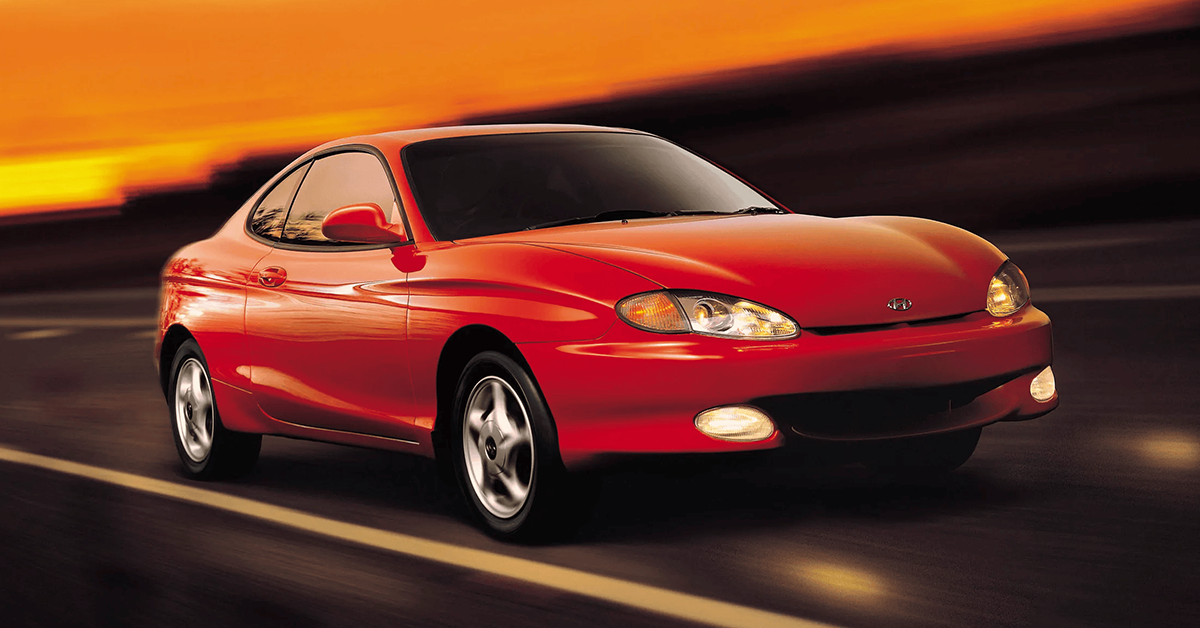
Official image of the Hyundai Tiburon. | © Hyundai Motor Company
Hyundai Tiburon. The 1996 sports coupe, the 2003 V6 redesign, 2007 prices, U.S. sales to 2008, crash tests and how it links to Hyundai N and the Veloster.
The Tiburon was Hyundai’s front-wheel-drive sports coupe of the late 1990s and 2000s. Hyundai Motor Group’s journal says it debuted in April 1996 as the company’s first fully independently developed sports model and Korea’s first fully independent sports car (Hyundai). Hyundai’s worldwide history page lists it as 1996 to 2001 for the first generation (Hyundai). Reports say production ran from 1996 to 2008, with a second generation that arrived for the 2003 model year (reported).
| Debut | April 1996 (Hyundai) |
| First generation | 1996 to 2001 (Hyundai) |
| Second generation | 2003 model year (reported) |
| Production, per reports | 1996 to 2008 (reported) |
| North American name | Tiburon (reported) |
| European name | Hyundai Coupe (reported) |
| Korean name | Tuscani (reported) |
| 2007 base engine | 2.0 four, 138 hp (reported) |
| 2007 V6 | 2.7, 172 hp (reported) |
| Successor in spirit | Veloster (reported) |
We read Hyundai’s own pages first. They were the Hyundai worldwide vehicle-history page, the Hyundai worldwide Brand Journal heritage page and the Hyundai Motor Group journal article of January 15, 2025 about a Tiburon restoration. Hyundai’s pages give no engine tables or prices for the second generation, so reports supply specifications, prices, sales and crash ratings and carry the reported tag. Prices and availability may have changed since publication, and exchange rates are not applied.
The name changed by market. A reprinted Hyundai release says the new coupe was known as the Tiburon in North America, the Hyundai Coupe in Europe and the Tuscani in Korea (reported). Another report adds that the Coupe name was also used in the Middle East and Indonesia, and that Korean buyers saw the name Turbulence on the first generation (reported). From 1996 to 2008 is 12 years, since 2008 minus 1996 is 12 (reported, our calculation).
Two engines defined the U.S. car. The 2.0-liter four-cylinder was the base unit, and the second generation added a 2.7-liter V6 as a first for the Tiburon (reported). A 2007 report lists 138 horsepower for the four and 172 for the V6 (reported). A 2003 test lists 181 horsepower for the V6 and another listing gives 170, so the figure depends on the source (reported). We show both values in the specification sections. Hyundai says the Pony of 1975 was Korea’s first indigenous model, and from the Pony to the end of the Tiburon in 2008 is 33 years, since 2008 minus 1975 is 33 (Hyundai, reported, our calculation). The first generation had 5 U.S. model years and the second 6, which together make 11, the count one report gives (reported, our calculation). Listings give four seats (reported).
This guide covers the 1996 debut, the platform and the engines of the first generation, the 2003 redesign, the 2007 refresh, prices, sales, crash ratings, Hyundai’s heritage story and the end of the car in 2008. Our Hyundai Veloster article covers the car that later filled the small coupe gap, and our Hyundai Elantra article covers the sedan that supplied the Tiburon’s first platform and later an N version.
We found no Hyundai page that lists Tiburon prices, second-generation specifications, sales or crash ratings. Those items rely on reports and reprinted releases, and where sources disagree we show both values. Our Hyundai Models article lists the current range and our Hyundai history article covers the company. Hyundai says the Tiburon holds a special place in its history and inspired a generation of car lovers (Hyundai). We list each figure with its source tag. The 2003 GT V6 weighs 3,023 pounds and the 2007 SE-era car 2,986 pounds, a difference of 37 pounds, since 3,023 minus 2,986 is 37 (reported, our calculation). Weight per horsepower is 16.7 pounds for 3,023 over 181 and 17.8 for 3,023 over 170 (reported, our calculation).
Hyundai’s worldwide history page says the Tiburon was unveiled in 1996 and used the first McPherson strut-type suspension that Hyundai developed in collaboration with Porsche (Hyundai). The page says the car won the 75th Pikes Peak International Hill Climb and had a class of its own with an innovative design and sporty character (Hyundai). It gives no engine specifications or other numbers for the car (Hyundai).
| Debut | April 1996 (Hyundai) |
| Dates on Hyundai history page | 1996 to 2001 (Hyundai) |
| Suspension | McPherson strut, with Porsche (Hyundai) |
| Motorsport | 75th Pikes Peak hill climb win (Hyundai) |
| Design inspiration | HCD-1 and HCD-2 concepts (Hyundai) |
| Engine, per Hyundai | Beta 2.0, up to 150 hp (Hyundai) |
| Platform | Second-generation Elantra, J2 (Hyundai) |
| 2.0 power, per report | 140 hp (reported) |
| 1.8 power, per report | 130 hp (reported) |
| U.S. model years | 1997 to 2001 (reported) |
Hyundai Motor Group’s journal says the Tiburon went on sale in April 1996, with styling inspired by the HCD-1 and HCD-2 concept cars (Hyundai). It says the car used Hyundai’s in-house Beta engine, a 2.0-liter unit with up to 150 horsepower, with a cast iron block and an aluminum head, and that it sat on the second-generation Elantra platform (Hyundai). The journal says its April 1996 release marked the real start of the domestic sports car market in Korea (Hyundai). The Elantra link is why our Hyundai Elantra article is a natural companion to this one.
Reports give lower figures for the U.S. cars. One says the early Tiburon was offered with a 1.8-liter of 130 horsepower and a 2.0-liter of 140 horsepower (reported). The 2.0 is 10 horsepower below Hyundai’s 150 hp figure, since 150 minus 140 is 10, but Hyundai says up to 150, and we could not confirm why the figures differ (Hyundai, reported, our calculation). Another report says the 1.8 was dropped in 1998, leaving the 2.0 in both models (reported). The 140 horsepower 2.0 makes 70.0 horsepower per liter, since 140 divided by 2.0 is 70.0, while Hyundai’s up to 150 horsepower gives 75.0 (Hyundai, reported, our calculation).
The journal places the Tiburon in a sequence of Hyundai sports cars. It says the Pony of 1975 was Korea’s first indigenous model, and that the Scoupe of 1990, development code SLC for Sport-looking Car, was a two-door coupe styled to look sporty (Hyundai). From the Pony to the Tiburon is 21 years, since 1996 minus 1975 is 21, and from the Scoupe to the Tiburon is 6 years (Hyundai, our calculation). It says Hyundai introduced its first model with the independently developed Alpha engine in 1991 (Hyundai).
A report says the design drew on the HCD-II Epoch concept that debuted at the 1993 Detroit show, and that the MacPherson strut suspension was co-developed with Porsche (reported). The same report says all versions of the Tiburon built from 1996 to 2002 are known as RD cars, and a second report says there was no 2002 model in the United States (reported). Model years in the United States were 1997 to 2001, which is 5 years (reported, our calculation).
The journal says the Tiburon did not have the highest sales but built a dedicated enthusiast community (Hyundai). It gives no sales figures for the first generation (Hyundai). A report says the car was restyled in 2000 with a harder edge, and that the redesigned 2003 car shared less with the Elantra because it had its own chassis, which the next sections cover (reported). We found no Hyundai page for the first generation’s dimensions or weight (Hyundai).
A reprinted Hyundai release says the all-new Tiburon was first shown at the Frankfurt show in September 2001 and made its North American debut at the South Florida International Auto Show in October (reported). Other reports describe the car as introduced in 2002 as a 2003 model (reported). The Frankfurt date and the 2002 introduction can both be true, since a show reveal comes before a sales launch, but we found no Hyundai page giving either date (Hyundai).
| Frankfurt reveal | September 2001 (reported) |
| North American show debut | October 2001 (reported) |
| Chassis | New GK chassis (reported) |
| Wheelbase | 99.6 in, 2,530 mm (reported) |
| Length | 4,394 mm or 4,395 mm (reported) |
| Width | 1,760 mm (reported) |
| V6 engine | 2.7 DOHC aluminum (reported) |
| Six-speed manual | First since 1997 (reported) |
| Top speed, track tests | 132 mph limited (reported) |
| GT V6 weight | 3,023 pounds (reported) |
The reprinted release says the old Tiburon shared a platform with the Elantra, while the all-new car had its own chassis, dubbed GK, with a slightly longer wheelbase of 99.6 inches (reported). In millimeters that is 2,530 mm, since 99.6 times 25.4 is 2,529.8 (reported, our calculation). Hyundai Motor America described two models, the Tiburon and the Tiburon GT V6 (reported). A report calls the GK car leaner and meaner than any production Hyundai before it (reported).
The big news was the V6. The reprinted release says it was the same all-aluminum DOHC 2.7-liter V6 used in the Sonata and the Santa Fe, and that the GT V6 had a GT handling package with revised suspension and 17-inch wheels (reported). It says a six-speed manual was available for the first time since the Tiburon’s 1997 introduction, with a four-speed Shiftronic automatic also offered (reported). In factory track tests the GT V6 reached an electronically limited 132 mph (reported).
That 132 mph is about 212 km/h, since 132 times 1.609 is 212.4 (reported, our calculation). A 2003 test says the V6 can for the first time be mated to a serious six-speed manual, unlike in the Sonata and Santa Fe (reported). The same test lists the engine as a Delta twin-cam 24-valve unit with 181 horsepower and 177 lb-ft (reported).
Dimensions are reported. Length is 173.0 inches or 4,394 mm, width 69.3 inches or 1,760 mm and height 1,328 mm, according to one source, while another gives 4,395 mm, 1,760 mm and 1,330 mm (reported). The conversions agree, since 173.0 times 25.4 is 4,394.2 and 69.3 times 25.4 is 1,760.2 (reported, our calculation). A 2003 review lists 3,023 pounds for the GT V6, which it called plump against the lightest rivals (reported). It adds that the base four is the previous Tiburon’s engine, shared with the Elantra GLS sedan and GT hatchback (reported). The 181 horsepower V6 makes 67.0 horsepower per liter, while the 140 horsepower four makes 70.0, since 140 divided by 2.0 is 70.0, so the four was the more efficient design per liter (reported, our calculation). At 3,023 pounds the GT V6 carries about 16.7 pounds per horsepower at 181 and 17.8 at 170 (reported, our calculation).
A special edition followed. A road test describes a Tiburon Tuscani with a bright yellow finish, a distinct interior and a 170 horsepower V6, noting that its 181 lb-ft of torque beat most rivals (reported). That report’s figures of 170 horsepower and 181 lb-ft are the reverse of the 181 horsepower and 177 lb-ft in other 2003 reports, so the engine ratings conflict between sources (reported). We could not find a Hyundai page that settles it (Hyundai).
The 2003 base engine was the 2.0-liter four. One 2003 review lists 140 horsepower at 6,000 rpm and 133 lb-ft at 4,800 rpm, while a listing gives 134 horsepower and 132 lb-ft (reported). The two differ by 6 horsepower, since 140 minus 134 is 6, so we show both values (reported, our calculation). The review rates fuel economy at 23 mpg city and 31 mpg highway with the manual and 23 and 30 with the automatic (reported). The review says the Tiburon moved upmarket with V6 power and an available six-speed manual, and recommends it for sporty-coupe shoppers with under 20,000 dollars to spend (reported).
| 2003 base engine | 2.0 four, 140 or 134 hp (reported) |
| 2003 base torque | 133 or 132 lb-ft (reported) |
| 2003 V6 power | 181 or 170 hp (reported) |
| 2003 V6 torque | 177 or 181 lb-ft (reported) |
| 2003 GT V6 base price | 17,999 dollars (reported) |
| 2003 GT V6 as tested | 19,344 or 18,744 dollars (reported) |
| 2003 loaded GT V6 | 19,997 dollars (reported) |
| Fuel tank | 14.5 gallons (reported) |
| Cargo space | 14.7 to 14.8 cubic feet (reported) |
| Warranty | 5 years, 60,000 miles; powertrain 10 years (reported) |
The V6 numbers conflict too. Several 2003 reports give 181 horsepower at 6,000 rpm and 177 lb-ft at 4,000 rpm, while a listing and another review give 170 horsepower and 181 lb-ft (reported). The gap is 11 horsepower, since 181 minus 170 is 11, and 4 lb-ft the other way, since 177 minus 181 is minus 4 (reported, our calculation). Per liter the two figures are 67.0 and 63.0 horsepower, since each is divided by 2.7 (reported, our calculation).
A 2003 test lists the GT V6 at a base price of 17,999 dollars and 19,344 dollars as tested, while another report gives a base of 17,999 and an as-tested price of 18,744 dollars for a six-speed car (reported). A listing gives a starting price of 18,599 dollars for the GT, which is 600 dollars above 17,999, and the reports do not say why (reported, our calculation). The base four was priced around 16,000 dollars, according to a report (reported).
Hyundai’s reprinted release says a fully loaded GT V6 with six-speed, leather, 17-inch wheels and a sunroof was priced at 19,997 dollars (reported). That is 1,998 dollars above the 17,999 base, since 19,997 minus 17,999 is 1,998, which is 11.1 percent (reported, our calculation). The same release says equipment included an Infinity stereo with seven speakers, though a different report counts six speakers on a later GT (reported). Prices and availability may have changed since publication, and exchange rates are not applied.
The warranty was a selling point. A report says Hyundai offered a 10-year or 100,000-mile powertrain warranty and a five-year or 60,000-mile bumper-to-bumper warranty (reported). A 2007 review repeats those terms and adds roadside assistance for five years at no charge (reported). Hyundai’s pages we read do not list warranty terms for the Tiburon (Hyundai). The Insurance Institute for Highway Safety does not appear to have tested the 2003 car, according to one source (reported).
Fuel economy and fuel tank are reported. One listing gives the 2003 four at 20 mpg city and 27 highway and the V6 at 17 and 24, while a review gives the four 23 and 31 with the manual, which is 3 city and 4 highway more, since 23 minus 20 is 3 and 31 minus 27 is 4 (reported, our calculation). The fuel tank holds 14.5 gallons, and cargo space is 14.7 cubic feet in 2003 and 14.8 in 2007 (reported). The 0.1 cubic foot difference is small and may be rounding, but we cannot confirm that (reported, our calculation).
The Tiburon was restyled for 2007, according to a review that calls the car perky with a new look (reported). The 2007 line-up had four trims, the GS, GT, GT Limited and SE (reported). The GS has a 2.0-liter four-cylinder of 138 horsepower, while the other three have a 2.7-liter V6 of 172 horsepower and 181 lb-ft at 3,800 rpm (reported). Dividing 172 by 2.7 gives 63.7 horsepower per liter (reported, our calculation). A report says GT buyers were the second-largest group, according to Hyundai (reported).
| 2007 trims | GS, GT, GT Limited, SE (reported) |
| 2007 GS engine | 2.0 four, 138 hp (reported) |
| 2007 V6 | 2.7, 172 hp, 181 lb-ft (reported) |
| 2007 GS price | 16,595 dollars (reported) |
| 2007 GT price | 19,295 dollars (reported) |
| 2007 GT Limited price | 21,595 dollars (reported) |
| 2007 SE price | 21,995 dollars (reported) |
| Automatic gearbox cost | 1,100 dollars (reported) |
| Freight charge | 600 dollars (reported) |
| 2007 weight | 2,986 pounds (reported) |
The 2007 V6 is rated lower than the 181 horsepower reported for 2003, a difference of 9 horsepower, since 181 minus 172 is 9, though it matches the 170 hp listing within 2 horsepower (reported, our calculation). We could not confirm whether the engine changed or whether the rating method changed, and Hyundai’s pages give neither number (Hyundai). The 2007 GS made 138 horsepower, which is 2 below the 140 hp reported for 2003, since 140 minus 138 is 2 (reported, our calculation).
The SE was the sport model. A report says it has a European-style sport-tuned suspension, a six-speed manual, cross-drilled brake rotors with red aluminum calipers and a rear spoiler, and that stability and traction control were new for 2007 on the SE, a rarity in that price class (reported). Seat-mounted side airbags and four-wheel disc antilock brakes were standard on all trims, according to a report (reported). The GT used a five-speed manual or four-speed automatic (reported).
Hyundai Motor America announced 2007 prices on December 11, 2006 (reported). The GS started at 16,595 dollars with the manual and 17,695 with the automatic, the GT at 19,295 and 20,395, the GT Limited at 21,595 and 22,695 and the SE at 21,995, all excluding a 600 dollar freight charge (reported). The automatic adds 1,100 dollars on each trim, since 17,695 minus 16,595, 20,395 minus 19,295 and 22,695 minus 21,595 are each 1,100 (reported, our calculation).
The SE costs 5,400 dollars more than the GS, since 21,995 minus 16,595 is 5,400, which is 32.5 percent (reported, our calculation). The SE is 2,700 dollars above the GT, or 14.0 percent, since 21,995 minus 19,295 is 2,700 (reported, our calculation). Another listing gives each of these prices 100 dollars higher, for example 16,695 for the GS and 22,095 for the SE, and we could not confirm why (reported, our calculation).
The 2007 GT is 1,296 dollars above the 2003 GT V6 base, or 7.2 percent, since 19,295 minus 17,999 is 1,296 and 1,296 divided by 17,999 is 0.072 (reported, our calculation). A review lists the 2007 weight as 2,986 pounds, which is about 17.4 pounds per horsepower at 172 horsepower (reported, our calculation). The 2007 car carries 17.4 pounds per horsepower against 16.7 for the 2003 GT V6 at 181 horsepower, which is 0.7 more, since 17.4 minus 16.7 is 0.7 (reported, our calculation). Across the 2007 line-up the SE is 2,700 dollars above the GT, and the GS is 2,700 below the GT, since 19,295 minus 16,595 is 2,700 (reported, our calculation). Its 63.7 horsepower per liter is 3.3 below the 67.0 of the 181 horsepower rating, since 67.0 minus 63.7 is 3.3 (reported, our calculation). Prices and availability may have changed since publication, and exchange rates are not applied.
Hyundai still celebrates the Tiburon. Its worldwide Brand Journal heritage page, titled A trip down memory lane with Tiburon, says that in 1996 Hyundai introduced the Tiburon as the company’s first independently designed sports model (Hyundai). The Hyundai Motor Group journal article published on January 15, 2025 follows a restoration project and says the car was designed, engineered and tuned entirely with Hyundai’s own technology (Hyundai).
| Hyundai journal date | January 15, 2025 (Hyundai) |
| Hyundai debut line | First independently designed sports model (Hyundai) |
| Everland Speedway opened | 1995 (Hyundai) |
| Pony launched | 1975 (Hyundai) |
| Scoupe code | SLC, Sport-looking Car (Hyundai) |
| Click Speed Festival sponsored | 2003 (Hyundai) |
| N brand link video | 2021 Elantra N premiere (Hyundai) |
| Restored car age | Almost three decades (Hyundai) |
| Restoration owner | Jang-hyuck Heo (Hyundai) |
| Restoration status | Completed (Hyundai) |
The article says that before the Tiburon, Korean motorsport ran on dirt roads in the 1980s, that Everland Speedway in Yongin opened in 1995 and established on-road racing, and that the Hyundai Scoupe Turbo and the Kia Concord were top contenders there (Hyundai). The Tiburon then quickly became a top performer and sparked a boom in domestic tuning, car clubs and sponsorship (Hyundai). The Everland opening came one year before the Tiburon, since 1996 minus 1995 is 1 (Hyundai, our calculation).
Jung-yong Park, a former racer and Ajou Motor College professor who in 1988 was the first Korean to compete in the Paris-Dakar Rally, said the Tiburon completely changed the atmosphere in Korean racing (Hyundai). In 2003 Hyundai sponsored the Click Speed Festival, which the article calls Korea’s first one-make race series (Hyundai). From the Dakar start in 1988 to the Tiburon in 1996 is 8 years (Hyundai, our calculation).
The link to the N brand is explicit. The article says that in the 2021 Elantra N world premiere video Hyundai showed a young car lover learning to drive in a Tiburon, and that Joon-woo Park, head of N Brand Management, called the Tiburon the mental foundation of the N brand (Hyundai). Hyundai’s heritage page adds that a young fan from the story later became a racecar driver graduating to the N series (Hyundai). Our Hyundai Veloster article covers the N model sold in America.
The restoration project is described in detail. Jang-hyuck Heo, who once led the Tiburon Owners Group, owned a Tiburon that had been on the road for almost three decades, and the goal was to restore it inside and out to near-new condition and drive it on the track again (Hyundai). Myung-won Won, a research engineer from Hyundai’s MLV Project 5 team, said restoring track performance needed new powertrain, wiring and electrical parts (Hyundai). The article says the restoration was completed (Hyundai). In 1975 about 200,000 cars were registered in Korea and the count is now about 25 million, which is 125 times as many, since 25 million divided by 200,000 is 125 (Hyundai, our calculation). Korea produced about 4.24 million vehicles in the year before the article, keeping it in the global top five (Hyundai).
The article gives no sales figures, and says the Tiburon did not have the highest sales but built a community (Hyundai). It also says Hyundai surpassed 100 million cars produced in its 57 years, though it does not state the year (Hyundai). Credits go to Se-hwan Lee for writing, HMG Journal for filming and Hyuk-soo Cho for photography (Hyundai). We found no Hyundai statement on whether a Tiburon revival is planned, and the page says nothing about one (Hyundai).
Sales fell steadily in the United States. A sales database lists 20,600 Tiburons in 2005, 17,382 in 2006, 14,073 in 2007, 9,111 in 2008 and 8,587 in 2009 (reported). Those five years total 69,753, since 20,600 plus 17,382 plus 14,073 plus 9,111 plus 8,587 is 69,753 (reported, our calculation). The 2009 figure falls after the last 2008 model year, and we could not confirm what it covers (reported).
| U.S. sales 2005 | 20,600 (reported) |
| U.S. sales 2006 | 17,382 (reported) |
| U.S. sales 2007 | 14,073 (reported) |
| U.S. sales 2008 | 9,111 (reported) |
| U.S. sales 2009 | 8,587 (reported) |
| Five-year total | 69,753 (reported, our calculation) |
| Fall, 2005 to 2008 | 55.8 percent (reported, our calculation) |
| First quarter 2008 change | Down 28.7 percent (reported) |
| Australia, June 2008 | 44 cars (reported) |
| Government frontal test | 35 mph, December 10, 2003 (reported) |
The 2008 total was 11,489 below 2005, a fall of 55.8 percent, since 20,600 minus 9,111 is 11,489 and 11,489 divided by 20,600 is 0.558 (reported, our calculation). The 2007 figure was 3,309 below 2006, or 19.0 percent, and 2008 was 4,962 below 2007, or 35.3 percent (reported, our calculation). The 2006 figure was 3,218 below 2005, or 15.6 percent, since 20,600 minus 17,382 is 3,218 (reported, our calculation). The four years 2005 to 2008 average about 15,292, since 61,166 divided by 4 is 15,291.5, and 2008 averages about 759 a month, since 9,111 divided by 12 is 759 (reported, our calculation). A report says first-quarter 2008 sales were down 28.7 percent (reported). Hyundai does not give sales figures on the pages we read (Hyundai).
Australian sales were tiny by the end. A report says Tiburon sales in June 2008 fell to 44 cars from 96 in the same month a year earlier, a drop of 52 cars, or 54.2 percent, since 96 minus 44 is 52 and 52 divided by 96 is 0.542 (reported, our calculation). A Hyundai Australia spokesman said the Tiburon was considered a discontinued model and the company was running out its stock (reported). A later report says only two were sold in one month of 2009, and 50 that year (reported).
Crash information is government data, not Hyundai data. The National Highway Traffic Safety Administration ran a 35 mph frontal test of a 2004 Tiburon on December 10, 2003 and a side test on December 8, 2003 (reported). A reprinted listing gives a 2005 Tiburon two-door with side airbags five stars for the driver in the frontal test, four for the passenger and four for the driver in the side test (reported). The side passenger and rollover were not tested (reported). The two 2003 tests were 2 days apart, since December 10 minus December 8 is 2 (reported, our calculation).
The Insurance Institute for Highway Safety had not tested the 2003, 2007 or 2008 Tiburon, according to listings that cite it (reported). A consumer database lists the Institute and government ratings as not available for 2003 and 2008 (reported). Hyundai’s pages we read give no crash ratings for the Tiburon (Hyundai). One site claims a zero-star government rating for 2003, which we treat as untested, not as a failing score (reported).
Equipment gives some safety context. A 2007 report says seat-mounted side airbags and four-wheel disc antilock brakes were standard, and that stability and traction control were added to the SE (reported). Another review calls the car a well-equipped sport coupe for 17,000 dollars, with a stiff ride (reported). Without Institute or Euro NCAP ratings, we make no claim about how safe the car is relative to its rivals (reported).
The 2008 model year was the Tiburon’s last. A report says Hyundai would stop production when the Genesis Coupe went on sale in the spring of 2009, because there was not enough room in the line-up for two coupes (reported). Another report credits John Krafcik, Hyundai’s vice president of product development, with the news that 2008 would be the last year (reported). Hyundai’s own pages give no end date (Hyundai).
| Last model year | 2008 (reported) |
| Reported replacement | Genesis Coupe, spring 2009 (reported) |
| Veloster, per Hyundai | Born 2011 (Hyundai) |
| Veloster U.S. start | 2012 model year (reported) |
| Gap to Veloster | 4 years (reported, our calculation) |
| Veloster concept shown | Seoul 2007 or Los Angeles (reported) |
| Hyundai end date found | None (Hyundai) |
| 2003 V6 power conflict | 181 or 170 hp (reported) |
| First-generation engine conflict | 150 hp or 140 hp (Hyundai, reported) |
| Length conflict | 4,394 or 4,395 mm (reported) |
The Veloster concept was linked to the replacement. One report says the concept debuted at the Seoul show in the spring of 2007 and would inspire Hyundai’s new front-wheel-drive two-door, while another says it was seen in Los Angeles the year before 2008, so the location conflicts between reports (reported). A report says Hyundai gave the green light to an entry-level coupe based on the concept, in addition to the Genesis rear-wheel-drive coupe (reported). A report from November 2009 says a Veloster would replace the Tiburon the next year (reported). The Genesis Coupe was due as a 2010 model, two model years after the last Tiburon, since 2010 minus 2008 is 2 (reported, our calculation).
The Veloster went on sale for the 2012 model year in the United States, which is 4 years after the last Tiburon, since 2012 minus 2008 is 4 (reported, our calculation). Hyundai’s own history page says the Veloster was born in 2011 with a two-right-doors, one-left-door layout (Hyundai). Our Hyundai Veloster article covers it in full, including the N version, since Hyundai calls the Tiburon the mental foundation of its N brand (Hyundai).
Several figures conflict across sources. The 2003 V6 is 181 horsepower and 177 lb-ft in some reports and 170 horsepower and 181 lb-ft in others, the base four is 140 or 134 horsepower, the 2007 prices differ by 100 dollars between two lists, and the length is 4,394 or 4,395 mm (reported). Hyundai gives up to 150 horsepower for its first-generation 2.0, against 140 reported for U.S. cars (Hyundai, reported). The Veloster concept location is Seoul in two reports and Los Angeles in one (reported).
Several items are not confirmed. We found no Hyundai page for second-generation specifications, prices, dimensions, weights or sales, and none for the end of production. We did not verify first-generation European or Korean prices. We found no Insurance Institute rating and no Euro NCAP rating for any Tiburon. The reasons for the end are reported, and Hyundai has not stated them on a page we read (Hyundai, reported).
To check this guide, begin with Hyundai’s worldwide vehicle-history page, the Brand Journal heritage page and the Hyundai Motor Group article of January 15, 2025, and compare model years before comparing numbers, because the first and second generations differ. Prices and availability may have changed since publication, and exchange rates are not applied. Our Hyundai Models article shows where today’s sporty Hyundai cars sit in the range. We list each source with its date. The 2003 GT V6 base of 17,999 dollars and the 2007 GT of 19,295 dollars are 1,296 apart, which is 7.2 percent (reported, our calculation).
