 Brands
Jeep Scrambler SRT Is Back — 777HP, Two Doors, Backward Seats

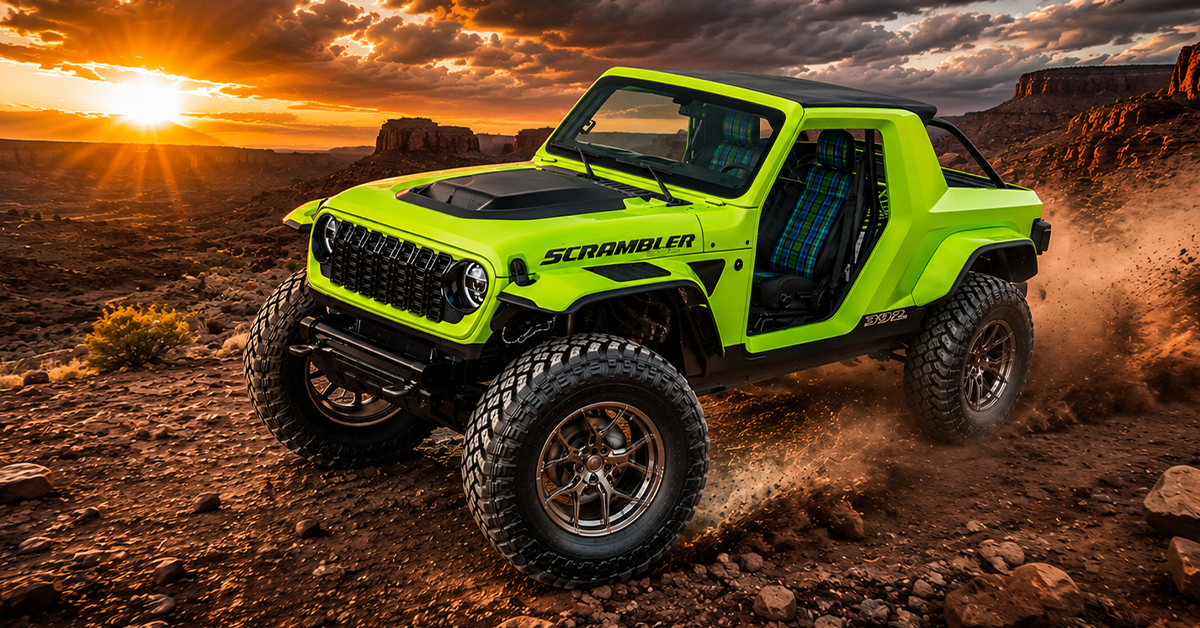
AI-generated concept illustration of the Jeep Wrangler Scrambler SRT — not an official Jeep image. | Rev N Rise
The Jeep Scrambler disappeared from showrooms in 1985. Forty-one years later, Jeep is bringing it back — and this time it has a supercharged 777-horsepower V8, backward-facing rear seats, a removable roof, independent front suspension and a shark nose design that nobody expected. Tim Kuniskis revealed the 3D-printed buck to a select group of journalists at the Stellantis Investor Day on May 21. No photos were allowed. What was described is extraordinary.
The original Jeep Scrambler — officially the CJ-8 — was produced from 1981 to 1985. It was essentially a Jeep CJ-7 with a stretched wheelbase and an open pickup bed — giving buyers the legendary off-road capability of the CJ in a format that could carry cargo as well as passengers. It was never a high-volume product. In four years of production, fewer than 30,000 were built. But it occupied a unique space in American automotive culture — a two-door open-air pickup that could go anywhere and carry anything — that nothing else in Jeep's lineup or any competitor's filled.
When the CJ was replaced by the Wrangler in 1987, the Scrambler variant did not survive the transition. Jeep has shown interest in reviving the concept multiple times — most notably with a series of pickup-bed Wrangler concepts at various Easter Jeep Safari events in Moab, Utah. The Gladiator, launched in 2020 as a four-door Wrangler-based pickup, was in some ways the spiritual successor to the Scrambler. But it was never the same thing. The Scrambler was two doors. It was compact. It was purpose-built for people who wanted a truck, not a family hauler. The new Scrambler restores all of that — and adds a supercharged V8 and SRT performance credentials that the original could never have imagined.
The Scrambler SRT buck shown to journalists at the Stellantis Investor Day on May 21 is a two-door Gladiator-based pickup truck — confirming that the Scrambler will use the Jeep Gladiator's ladder frame and overall architecture but significantly modified for the two-door configuration and SRT performance requirements. The doors are slightly longer than a standard Wrangler two-door — designed to allow easier access to the rear seating area, which features one of the most unusual details in any production vehicle announcement in recent memory: backward-facing rear seats.
The backward-facing rear configuration — similar to the seating in the rear of an old Land Rover Defender 110 or the jump seats in certain pickup trucks — means rear passengers face toward the bed of the truck rather than toward the windshield. A side step is integrated into the sill to provide easy entry to these rear seats. The concept is part utility, part theatre — particularly given what sits above those seats. The hardtop is removable on the rear section — like the K5 Chevrolet Blazer — while the front section uses Wrangler "freedom panels" that pop off with a few latches. In full open-air configuration, the Scrambler SRT would offer a driving experience closer to a purpose-built track toy than a conventional pickup truck.
The front end is described as a shark nose design with the top edge of the hood canting forward — an aggressive, forward-leaning stance. The headlights are squarish. A mail-slot intake runs across the top of the hood — providing both airflow and visual drama. The overall front end impression was described as a blend of the Convoy concept from the 2025 Easter Jeep Safari and the Wrangler Anvil 715 concept from the 2026 event — both of which previewed exactly this aesthetic direction.
No engine has been officially confirmed for the Scrambler SRT. But the designation tells the story. The SRT badge — Street and Racing Technology — has historically been applied to Jeep's highest-performance variants, and the most powerful engine available in the Jeep/Ram/Dodge ecosystem is the supercharged 6.2-litre Hellcat V8 producing 777 horsepower and 680 lb-ft of torque — the same unit that powers the Ram 1500 Rumble Bee SRT revealed just two days ago.
A naturally aspirated 6.4-litre 392 HEMI V8 is also possible for a lower-specification Scrambler variant — producing 470 horsepower in the Ram Rumble Bee 392's tune. The Grand Cherokee SRT and Grand Wagoneer SRT announced at the same Investor Day presentation are also expected to use the supercharged 6.2-litre unit. Given that the Scrambler SRT is the flagship Jeep performance product — the vehicle Kuniskis chose to headline his entire Jeep presentation — anything less than the Hellcat V8 would be a disappointment. The 777-horsepower figure should be treated as the most likely outcome.
One of the most significant technical details in the Scrambler SRT announcement is the suspension architecture. Jeep's senior vice president of product planning, Thomas Sacoman, confirmed to journalists that the Scrambler will have independent front suspension — a significant departure from the solid front axle that has defined Wrangler and Gladiator off-road dynamics for decades. Independent front suspension offers meaningfully better on-road handling, higher-speed stability and improved ride comfort compared to a solid axle — essential qualities for an SRT-designated performance vehicle.
The rear suspension situation is less certain. Sacoman initially described the rear as mirroring the independent front setup — suggesting IRS throughout. However, Kuniskis subsequently walked this back, saying Jeep is "trying" to get independent rear suspension into the production Scrambler. That qualification suggests IRS in the rear is an engineering aspiration rather than a confirmed specification — and that a traditional solid rear axle remains possible if the development targets cannot be met within the production timeline.
The Scrambler SRT is not the only SRT model Jeep confirmed at the Investor Day. Alongside the Scrambler announcement, Jeep confirmed SRT versions of the Grand Cherokee and Grand Wagoneer — two of the brand's highest-volume and highest-margin products in the US market. Both are expected to feature aggressive front fascias, street-focused suspension tuning and the supercharged 6.2-litre V8 — arriving by 2030 as part of Jeep's commitment to building 11 all-new nameplates and refreshing 12 existing models by the end of the decade under FaSTLAne 2030.
The SRT badge's return to Jeep — after several years of dormancy — is part of Tim Kuniskis's broader strategy of restoring emotional engagement to American brands that had lost it. The same philosophy produced the Ram Rumble Bee, the Dodge Charger SIXPACK and the Ram 1500 TRX. The SRT Scrambler is the most extreme expression of that strategy yet — a two-door, backward-seated, removable-roofed, supercharged V8 pickup truck that no other manufacturer in the world would build. That is entirely the point.
| Name | Jeep Wrangler Scrambler SRT |
| Body | 2-door Gladiator-based pickup truck |
| Seats | 4 — backward-facing rear seats |
| Doors | Slightly longer than Wrangler 2-door — easier rear access |
| Side Step | Integrated — for rear seat entry |
| Roof | Removable rear hardtop + Wrangler freedom panels front |
| Front End | Shark nose — canted hood — mail-slot intake — squarish headlights |
| Design References | Convoy concept (2025) + Wrangler Anvil 715 (2026) |
| Front Suspension | Independent — confirmed |
| Rear Suspension | IRS being attempted — not confirmed |
| Engine (likely) | 6.2L supercharged Hellcat V8 — ~777hp / 680 lb-ft |
| Engine (alt. option) | 6.4L 392 HEMI V8 — 470hp — lower spec |
| SRT Badge | Street and Racing Technology — highest Jeep performance tier |
| Also Confirmed SRT | Grand Cherokee SRT + Grand Wagoneer SRT |
| Current Status | 3D-printed buck — no photos allowed — not production ready |
| Production Target | 2030 |
| Revealed By | Tim Kuniskis — Stellantis Investor Day — May 21 2026 |
| Original Scrambler | 1981–1985 — CJ-8 — stretched CJ-7 — under 30,000 built |
| Price | TBC — expected well above $100,000 |
The Gladiator — Jeep's current pickup truck — is a competent, well-regarded vehicle that fills a genuine gap in the market. But it has never excited Jeep's core enthusiast community the way the Wrangler does. It is too long, too heavy and too family-oriented to capture the raw, purpose-built character that makes Jeep ownership an identity rather than a transaction. The Scrambler SRT addresses exactly this gap.
A two-door pickup with a supercharged V8, removable roof, backward-facing seats and independent front suspension is not a practical family vehicle. It is not trying to be. It is a vehicle for people who buy a Jeep specifically because they do not want a practical family vehicle — who want something that is faster, more unusual and more capable than anything else available. In the same week that Ram revealed the Rumble Bee and Dodge reconfirmed the SIXPACK, the Scrambler SRT is Jeep's answer to the same question: what do you build for the buyer who wants maximum character, maximum performance and nothing sensible? The answer, it turns out, is a two-door pickup truck with backward seats and a Hellcat V8.
The Jeep Wrangler Scrambler SRT is the most compelling Jeep announcement in decades. A two-door pickup truck with a supercharged V8, backward-facing rear seats, a removable roof, independent front suspension and a shark nose design that looks unlike anything in Jeep's current lineup. It exists right now only as a 3D-printed buck in a room that journalists could see but not photograph. Production is targeted for 2030. Four years is a long time in automotive. But the vision is clear, the commitment is confirmed and Tim Kuniskis is the person who made the TRX, the Rumble Bee and the Charger SIXPACK happen. When he shows you a buck, you pay attention. The Scrambler is coming.