 Brands
Stellantis FaSTLAne 2030 — €60 Billion, 60 New Cars and Four Brands That Matter

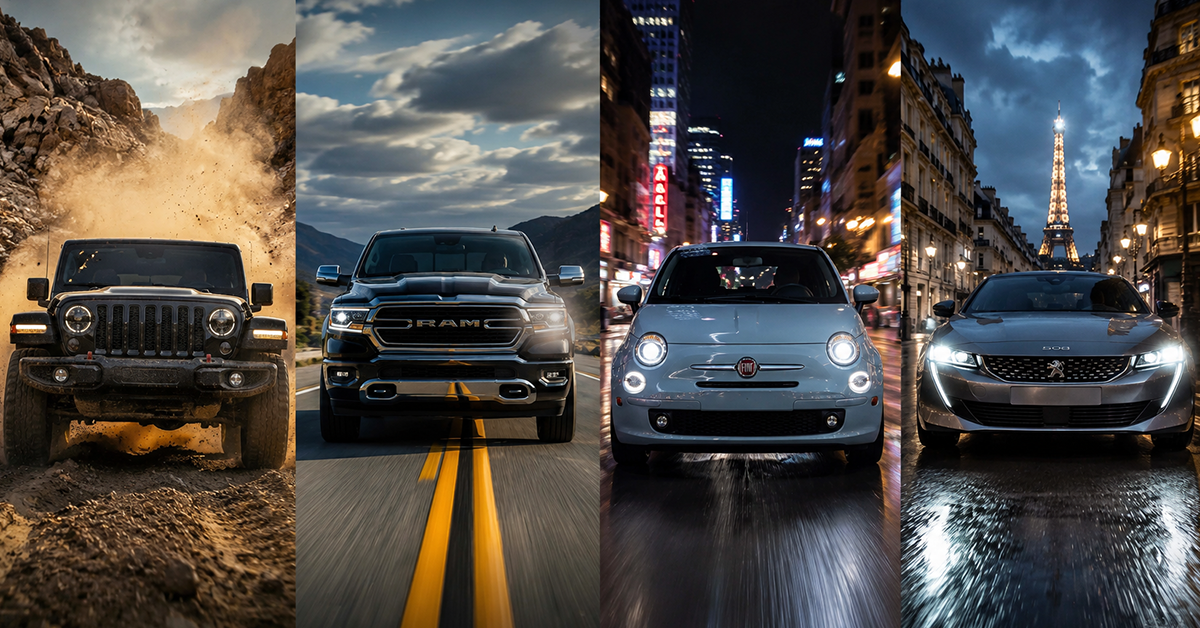
AI-generated concept illustration representing Stellantis FaSTLAne 2030 — not an official Stellantis image. | Rev N Rise
Stellantis just drew its line in the sand. At its Investor Day in Auburn Hills, Michigan today — the first under CEO Antonio Filosa — the world's fourth-largest automaker unveiled FaSTLAne 2030: a €60 billion five-year plan that includes 60 brand-new car models, 50 major refreshes, a hard focus on four priority brands and a target to cut annual costs by €6 billion by 2028. After two years of crisis, losses and leadership changes, Stellantis is telling the world it is back — and it has a very specific plan for what comes next.
FaSTLAne 2030 is Stellantis's new strategic plan — the roadmap that replaces the previous Dare Forward 2030 strategy that was abandoned when Stellantis's financial performance collapsed in 2025. The plan was unveiled today at Stellantis's North American headquarters in Auburn Hills, Michigan, presented by CEO Antonio Filosa in his first Investor Day since taking over the role. It is a comprehensive overhaul of how Stellantis will allocate its capital, manage its 14 brands and compete globally through the end of the decade.
The headline figure is €60 billion ($69.7 billion USD) in total investment over five years — split between €36 billion directed at brand and product launches and €24 billion toward global platforms, powertrains and new technologies. The product commitment is equally clear: more than 60 new vehicle launches and 50 significant model refreshes between now and 2030, spanning every powertrain type from fully electric to mild hybrid.
The most significant strategic decision in FaSTLAne 2030 is the concentration of investment. Stellantis has 14 brands — from Jeep and Ram in North America to Peugeot and Fiat in Europe to Alfa Romeo, Maserati, Dodge, Chrysler and Citroën in various markets. In FaSTLAne 2030, 70% of all brand and product investment is being directed at just four of those 14 brands: Jeep, Ram, Peugeot and Fiat, plus the Pro One commercial vehicle unit.
This is a decisive and overdue prioritisation. Jeep and Ram are Stellantis's most profitable brands globally — with the strongest pricing power, the highest margins and the most loyal buyer bases. Peugeot is Stellantis's highest-volume European brand and the standard-bearer for its European passenger car strategy. Fiat — particularly with the new 500 Hybrid now in production at Mirafiori — is the affordable entry point across Europe and select emerging markets. By concentrating 70% of investment in these four brands, Filosa is effectively acknowledging what analysts and investors have said for years: Stellantis had too many brands competing for the same resources, diluting the investment that each individual brand needed to compete effectively.
The remaining 30% of investment is distributed across the other 10 brands — Alfa Romeo, Maserati, Dodge, Chrysler, Citroën, Vauxhall/Opel, DS, Lancia, LEAPMOTOR and Chrysler. None are being discontinued — Filosa explicitly confirmed that all 14 brands continue. But the investment differential is significant. Brands outside the four priorities will receive fewer new models, slower refresh cycles and less marketing support than they would have received under the previous strategy.
The 60+ new vehicle launches by 2030 cover every powertrain in Stellantis's portfolio — a direct signal that the brand is abandoning the EV-only mandate of the previous strategy in favour of what CEO Filosa calls a "freedom of choice" approach. The breakdown is explicit: 29 battery-electric vehicles, 15 plug-in hybrid or range-extended electric vehicles, 24 hybrid electric vehicles and 39 internal combustion or mild hybrid vehicles. That is 107 total launches and refreshes — an extraordinary product commitment from a company that had largely stalled its new model pipeline during its 2025 crisis.
The ICE and mild hybrid commitment — 39 vehicles — is the most significant departure from the previous Dare Forward strategy, which had targeted a predominantly electric lineup by the late 2020s. Filosa's message is unambiguous: Stellantis will build the cars that customers in each market want to buy, rather than the cars that regulators or strategic plans dictate. In markets where EV demand is strong, Stellantis will lead with EVs. In markets where it is not, Stellantis will continue to offer combustion-powered vehicles competitively priced and well-specified.
FaSTLAne 2030's financial framework centres on a Multi-year Value Creation Program targeting €6 billion in annual cost savings by 2028 — measured against a 2025 baseline. This is an aggressive target that will require significant structural changes across Stellantis's global manufacturing and supply chain operations. European manufacturing capacity is being reduced by over 800,000 units — a direct acknowledgement that Stellantis has significantly more factory space in Europe than its current sales volumes can fill. Factory utilisation is targeted to rise from approximately 60% to 80% — a threshold that would make European manufacturing genuinely cost-competitive.
The mechanism for achieving this includes plant repurposing, partnerships and localised product strategies — and most significantly, contract manufacturing. Stellantis has confirmed it will use its underutilised factories to manufacture vehicles for other brands — with the JLR collaboration announced yesterday being the most prominent example. A Stellantis plant building Land Rover vehicles generates revenue from otherwise idle capacity while JLR avoids the cost and time of building its own US factory. Both sides benefit. This is the logic that will be repeated across multiple partnerships as FaSTLAne 2030 progresses.
Maserati — one of the brands outside the four priorities — received specific attention in the FaSTLAne 2030 presentation. Stellantis confirmed that two new E-segment vehicles are planned for Maserati — premium, high-value models that justify the brand's positioning as a pure luxury nameplate. A detailed Maserati roadmap will be presented separately in Modena in December 2026. The choice of Modena — Maserati's spiritual home — for the roadmap presentation is deliberate. It is a signal that Maserati's future is being taken seriously even as it sits outside the four-brand priority group.
| Plan Name | FaSTLAne 2030 |
| Announced | May 21 2026 — Auburn Hills, Michigan |
| CEO | Antonio Filosa — first Investor Day as CEO |
| Total Investment | €60 billion ($69.7 billion USD) — 5 years |
| Brand + Product Investment | €36 billion |
| Platform + Technology Investment | €24 billion |
| New Vehicle Launches | 60+ by 2030 |
| Model Refreshes | 50 significant refreshes |
| BEVs | 29 battery-electric vehicles |
| PHEVs / REEVs | 15 plug-in hybrid + range-extended EVs |
| HEVs | 24 hybrid electric vehicles |
| ICE / MHEV | 39 combustion + mild hybrid vehicles |
| 4 Priority Brands | Jeep, Ram, Peugeot, Fiat — 70% of brand investment |
| Also Priority | Pro One — commercial vehicles |
| All 14 Brands | Continue — none discontinued |
| Cost Savings Target | €6 billion annual savings by 2028 vs 2025 |
| Europe Capacity Cut | 800,000+ units — utilisation 60%→80% |
| Contract Manufacturing | Stellantis plants to build other brands' vehicles — incl. JLR |
| Maserati | 2 new E-segment vehicles — roadmap December 2026 — Modena |
| New Global Platform | STLA One — covers B, C, D segments — 70% component reuse |
| First STLA One Model | Peugeot 208 — 2027 |
| North America Investment | ~60% of total — highest regional allocation |
| Tech Partners | Qualcomm, NVIDIA, Wayve, Mistral AI |
| Leapmotor / Dongfeng | Expanded partnerships — Europe + China |
| Elkann on the plan | "Ambitious, but realistic" — John Elkann, Chairman |
| Stock reaction | -6% on day — trading briefly suspended |
| Q1 2026 Net Profit | €377 million — back to profit after 2025 loss |
One of the most significant technical announcements in FaSTLAne 2030 is the confirmation of a brand-new global platform called STLA One. This modular architecture will cover the B, C and D segments — from small affordable hatchbacks up to mid-size family cars — and is designed with up to 70% component reuse across models built on it. By 2030, Stellantis targets 50% of its total global volume produced on just three global platforms, including STLA One. The efficiency gains from this level of platform consolidation are significant — fewer unique parts to develop, source, manufacture and stock — directly supporting the €6 billion cost savings target.
The first STLA One model is confirmed to be the next-generation Peugeot 208, arriving in 2027. The platform will also underpin future Citroën, Fiat and Opel/Vauxhall products — giving Europe's most affordable Stellantis models a shared architecture that dramatically reduces per-unit development costs while maintaining each brand's distinct identity.
While FaSTLAne 2030 is a global plan, its capital allocation is decidedly North American. Stellantis confirmed that North America will receive approximately 60% of total investment — the largest single regional allocation by a significant margin. Filosa was explicit about why: "It is our biggest opportunity in terms of growth and profit." The US and Canadian markets — where Jeep and Ram command premium pricing and strong margins — represent Stellantis's most profitable territory. Directing the majority of investment there is a financial decision as much as a strategic one.
Europe, by contrast, is primarily a rationalisation story in FaSTLAne 2030. Capacity is being cut, costs are being reduced and manufacturing is being consolidated. European growth will come from the STLA One platform's affordable models and from the contract manufacturing partnerships — not from aggressive new investment in premium European-market products.
FaSTLAne 2030 is not purely a product and manufacturing plan. Stellantis confirmed a series of technology partnerships that will define its vehicles' software and AI capabilities through the decade. Qualcomm provides the chip architecture for Stellantis's connected vehicle platforms. NVIDIA powers the AI computing infrastructure for autonomous and semi-autonomous driving features. Wayve — the British AI driving company — contributes its neural network-based driving model. And Mistral AI — the French large language model company — provides the conversational AI layer for in-vehicle assistants across Stellantis brands.
This partnership approach — buying in best-in-class technology rather than building it in-house — is a direct lesson from the failures of the previous strategy, which attempted to develop proprietary software at enormous cost and with limited success. Filosa's technology approach is pragmatic: let the best technology companies provide the technology, and let Stellantis focus on what it does best — designing and building vehicles that customers want to buy.
Stellantis's stock fell more than 6% during the Investor Day presentation — with trading suspended briefly due to the speed of the decline. The market's reaction reflects a tension at the heart of FaSTLAne 2030: the plan is coherent and credible, but it is fundamentally a plan for catching up rather than for breaking ahead. The €60 billion investment is being spent largely on correcting the mistakes of the previous strategy — rebuilding product pipelines that were starved of investment, filling factories that were idled, restoring brand reputations that were damaged. Investors appear to have hoped for evidence of a new competitive advantage rather than a roadmap for recovery.
Stellantis Chairman John Elkann — a member of the Agnelli family that controls Stellantis through Exor — called the plan "ambitious, but realistic" during his remarks at the event. That qualifier — realistic — is both the plan's greatest strength and its greatest limitation. It is a plan built on things that are achievable. Whether achievable is enough to rebuild Stellantis's competitive position against Toyota, Volkswagen, Hyundai and the rapidly advancing Chinese brands is the question the next four years will answer.
For buyers of Jeep and Ram vehicles — the two most important Stellantis brands in North America — FaSTLAne 2030 is straightforwardly good news. The concentration of 70% of brand investment into four brands means more new Jeep models, more new Ram models, faster refresh cycles and stronger product investment than would have been possible under a 14-brand-equal approach. The Jeep Cherokee's return, the Ram Rumble Bee revealed yesterday and the Ram Dakota mid-size truck are all early evidence of this investment in action.
Jeep's global ambition — positioning the brand as the premium off-road choice across North America, Europe, Middle East and Australia — is central to FaSTLAne 2030. New Jeep models confirmed for the plan period include electrified versions of core nameplates alongside traditional off-road ICE variants. The "freedom of choice" philosophy means Jeep buyers in Australia who want a petrol Wrangler will continue to get one. Jeep buyers in Europe who want a plug-in hybrid Grand Cherokee will continue to get that too.
The honest question about FaSTLAne 2030 is whether it is credible — not whether it is ambitious. Stellantis announced ambitious plans under its previous CEO too. What is different about Filosa's plan is its specificity and its realism. The €60 billion figure is not aspirational — it is a funded commitment backed by the €49.8 billion in available liquidity that Stellantis reported at the end of 2025. The four-brand focus is not a vague priority statement — it is a specific capital allocation decision with a clear percentage. The cost savings target is not a hope — it is a programme with defined initiatives already underway.
Stellantis returned to profit in Q1 2026 — €377 million net profit on €38.1 billion in revenue — after the devastating €22.3 billion net loss of 2025. The recovery is early and fragile. But FaSTLAne 2030's combination of product investment, cost discipline and partnership strategy provides a credible framework for sustaining it. The automotive industry will be watching Auburn Hills very closely for the next four years.
"Every brand in Stellantis will play a clear role in delivering our FaSTLAne 2030 commitments."
— Antonio Filosa, CEO, Stellantis — Investor Day, May 21 2026FaSTLAne 2030 is the most coherent strategic plan Stellantis has presented in years. €60 billion. 60 new cars. Four priority brands. A genuine commitment to ICE alongside EVs. A cost programme with real targets. And a partnership strategy — with JLR, with Dongfeng — that turns idle factory capacity into a revenue stream. Whether it delivers will depend on execution. Stellantis has promised big before and delivered less. But Filosa's plan has something that its predecessor's did not: a clear acknowledgement of what went wrong, a specific set of decisions about what to change, and the financial resources to back those decisions up. The next four years will tell us whether it was enough.