 Brands
Mahindra — History, Models and Everything You Need to Know
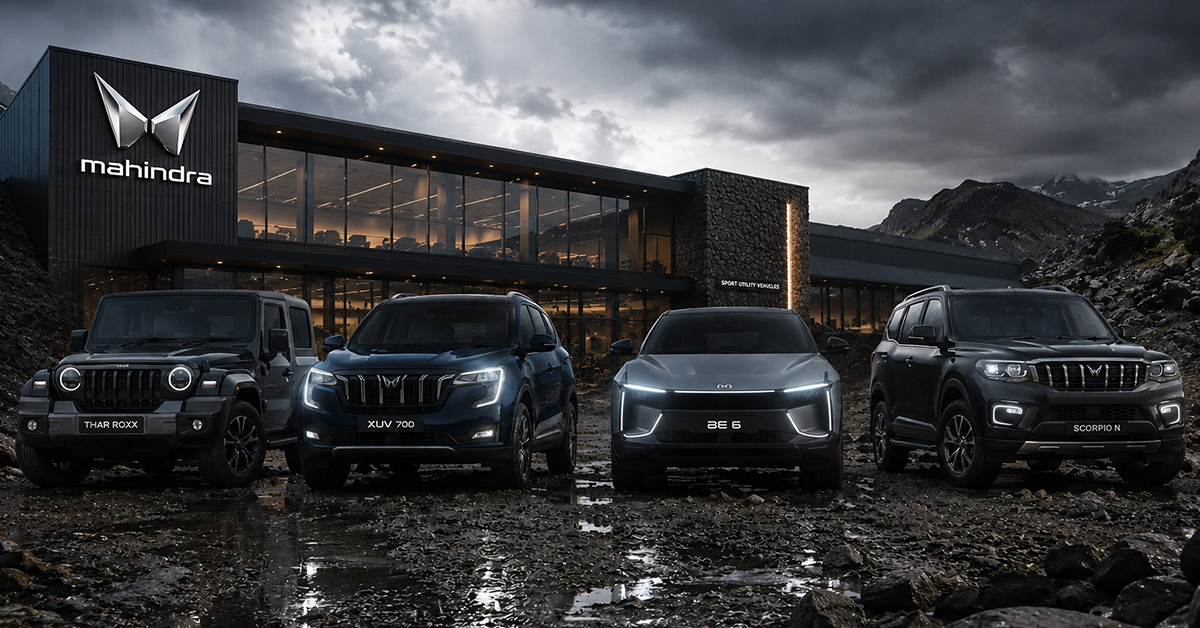
AI-generated concept illustration — Mahindra brand overview. | Rev N Rise
Mahindra is India's most aspirational homegrown car brand — the manufacturer of the iconic Thar off-roader, the rugged Scorpio and the XUV series that has dominated India's SUV segment for years. Founded in 1945 and built on the foundation of Willys Jeep assembly, Mahindra has grown into a global automotive and industrial group whose reach extends from Indian farms to Formula E race tracks and whose new INGLO electric platform signals a serious tilt at the global EV market.
J.C. Mahindra and K.C. Mahindra founded Mahindra & Mohammed in 1945 in Mumbai — a steel trading company established in partnership with Ghulam Mohammad. The partnership dissolved when Mohammad became Pakistan's first Finance Minister after Partition in 1947, and the company was renamed Mahindra & Mahindra. The brothers secured a licence to assemble Willys Jeeps for the Indian market in 1947 — a decision that defined the company's character for the next 75 years. The rugged, go-anywhere philosophy of the Willys Jeep became Mahindra's core product identity.
Through the 1950s, 1960s and 1970s Mahindra expanded from Jeep assembly into indigenous vehicle design — producing trucks, tractors and utility vehicles that became essential to Indian agriculture and industry. The Mahindra CJ series — Willys-derived Jeeps produced under licence — became ubiquitous across rural India. When the licence arrangement changed, Mahindra developed its own derivative vehicles, maintaining the Jeep's go-anywhere character with Indian engineering.
The modern Mahindra story accelerated dramatically in the 2000s. The Scorpio of 2002 was Mahindra's breakthrough premium SUV — a vehicle designed entirely in-house that competed directly with imported SUVs at a fraction of the price and became one of India's most aspirational vehicles. The XUV500 of 2011 — a seven-seat SUV with European styling ambitions — demonstrated that Mahindra could produce globally competitive designs. And the Thar revival of 2020 became one of independent India's most celebrated automotive launches — a modern off-road icon with waiting lists extending months across every major Indian city.
The Mahindra Thar is the most emotionally significant vehicle in the Indian market — the country's answer to the Jeep Wrangler and Land Rover Defender, built for a fraction of their price and equally capable on India's most challenging terrain. The second generation Thar — launched in October 2020 — arrived with a completely new platform, modern safety features, a significantly more premium interior and a choice of petrol and diesel engines. The response was extraordinary. Over 75,000 bookings were received in the first week. Waiting periods stretched to six months or more across India.
The Thar's appeal is deeply cultural — it represents freedom, adventure and Indian manufacturing ambition in a single product. Its removable roof, fold-down windscreen and genuine 4WD capability give it authentic off-road credentials. Its new generation's vastly improved interior quality and safety ratings give it credibility with a broader buyer demographic than the original ever achieved. The Thar Roxx — a five-door version launched in 2024 — extended the Thar's appeal to family buyers who wanted the icon's character in a more practical package.
Mahindra's most significant recent investment is the INGLO electric platform — co-developed with Volkswagen Group technology — on which the BE 6 and
Mahindra's competitive advantage in India is its authentic off-road heritage and its deep understanding of Indian buyers — the terrain they drive on, the aspirations they hold and the value they demand. No other Indian brand carries the Thar's emotional weight or the Scorpio's rural India street credibility. The XUV 700's ADAS safety features — lane keep assist, autonomous emergency braking, driver drowsiness detection — at Indian market prices was a landmark moment for affordable safety technology in a developing market. And the BE 6 and XEV 9e's premium positioning on the INGLO platform suggests that Mahindra's next decade will be defined by the question of whether an Indian brand can build genuinely world-class electric vehicles — not just affordable ones. The early reception of both models suggests the answer may well be yes.