 Brands
Tata Motors — History, Models and Everything You Need to Know
AI-generated concept illustration — Tata Motors brand overview. | Rev N Rise
Tata Motors is India's most internationally significant automotive company — the manufacturer that owns Jaguar Land Rover, leads India's electric vehicle market with the Nexon EV and builds everything from affordable city cars to heavy commercial vehicles. Founded in Mumbai in 1945 as part of the Tata Group conglomerate, Tata Motors has become a global automotive force whose reach extends from Indian rural roads to British motorways.
Tata Motors was established in 1945 in Mumbai as TELCO — Tata Engineering and Locomotive Company — a division of the Tata Group, the Indian industrial conglomerate founded by Jamsetji Tata in the 19th century. The company initially manufactured locomotives and other heavy engineering products under licence from Daimler-Benz before pivoting exclusively to commercial vehicles in the 1950s and 1960s. The first Tata truck rolled off the production line in 1954 — beginning a commercial vehicle programme that would make Tata the dominant force in Indian trucking for decades.
Tata entered the passenger car market in 1991 with the Tata Sierra — India's first indigenous multi-utility vehicle — and followed with the Tata Estate and the landmark Tata Indica in 1998. The Indica was India's first fully indigenous passenger car — designed, developed and manufactured in India without foreign technology licence — and its launch was a moment of enormous national industrial pride. The Indica became one of India's best-selling cars and established Tata as a serious passenger car manufacturer.
The most audacious chapter in Tata Motors' history came in 2008 with two announcements. First, the launch of the Tata Nano — the world's cheapest production car at approximately £1,200 — which attracted global attention for its remarkable engineering ambition of providing affordable four-wheel transport for Indian families. Second and more consequentially, Tata Motors' acquisition of Jaguar Land Rover from Ford for £1.15 billion — transforming an Indian commercial vehicle manufacturer into the owner of two of Britain's most prestigious automotive brands overnight.
The acquisition of Jaguar Land Rover in 2008 was widely questioned at the time — sceptics wondered whether an Indian commercial vehicle manufacturer could successfully manage two iconic British luxury brands. The results have comprehensively answered those critics. Under Tata's ownership, JLR has invested heavily in new platforms, new models and new technology — producing its strongest and most acclaimed product lineup in history. The Range Rover fifth generation, the Jaguar F-Pace, the Defender revival and the I-Pace electric SUV all arrived under Tata's stewardship. JLR is now consistently one of Tata Motors' most profitable business units and generates revenue that dwarfs Tata's domestic Indian operations.
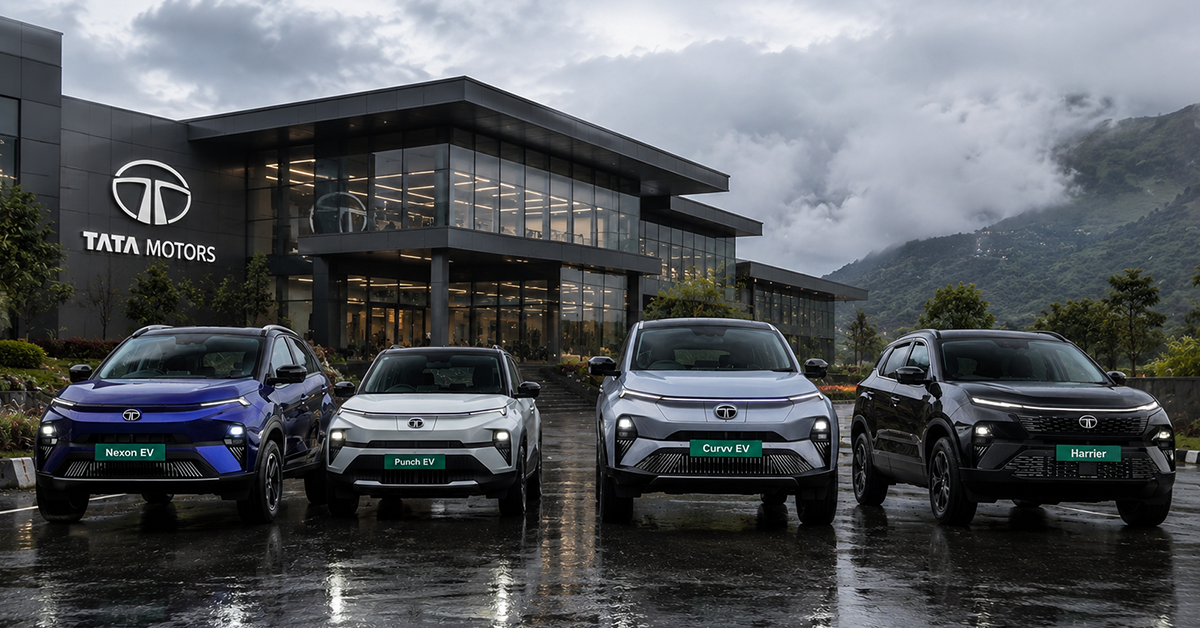
Tata Motors has established itself as the dominant force in India's electric vehicle market — a position achieved through early investment in EV technology and a product strategy that offered realistic, affordable electric vehicles before any competitor. The Tata Nexon EV — launched in 2020 on the Ziptron platform — became India's best-selling electric vehicle almost immediately and has maintained that position for multiple years. The Tata Tiago EV — launched in 2022 as India's most affordable electric car — democratised EV ownership for a new segment of Indian buyers. Tata's aggressive expansion of its EV portfolio through the Punch EV, Curvv EV and upcoming models has given the brand a commanding position that rivals including Hyundai, MG and Mahindra have been unable to meaningfully challenge.
Tata Motors' story is one of the most remarkable in the automotive world — a company that began making locomotives, built India's first indigenous car, launched the world's cheapest production vehicle and then bought Jaguar Land Rover. Its diversity is extraordinary: it makes city EVs for Indian urban buyers, luxury SUVs for British country estates and heavy trucks for African mining operations. In India, Tata's EV leadership is built on the recognition that electrification requires accessible price points — the Tiago EV's sub-₹9 lakh starting price (approximately £8,500) has brought electric mobility to buyers who could never have considered a Tesla or a Hyundai Ioniq. And JLR's ongoing success under Tata's ownership demonstrates that the acquisition, however unexpected it seemed in 2008, was one of the most strategically astute industrial decisions of the 21st century.