 Brands
McLaren W1 vs Ferrari F80 — Which Hypercar Wins?

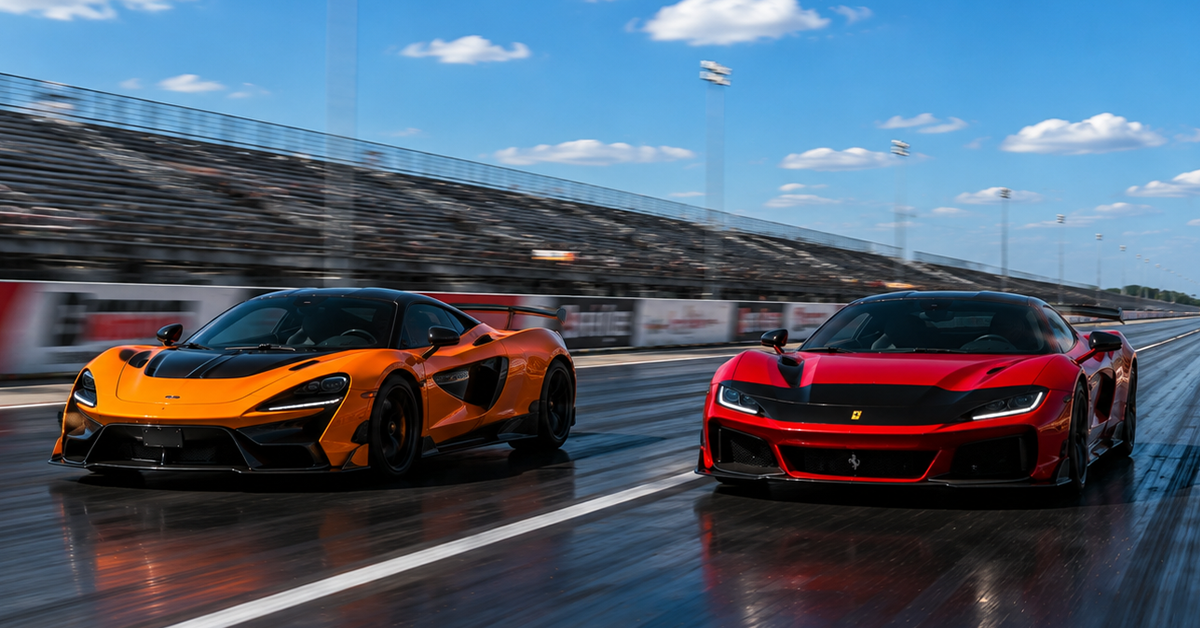
AI-generated concept illustration of the McLaren W1 and Ferrari F80 — not official images. | Rev N Rise
The Ferrari F80 wins on outright performance — more horsepower, all-wheel drive and a faster 0-60 time, but it costs $1.8 million more. The McLaren W1 is the better choice for driving purity — rear-wheel drive only, lighter, and significantly cheaper within the hypercar segment at $2.1 million. Both sold out before being fully revealed, and both represent their respective brand's most powerful road car ever built.
Two of the most exclusive manufacturers on earth, two flagship halo cars revealed within weeks of each other, and two completely different philosophies about what a modern hypercar should be. The McLaren W1 and Ferrari F80 are shaping up to be this generation's defining rivalry — following directly in the footsteps of the McLaren P1, Ferrari LaFerrari and Porsche 918 Spyder before them. Having studied every specification, every engineering decision and every number behind both cars, this is the most complete comparison of the two available anywhere.
| Specification | McLaren W1 | Ferrari F80 |
|---|---|---|
| Starting Price | $2.1 million Winner | $3.9 million |
| Combined Output | 1,258 hp | 1,184 hp |
| Drive | Rear-wheel drive | All-wheel drive Winner |
| 0-60 / 0-62 mph | 2.7 sec | 2.15 sec Winner |
| Top Speed | 217 mph | 217.5 mph |
| Dry Weight | 3,084 lbs Winner | 3,362 lbs |
| Engine | 4.0L twin-turbo V8 | 3.0L twin-turbo V6 |
| Max Downforce | 650 kg | 1,050 kg Winner |
| Production Run | 399 units | 799 units Winner |
| Driving Purity | Rear-drive analogue feel Winner | AWD-assisted traction |
| Racing Heritage | Formula 1-derived | Le Mans 499P-derived |
| "1" Nameplate Lineage | 3rd — F1, P1, W1 | 6th — GTO, F40, F50, Enzo, LaFerrari, F80 |
| Allocation Status | Sold out | Sold out |
The price gap between these two cars is enormous even by hypercar standards. The McLaren W1 starts at approximately $2.1 million, while the Ferrari F80 starts at roughly $3.9 million — a difference of $1.8 million, or almost double the W1's entire price. That gap is especially notable given the W1 actually produces more combined horsepower than the F80. Whether that premium for the F80 is justified depends entirely on how much value you place on all-wheel drive, Ferrari's badge, and the additional downforce and traction the F80's more complex system delivers.
On paper, the Ferrari F80 is the quicker car in a straight line — its 2.15-second 0-62mph time beats the McLaren W1's 2.7-second 0-60mph time by more than half a second, a genuinely significant margin at this level. The F80's all-wheel-drive system is the primary reason, putting power down through all four corners rather than asking the rear tyres alone to manage everything.
But the W1 actually has the power advantage — 1,258 horsepower versus the F80's 1,184 horsepower — and it carries that power in a lighter body, at 3,084 pounds versus the F80's 3,362 pounds. The W1's rear-wheel-drive system also means every one of those horsepower has to be managed through two tyres rather than four, which is precisely the trade-off McLaren chose deliberately, prioritising feel and connection over the lowest possible 0-60 number.
This is where the two cars diverge most fundamentally. McLaren built the W1 around an entirely new 4.0-litre twin-turbo V8, designed from scratch, and made the deliberate decision to keep it rear-wheel-drive only — the same philosophy that governs Formula 1 cars, where McLaren's racing heritage runs deepest. Ferrari, by contrast, took its biggest risk in decades by replacing its traditional naturally-aspirated V12 with a 3.0-litre twin-turbo V6 lifted directly from its Le Mans-winning 499P race car, then added its first-ever all-wheel-drive system to a flagship halo car.
Both approaches are genuinely radical for their respective brands. McLaren's bet is that purity and weight discipline matter more than outright traction. Ferrari's bet is that motorsport-derived hybrid technology and all-wheel drive represent the future of the halo car, even at the cost of abandoning the V12 soundtrack that defined its last three flagships. Neither is wrong — they're just different answers to the same question.
Neither car can actually be bought new at this point — both the W1's 399 units and the F80's 799 units sold out before either car was fully revealed to the public. That said, the F80's production run is exactly double the W1's, meaning slightly more units exist in the world and, in theory, slightly more opportunity on the secondary market over time. Expect both to command significant premiums above their original list prices for years to come.
| Category | McLaren W1 | Ferrari F80 |
|---|---|---|
| Price | ✓ Winner | — |
| 0-60 Sprint | — | ✓ Winner |
| Power-to-Weight | ✓ Winner | — |
| Downforce | — | ✓ Winner |
| Driving Purity | ✓ Winner | — |
| Engineering Risk | Draw | Draw |
| Overall Winner | 3 Wins | 2 Wins |
On the numbers: McLaren W1. More power, less weight, rear-wheel-drive purity and $1.8 million less money. The W1 wins this comparison on the metrics that matter most to genuine driving enthusiasts, and it does so while costing dramatically less than its closest rival.
For outright speed and traction: Ferrari F80. If the 0-60 number and the security of all-wheel drive matter most to you, the F80's e-4WD system and Le Mans-derived powertrain deliver something the W1 simply cannot match — at a price that reflects it.
The short answer: Buy the W1 for the purest hypercar experience at the lower price. Buy the F80 if you want the faster car and don't mind paying nearly double for it.