 Brands
Mitsubishi Pajero Is Officially Back — Here's Everything Confirmed So Far

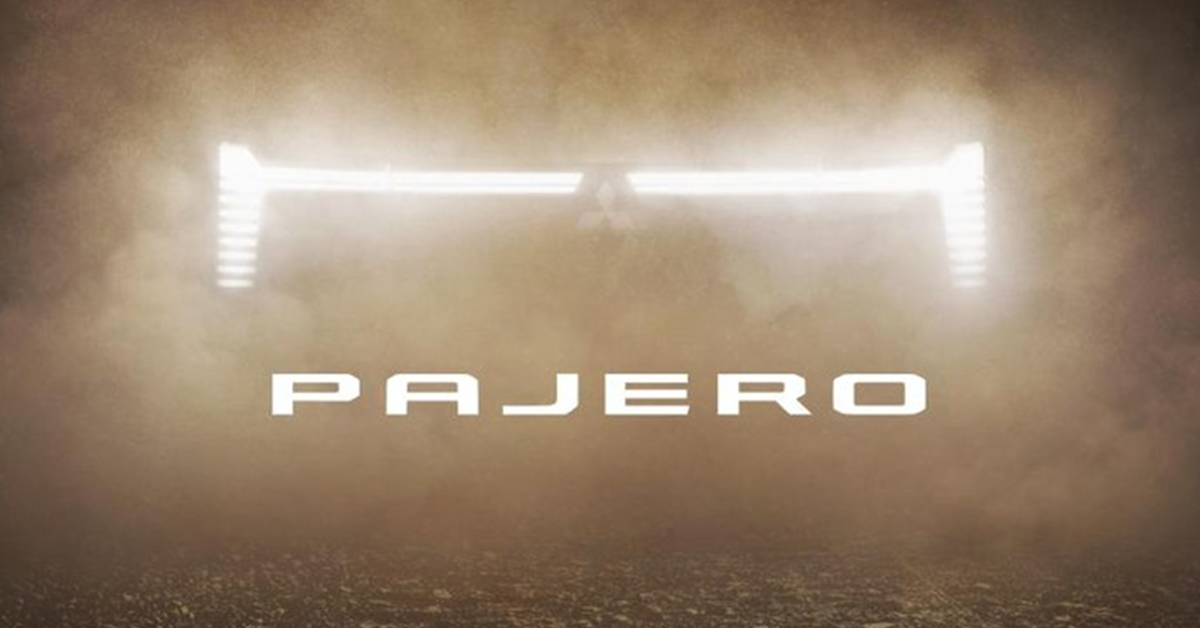
Official teaser image of the returning Mitsubishi Pajero. | © Mitsubishi Motors
One of the most iconic names in off-road history is coming back from the dead. Mitsubishi has officially confirmed the Pajero nameplate is returning for a fifth generation, ending a five-year absence from global showrooms. This time it's built on a tougher, more traditional foundation than the model that bowed out in 2021 — and the timeline for getting one is now locked in.
Mitsubishi's head office in Japan has confirmed what had been one of the automotive industry's worst-kept secrets for months: the all-new, fifth-generation Pajero will make its global debut in autumn 2026, broadly meaning the third quarter of the year, between roughly August and November depending on region. The automaker released an official teaser image alongside the announcement, describing the new Pajero as a flagship model that "embodies Mitsubishi Motors' spirit of adventure and determination to take on challenges."
Crucially, this is being positioned as Mitsubishi's "first return to the global market in five years," language that confirms the new Pajero is intended as a genuine worldwide model rather than a region-specific product. Pre-orders are expected to open shortly after the global reveal, with first customer deliveries beginning in December 2026 in markets like Australia — meaning some buyers could realistically be driving the new Pajero before the year is even out.
The most significant engineering change is the return to body-on-frame, ladder-frame construction — the same fundamental approach used by the very first Pajero when it launched in 1982. The previous, fourth-generation Pajero, sold from 2006 until its 2021 discontinuation, used unibody construction instead. This new model effectively reverses that decision, swapping car-like unibody architecture for a genuine truck-style separate chassis underneath.
The new Pajero shares its ladder-frame platform directly with the current Mitsubishi Triton pickup truck, and will reportedly be built in Thailand alongside it. Mitsubishi says the Pajero will receive "model-specific development of the cabin and front and rear suspension" to give it its own dynamic character distinct from the Triton — including an entirely different LED headlight signature shown in the official teaser, rather than simply being a rebadged pickup-based SUV.
Reports converge on the new Pajero carrying over the Triton's 2.4-litre twin-turbo-diesel engine, likely producing around 150kW (204PS) and 470Nm of torque in its strongest configuration, alongside Mitsubishi's well-regarded Super Select II full-time four-wheel-drive system — a feature that lets the Pajero be driven in 4WD mode even on sealed roads, something most rivals can't do. Dealer sources have suggested an eight-speed automatic transmission could replace the Triton's existing six-speed unit, though this remains unconfirmed.
Diesel power is expected to lead the initial launch, but it won't be the only option for long. Mitsubishi is reportedly developing a hybrid system for the Pajero, internally referred to in some reports as the "P2" system, likely pairing a turbocharged petrol engine with an electric motor positioned between the engine and transmission while preserving genuine 4WD capability. Petrol-only variants are also expected for markets in the Middle East and parts of Latin America, where buyers favour already-proven combustion technology over newer alternatives.
| Global Debut | Q3 2026 (Aug–Nov) |
| First Deliveries | December 2026 |
| Chassis | Ladder-frame (shared with Triton) |
| Build Location | Thailand |
| Launch Engine | 2.4L twin-turbo diesel — up to 204PS / 470Nm |
| 4WD System | Super Select II full-time 4WD |
| Future Powertrain | Hybrid ("P2" system) in development |
| Italy Distribution | Confirmed via Bassadone Auto agreement |
| Key Rivals | Toyota Land Cruiser Prado, Ford Everest, Isuzu MU-X, Nissan Patrol |
With a record-setting seven consecutive victories and twelve overall wins, Mitsubishi closed the curtain on its Dakar Rally dominance — records that have never been broken.
— On the Pajero's Dakar Rally legacy, 1985–2007The Pajero name carries serious motorsport weight. Various generations of the Pajero won the brutal Dakar Rally 12 times between 1985 and 2007, including seven consecutive victories from 2001 to 2007 — a achievement that earned Mitsubishi a Guinness World Record for the most Dakar Rally wins by any manufacturer, a record that still stands today. That heritage is a big part of why this nameplate's return matters so much to enthusiasts, rather than it simply being another new SUV name.
There's also a curious linguistic wrinkle behind the global rollout. In Spain, "Pajero" translates literally as a vulgar insult, which is why Mitsubishi has historically sold the same vehicle as the Montero in Spain, North America and most of Latin America, and as the Shogun in the United Kingdom. Reports indicate the official teaser for the new model references both the Pajero and Montero names together, underlining Mitsubishi's intent to push this as a genuinely global nameplate from day one.
For Italian buyers specifically, this isn't just a new model launch — it's a homecoming. The Pajero first arrived in Italy in 1983, a year after its original Japanese debut, and built a loyal following over four generations before quietly disappearing from European price lists as the previous generation was phased out from 2018 onward. Mitsubishi has already laid the groundwork for the nameplate's Italian return through a confirmed distribution agreement with Bassadone Auto for the new range, well ahead of the car's actual on-sale date.
Pricing for Italy and Europe hasn't been announced, but industry chatter from Japan suggests Mitsubishi could position the new Pajero more competitively than direct rivals like the Toyota Land Cruiser, which currently starts at roughly €84,000 in Europe. Whether the new Pajero actually reaches European showrooms at all remains slightly uncertain given the declining popularity of large dedicated off-roaders on the continent — but the Italy distribution deal is a strong signal that Mitsubishi intends to try.
Returning to a ladder-frame chassis puts the new Pajero in direct competition with some of the toughest, most capable SUVs still on sale — the Toyota Land Cruiser Prado and full-size 300 Series, the Nissan Patrol, the Ford Everest, the Isuzu MU-X, and increasingly serious competition from Chinese rivals like the GWM Tank 500. To genuinely compete, the new Pajero will likely need towing capacity in the region of 3.5 tonnes and a properly premium-feeling interior, complete with a large touchscreen and heated, ventilated seats, to match what buyers in this segment now expect as standard.
This is exactly the kind of comeback enthusiasts dream about and manufacturers rarely deliver. Going back to a real ladder-frame chassis after the last generation went soft with unibody construction shows Mitsubishi genuinely listened to what made the Pajero special in the first place. Pairing that with the Triton's proven diesel and Super Select II 4WD system gives the new Pajero real off-road credibility from day one, while the promised hybrid option down the line should keep it relevant as emissions rules tighten. The Dakar heritage alone makes this one of the most emotionally significant nameplate revivals in recent memory. The big question now is pricing — get that right against the Land Cruiser Prado and Ford Everest, and Mitsubishi could have its most important model launch in over a decade.