 Brands
Lucid's $50K Cosmos Just Leaked in Patent Filings

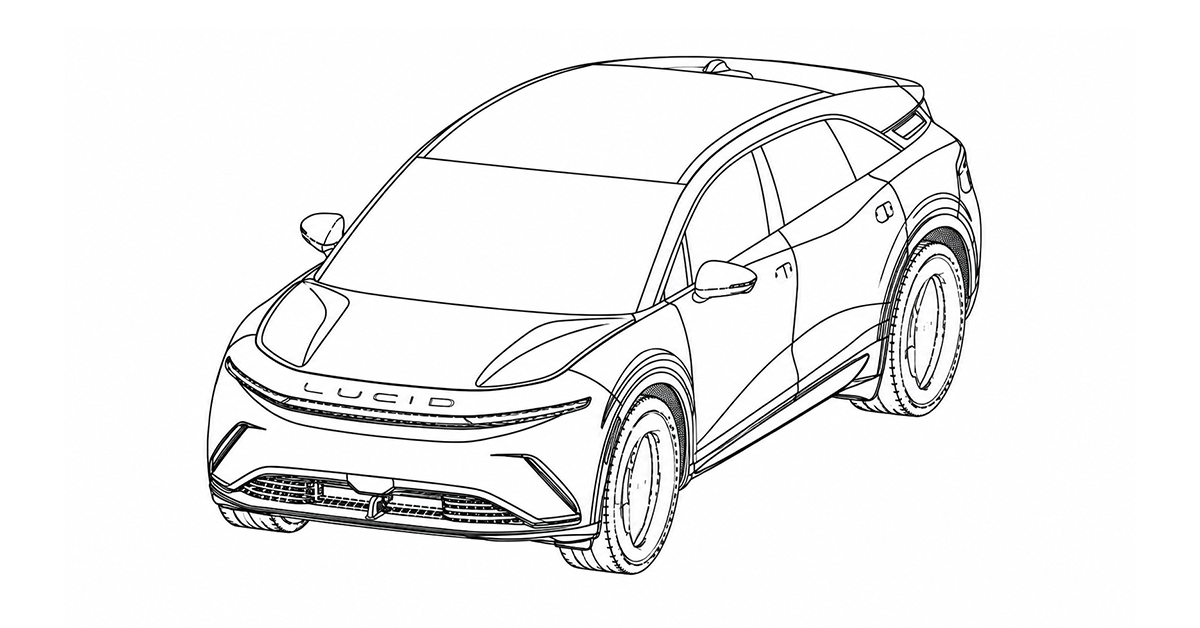
Design drawing from Lucid's EU Registered Community Design filing (No. 015142895), enhanced for clarity. | Source: EUIPO/WIPO
Lucid's most important car yet wasn't supposed to be seen this early. But thanks to a design patent filing, we now have a real look at the Cosmos — the sub-$50,000 EV that Lucid is counting on to finally turn it into a genuine mainstream automaker rather than a niche luxury brand burning cash.
If you were hoping for a radical design departure, you'll be disappointed — the Cosmos, at least as represented in the patent drawings, doesn't deviate far from the styling language already established by the Air sedan and the Gravity SUV. But the proportions are genuinely different. The Cosmos loses the slightly minivan-like stance of the larger Gravity and turns the same basic shape into something noticeably sleeker and lower. The wheels do a lot of the visual work here — in side profile they look almost comically large, rising nearly to the door handles, similar to the oversized wheel treatment on the Gravity but pushed even further on this smaller body.
The filings reveal more than one variant. Alongside the sleek standard shape, there's a second, ruggedized version with aggressive bumper cladding and jutting front and rear protection — almost certainly the off-road grade that Lucid has already confirmed is coming, in the same vein as the Toyota RAV4 Woodland or Hyundai Ioniq 5 XRT. The face on that variant is clearly derived from the Gravity X concept Lucid revealed last year. Inside, the patents show a nearly full-width screen sitting above a vent trim spanning the cabin, with no traditional center touchscreen — instead, two physical control dials in the center console appear to handle functions a center screen normally would.
Getting an EV under $50,000 without losing money on every unit is one of the hardest problems in the industry, and Lucid's approach centers on two new pieces of hardware. A new drive unit called Atlas uses 30% fewer parts than Lucid's current Zeus motors and offers a 37% cost advantage, with the same unit usable on both the front and rear axle — eliminating the need to engineer and produce two separate motor designs. A new battery pack architecture also brings a 40% smaller manufacturing footprint, directly lowering production costs.
Lucid hasn't confirmed the exact range or battery size for the Cosmos, but the company has said that a 69 kWh pack could deliver around 300 miles — figures shared specifically to illustrate how much smaller a battery Lucid needs compared to rivals to cover the same distance, a direct nod to the Air's reputation as one of the most efficient EVs sold in the US.
| Model Name | Cosmos |
| Target Price | Under $50,000 |
| New Drive Unit | Atlas — 30% fewer parts, 37% cost savings |
| Battery Footprint | 40% smaller manufacturing footprint |
| Possible Range | ~300 miles (69 kWh pack scenario) |
| Body Variants | Standard + off-road grade (Gravity X-derived) |
| Production Target | Before end of 2026 |
| Next Sibling Model | Earth — one year after Cosmos |
Tesla's Model Y is the obvious primary target, but it's no longer the only serious competitor in this price bracket. Rivian's R2 has already gone on sale, although currently only in the $57,990 Performance trim rather than its eventual sub-$50,000 versions. Here's how the full 2027 Rivian R2 lineup is shaping up — the benchmark Lucid will need to beat on both price and capability:
| R2 Standard | 350hp, RWD, 275+ mi range, $46,485 — Summer 2027 |
| R2 Standard Long Range | 87.9 kWh battery, up to 345 mi range, $49,985 — Early 2027 |
| R2 Premium | 450hp, AWD, up to 330 mi range, $55,485 — Late 2026 |
| R2 Performance | 656hp, AWD, 3.6s 0-60, $59,485 — Spring 2026 |
Lucid has been waiting on a genuinely mainstream model for years, and if it follows a similar trajectory to Tesla's, the Cosmos and its siblings are what will ultimately determine whether Lucid becomes a real mass-market automaker or stays a niche luxury brand. Tesla itself jumped from around 100,000 vehicles a year before the Model 3's full launch to 245,000 the year after, and eventually crossed a million annually once the Model Y arrived. Lucid's ramp will likely be slower, given how much more crowded the affordable EV market is now compared to when Tesla made that same leap — but the underlying logic hasn't changed. If Lucid can bring the qualities that have made the Air the most efficient EV sold in the US, and the Gravity a genuinely accomplished SUV, down to this lower price point, the Cosmos could be the car that finally proves Lucid's engineering can scale.
Important note: Patent filings do not guarantee that the depicted technology or design will appear in the final production vehicle, and are often filed purely to protect intellectual property. This should not be treated as confirmation of the Cosmos's final design or specifications.
This is the most important leak Lucid has had in years, not because the design itself is shocking, but because of what it represents — the company finally moving toward the volume segment that determines whether an EV startup survives long-term. The Atlas drive unit and smaller battery footprint suggest Lucid has genuinely solved real engineering problems rather than simply slashing specs to hit a price target. But the competitive landscape has shifted dramatically since Tesla pulled off this same trick a decade ago — Rivian's R2 is already shipping, and Tesla itself isn't standing still. Whether the Cosmos can actually deliver on the promise of Lucid-level efficiency at a genuinely mainstream price, while a financially stretched company executes its most ambitious volume ramp yet, is the real story to watch through the rest of 2026.