 Brands
New Renault Megane E-Tech Gets Sharper Looks, 310-Mile Range and Google Gemini

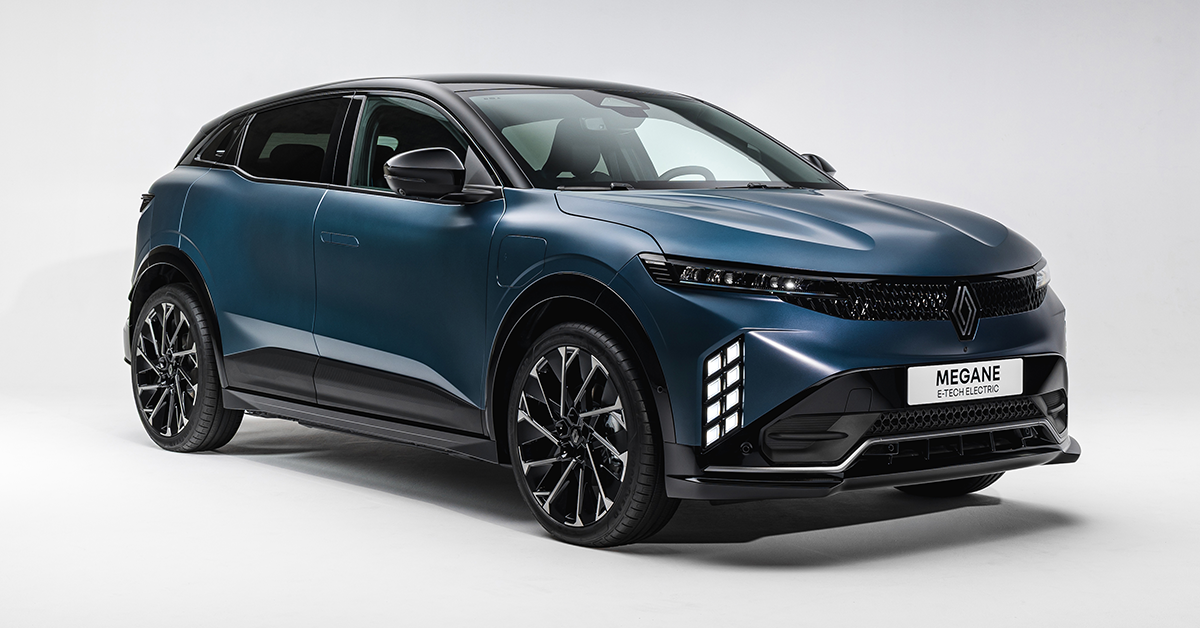
Official press image of the new Renault Megane E-Tech Electric. | © Renault
Four years after it first hit the road, Renault's electric Megane has gone under the knife — and the changes go well beyond a new face. A bigger battery, faster charging and a Google Gemini-powered cockpit headline a thorough mid-life update that aims to keep the E-Tech relevant against a flood of newer rivals.
Up front, the changes are extensive. New diamond-shaped daytime running lights now flank the bumper, paired with a redesigned central bumper section, a larger grille and an entirely reworked air intake and apron. Renault says the only parts carried over up front are the main headlight clusters themselves — everything else is new. The rear has also been reworked for a more three-dimensional look, and the overall styling now borrows visual cues from the larger Renault Scenic and the next-generation petrol Clio due to arrive next year.
The car's proportions have shifted slightly too. Because the new, larger battery pack needs more room, the Megane now stands 20mm taller than before. Renault has also streamlined the trim lineup down to just two options — entry-level Techno and range-topping Esprit Alpine, the latter bringing suede-effect upholstery with blue stitching and exclusive 20-inch wheels. New 19-inch wheel designs are standard elsewhere, and a fresh Satin Slate Blue paint finish joins the colour palette.
The headline mechanical change is a new 67kWh battery pack, up from the previous 60kWh unit, switching from Nickel Manganese Cobalt (NMC) chemistry to Lithium Iron Phosphate (LFP) — the same broad category of cell Tesla uses in its standard-range models. The bigger pack lifts WLTP range to up to 310 miles (500km), a 25-mile improvement over the outgoing car's 285 miles.
Interestingly, the new LFP pack is technically less efficient per kilowatt-hour than the old NMC unit — 4.6 miles/kWh versus 4.75 miles/kWh on the WLTP cycle — meaning the range gain comes entirely from the larger capacity, not improved efficiency. Megane product manager Benjamin Kotlowski explained the reasoning directly: LFP "offers the best ratio between price, range and chargeability." He added that Renault's own research found 300 miles is "the psychological level that customers think 'okay, this can be my main vehicle.'" LFP cells are also generally more resistant to degradation from repeated rapid charging, though they perform somewhat worse in cold weather than NMC — a gap the Megane's standard-fit heat pump is designed to help close.
DC charging power rises to 165kW, a 35kW improvement, cutting the 15-80% charge time to roughly 24 minutes — about a quarter faster than before. The trade-off for the bigger, heavier pack is a small dent in performance: the added 100kg of mass pushes 0-62mph from 7.5 to 7.6 seconds, with the rear-mounted 217bhp/300Nm motor and 99mph top speed otherwise unchanged. Renault says it has retuned the steering and suspension to keep the driving experience just as sharp as before despite the extra weight.
| Battery | 67kWh LFP (up from 60kWh NMC) |
| WLTP Range | Up to 310 miles (+25 vs outgoing car) |
| DC Charging | 165kW — 15-80% in ~24 minutes |
| Motor | 217bhp (220 PS) / 300Nm, rear-mounted |
| 0-62mph | 7.6 seconds |
| Top Speed | 99mph (160km/h) |
| Trim Levels | Techno, Esprit Alpine (2 only) |
| Infotainment | Dual 12-inch / 12.3-inch screens, Google built-in + Gemini |
| UK Starting Price | "No more" than current car (~£31,295 incl. grant) |
| On Sale | Later in 2026 |
We have enhanced the perceived width and on-road stance of the new Renault Megane E-Tech electric to give it greater presence.
— Benjamin Kotlowski, Megane Product ManagerInside, Renault has deliberately left well alone. The dual 12-inch infotainment display and 12.3-inch digital driver cluster remain standard, and — sensibly — physical climate-control buttons stay separate from the touchscreen rather than being absorbed into it. The big update is software: Google's built-in services, already a Megane fixture, now gain Google Gemini, allowing natural, conversational voice commands rather than rigid pre-set phrases.
A new driver-recognition camera sits on the A-pillar, doing double duty. It satisfies a new EU regulatory requirement for driver-attention monitoring, while also automatically recognising who's behind the wheel and adjusting seat position and media preferences accordingly. The Megane shares its underlying platform with the Nissan Ariya, which received a similar Google-powered infotainment update in its own recent facelift, and Renault may eventually offer the Ariya's bi-directional charging capability as an option here too.
Renault says UK pricing will start "no more" than the current car, which kicks off at £31,295 including the existing £1,500 Electric Car Grant. More significantly, Renault has indicated the new Megane could qualify for the full £3,750 grant available to its Scenic, 4 and 5 siblings — which would, if confirmed, bring the entry price down to under £30,000. For comparison, a closely-matched Volkswagen ID.3 Neo with the equivalent 58kWh LFP battery is rated at 307 miles — essentially matching the Megane on range despite the smaller pack, while a Kia EV4 in Standard Range form returns 273 miles, rising past 380 miles with its largest battery fitted.
This is a textbook mid-life refresh done well — Renault hasn't chased a flashy redesign or a bigger headline number for its own sake, it's targeted the two things that actually matter to EV buyers shopping in this segment: real-world range crossing the psychologically important 300-mile mark, and meaningfully faster charging. Keeping physical climate controls while adding genuinely useful AI through Gemini, rather than removing buttons just to look modern, is the right call. The honest trade-off — slightly reduced per-kWh efficiency from the LFP switch — is the kind of engineering compromise that's easy to justify when the end result is more usable range. If the full EV grant does apply, a sub-£30k price for a proper 310-mile family EV with this level of tech would be genuinely difficult to beat.