 Brands
Toyota 4Runner — From a Pickup With a Cap to a TNGA-F Icon
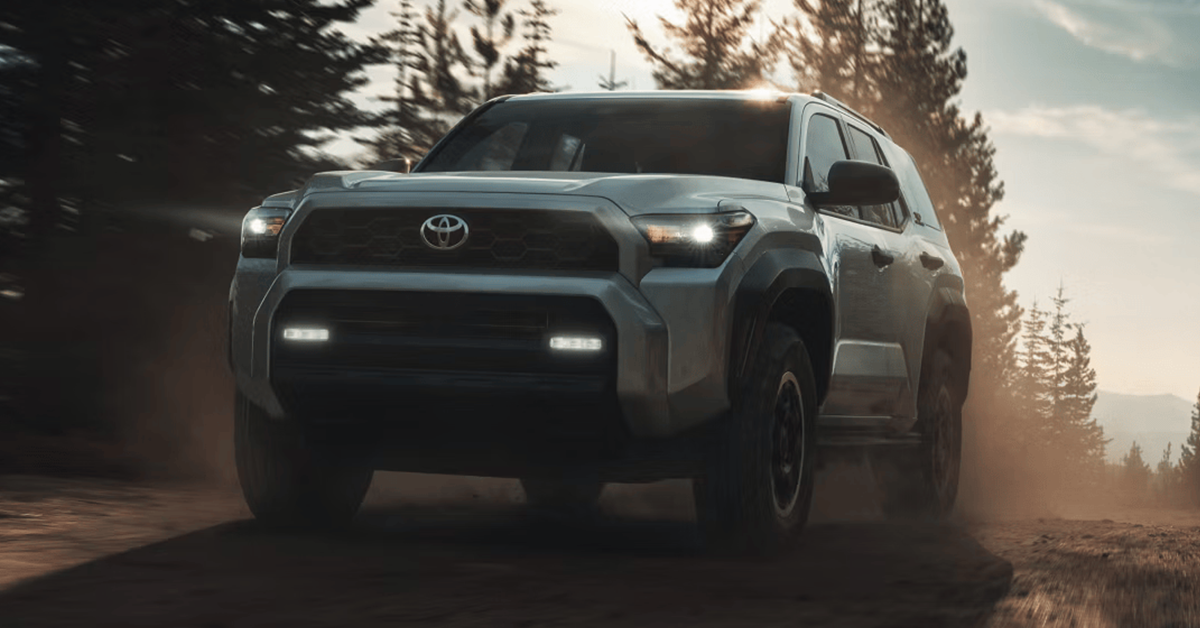
Official press image of the Toyota 4Runner. | © Toyota Motor Corporation
The Toyota 4Runner did not begin life as a purpose-built SUV. It began as a genuinely simple idea: take a Toyota pickup truck, bolt a removable fiberglass cap over the bed, add a rear seat, and sell the result to buyers who wanted truck toughness with enclosed practicality. Four decades and six generations later, that modest origin has grown into one of the most trusted, most stubbornly capable off-road SUVs Toyota builds — a nameplate that spent 15 years on a single generation because buyers simply refused to stop wanting it exactly as it was.
The 4Runner launched in May 1984 as Toyota’s second SUV in the American market, behind only the Land Cruiser. The connection to Toyota’s pickup truck lineup was not subtle — the original 4Runner looked almost exactly like a pickup wearing a cap on the back, because that is essentially what it was: a modified Toyota pickup fitted with a removable fiberglass canopy over the cargo area, giving it enclosed SUV utility on top of genuine truck-based toughness. It launched as a two-door model, and base versions did not even include a second row of seats — a genuinely stripped-down proposition by any modern standard. Power came from a modest 2.4-litre four-cylinder engine producing around 100 horsepower, later joined by a turbocharged 135-horsepower option and eventually a 3.0-litre V6 making 150 horsepower. Simple, tough and capable, it was, from day one, a genuine hit — and remains the only 4Runner generation ever to offer a removable top.
The second generation, arriving in 1990, was the point where the 4Runner stopped pretending to be a modified pickup and became a purpose-built SUV in its own right — discarding the removable canopy for a conventional all-steel body, and eventually abandoning the two-door configuration entirely to establish the four-door layout every subsequent generation has followed. It was also the only 4Runner generation ever offered with a factory swing-out rear bumper, and introduced an oversized rear window design that Toyota would later revive as a deliberate heritage cue on the sixth generation.
The third generation, launched in 1996, represented a ground-up redesign that migrated the 4Runner onto the same platform used by the J90 Land Cruiser Prado — a genuine step up in structural sophistication, and the generation whose 3.4-litre V6 is still particularly praised today for long-term durability. The fourth generation, arriving in 2003, brought genuine V8 power to the platform for the first time, built on the related Prado 120 architecture and offering meaningfully more towing capacity for buyers who needed it.
If any single generation defines the 4Runner’s reputation for stubborn, deliberate simplicity, it is the fifth. Launched in 2010, it returned to a boxier, more aggressive design, and for the overwhelming majority of its production run offered a single engine choice: a naturally aspirated 4.0-litre V6 producing 270 horsepower, paired with a five-speed automatic transmission — a genuinely short-lived four-cylinder option existed only for the 2010 model year before Toyota abandoned it entirely. This generation introduced the now-iconic TRD Pro trim, alongside coil-spring rear suspension in place of the leaf springs used previously, and received a meaningful facelift in 2014 alongside the eventual addition of Toyota Safety Sense P and modern smartphone connectivity by 2020.
What made the fifth generation genuinely remarkable was simply how long it lasted: 15 years, from 2010 through 2024, an almost unheard-of production cycle for a modern vehicle in an industry that typically redesigns models every five to seven years. Toyota kept it in production that long because buyers kept buying it — a genuine testament to how strongly 4Runner loyalists valued the specific combination of mechanical simplicity, proven reliability and off-road credibility the fifth generation offered, even as rivals moved to more modern, more complex platforms around it.
The sixth-generation 4Runner arrived for the 2025 model year, and represents, by any honest measure, the single biggest transformation in the nameplate’s 40-year history. Toyota moved the 4Runner onto its modern TNGA-F global truck platform — the same architecture now shared with the current Tacoma, Tundra, Sequoia and Land Cruiser — replacing the ageing, dedicated fifth-generation underpinnings entirely. The beloved 4.0-litre V6 is gone, replaced by a turbocharged 2.4-litre four-cylinder i-FORCE engine producing 278 horsepower and 317 lb-ft of torque, or the hybrid i-FORCE MAX variant, integrating an electric motor into the transmission for a combined 326 horsepower and 465 lb-ft of torque — the most powerful 4Runner Toyota has ever built. Both powertrains route through a genuinely modern eight-speed automatic, replacing the old five-speed unit.
The chassis changes go deeper than the powertrain. Toyota replaced the old suspension setup with a multi-link coil rear and double-wishbone front arrangement, and introduced an entirely new factory overland trim, Trailhunter, purpose-built for expedition use with 10.1 inches of ground clearance versus the base model’s 8.1 inches. Styling deliberately reaches back into the nameplate’s own history — the sixth generation’s distinctive “wrap-over” rear quarter glass is a direct heritage nod to the oversized rear window first introduced on the second generation back in 1990.
The 2026 4Runner spans an extensive 12 total trims, evenly split between gas and hybrid configurations. Gas trims run SR5, TRD Sport, TRD Sport Premium, TRD Off-Road, TRD Off-Road Premium and Limited, while hybrid i-FORCE MAX trims include TRD Off-Road i-FORCE MAX, TRD Off-Road i-FORCE MAX Pro, Limited i-FORCE MAX, Platinum, TRD Pro and Trailhunter. 2026 pricing spans approximately $41,570 to $43,065 for the base SR5, up to approximately $67,700 to $69,695 for the range-topping TRD Pro. For 2026, Toyota replaced the TRD Pro’s exclusive tan “Mudbath” exterior colour with a striking new teal shade called Wave Maker, and extended the optional Stabilizer Bar Disconnect Mechanism — previously exclusive to TRD Pro and Trailhunter — to the TRD Off-Road Premium i-FORCE MAX trim as well.